Adverse Reactions in Placebo-Controlled Trials
In the two well-controlled studies demonstrating effectiveness, 1529 patients received dimethyl fumarate with an overall exposure of 2244 person-years
[see Clinical Studies (
14)].
The adverse reactions presented in the table below are based on safety information from 769 patients treated with dimethyl fumarate 240 mg twice a day and 771 placebo-treated patients.
Table 1: Adverse Reactions in Study 1 and 2 reported for Dimethyl Fumarate 240 mg BID at ≥ 2% higher incidence than placebo
| Dimethyl Fumarate
N=769
% | Placebo
N=771
% |
| | |
| Flushing
| 40
| 6
|
| Abdominal pain
| 18
| 10
|
| Diarrhea
| 14
| 11
|
| Nausea
| 12
| 9
|
| Vomiting
| 9
| 5
|
| Pruritus
| 8
| 4
|
| Rash
| 8
| 3
|
| Albumin urine present
| 6
| 4
|
| Erythema
| 5
| 1
|
| Dyspepsia
| 5
| 3
|
| Aspartate aminotransferase increased
| 4
| 2
|
| Lymphopenia
| 2
| <1
|
Gastrointestinal
Dimethyl fumarate caused GI events (e.g., nausea, vomiting, diarrhea, abdominal pain, and dyspepsia). The incidence of GI events was higher early in the course of treatment (primarily in month 1) and usually decreased over time in patients treated with dimethyl fumarate compared with placebo. Four percent (4%) of patients treated with dimethyl fumarate and less than 1% of placebo patients discontinued due to gastrointestinal events. The incidence of serious GI events was 1% in patients treated with dimethyl fumarate.
Hepatic Transaminases
An increased incidence of elevations of hepatic transaminases in patients treated with dimethyl fumarate was seen primarily during the first six months of treatment, and most patients with elevations had levels < 3 times the upper limit of normal (ULN) during controlled trials. Elevations of alanine aminotransferase and aspartate aminotransferase to ≥ 3 times the ULN occurred in a small number of patients treated with both dimethyl fumarate and placebo and were balanced between groups. There were no elevations in transaminases ≥ 3 times the ULN with concomitant elevations in total bilirubin > 2 times the ULN. Discontinuations due to elevated hepatic transaminases were < 1% and were similar in patients treated with dimethyl fumarate or placebo.
Eosinophilia
A transient increase in mean eosinophil counts was seen during the first 2 months of therapy.
Adverse Reactions in Placebo-Controlled and Uncontrolled Studies
In placebo-controlled and uncontrolled clinical studies, a total of 2513 patients have received dimethyl fumarate and been followed for periods up to 4 years with an overall exposure of 4603 person-years. Approximately 1162 patients have received more than 2 years of treatment with dimethyl fumarate. The adverse reaction profile of dimethyl fumarate in the uncontrolled clinical studies was consistent with the experience in the placebo-controlled clinical trials.
Risk Summary
There are no adequate data on the developmental risk associated with the use of dimethyl fumarate delayed-release capsules in pregnant women. In animals, adverse effects on offspring survival, growth, sexual maturation, and neurobehavioral function were observed when dimethyl fumarate (DMF) was administered during pregnancy and lactation at clinically relevant doses [see Data].
In the U.S. general population, the estimated background risk of major birth defects and miscarriage in clinically recognized pregnancies is 2 to 4% and 15 to 20%, respectively. The background risk of major birth defects and miscarriage for the indicated population is unknown.
Data
Animal Data
In rats administered DMF orally (25, 100, 250 mg/kg/day) throughout organogenesis, embryofetal toxicity (reduced fetal body weight and delayed ossification) were observed at the highest dose tested. This dose also produced evidence of maternal toxicity (reduced body weight). Plasma exposure (AUC) for monomethyl fumarate (MMF), the major circulating metabolite, at the no-effect dose is approximately three times that in humans at the recommended human dose (RHD) of 480 mg/day. In rabbits administered DMF orally (25, 75, and 150 mg/kg/day) throughout organogenesis, embryolethality and decreased maternal body weight were observed at the highest dose tested. The plasma AUC for MMF at the no-effect dose is approximately 5 times that in humans at the RHD.
Oral administration of DMF (25 mg, 100 mg, and 250 mg/kg/day) to rats throughout organogenesis and lactation resulted in increased lethality, persistent reductions in body weight, delayed sexual maturation (male and female pups), and reduced testicular weight at the highest dose tested. Neurobehavioral impairment was observed at all doses. A no-effect dose for developmental toxicity was not identified. The lowest dose tested was associated with plasma AUC for MMF lower than that in humans at the RHD.
Potential to prolong the QT interval
In a placebo controlled thorough QT study performed in healthy subjects, there was no evidence that dimethyl fumarate caused QT interval prolongation of clinical significance (i.e., the upper bound of the 90% confidence interval for the largest placebo-adjusted, baseline-corrected QTc was below 10 ms).
Absorption
The median T
max of MMF is 2 to 2.5 hours. The peak plasma concentration (C
max) and overall exposure (AUC) increased approximately dose proportionally in the dose range studied (120 mg to 360 mg). Following administration of dimethyl fumarate 240 mg twice a day with food, the mean C
max of MMF was 1.87 mg/L and AUC was 8.21 mg.hr/L in MS patients.
A high-fat, high-calorie meal did not affect the AUC of MMF but decreased its C
max by 40%. The T
max was delayed from 2.0 hours to 5.5 hours. In this study, the incidence of flushing was reduced by approximately 25% in the fed state.
Distribution
The apparent volume of distribution of MMF varies between 53 and 73 L in healthy subjects. Human plasma protein binding of MMF is 27 to 45% and independent of concentration.
Metabolism
In humans, dimethyl fumarate is extensively metabolized by esterases, which are ubiquitous in the gastrointestinal tract, blood, and tissues, before it reaches the systemic circulation. Further metabolism of MMF occurs through the tricarboxylic acid (TCA) cycle, with no involvement of the cytochrome P450 (CYP) system. MMF, fumaric and citric acid, and glucose are the major metabolites in plasma.
Elimination
Exhalation of CO
2 is the primary route of elimination, accounting for approximately 60% of the dimethyl fumarate dose. Renal and fecal elimination are minor routes of elimination, accounting for 16% and 1% of the dose respectively. Trace amounts of unchanged MMF were present in urine.
The terminal half-life of MMF is approximately 1 hour and no circulating MMF is present at 24 hours in the majority of individuals. Accumulation of MMF does not occur with multiple doses of dimethyl fumarate.
Specific Populations
Body weight, gender, and age do not require dosage adjustment.
No studies have been conducted in subjects with hepatic or renal impairment. However, neither condition would be expected to affect exposure to MMF nor therefore no dosage adjustment is necessary.
Drug Interaction Studies
No potential drug interactions with dimethyl fumarate or MMF were identified in
in vitro CYP inhibition and induction studies, or in P-glycoprotein studies. Single doses of interferon beta-1a or glatiramer acetate did not alter the pharmacokinetics of MMF. Aspirin, when administered approximately 30 minutes before dimethyl fumarate, did not alter the pharmacokinetics of MMF.
Oral Contraceptives
The coadministration of dimethyl fumarate with a combined oral contraceptive (norelgestromin and ethinyl estradiol) did not elicit any relevant effects in oral contraceptives exposure. No interaction studies have been performed with oral contraceptives containing other progestogens.
Carcinogenesis
Carcinogenicity studies of dimethyl fumarate (DMF) were conducted in mice and rats. In mice, oral administration of DMF (25 mg, 75 mg, 200 mg, and 400 mg/kg/day) for up to two years resulted in an increase in nonglandular stomach (forestomach) and kidney tumors: squamous cell carcinomas and papillomas of the forestomach in males and females at 200 mg and 400 mg/kg/day; leiomyosarcomas of the forestomach at 400 mg/kg/day in males and females; renal tubular adenomas and carcinomas at 200 mg and 400 mg/kg/day in males; and renal tubule adenomas at 400 mg/kg/day in females. Plasma MMF exposure (AUC) at the highest dose not associated with tumors in mice (75 mg/kg/day) was similar to that in humans at the recommended human dose (RHD) of 480 mg/day.
In rats, oral administration of DMF (25 mg, 50 mg, 100 mg, and 150 mg/kg/day) for up to two years resulted in increases in squamous cell carcinomas and papillomas of the forestomach at all doses tested in males and females, and in testicular interstitial (Leydig) cell adenomas at 100 mg and 150 mg/kg/day. Plasma MMF AUC at the lowest dose tested was lower than that in humans at the RHD.
Mutagenesis
Dimethyl fumarate (DMF) and monomethyl fumarate (MMF) were not mutagenic in the
in vitro bacterial reverse mutation (Ames) assay. DMF and MMF were clastogenic in the
in vitro chromosomal aberration assay in human peripheral blood lymphocytes in the absence of metabolic activation. DMF was not clastogenic in the
in vivo micronucleus assay in the rat.
Impairment of Fertility
In male rats, oral administration of DMF (75 mg, 250 mg, and 375 mg/kg/day) prior to and throughout the mating period had no effect on fertility; however, increases in non-motile sperm were observed at the mid and high doses. The no-effect dose for adverse effects on sperm is similar to the recommended human dose (RHD) of 480 mg/day on a body surface area (mg/m
2) basis.
In female rats, oral administration of DMF (20 mg, 100 mg, and 250 mg/kg/day) prior to and during mating and continuing to gestation day 7 caused disruption of the estrous cycle and increases in embryolethality at the highest dose tested. The highest dose not associated with adverse effects (100 mg/kg/day) is twice the RHD on a mg/m
2 basis.
Testicular toxicity (germinal epithelial degeneration, atrophy, hypospermia, and/or hyperplasia) was observed at clinically relevant doses in mice, rats, and dogs in subchronic and chronic oral toxicity studies of DMF, and in a chronic oral toxicity study evaluating a combination of four fumaric acid esters (including DMF) in rats.
Study 1: Placebo-Controlled Trial in RRMS
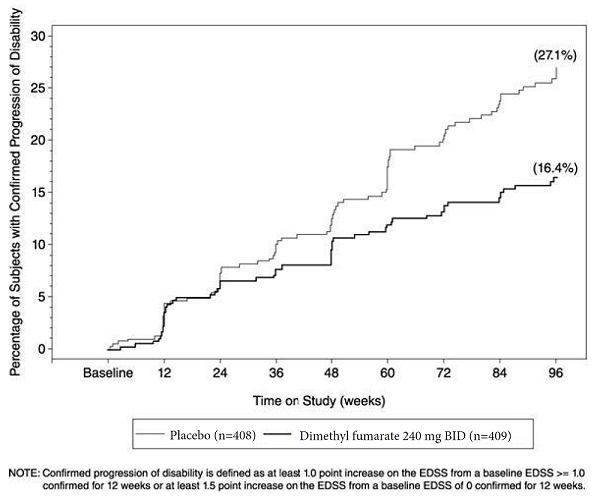
Study 1 was a 2-year randomized, double-blind, placebo-controlled study in 1234 patients with RRMS. The primary endpoint was the proportion of patients relapsed at 2 years. Additional endpoints at 2 years included the number of new or newly enlarging T2 hyperintense lesions, number of new T1 hypointense lesions, number of Gd+ lesions, annualized relapse rate (ARR), and time to confirmed disability progression. Confirmed disability progression was defined as at least a 1 point increase from baseline EDSS (1.5 point increase for patients with baseline EDSS of 0) sustained for 12 weeks.
Patients were randomized to receive dimethyl fumarate 240 mg twice a day (n=410), dimethyl fumarate 240 mg three times a day (n=416), or placebo (n=408) for up to 2 years. The median age was 39 years, median time since diagnosis was 4 years, and median EDSS score at baseline was 2. The median time on study drug for all treatment arms was 96 weeks. The percentages of patients who completed 96 weeks on study drug per treatment group were 69% for patients assigned to dimethyl fumarate 240 mg twice a day, 69% for patients assigned to dimethyl fumarate 240 mg three times a day and 65% for patients assigned to placebo groups.
Dimethyl fumarate had a statistically significant effect on all of the endpoints described above and the 240 mg three times daily dose showed no additional benefit over the dimethyl fumarate 240 mg twice daily dose. The results for this study (240 mg twice a day vs. placebo) are shown in
Table 2 and
Figure 1.
Table 2: Clinical and MRI Results of Study 1
| Dimethyl Fumarate
240 mg BID |
Placebo |
P-value |
|---|
| | | |
| Clinical Endpoints | N=410
| N=408
| |
Proportion relapsing (primary endpoint)
Relative risk reduction
| 27%
49%
| 46%
| <0.0001
|
| | | |
| Annualized relapse rate
| 0.172
| 0.364
| <0.0001
|
| Relative reduction
| 53%
| | |
| | | |
| Proportion with disability progression
| 16%
| 27%
| 0.0050
|
| Relative risk reduction
| 38%
| | |
| | | |
| MRI Endpoints | N=152
| N=165
| |
Mean number of new or newly enlarging
| 2.6
| 17
| <0.0001
|
T2 lesions over 2 years
| | | |
| | | |
Percentage of subjects with no new or newly
enlarging lesions
| 45%
| 27%
| |
| | | |
| | | |
| Number of Gd+ lesions at 2 years
| 0.1 (0)
| 1.8 (0)
| |
| Mean (median)
| | | |
| | | |
Percentage of subjects with
| | | |
0 lesions
| 93%
| 62%
| |
1 lesion
| 5%
| 10%
| |
2 lesions
| <1%
| 8%
| |
3 to 4 lesions
| 0
| 9%
| |
5 or more lesions
| <1%
| 11%
| |
| | | |
Relative odds reduction
| 90%
| | <0.0001
|
(percentage)
| | | |
| | | |
Mean number of new T1 hypointense
| 1.5
| 5.6
| <0.0001
|
lesions over 2 years
| | | |
Figure 1: Time to 12-Week Confirmed Progression of Disability (Study 1)
Study 2: Placebo-Controlled Trial in RRMS
Study 2 was a 2-year multicenter, randomized, double-blind, placebo-controlled study that also included an open-label comparator arm in patients with RRMS. The primary endpoint was the annualized relapse rate at 2 years. Additional endpoints at 2 years included the number of new or newly enlarging T2 hyperintense lesions, number of T1 hypointense lesions, number of Gd+ lesions, proportion of patients relapsed, and time to confirmed disability progression as defined in Study 1.
Patients were randomized to receive dimethyl fumarate 240 mg twice a day (n=359), dimethyl fumarate 240 mg three times a day (n=345), an open-label comparator (n=350), or placebo (n=363) for up to 2 years. The median age was 37 years, median time since diagnosis was 3 years, and median EDSS score at baseline was 2.5. The median time on study drug for all treatment arms was 96 weeks. The percentages of patients who completed 96 weeks on study drug per treatment group were 70% for patients assigned to dimethyl fumarate 240 mg twice a day, 72% for patients assigned to dimethyl fumarate 240 mg three times a day and 64% for patients assigned to placebo groups.
Dimethyl fumarate had a statistically significant effect on the relapse and MRI endpoints described above. There was no statistically significant effect on disability progression. The dimethyl fumarate 240 mg three times daily dose resulted in no additional benefit over the dimethyl fumarate 240 mg twice daily dose. The results for this study (240 mg twice a day vs. placebo) are shown in
Table 3.
Table 3: Clinical and MRI Results of Study 2
| Dimethyl Fumarate
240 mg BID |
Placebo |
P-value |
|---|
| | | |
| Clinical Endpoints | N=359
| N=363
| |
| Annualized relapse rate
| 0.224
| 0.401
| <0.0001
|
| Relative reduction
| 44%
| | |
| | | |
| Proportion relapsing
| 29%
| 41%
| 0.0020
|
| Relative risk reduction
| 34%
| | |
| | | |
| Proportion with disability progression
| 13%
| 17%
| 0.25
|
| Relative risk reduction
| 21%
| | |
| | | |
| MRI Endpoints | N=147
| N=144
| |
Mean number of new or newly enlarging
| 5.1
| 17.4
| <0.0001
|
T2 lesions over 2 years
| | | |
| | | |
| Percentage of subjects with no new or
| 27%
| 12%
| |
| newly enlarging lesions
| | | |
| | | |
| Number of Gd+ lesions at 2 years
| | | |
Mean (median)
| 0.5 (0.0)
| 2.0 (0.0)
| |
| | | |
| Percentage of subjects with
| | | |
0 lesions
| 80%
| 61%
| |
1 lesion
| 11%
| 17%
| |
2 lesions
| 3%
| 6%
| |
3 to 4 lesions
| 3%
| 2%
| |
5 or more lesions
| 3%
| 14%
| |
| | | |
Relative odds reduction
| 74%
| | <0.0001
|
(percentage)
| | | |
| | | |
Mean number of new T1 hypointense
| 3.0
| 7.0
| <0.0001
|
lesions over 2 years
| | | |
Dosage
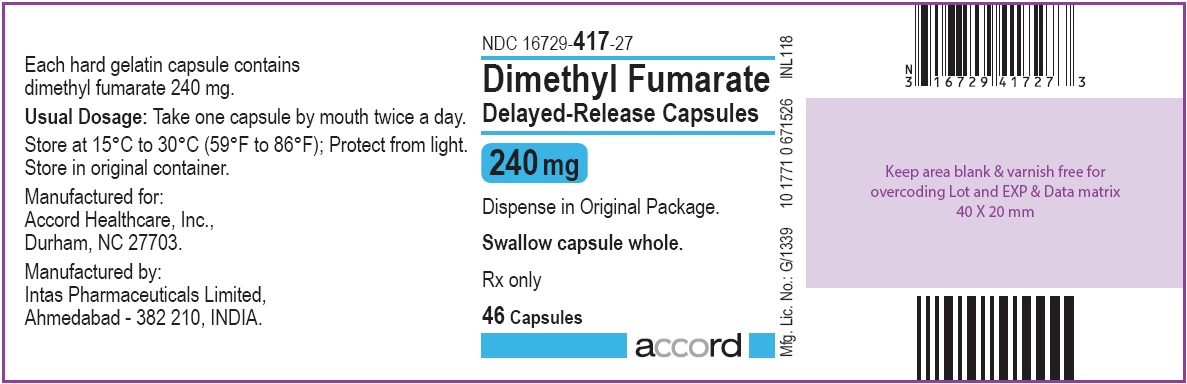
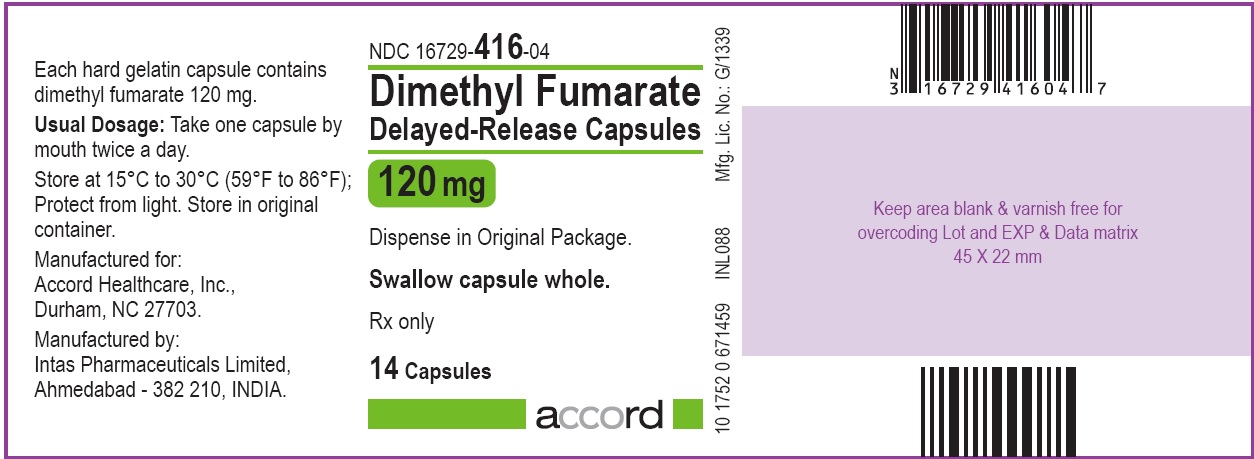
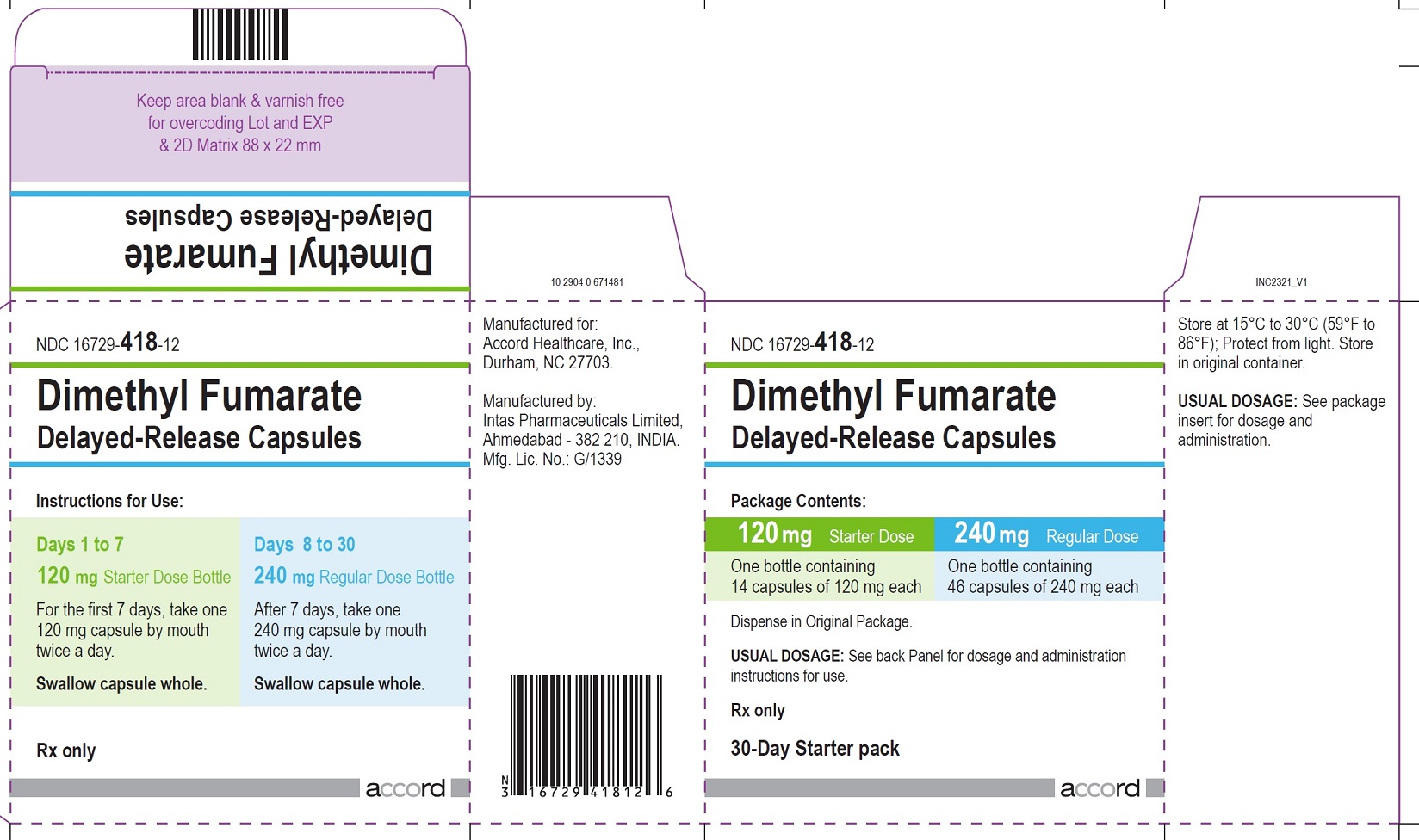
Inform patients that they will be provided two strengths of dimethyl fumarate delayed-release capsules when starting treatment: 120 mg capsules for the 7 day starter dose and 240 mg capsules for the maintenance dose, both to be taken twice daily. Inform patients to swallow dimethyl fumarate delayed-release capsules whole and intact. Inform patients to not crush, chew, or sprinkle capsule contents on food. Inform patients that dimethyl fumarate delayed-release capsules can be taken with or without food
[see Dosage and Administration (
2.1)].
Anaphylaxis and Angioedema
Advise patients to discontinue dimethyl fumarate delayed-release capsules and seek medical care if they develop signs and symptoms of anaphylaxis or angioedema
[see Warnings and Precautions (
5.1)].
Progressive Multifocal Leukoencephalopathy
Inform patients that progressive multifocal leukoencephalopathy (PML) has occurred in patients who received dimethyl fumarate delayed-release capsules. Inform the patient that PML is characterized by a progression of deficits and usually leads to death or severe disability over weeks or months. Instruct the patient of the importance of contacting their doctor if they develop any symptoms suggestive of PML. Inform the patient that typical symptoms associated with PML are diverse, progress over days to weeks, and include progressive weakness on one side of the body or clumsiness of limbs, disturbance of vision, and changes in thinking, memory, and orientation leading to confusion and personality changes
[see Warnings and Precautions (
5.2)]
.
Herpes Zoster and Other Serious Opportunistic Infections
Inform patients that herpes zoster and other serious opportunistic infections have occurred in patients who received dimethyl fumarate delayed-release capsules. Instruct the patient of the importance of contacting their doctor if they develop any signs or symptoms associated with herpes zoster or other serious opportunistic infections
[see Warnings and Precautions (
5.3)]
.
Lymphocyte Counts
Inform patients that dimethyl fumarate delayed-release capsules may decrease lymphocyte counts. A blood test should be obtained before they start therapy. Blood tests are also recommended after 6 months of treatment, every 6 to 12 months thereafter, and as clinically indicated
[see Warnings and Precautions (
5.4), Adverse Reactions (
6.1)]
.
Liver Injury
Inform patients that dimethyl fumarate delayed-release capsules may cause liver injury. Instruct patients treated with dimethyl fumarate delayed-release capsules to report promptly any symptoms that may indicate liver injury, including fatigue, anorexia, right upper abdominal discomfort, dark urine, or jaundice. A blood test should be obtained before patients start therapy and during treatment, as clinically indicated
[see Warnings and Precautions (
5.5)]
.
Flushing and Gastrointestinal (GI) Reactions
Flushing and GI reactions (abdominal pain, diarrhea, and nausea) are the most common reactions, especially at the initiation of therapy, and may decrease over time. Advise patients to contact their healthcare provider if they experience persistent and/or severe flushing or GI reactions. Advise patients experiencing flushing that taking dimethyl fumarate delayed-release capsules with food or taking a non-enteric coated aspirin prior to taking dimethyl fumarate delayed-release capsules may help
[see Adverse Reactions (
6.1)].
Pregnancy
Instruct patients that if they are pregnant or plan to become pregnant while taking dimethyl fumarate delayed-release capsules they should inform their physician.
Manufactured For:
Accord Healthcare, Inc.,
1009 Slater Road,
Suite 210-B,
Durham, NC 27703,
USA
Manufactured By:
Intas Pharmaceuticals Limited,
Plot No. : 457, 458,
Village - Matoda,
Bavla Road, Ta.- Sanand,
Dist.- Ahmedabad - 382 210,
INDIA.
10 1396 0 671475
Issued August 2020