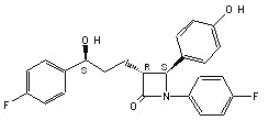
The most commonly reported adverse reactions (incidence ≥2% and greater than placebo) in the ezetimibe monotherapy controlled clinical trial database of 2396 patients were: upper respiratory tract infection (4.3%), diarrhea (4.1%), arthralgia (3%), sinusitis (2.8%), and pain in extremity (2.7%).
- Alanine aminotransferase increased (0.6%)
- Myalgia (0.5%)
- Fatigue, aspartate aminotransferase increased, headache, and pain in extremity (each at 0.2%)
The most commonly reported adverse reactions (incidence ≥2% and greater than statin alone) in the ezetimibe + statin controlled clinical trial database of 11,308 patients were: nasopharyngitis (3.7%), myalgia (3.2%), upper respiratory tract infection (2.9%), arthralgia (2.6%) and diarrhea (2.5%).
Monotherapy
In 10 double-blind, placebo-controlled clinical trials, 2396 patients with primary hyperlipidemia (age range 9 to 86 years, 50% women, 90% Caucasians, 5% Blacks, 3% Hispanics, 2% Asians) and elevated LDL-C were treated with ezetimibe 10 mg/day for a median treatment duration of 12 weeks (range 0 to 39 weeks).
Adverse reactions reported in ≥2% of patients treated with ezetimibe and at an incidence greater than placebo in placebo-controlled studies of ezetimibe, regardless of causality assessment, are shown in
Table 1.
TABLE 1: Clinical Adverse Reactions Occurring in ≥2% of Patients Treated with Ezetimibe and at an Incidence Greater than Placebo, Regardless of CausalityBody System/Organ Class
Adverse Reaction
| Ezetimibe 10 mg
(%)
n = 2396
| Placebo
(%)
n = 1159
|
| Gastrointestinal disorders | | |
| Diarrhea | 4.1 | 3.7 |
| General disorders and administration site conditions | | |
| Fatigue | 2.4 | 1.5 |
| Infections and infestations | | |
| Influenza | 2 | 1.5 |
| Sinusitis | 2.8 | 2.2 |
| Upper respiratory tract infection | 4.3 | 2.5 |
| Musculoskeletal and connective tissue disorders | | |
| Arthralgia | 3 | 2.2 |
| Pain in extremity | 2.7 | 2.5 |
The frequency of less common adverse reactions was comparable between ezetimibe and placebo.
Combination with a Statin
In 28 double-blind, controlled (placebo or active-controlled) clinical trials, 11,308 patients with primary hyperlipidemia (age range 10 to 93 years, 48% women, 85% Caucasians, 7% Blacks, 4% Hispanics, 3% Asians) and elevated LDL-C were treated with ezetimibe 10 mg/day concurrently with or added to on-going statin therapy for a median treatment duration of 8 weeks (range 0 to 112 weeks).
The incidence of consecutive increased transaminases (≥3 × ULN) was higher in patients receiving ezetimibe administered with statins (1.3%) than in patients treated with statins alone (0.4%).
[see
Warnings and Precautions (5.2).]
Clinical adverse reactions reported in ≥2% of patients treated with ezetimibe + statin and at an incidence greater than statin, regardless of causality assessment, are shown in
Table 2.
TABLE 2: Clinical Adverse Reactions Occurring in ≥2% of Patients Treated with Ezetimibe Coadministered with a Statin and at an Incidence Greater than Statin, Regardless of CausalityBody System/Organ Class
Adverse Reaction
| All Statins
All Statins = all doses of all statins
(%)
n = 9361
| Ezetimibe + All Statins
(%)
n = 11,308
|
| Gastrointestinal disorders | | |
| Diarrhea | 2.2 | 2.5 |
| General disorders and administration site conditions | | |
| Fatigue | 1.6 | 2 |
| Infections and infestations | | |
| Influenza | 2.1 | 2.2 |
| Nasopharyngitis | 3.3 | 3.7 |
| Upper respiratory tract infection | 2.8 | 2.9 |
| Musculoskeletal and connective tissue disorders | | |
| Arthralgia | 2.4 | 2.6 |
| Back pain | 2.3 | 2.4 |
| Myalgia | 2.7 | 3.2 |
| Pain in extremity | 1.9 | 2.1 |
Combination with Fenofibrate
This clinical study involving 625 patients with mixed dyslipidemia (age range 20 to 76 years, 44% women, 79% Caucasians, 0.1% Blacks, 11% Hispanics, 5% Asians) treated for up to 12 weeks and 576 patients treated for up to an additional 48 weeks evaluated coadministration of ezetimibe and fenofibrate. This study was not designed to compare treatment groups for infrequent events. Incidence rates (95% CI) for clinically important elevations (≥3 × ULN, consecutive) in hepatic transaminase levels were 4.5% (1.9, 8.8) and 2.7% (1.2, 5.4) for fenofibrate monotherapy (n=188) and ezetimibe co-administered with fenofibrate (n=183), respectively, adjusted for treatment exposure. Corresponding incidence rates for cholecystectomy were 0.6% (95% CI: 0%, 3.1%) and 1.7% (95% CI: 0.6%, 4%) for fenofibrate monotherapy and ezetimibe coadministered with fenofibrate, respectively
[see
Drug Interactions (7.3)]
. The numbers of patients exposed to coadministration therapy as well as fenofibrate and ezetimibe monotherapy were inadequate to assess gallbladder disease risk. There were no CPK elevations >10 × ULN in any of the treatment groups.
Monotherapy Studies
Of the 2396 patients who received ezetimibe in clinical studies, 669 (28%) were 65 and older, and 111 (5%) were 75 and older.
Statin Coadministration Studies
Of the 11,308 patients who received ezetimibe + statin in clinical studies, 3587 (32%) were 65 and older, and 924 (8%) were 75 and older.
No overall differences in safety and effectiveness were observed between these patients and younger patients, and other reported clinical experience has not identified differences in responses between the elderly and younger patients, but greater sensitivity of some older individuals cannot be ruled out
[see
Clinical Pharmacology (12.3)]
.
Absorption
After oral administration, ezetimibe is absorbed and extensively conjugated to a pharmacologically active phenolic glucuronide (ezetimibe-glucuronide). After a single 10-mg dose of ezetimibe to fasted adults, mean ezetimibe peak plasma concentrations (C
max) of 3.4 to 5.5 ng/mL were attained within 4 to 12 hours (T
max). Ezetimibe-glucuronide mean C
max values of 45 to 71 ng/mL were achieved between 1 and 2 hours (T
max). There was no substantial deviation from dose proportionality between 5 and 20 mg. The absolute bioavailability of ezetimibe cannot be determined, as the compound is virtually insoluble in aqueous media suitable for injection.
Effect of Food on Oral Absorption
Concomitant food administration (high-fat or non-fat meals) had no effect on the extent of absorption of ezetimibe when administered as ezetimibe 10-mg tablets. The C
max value of ezetimibe was increased by 38% with consumption of high-fat meals. Ezetimibe tablets can be administered with or without food.
Distribution
Ezetimibe and ezetimibe-glucuronide are highly bound (>90%) to human plasma proteins.
Metabolism and Excretion
Ezetimibe is primarily metabolized in the small intestine and liver via glucuronide conjugation (a phase II reaction) with subsequent biliary and renal excretion. Minimal oxidative metabolism (a phase I reaction) has been observed in all species evaluated.
In humans, ezetimibe is rapidly metabolized to ezetimibe-glucuronide. Ezetimibe and ezetimibe-glucuronide are the major drug-derived compounds detected in plasma, constituting approximately 10 to 20% and 80 to 90% of the total drug in plasma, respectively. Both ezetimibe and ezetimibe-glucuronide are eliminated from plasma with a half-life of approximately 22 hours for both ezetimibe and ezetimibe-glucuronide. Plasma concentration-time profiles exhibit multiple peaks, suggesting enterohepatic recycling.
Following oral administration of
14C-ezetimibe (20 mg) to human subjects, total ezetimibe (ezetimibe + ezetimibe-glucuronide) accounted for approximately 93% of the total radioactivity in plasma. After 48 hours, there were no detectable levels of radioactivity in the plasma.
Approximately 78% and 11% of the administered radioactivity were recovered in the feces and urine, respectively, over a 10-day collection period. Ezetimibe was the major component in feces and accounted for 69% of the administered dose, while ezetimibe-glucuronide was the major component in urine and accounted for 9% of the administered dose.
Specific Populations
Geriatric Patients: In a multiple-dose study with ezetimibe given 10 mg once daily for 10 days, plasma concentrations for total ezetimibe were about 2-fold higher in older (≥65 years) healthy subjects compared to younger subjects.
Pediatric Patients:
[See
Use in Specific Populations (8.4).]
Gender: In a multiple-dose study with ezetimibe given 10 mg once daily for 10 days, plasma concentrations for total ezetimibe were slightly higher (<20%) in women than in men.
Race: Based on a meta-analysis of multiple-dose pharmacokinetic studies, there were no pharmacokinetic differences between Black and Caucasian subjects. Studies in Asian subjects indicated that the pharmacokinetics of ezetimibe were similar to those seen in Caucasian subjects.
Hepatic Impairment: After a single 10-mg dose of ezetimibe, the mean AUC for total ezetimibe was increased approximately 1.7-fold in patients with mild hepatic impairment (Child-Pugh score 5 to 6), compared to healthy subjects. The mean AUC values for total ezetimibe and ezetimibe were increased approximately 3- to 4-fold and 5- to 6-fold, respectively, in patients with moderate (Child-Pugh score 7 to 9) or severe hepatic impairment (Child-Pugh score 10 to 15). In a 14-day, multiple-dose study (10 mg daily) in patients with moderate hepatic impairment, the mean AUC values for total ezetimibe and ezetimibe were increased approximately 4-fold on Day 1 and Day 14 compared to healthy subjects. Due to the unknown effects of the increased exposure to ezetimibe in patients with moderate or severe hepatic impairment, ezetimibe is not recommended in these patients
[see
Warnings and Precautions (5.4)]
.
Renal Impairment: After a single 10-mg dose of ezetimibe in patients with severe renal disease (n=8; mean CrCl ≤30 mL/min/1.73 m
2), the mean AUC values for total ezetimibe, ezetimibe-glucuronide, and ezetimibe were increased approximately 1.5-fold, compared to healthy subjects (n=9).
Drug Interactions [See also
Drug Interactions (7)]
Ezetimibe had no significant effect on a series of probe drugs (caffeine, dextromethorphan, tolbutamide, and IV midazolam) known to be metabolized by cytochrome P450 (1A2, 2D6, 2C8/9 and 3A4) in a "cocktail" study of twelve healthy adult males. This indicates that ezetimibe is neither an inhibitor nor an inducer of these cytochrome P450 isozymes, and it is unlikely that ezetimibe will affect the metabolism of drugs that are metabolized by these enzymes.
TABLE 4: Effect of Coadministered Drugs on Total Ezetimibe| Coadministered Drug and Dosing Regimen | Total Ezetimibe
Based on 10-mg dose of ezetimibe. |
|---|
| Change in AUC | Change in C
max |
|---|
| Cyclosporine-stable dose required (75 to 150 mg BID)
Post-renal transplant patients with mild impaired or normal renal function. In a different study, a renal transplant patient with severe renal insufficiency (creatinine clearance of 13.2 mL/min/1.73 m
2) who was receiving multiple medications, including cyclosporine, demonstrated a 12-fold greater exposure to total ezetimibe compared to healthy subjects.
,See
Drug Interactions (7).
| ↑240% | ↑290% |
| Fenofibrate, 200 mg QD, 14 days
| ↑48% | ↑64% |
| Gemfibrozil, 600 mg BID, 7 days
| ↑64% | ↑91% |
| Cholestyramine, 4 g BID, 14 days
| ↓55% | ↓4% |
| Aluminum & magnesium hydroxide combination antacid, single dose
Supralox, 20 mL. | ↓4% | ↓30% |
| Cimetidine, 400 mg BID, 7 days | ↑6% | ↑22% |
| Glipizide, 10 mg, single dose | ↑4% | ↓8% |
| Statins | | |
| Lovastatin 20 mg QD, 7 days | ↑9% | ↑3% |
| Pravastatin 20 mg QD, 14 days | ↑7% | ↑23% |
| Atorvastatin 10 mg QD, 14 days | ↓2% | ↑12% |
| Rosuvastatin 10 mg QD, 14 days | ↑13% | ↑18% |
| Fluvastatin 20 mg QD, 14 days | ↓19% | ↑7% |
TABLE 5: Effect of Ezetimibe Coadministration on Systemic Exposure to Other Drugs| Coadministered Drug and its Dosage Regimen | Ezetimibe Dosage Regimen | Change in AUC of Coadministered Drug | Change in C
max of Coadministered Drug
|
|---|
| Warfarin, 25-mg single dose on Day 7 | 10 mg QD, 11 days | ↓2% (R-warfarin)
↓4% (S-warfarin)
| ↑3% (R-warfarin)
↑1% (S-warfarin)
|
| Digoxin, 0.5-mg single dose | 10 mg QD, 8 days | ↑2% | ↓7% |
Gemfibrozil, 600 mg BID,
7 days
See
Drug Interactions (7).
| 10 mg QD, 7 days | ↓1% | ↓11% |
Ethinyl estradiol &
Levonorgestrel, QD,
21 days
| 10 mg QD, days 8 to 14 of 21d oral contraceptive cycle | Ethinyl estradiol
0%
Levonorgestrel
0%
| Ethinyl estradiol
↓9%
Levonorgestrel
↓5%
|
| Glipizide, 10 mg on Days 1 and 9 | 10 mg QD, days 2 to 9 | ↓3% | ↓5% |
Fenofibrate, 200 mg QD,
14 days
| 10 mg QD, 14 days | ↑11% | ↑7% |
| Cyclosporine, 100-mg single dose Day 7
| 20 mg QD, 8 days | ↑15% | ↑10% |
| Statins | | | |
Lovastatin 20 mg QD,
7 days
| 10 mg QD, 7 days | ↑19% | ↑3% |
| Pravastatin 20 mg QD, 14 days | 10 mg QD, 14 days | ↓20% | ↓24% |
| Atorvastatin 10 mg QD, 14 days | 10 mg QD, 14 days | ↓4% | ↑7% |
| Rosuvastatin 10 mg QD, 14 days | 10 mg QD, 14 days | ↑19% | ↑17% |
| Fluvastatin 20 mg QD, 14 days | 10 mg QD, 14 days | ↓39% | ↓27% |
Monotherapy
In two multicenter, double-blind, placebo-controlled, 12-week studies in 1719 patients with primary hyperlipidemia, ezetimibe significantly lowered total-C, LDL-C, Apo B, non-HDL-C, and TG, and increased HDL-C compared to placebo (see
Table 6). Reduction in LDL-C was consistent across age, sex, and baseline LDL-C.
TABLE 6: Response to Ezetimibe in Patients with Primary Hyperlipidemia (Mean
For triglycerides, median % change from baseline.
% Change from Untreated Baseline
Baseline - on no lipid-lowering drug.
)
| Treatment Group | N | Total-C | LDL-C | Apo B | Non-HDL-C | TG
| HDL-C |
|---|
| Study 1
Ezetimibe significantly reduced total-C, LDL-C, Apo B, non-HDL-C, and TG, and increased HDL-C compared to placebo. | Placebo | 205 | +1 | +1 | -1 | +1 | -1 | -1 |
| Ezetimibe | 622 | -12 | -18 | -15 | -16 | -7 | +1 |
| Study 2
| Placebo | 226 | +1 | +1 | -1 | +2 | +2 | -2 |
| Ezetimibe | 666 | -12 | -18 | -16 | -16 | -9 | +1 |
| Pooled Data
(Studies 1 & 2)
| Placebo | 431 | 0 | +1 | -2 | +1 | 0 | -2 |
| Ezetimibe | 1288 | -13 | -18 | -16 | -16 | -8 | +1 |
Combination with Statins
Ezetimibe Added to On-going Statin Therapy
In a multicenter, double-blind, placebo-controlled, 8-week study, 769 patients with primary hyperlipidemia, known coronary heart disease or multiple cardiovascular risk factors who were already receiving statin monotherapy, but who had not met their NCEP ATP II target LDL-C goal were randomized to receive either ezetimibe or placebo in addition to their on-going statin.
Ezetimibe, added to on-going statin therapy, significantly lowered total-C, LDL-C, Apo B, non-HDL-C, and TG, and increased HDL-C compared with a statin administered alone (see
Table 7). LDL-C reductions induced by ezetimibe were generally consistent across all statins.
TABLE 7: Response to Addition of Ezetimibe to On-Going Statin Therapy
Patients receiving each statin: 40% atorvastatin, 31% simvastatin, 29% others (pravastatin, fluvastatin, cerivastatin, lovastatin).
in Patients with Hyperlipidemia (Mean
For triglycerides, median % change from baseline.
% Change from Treated Baseline
Baseline - on a statin alone.
)
| Treatment (Daily Dose) | N | Total-C | LDL-C | Apo B | Non-HDL-C | TG
| HDL-C |
|---|
| On-going Statin + Placebo
Ezetimibe + statin significantly reduced total-C, LDL-C, Apo B, non-HDL-C, and TG, and increased HDL-C compared to statin alone. | 390 | -2 | -4 | -3 | -3 | -3 | +1 |
| On-going Statin + Ezetimibe
| 379 | -17 | -25 | -19 | -23 | -14 | +3 |
Ezetimibe Initiated Concurrently with a Statin
In four multicenter, double-blind, placebo-controlled, 12-week trials, in 2382 hyperlipidemic patients, ezetimibe or placebo was administered alone or with various doses of atorvastatin, simvastatin, pravastatin, or lovastatin.
When all patients receiving ezetimibe with a statin were compared to all those receiving the corresponding statin alone, ezetimibe significantly lowered total-C, LDL-C, Apo B, non-HDL-C, and TG, and, with the exception of pravastatin, increased HDL-C compared to the statin administered alone. LDL-C reductions induced by ezetimibe were generally consistent across all statins. (See footnote
,
Tables 8 to
11.)
TABLE 8: Response to Ezetimibe and Atorvastatin Initiated Concurrently in Patients with Primary Hyperlipidemia (Mean
For triglycerides, median % change from baseline.
% Change from Untreated Baseline
Baseline - on no lipid-lowering drug.
)
Treatment
(Daily Dose)
| N | Total-C | LDL-C | Apo B | Non-HDL-C | TG
| HDL-C |
|---|
| Placebo | 60 | +4 | +4 | +3 | +4 | -6 | +4 |
| Ezetimibe | 65 | -14 | -20 | -15 | -18 | -5 | +4 |
| Atorvastatin 10 mg | 60 | -26 | -37 | -28 | -34 | -21 | +6 |
| Ezetimibe + Atorvastatin 10 mg | 65 | -38 | -53 | -43 | -49 | -31 | +9 |
| Atorvastatin 20 mg | 60 | -30 | -42 | -34 | -39 | -23 | +4 |
| Ezetimibe + Atorvastatin 20 mg | 62 | -39 | -54 | -44 | -50 | -30 | +9 |
| Atorvastatin 40 mg | 66 | -32 | -45 | -37 | -41 | -24 | +4 |
| Ezetimibe + Atorvastatin 40 mg | 65 | -42 | -56 | -45 | -52 | -34 | +5 |
| Atorvastatin 80 mg | 62 | -40 | -54 | -46 | -51 | -31 | +3 |
| Ezetimibe + Atorvastatin 80 mg | 63 | -46 | -61 | -50 | -58 | -40 | +7 |
| Pooled data (All Atorvastatin Doses)
Ezetimibe + all doses of atorvastatin pooled (10 to 80 mg) significantly reduced total-C, LDL-C, Apo B, non-HDL-C, and TG, and increased HDL-C compared to all doses of atorvastatin pooled (10 to 80 mg). | 248 | -32 | -44 | -36 | -41 | -24 | +4 |
| Pooled data (All Ezetimibe + Atorvastatin Doses)
| 255 | -41 | -56 | -45 | -52 | -33 | +7 |
TABLE 9: Response to Ezetimibe and Simvastatin Initiated Concurrently in Patients with Primary Hyperlipidemia (Mean
For triglycerides, median % change from baseline.
% Change from Untreated Baseline
Baseline - on no lipid-lowering drug.
)
Treatment
(Daily Dose)
| N | Total-C | LDL-C | Apo B | Non-HDL-C | TG
| HDL-C |
|---|
| Placebo | 70 | -1 | -1 | 0 | -1 | +2 | +1 |
| Ezetimibe | 61 | -13 | -19 | -14 | -17 | -11 | +5 |
| Simvastatin 10 mg | 70 | -18 | -27 | -21 | -25 | -14 | +8 |
| Ezetimibe + Simvastatin 10 mg | 67 | -32 | -46 | -35 | -42 | -26 | +9 |
| Simvastatin 20 mg | 61 | -26 | -36 | -29 | -33 | -18 | +6 |
| Ezetimibe + Simvastatin 20 mg | 69 | -33 | -46 | -36 | -42 | -25 | +9 |
| Simvastatin 40 mg | 65 | -27 | -38 | -32 | -35 | -24 | +6 |
| Ezetimibe + Simvastatin 40 mg | 73 | -40 | -56 | -45 | -51 | -32 | +11 |
| Simvastatin 80 mg | 67 | -32 | -45 | -37 | -41 | -23 | +8 |
| Ezetimibe + Simvastatin 80 mg | 65 | -41 | -58 | -47 | -53 | -31 | +8 |
| Pooled data (All Simvastatin Doses)
Ezetimibe + all doses of simvastatin pooled (10 to 80 mg) significantly reduced total-C, LDL-C, Apo B, non-HDL-C, and TG, and increased HDL-C compared to all doses of simvastatin pooled (10 to 80 mg). | 263 | -26 | -36 | -30 | -34 | -20 | +7 |
| Pooled data (All Ezetimibe + Simvastatin Doses)
| 274 | -37 | -51 | -41 | -47 | -29 | +9 |
TABLE 10: Response to Ezetimibe and Pravastatin Initiated Concurrently in Patients with Primary Hyperlipidemia (Mean
For triglycerides, median % change from baseline.
% Change from Untreated Baseline
Baseline - on no lipid-lowering drug.
)
Treatment
(Daily Dose)
| N | Total-C | LDL-C | Apo B | Non-HDL-C | TG
| HDL-C |
|---|
| Placebo | 65 | 0 | -1 | -2 | 0 | -1 | +2 |
| Ezetimibe | 64 | -13 | -20 | -15 | -17 | -5 | +4 |
| Pravastatin 10 mg | 66 | -15 | -21 | -16 | -20 | -14 | +6 |
| Ezetimibe + Pravastatin 10 mg | 71 | -24 | -34 | -27 | -32 | -23 | +8 |
| Pravastatin 20 mg | 69 | -15 | -23 | -18 | -20 | -8 | +8 |
| Ezetimibe + Pravastatin 20 mg | 66 | -27 | -40 | -31 | -36 | -21 | +8 |
| Pravastatin 40 mg | 70 | -22 | -31 | -26 | -28 | -19 | +6 |
| Ezetimibe + Pravastatin 40 mg | 67 | -30 | -42 | -32 | -39 | -21 | +8 |
| Pooled data (All Pravastatin Doses)
Ezetimibe + all doses of pravastatin pooled (10 to 40 mg) significantly reduced total-C, LDL-C, Apo B, non-HDL-C, and TG compared to all doses of pravastatin pooled (10 to 40 mg). | 205 | -17 | -25 | -20 | -23 | -14 | +7 |
| Pooled data (All Ezetimibe + Pravastatin Doses)
| 204 | -27 | -39 | -30 | -36 | -21 | +8 |
TABLE 11: Response to Ezetimibe and Lovastatin Initiated Concurrently in Patients with Primary Hyperlipidemia (Mean
For triglycerides, median % change from baseline.
% Change from Untreated Baseline
Baseline - on no lipid-lowering drug.
)
Treatment
(Daily Dose)
| N | Total-C | LDL-C | Apo B | Non-HDL-C | TG
| HDL-C |
|---|
| Placebo | 64 | +1 | 0 | +1 | +1 | +6 | 0 |
| Ezetimibe | 72 | -13 | -19 | -14 | -16 | -5 | +3 |
| Lovastatin 10 mg | 73 | -15 | -20 | -17 | -19 | -11 | +5 |
| Ezetimibe + Lovastatin 10 mg | 65 | -24 | -34 | -27 | -31 | -19 | +8 |
| Lovastatin 20 mg | 74 | -19 | -26 | -21 | -24 | -12 | +3 |
| Ezetimibe + Lovastatin 20 mg | 62 | -29 | -41 | -34 | -39 | -27 | +9 |
| Lovastatin 40 mg | 73 | -21 | -30 | -25 | -27 | -15 | +5 |
| Ezetimibe + Lovastatin 40 mg | 65 | -33 | -46 | -38 | -43 | -27 | +9 |
| Pooled data (All Lovastatin Doses)
Ezetimibe + all doses of lovastatin pooled (10 to 40 mg) significantly reduced total-C, LDL-C, Apo B, non-HDL-C, and TG, and increased HDL-C compared to all doses of lovastatin pooled (10 to 40 mg). | 220 | -18 | -25 | -21 | -23 | -12 | +4 |
| Pooled data (All Ezetimibe + Lovastatin Doses)
| 192 | -29 | -40 | -33 | -38 | -25 | +9 |
Combination with Fenofibrate
In a multicenter, double-blind, placebo-controlled, clinical study in patients with mixed hyperlipidemia, 625 patients were treated for up to 12 weeks and 576 for up to an additional 48 weeks. Patients were randomized to receive placebo, ezetimibe alone, 160-mg fenofibrate alone, or ezetimibe and 160-mg fenofibrate in the 12-week study. After completing the 12-week study, eligible patients were assigned to ezetimibe coadministered with fenofibrate or fenofibrate monotherapy for an additional 48 weeks.
Ezetimibe coadministered with fenofibrate significantly lowered total-C, LDL-C, Apo B, and non-HDL-C compared to fenofibrate administered alone. The percent decrease in TG and percent increase in HDL-C for ezetimibe coadministered with fenofibrate were comparable to those for fenofibrate administered alone (see
Table 12).
TABLE 12: Response to ezetimibe and Fenofibrate Initiated Concurrently in Patients with Mixed Hyperlipidemia (Mean
For triglycerides, median % change from baseline.
% Change from Untreated Baseline
Baseline - on no lipid-lowering drug.
at 12 weeks)
Treatment
(Daily Dose)
| N | Total-C | LDL-C | Apo B | TG
| HDL-C | Non-HDL-C |
|---|
| Placebo | 63 | 0 | 0 | -1 | -9 | +3 | 0 |
| Ezetimibe | 185 | -12 | -13 | -11 | -11 | +4 | -15 |
| Fenofibrate 160 mg | 188 | -11 | -6 | -15 | -43 | +19 | -16 |
Ezetimibe + Fenofibrate
160 mg
| 183 | -22 | -20 | -26 | -44 | +19 | -30 |
The changes in lipid endpoints after an additional 48 weeks of treatment with ezetimibe co-administered with fenofibrate or with fenofibrate alone were consistent with the 12-week data displayed above.
Limitations of Use
The effect of ezetimibe on cardiovascular morbidity and mortality has not been determined.
Manufactured For:
Accord Healthcare, Inc.,
1009, Slater Road,
Suite 210-B,
Durham, NC 27703,
USA.
Manufactured By:
Intas Pharmaceuticals Limited,
Plot No. : 457, 458,
Village - Matoda,
Bavla Road, Ta. - Sanand,
Dist. - Ahmedabad - 382 210,
INDIA.
10 2599 0 679671
Issued November 2018