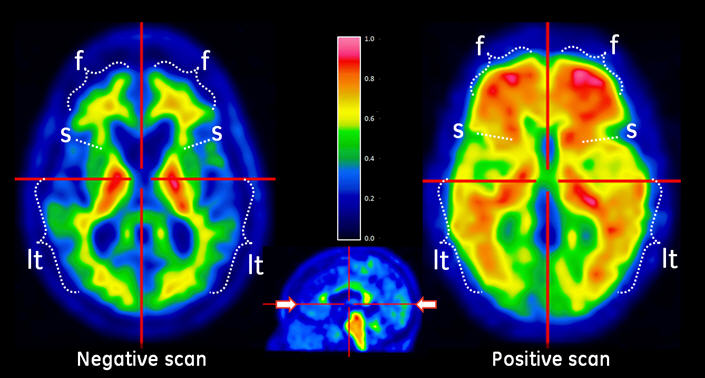
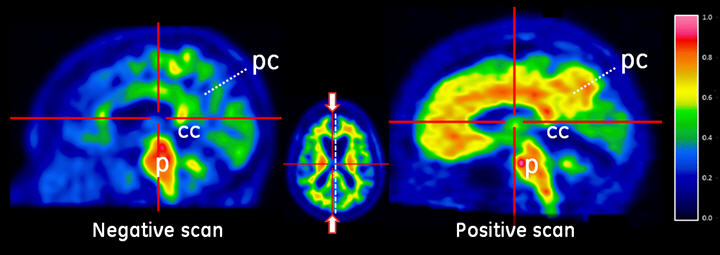
Vizamyl was evaluated in two clinical studies (Study One and Study Two) in adult subjects with a range of cognitive function, including some terminally ill patients who had agreed to participate in a post-mortem brain donation program. Both studies were single-arm and subjects underwent Vizamyl injection and scan. The images were interpreted by five independent readers masked to all clinical information; readers in Study Two were naïve to all forms of amyloid PET imaging. PET images were reviewed first without, and subsequently with, brain CT or MRI images.
Study One evaluated pre-mortem Vizamyl PET images from terminally ill patients and compared the results to postmortem truth standard assessments of cerebral cortical neuritic plaque density in patients who died during the study. Readers evaluated images using a clinically applicable binary image interpretation method (positive/negative) that involved evaluating regional Vizamyl brain uptake to yield a final overall image assessment that was compared to the truth standard. Before image interpretation, all readers underwent in-person tutoring on image interpretation. To determine the agreement between the in vivo Vizamyl image results and the post-mortem whole brain amyloid neuritic plaque density, Vizamyl results (negative/positive) were pre-specified to correspond with specific global histopathology plaque density scores, based upon a modification of the Consortium to Establish a Registry for Alzheimer's Disease (CERAD) criteria (Table 5), which use neuritic plaque counts as a necessary pathological feature of AD. Plaques were counted on microscope slides with modified Bielschowsky silver-stained tissue sections. The global brain neuritic plaque density score for each subject was determined by averaging across the scores (0-3) for five grey matter fields per slide and then across the six slides for each of eight regions; if any one region had a regional score of greater than 1.5, the subject's brain was classified as positive for amyloid.
Table 5: Global and Regional Neuritic Plaque Score Correlates to Vizamyl Image Results| Vizamyl Image Result | CERAD Classification (Score) | Neuritic Plaque Counts |
|---|
| Negative | None (0) | 0 |
| Sparse (1) | 1 to 5 |
| Positive | Moderate (2) | 6 to 19 |
| Frequent (3) | >20 |
In Study One, one hundred eighty patients were dosed with Vizamyl and 176 were imaged. The median patient age was 82 years (range 47 to 98 years) and 57% of the patients were female. By medical history 44 patients had no cognitive impairment, 135 had dementia, no patients had mild cognitive impairment (MCI), and one patient had memory loss of unspecified nature. Sixty-nine patients died during the study; 68 had cerebral cortical amyloid status determined (43 positive and 25 negative) and were included in the primary analysis. The time interval between the Vizamyl scan and death ranged from 0 to 13 months, with a median of 2.6 months, and was less than one year for 66 patients and between 12 to 13 months for 2 patients. At autopsy, the global brain neuritic plaque density category (CERAD classification as in Table 5) was available for 67/68 subjects: frequent (n = 19); moderate (n = 22); sparse (n = 14); and none (n = 12).
In Study Two, the effectiveness of an electronic training program for Vizamyl image orientation and interpretation was evaluated using Vizamyl PET images from across subjects with different cognitive abilities who had participated in earlier studies. Inter-reader reproducibility of image interpretation was assessed using images from subjects with a truth standard (68 patients who underwent an autopsy and 36 known or suspected normal pressure hydrocephalus patients with in vivo brain biopsy) and without a truth standard (28 cognitively normal volunteers 55 years or above, 80 patients with amnestic mild cognitive impairment (aMCI), 33 patients with probable AD (pAD)), and 31 young healthy volunteers. Additionally, intra-reader reproducibility was assessed from 29 images (10%). Among the 276 subjects, the median age was 72 years (range 20 to 95), 136 were females, and 251 were Caucasian.
Vizamyl performance characteristics for Study One and Study Two patients with an autopsy-based truth standard are shown in Table 6 and Table 7. Among patients who underwent autopsy (n=68; 43 positive and 25 negative based on histopathology), the median (and range) of correct read results, false negatives, and false positives were 59 (51, 61), 5 (3, 8), 3 (2, 14), respectively, for in-person training (Study One); and were 60 (55 to 61), 3 (3 to 6), 4 (2 to 10), respectively, for electronic media training (Study Two). Image reproducibility for various subject groups in Study Two is presented in Table 8. Inter-reader reproducibility analysis showed an overall Fleiss' kappa statistic of 0.83 (95% CI 0.79 to 0.86) which met the pre-specified success criterion (95% CI lower bound > 0.60). Intra-reader reproducibility analysis showed that, between the two readings for each of the 29 duplicate patient images, one of the five readers had complete agreement for all 29 images, two readers had discordant reads for a single image, and two readers had discordant reads for two images. Intra-reader reproducibility for a subgroup of 8 images from aMCI patients showed that all five readers had complete agreement for all duplicate images.
Table 6. Vizamyl Scan Results by Reader Training Method among Patients with Autopsy (n = 68)| Test Performance | In-Person Training
(Study One) | Electronic Media Training
(Study Two) |
|---|
| Sensitivity (%) | Median | 88 | 93 |
| Range among the 5 readers | 81 - 93 | 86 - 93 |
| Specificity (%) | Median | 88 | 84 |
| Range among the 5 readers | 44 - 92 | 60 - 92 |
Table 7: Vizamyl Scan Interpretations by Reader Training Method among Autopsied Patients (n = 68) | | In-Person Training
(Study One) | Electronic Media Training
(Study Two) |
|---|
| | Reader | Reader |
|---|
| | 1 | 2 | 3 | 4 | 5 | 6 | 7 | 8 | 9 | 10 |
|---|
All scans with autopsies
(n = 6843 positive and 25 negative based on histopathology ) | Correct | 57 | 60 | 51 | 59 | 61 | 58 | 61 | 61 | 55 | 60 |
| False Negative | 8 | 5 | 3 | 3 | 5 | 3 | 3 | 4 | 3 | 6 |
| False Positive | 3 | 2 | 14 | 5 | 2 | 7 | 4 | 3 | 10 | 2 |
Table 8 (Study Two): Median Number of Positive Vizamyl Scans and Reproducibility of Scan Results| Subject Group by Cognitive and Truth Standard (TS) | Positive Scans
NShown is the median number of scans interpreted as positive across the 5 readers for each subgroup of subjects listed in the first column. | Kappa
(95% CI) | Percent of Scans with Inter-reader Agreement |
|---|
| 3 of 5 readers agreed | 4 of 5 readers agreed | 5 of 5 readers agreed |
|---|
| pAD: probable AD; aMCI: amnestic MCI; Elderly: 55 years or above |
| All 276 subjects | 139 | 0.83 (0.79, 0.86) | 5 | 14 | 81 |
| All subjects with a TS, n=104 (68 autopsy; 36 biopsy) | 58 | 0.74 (0.68, 0.80) | 6 | 24 | 70 |
| All subjects without a TS, n = 172 | 76 | 0.88 (0.83, 0.92) | 5 | 8 | 87 |
| pAD, n = 63 (30 with TS 30 with TS from autopsy ; 33 no TS) | 47 | 0.88 (0.80, 0.96) | 3 | 6 | 90 |
| aMCI, n = 80 (0 with TS) | 45 | 0.89 (0.82, 0.96) | 4 | 7 | 89 |
| Elderly cognitively normal without TS, n = 28 | 2 | 0.46 (0.34, 0.57) | 4 | 14 | 82 |
| Cognitively normal with TS 21 with TS from autopsy, 0 with TS from biopsy , (n=21) | 10 | 0.64 (0.5, 0.77) | 5 | 38 | 57 |
| Other (non-AD) dementia with TS, n=53 17 from autopsy, 5 of 36 with TS from biopsy were not definitively classified as pAD based on clinical diagnosis | 27 | 0.71 (0.63, 0.80) | 8 | 25 | 68 |