Pediatric patients 6 to 11 years of age
The recommended starting dosage for pediatric patients 6 to 11 years of age is 100 mg orally once daily. Dosage may be titrated in increments of 100 mg at weekly intervals to the maximum recommended dosage of 400 mg once daily, depending on response and tolerability.
Pediatric patients 12 to 17 years of age
The recommended starting dosage for pediatric patients 12 to 17 years of age is 200 mg orally once daily. After 1 week, dosage may be titrated by an increment of 200 mg to the maximum recommended dosage of 400 mg once daily, depending on response and tolerability.
Pharmacological treatment of ADHD may be needed for extended periods. Periodically reevaluate the long-term use of Qelbree and adjust dosage as needed.
Adverse Reactions Leading to Discontinuation of Qelbree Treatment: Approximately 3% of the 826 patients receiving Qelbree in clinical studies discontinued treatment due to an adverse reaction. The adverse reactions most commonly associated with discontinuation of Qelbree were somnolence, nausea, headache, irritability, tachycardia, fatigue, and decreased appetite.
Most Common Adverse Reactions (occurring at ≥5% and at least twice the placebo rate for any dose): somnolence, decreased appetite, fatigue, nausea, vomiting, insomnia, and irritability.
Table 1 lists adverse reactions that occurred in at least 2% of patients treated with Qelbree and more frequently in Qelbree-treated patients than in placebo-treated patients. Table 1 data represents pooled data from pediatric patients 6 to 17 years of age who were enrolled in randomized, placebo-controlled trials of Qelbree.
Table 1. Adverse Reactions Reported in ≥2% of Pediatric Patients (6 to 17 Years of Age) Treated with Qelbree and at a Rate Greater than Placebo-Treated Patients in Placebo-Controlled ADHD StudiesBody System
Adverse Reaction
| | Qelbree |
|---|
Placebo
N=463
(%)
| 100mg
N=154
(%)
| 200mg
N=367
(%)
| 400mg
N=305
(%)
| All
Qelbree
N=826
(%)
|
|---|
| Nervous system disorders | | | | | |
|
Somnolence The following terms were combined:
Somnolence: somnolence, lethargy, sedation
Headache: headache, migraine, migraine with aura, tension headache
Upper respiratory tract infection: nasopharyngitis, pharyngitis, sinusitis, upper respiratory tract infection, viral sinusitis, viral upper respiratory tract infection
Abdominal pain: abdominal discomfort, abdominal pain, abdominal pain lower, abdominal pain upper
Insomnia: initial insomnia, insomnia, middle insomnia, poor quality sleep, sleep disorder, terminal insomnia
| 4 | 12 | 16 | 19 | 16 |
|
Headache | 7 | 10 | 11 | 11 | 11 |
| Metabolic and nutritional disorders | | | | | |
|
Decreased appetite | 0.4 | 5 | 8 | 8 | 7 |
| Infections and infestations | | | | | |
|
Upper respiratory tract infection | 6 | 5 | 7 | 8 | 7 |
| Body as a Whole - General disorders | | | | | |
|
Fatigue | 2 | 4 | 5 | 9 | 6 |
|
Pyrexia | 0.2 | 3 | 2 | 1 | 2 |
| Gastrointestinal system disorders | | | | | |
|
Abdominal Pain | 4 | 3 | 6 | 7 | 5 |
|
Nausea | 3 | 1 | 4 | 7 | 5 |
|
Vomiting | 2 | 5 | 3 | 6 | 4 |
| Psychiatric disorders | | | | | |
|
Insomnia | 1 | 2 | 5 | 5 | 4 |
|
Irritability | 1 | 3 | 2 | 5 | 3 |
Effects on Weight: In short–term, controlled studies (6 to 8 weeks), Qelbree-treated patients 6 to 11 years of age gained an average of 0.2 kg, compared to a gain of 1 kg in same-aged patients who received placebo. Qelbree-treated patients 12 to 17 years of age lost an average of 0.2 kg, compared to a weight gain of 1.5 kg in same-aged patients who received placebo. In a long-term open-label extension safety trial, 1097 patients received at least 1 dose of Qelbree. Among the 338 patients evaluated at 12 months, the mean change from baseline in weight-for-age z-score was -0.2 (standard deviation of 0.5). In the absence of a control group, it is unclear whether the weight change observed in the long-term open-label extension was attributable to the effect of Qelbree.
Pregnancy Exposure Registry
There is a pregnancy exposure registry that monitors pregnancy outcomes in women exposed Qelbree during pregnancy. Healthcare providers are encouraged to register patients by calling the National Pregnancy Registry for Psychiatric Medications at 1-866-961-2388 or visiting online at www.womensmentalhealth.org/preg.
Risk Summary
Based on findings from animal reproduction studies, viloxazine may cause maternal harm when used during pregnancy. Discontinue Qelbree when pregnancy is recognized unless the benefits of therapy outweigh the potential risk to the mother. Available data from case series with viloxazine use in pregnant women are insufficient to determine a drug-associated risk of major birth defects, miscarriage or adverse maternal outcomes.
In animal reproduction studies, oral administration of viloxazine to pregnant rats and rabbits during the period of organogenesis did not cause significant maternal toxicity but caused fetal toxicities and delayed fetal development in the rat at doses up to 2 times the maximum recommended human dose (MRHD) of 400 mg, based on mg/m
2. In the rabbit, viloxazine caused maternal toxicity without significant fetal toxicity at doses ≥ 7 times the MRHD based on mg/m
2. The no observed adverse effect levels (NOAELs) for fetal toxicity are approximately equal to and 11 times the MRHD, based on mg/m
2 in the rat and rabbit, respectively. Oral administration of viloxazine to pregnant rats and mice during pregnancy and lactation caused maternal toxicities and deaths at doses approximately 2 and 1 time the MRHD, based on mg/m
2, respectively
(see
Data).
At these maternally toxic doses, viloxazine caused offspring toxicities. The NOAEL for maternal and developmental toxicity is approximately equal to or less than the MRHD, based on mg/m
2, in the rat and mouse, respectively
(see
Data)
.
The estimated background risk of major birth defects and miscarriage for the indicated population is unknown. All pregnancies have a background risk of birth defect, loss, or other adverse outcomes. In the U.S. general population, the estimated background risk of major birth defects and miscarriage in clinically recognized pregnancies is 2 to 4% and 15 to 20%, respectively.
Data
Animal Data
Viloxazine was administered orally to pregnant rats during the period of organogenesis at doses of 13, 33, and 82 mg/kg/day, which are less than, equal to, and 2 times the MRHD of 400 mg, based on mg/m
2, respectively. Viloxazine did not cause maternal toxicity at doses up to 82 mg/kg/day. Viloxazine at 82 mg/kg/day increased early and late resorption, delayed fetal development, and possibly caused low incidences of fetal malformations or anomalies (craniorachischisis, missing cervical vertebrae, and morphological changes associated with hydranencephaly). The NOAEL for fetal toxicity and malformation is 33 mg/kg/day, which is approximately equal to the MRHD, based on mg/m
2.
Viloxazine was administered orally to pregnant rabbits during the period of organogenesis at doses of 43, 87, and 130 mg/kg/day, which are approximately 4, 7, and 11 times the MRHD of 400 mg, based on mg/m
2, respectively. Viloxazine decreased maternal body weight, weight gain, or food consumption at doses ≥ 87 mg/kg/day but did not cause fetal toxicity at doses up to 130 mg/kg/day. The NOAELs for maternal and fetal toxicity is 43 and 130 mg/kg/day, respectively, which is approximately 4 and 11 times the MRHD, based on mg/m
2, respectively.
Viloxazine was administered orally to pregnant rats during gestation and lactation at doses of 43, 87, and 217 mg/kg/day, which are approximately 1, 2, and 5 times the MRHD of 400 mg, based on mg/m
2, respectively. Viloxazine caused maternal toxicity of decreased body weight, weight gain, and food consumption at doses ≥ 87 mg/kg/day and maternal deaths near term at 217 mg/kg/day. At these maternally toxic doses, viloxazine caused lower live birth, decreased viability, and delayed growth and sexual maturation without affecting learning and memory in the offspring. The NOAEL for maternal and developmental toxicity is 43 mg/kg/day, which is approximately equal to the MRHD, based on mg/m
2.
Viloxazine was administered orally to pregnant mice during gestation and lactation at doses of 13, 33, and 82 mg/kg/day, which are approximately less than or equal to the MRHD of 400 mg, based on mg/m
2, respectively. Viloxazine treatment at 82 mg/kg/day during the gestation period caused maternal deaths and decreased body weight in the offspring. The NOAEL for both maternal and developmental toxicity is 33 mg/kg/day, which is less than the MRHD, based on mg/m
2.
Risk Summary
There are no data on the presence of viloxazine in human milk, the effects on the breastfed infant, or the effects on milk production. Viloxazine is likely present in rat milk. When a drug is present in animal milk, it is likely that the drug will be present in human milk.
The developmental and health benefits of breastfeeding should be considered along with the mother's clinical need for Qelbree and any potential adverse effects on the breastfed child from Qelbree or from the underlying maternal condition.
Juvenile Animal Toxicity Data
Viloxazine was administered orally to juvenile rats from postnatal day (PND) 23 through PND 79 at doses of 43, 130, and 217 mg/kg/day, which are approximately 1, 2, and 3 times the MRHD of 400 mg, based on mg/m
2 in children, respectively. Viloxazine decreased body weight, weight gain, and food consumption in both sexes at 217 mg/kg/day. Sexual maturation, reproductive capacity, and learning and memory were not affected. The NOAEL for juvenile toxicity is 130 mg/kg/day, which is approximately 2 times the MRHD, based on mg/m
2 in children.
Human Experience
The pre-market clinical trials with Qelbree do not provide information regarding symptoms of overdose.
Literature reports from post marketing experience with immediate-release viloxazine include cases of overdosage from 1000 mg to 6500 mg (2.5 to 16.25 times the maximum recommended daily dose). The most reported symptom was drowsiness. Impaired consciousness, diminished reflexes, and increased heart rate have also been reported.
Treatment and Management
There is no specific antidote for Qelbree overdose. Administer symptomatic and supportive treatment as appropriate. In case of overdose, consult a Certified Poison Control Center (1-800-222-1222 or
www.poison.org).
Cardiac Electrophysiology
At a dose 4.5 times the maximum recommended dose, Qelbree did not prolong the QT interval to any clinically relevant extent. There was no effect of Qelbree on the PR interval or QRS duration in healthy volunteers. However, nonclinical studies suggest the potential for Qelbree to inhibit cardiac sodium channels.
Absorption
The relative bioavailability of viloxazine extended-release relative to an immediate-release formulation was about 88%. The median (range) time to peak plasma concentration of viloxazine (T
max) was approximately 5 hours, with a range of 3 to 9 hours, following a single 200 mg dose.
Effect of Food
Administration of 200 mg viloxazine extended-release with a high-fat meal (800 to 1000 calories) decreased viloxazine C
max and AUC by about 9% and 8%, respectively. Viloxazine T
max increased by about 2 hours after administration with a high-fat meal. Sprinkling the contents of a capsule on applesauce decreased viloxazine C
max and AUC by about 10% and 5%, respectively.
Distribution
Viloxazine is 76-82% bound to human plasma proteins over the blood concentration range of 0.5 mcg/mL to 10 mcg/mL.
Elimination
The mean (± SD) half-life of viloxazine was 7.02 ± (4.74 hours).
Metabolism
Viloxazine is primarily metabolized by CYP2D6, UGT1A9, and UGT2B15. The major metabolite detected in plasma is 5-hydroxy-viloxazine glucuronide.
Excretion
Renal excretion is the primary route of excretion of viloxazine. After administration of radiolabeled viloxazine, 90% of the dose was recovered in urine within the first 24 hours post-dose. Less than 1% of the dose is excreted in the feces.
Specific Populations
Geriatric Patients
No studies were conducted to evaluate pharmacokinetics in the geriatric population.
Pediatric Patients
The estimated steady-state C
max and AUC
0-t of viloxazine and its major metabolite, at doses ranging from 100 mg to 400 mg, were approximately 40-50% higher in pediatric patients 6 to 11 years of age than in pediatric patients 12 to 17 years of age.
Male or Female Patients and Racial or Ethnic Groups
No clinically significant differences in the pharmacokinetics of viloxazine was observed based on race and sex.
Patients with Renal Impairment
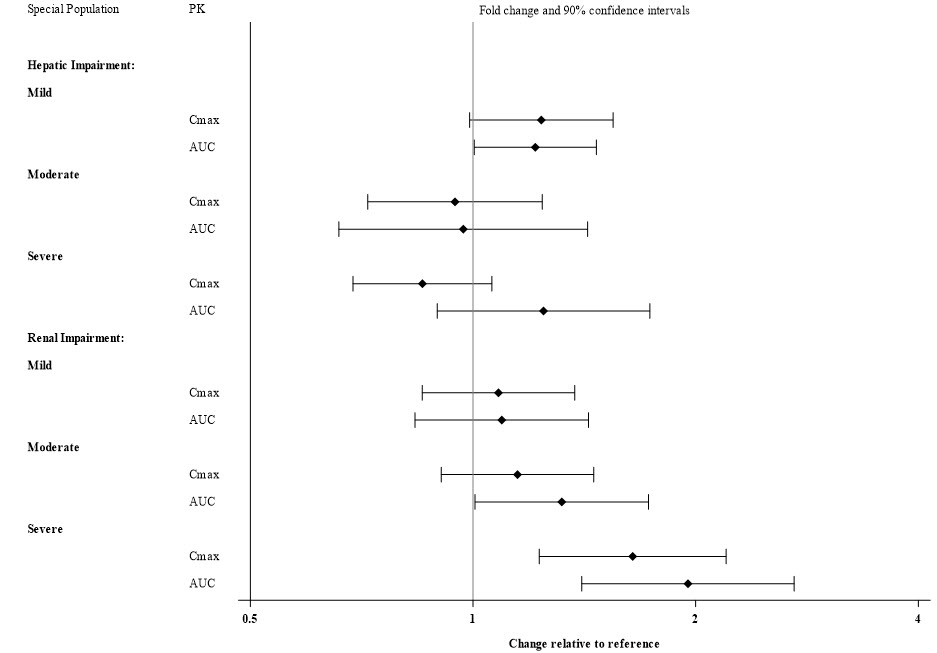
Exposures of viloxazine in patients with renal impairment are summarized in Figure 1
[see
Dosage and Administration (2.4) and
Use in Specific Populations (8.6)]
Figure 1: Effect of Renal Impairment on Viloxazine Pharmacokinetics
Patients with Hepatic Impairment
The pharmacokinetics of viloxazine have not been evaluated in hepatic impairment
[see
Use in Specific Populations (8.7)]
.
CYP2D6 Metabolism
A multiple-dose study was conducted with Qelbree 900 mg once-daily in healthy volunteers to compare the effect of CYP2D6 poor metabolizers (PMs) and extensive metabolizers (EMs) on the PK of viloxazine. At steady state, viloxazine geometric means for C
max and AUC
0-24 were 21% and 26%, respectively, higher in CYP2D6 PMs compared to EMs.
Drug Interaction Studies
Alcohol: There was no significant effect on viloxazine C
max and AUC when 200 mg viloxazine ER was administered with orange juice containing 4% and 20% alcohol. However, when administered with orange juice containing 40% alcohol, C
max and AUC of viloxazine decreased by about 32% and 19%, respectively .
The effect of other drugs on the pharmacokinetics of viloxazine is presented in Figure 2.
Figure 2: Effects of Other Drugs on Viloxazine Pharmacokinetics
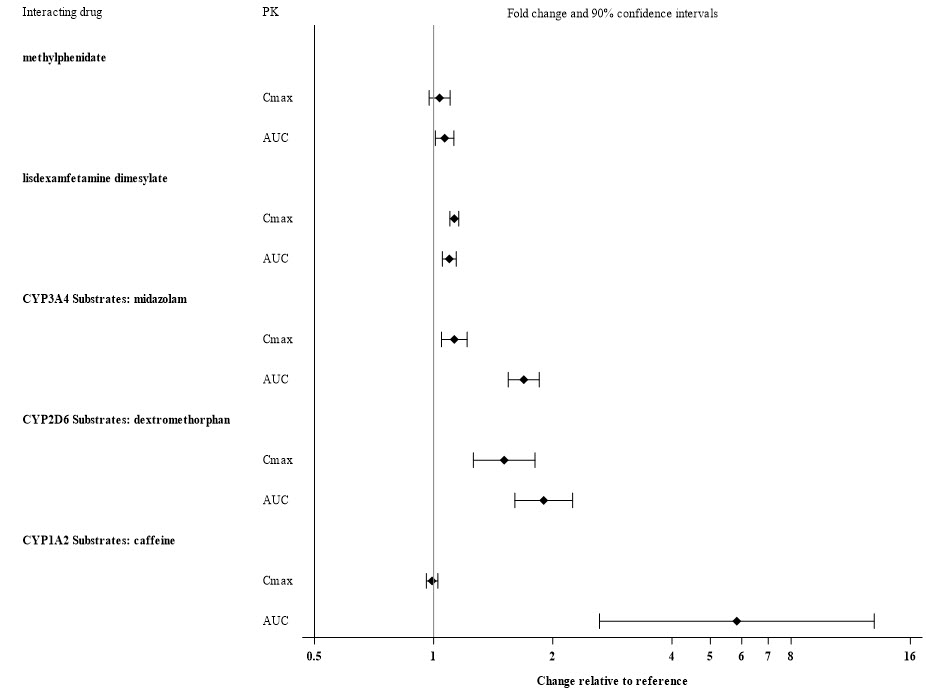
The effect of viloxazine on the pharmacokinetics of other drugs is presented in Figure 3
[see
Drug Interactions (7.1)]
.
Figure 3: Effect of Viloxazine on the Pharmacokinetics of Other Drugs
In Vitro Studies
Based on
in vitro data, drugs that inhibit CYP isozymes 1A1, 1A2, 2B6, 2D6, 2C8, 2C9, 2C19, and 2E1 are not expected to have significant impact on the pharmacokinetic profile of viloxazine.
Viloxazine does not inhibit CYP2C8, 2C9 or 2C19 activities. Viloxazine is a reversible inhibitor of P450-1A2, 2B6, 2D6 and 3A4/5. Viloxazine is a potential inducer of CYP1A2 and CYP2B6.
Viloxazine is not a inhibitor of P-gp, BCRP, MATE2-K,OATP1B1*1a, and OATP1B3 transporters. Viloxazine appears to be a weak inhibitor of the MATE1. Viloxazine is not a substrate of either OATP1B1*1a or OATP1B3 transporters.
Carcinogenesis
Viloxazine did not increase the incidence of tumors in rats treated for 2 years at oral doses of 22, 43, and 87 mg/kg/day. The high dose of 87 mg/kg/day is approximately equal to the MRHD of 400 mg, based on mg/m
2 in children.
Viloxazine did not increase the incidence of tumors in Tg.rasH2 mice treated for 26 weeks at oral doses of 4.3, 13, and 43 mg/kg/day.
Mutagenesis
Viloxazine was not genotoxic in a battery of genotoxicity tests. It was not mutagenic in the
in vitro bacterial reverse mutation (Ames) assay or clastogenic in the
in vitro mammalian chromosomal aberration assay or in the
in vivo rat bone marrow micronucleus assay.
Impairment of Fertility
Viloxazine was orally administered to male and female rats prior to and throughout mating and continued until completion of the second littering at doses of 13, 33, and 82 mg/kg/day, which are less than, equal to, and 2 times the MRHD of 400 mg, based on mg/m
2, respectively. Viloxazine did not affect male or female fertility parameters in the rat. The NOAEL for male and female fertility is 82 mg/kg/day, which is approximately 2 times the MRHD, based on mg/m
2.
How Supplied
Qelbree (viloxazine extended-release capsules) are available in the following strengths and colors:
100mg (yellow capsule printed with "SPN" on capsule cap and "100" on capsule body with edible black ink).
| Bottles of 100 capsules | NDC 17772-131-01 |
| Bottles of 90 capsules | NDC 17772-131-90 |
| Bottles of 60 capsules | NDC 17772-131-60 |
| Bottles of 30 capsules | NDC 17772-131-30 |
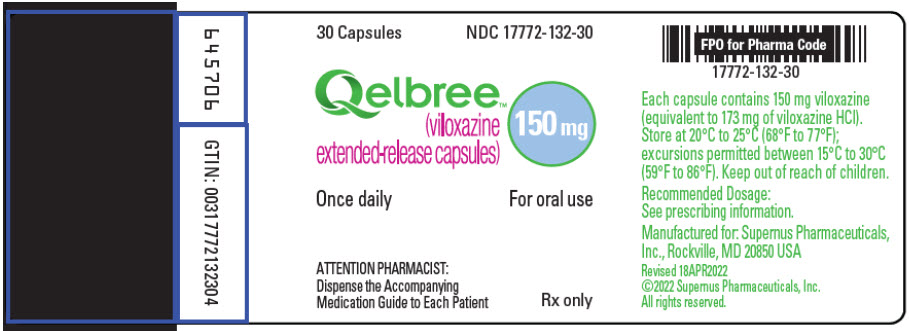
150mg (lavender capsule printed with "SPN" on capsule cap and "150" on capsule body with edible black ink).
| Bottles of 100 capsules | NDC 17772-132-01 |
| Bottles of 90 capsules | NDC 17772-132-90 |
| Bottles of 60 capsules | NDC 17772-132-60 |
| Bottles of 30 capsules | NDC 17772-132-30 |
200mg (light green capsule printed with "SPN" on capsule cap and "200" on capsule body with edible black ink).
| Bottles of 100 capsules | NDC 17772-133-01 |
| Bottles of 90 capsules | NDC 17772-133-90 |
| Bottles of 60 capsules | NDC 17772-133-60 |
| Bottles of 30 capsules | NDC 17772-133-30 |
Suicidal Thoughts and Behaviors
Advise patients and caregivers to monitor for the emergence of suicidal thoughts or behaviors or symptoms that might be precursors to emerging suicidal ideation or behavior, especially early during treatment and when the dosage is adjusted up or down. Instruct patients and caregivers to report such symptoms to the healthcare provider
[see
Boxed Warning and
Warnings and Precautions (5.1)]
.
Concomitant Use with Monoamine Oxidase Inhibitors (MAOI)
Caution patients about the concomitant use of Qelbree and monoamine oxidase inhibitors (MAOI), or within 14 days after discontinuing an MAOI, because of an increased risk of hypertensive crisis
[see
Contraindications (4) and
Drug Interactions (7.1)]
.
Blood Pressure and Heart Rate Increases
Instruct patients that Qelbree can cause elevations of their blood pressure and pulse rate and they should be monitored for such effects
[see
Warnings and Precautions (5.2)]
.
Activation of Mania/Hypomania
Advise patients and their caregivers to look for signs of activation of mania/hypomania
[see
Warnings and Precautions (5.3)]
.
Somnolence and Fatigue
Advise patients about the potential for somnolence (including sedation and lethargy) and fatigue. Advise patients to use caution when performing activities requiring mental alertness, such as driving a motor vehicle or operating hazardous machinery, until they know how they will be affected by Qelbree
[see
Warnings and Precautions (5.4)].
Effects on Weight
Advise patients and their caregivers that Qelbree may affect weight and that weight should be monitored while using Qelbree
[see
Adverse Reactions (6.1)].
Pregnancy
Advise patients that there is a pregnancy registry that monitors pregnancy outcomes in women exposed to Qelbree during pregnancy. Advise females of reproductive potential to inform their healthcare provider of a known or suspected pregnancy to discuss if Qelbree should be discontinued
[see
Use in Specific Populations (8.1)].
Administration Instructions
Advise patients to take the capsule whole or sprinkled on a teaspoonful of applesauce and consume within 2 hours. Do not cut, chew or crush the capsule
[see
Dosage and Administration (2.3)]
.
Qelbree is manufactured by: Catalent Pharma Solutions, LLC, 1100 Enterprise Drive Winchester, KY 40391.
Distributed by: Supernus Pharmaceuticals, Inc. Rockville, MD 20850 USA
Qelbree is a trademark of Supernus Pharmaceuticals, Inc.
RA-QEL-V1-202104
© Supernus Pharmaceuticals Inc. 2021