Description
Each 5 mL (one teaspoonful), for oral administration contains: Dextromethorphan hydrobromide 15 mg; promethazine hydrochloride 6.25 mg. Alcohol 7.0%.
Inactive Ingredients: artificial pineapple flavor, artificial raspberry flavor, ascorbic acid, citric acid anhydrous, dehydrated alcohol, D&C Yellow No. 10, edetate disodium, FD&C Yellow No. 6, glycerin, sucrose, methylparaben, purified water, saccharin sodium, sodium benzoate, sodium citrate dihydrate and sodium propionate.
Dextromethorphan hydrobromide is a salt of the methyl ether of the dextrorotatory isomer of levorphanol, a narcotic analgesic. It is chemically designated as 3-Methoxy-17-methyl-9α, 13α, 14α-morphinan hydrobromide monohydrate. Dextromethorphan hydrobromide occurs as white crystals sparingly soluble in water and freely soluble in alcohol. It has a molecular weight of 370.32, a molecular formula of C 18H 25NO•HBr•H 2O, and the following structural formula:
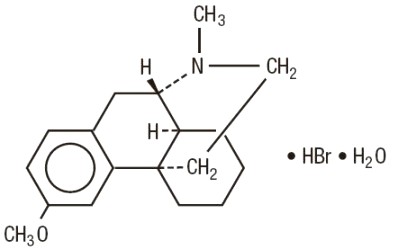
Prome-dextro-01 (5c4c8d2e B9db 4452 Adb5 68e474d07d6d 01)
Promethazine is a racemic compound. Promethazine hydrochloride, a phenothiazine derivative, is chemically designated as 10 H-Phenothiazine-10-ethanamine, N, N, α-trimethyl-, monohydrochloride, (±)-.
Promethazine hydrochloride occurs as a white to faint yellow, practically odorless, crystalline powder which slowly oxidizes and turns blue on prolonged exposure to air. It is soluble in water and freely soluble in alcohol. It has a molecular weight of 320.88, a molecular formula of C 17H 20N 2S•HCl, and the following structural formula:
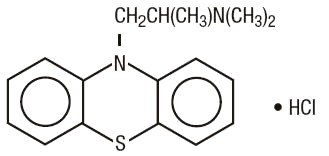
Prome-dextro-02 (5c4c8d2e B9db 4452 Adb5 68e474d07d6d 02)
