Other
NUCYNTA® (tapentadol) is indicated for the relief of moderate to severe acute pain in patients 18 years of age or older.
Absorption
Mean absolute bioavailability after single-dose administration (fasting) is approximately 32% due to extensive first-pass metabolism. Maximum serum concentrations of tapentadol are typically observed at around 1.25 hours after dosing.
Dose-proportional increases in the Cmax and AUC values of tapentadol have been observed over the 50 to 150 mg dose range.
A multiple (every 6 hour) dose study with doses ranging from 75 to 175 mg tapentadol showed a mean accumulation factor of 1.6 for the parent drug and 1.8 for the major metabolite tapentadol-O-glucuronide, which are primarily determined by the dosing interval and apparent half-life of tapentadol and its metabolite.
Food Effect
The AUC and Cmax increased by 25% and 16%, respectively, when NUCYNTA® was administered after a high-fat, high-calorie breakfast. NUCYNTA® may be given with or without food.
Distribution
Tapentadol is widely distributed throughout the body. Following intravenous administration, the volume of distribution (Vz) for tapentadol is 540 +/- 98 L. The plasma protein binding is low and amounts to approximately 20%.
Metabolism and Elimination
In humans, the metabolism of tapentadol is extensive. About 97% of the parent compound is metabolized. Tapentadol is mainly metabolized via Phase 2 pathways, and only a small amount is metabolized by Phase 1 oxidative pathways. The major pathway of tapentadol metabolism is conjugation with glucuronic acid to produce glucuronides. After oral administration approximately 70% (55% O-glucuronide and 15% sulfate of tapentadol) of the dose is excreted in urine in the conjugated form. A total of 3% of drug was excreted in urine as unchanged drug. Tapentadol is additionally metabolized to N-desmethyl tapentadol (13%) by CYP2C9 and CYP2C19 and to hydroxy tapentadol (2%) by CYP2D6, which are further metabolized by conjugation. Therefore, drug metabolism mediated by cytochrome P450 system is of less importance than phase 2 conjugation.
None of the metabolites contributes to the analgesic activity.
Tapentadol and its metabolites are excreted almost exclusively (99%) via the kidneys. The terminal half-life is on average 4 hours after oral administration. The total clearance is 1530 +/- 177 ml/min.
Special Populations
Elderly
The mean exposure (AUC) to tapentadol was similar in elderly subjects compared to young adults, with a 16% lower mean Cmax observed in the elderly subject group compared to young adult subjects.
Renal Impairment
AUC and Cmax of tapentadol were comparable in subjects with varying degrees of renal function (from normal to severely impaired). In contrast, increasing exposure (AUC) to tapentadol-O-glucuronide was observed with increasing degree of renal impairment. In subjects with mild, moderate, and severe renal impairment, the AUC of tapentadol-O-glucuronide are 1.5-, 2.5-, and 5.5-fold higher compared with normal renal function, respectively.
Hepatic Impairment
Administration of NUCYNTA® resulted in higher exposures and serum levels to tapentadol in subjects with impaired hepatic function compared to subjects with normal hepatic function. The ratio of tapentadol pharmacokinetic parameters for the mild and moderate hepatic impairment groups in comparison to the normal hepatic function group were 1.7 and 4.2, respectively, for AUC; 1.4 and 2.5, respectively, for Cmax; and 1.2 and 1.4, respectively, for t1/2. The rate of formation of tapentadol-O-glucuronide was lower in subjects with increased liver impairment.
Pharmacokinetic Drug Interactions
Tapentadol is mainly metabolized by Phase 2 glucuronidation, a high capacity/low affinity system, therefore, clinically relevant interactions caused by Phase 2 metabolism are unlikely to occur. Naproxen and probenecid increased the AUC of tapentadol by 17% and 57%, respectively. These changes are not considered clinically relevant and no change in dose is required.
No changes in the pharmacokinetic parameters of tapentadol were observed when acetaminophen and acetylsalicylic acid were given concomitantly.
In vitro studies did not reveal any potential of tapentadol to either inhibit or induce cytochrome P450 enzymes. Thus, clinically relevant interactions mediated by the cytochrome P450 system are unlikely to occur.
The pharmacokinetics of tapentadol were not affected when gastric pH or gastrointestinal motility were increased by omeprazole and metoclopramide, respectively.
Plasma protein binding of tapentadol is low (approximately 20%). Therefore, the likelihood of pharmacokinetic drug-drug interactions by displacement from the protein binding site is low.
Carcinogenesis
Tapentadol was administered to rats (diet) and mice (oral gavage) for two years.
In mice, tapentadol HCl was administered by oral gavage at dosages of 50, 100 and 200 mg/kg/day for 2 years (up to 0.2 times the plasma exposure at the maximum recommended human dose [MRHD] on an area under the time-curve [AUC] basis). No increase in tumor incidence was observed at any dose level.
In rats, tapentadol HCl was administered in diet at dosages of 10, 50, 125 and 250 mg/kg/day for two years (up to 0.2 times in the male rats and 0.6 times in the female rats the MRHD on an AUC basis). No increase in tumor incidence was observed at any dose level.
Mutagenesis
Tapentadol did not induce gene mutations in bacteria, but was clastogenic with metabolic activation in a chromosomal aberration test in V79 cells. The test was repeated and was negative in the presence and absence of metabolic activation. The one positive result for tapentadol was not confirmed in vivo in rats, using the two endpoints of chromosomal aberration and unscheduled DNA synthesis, when tested up to the maximum tolerated dose.
Impairment of Fertility
Tapentadol HCl was administered intravenously to male or female rats at dosages of 3, 6, or 12 mg/kg/day (representing exposures of up to approximately 0.4 times the exposure at the MRHD on an AUC basis, based on extrapolation from toxicokinetic analyses in a separate 4-week intravenous study in rats). Tapentadol did not alter fertility at any dose level. Maternal toxicity and adverse effects on embryonic development, including decreased number of implantations, decreased numbers of live conceptuses, and increased pre- and post-implantation losses occurred at dosages ≥6 mg/kg/day.
The proportions of patients who showed reduction in pain intensity at 48 hours of 30% or greater, or 50% or greater were significantly higher in patients treated with NUCYNTA® at each dose versus placebo.
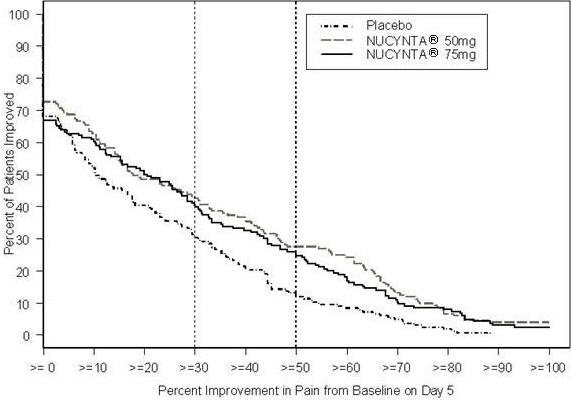
The proportions of patients who showed reduction in pain intensity at 5 days of 30% or greater, or 50% or greater were significantly higher in patients treated with NUCYNTA® at each dose versus placebo.
Revised: March 2011
Manufactured by:
Janssen Ortho, LLC
Gurabo, PR 00778
Manufactured for:
PriCara®, Division of Ortho-McNeil-Janssen Pharmaceuticals, Inc.
Raritan, NJ 08869
© Ortho-McNeil-Janssen Pharmaceuticals, Inc. 2009
Repackaged by:
Rebel Distributors Corp
Thousand Oaks, CA 91320
Read the Medication Guide that comes with NUCYNTA® before you start taking it and each time you get a new prescription. There may be new information. This Medication Guide does not take the place of talking to your doctor about your medical condition or your treatment. Talk to your doctor if you have any questions.
What is the most important information I should know about NUCYNTA®?
NUCYNTA® is a tablet that contains tapentadol, a strong medicine that is a pain medicine.
Use NUCYNTA® exactly how your doctor tells you to. Do not use NUCYNTA® if it has not been prescribed for you.
You should not take NUCYNTA® if your pain is mild and can be controlled with other pain medicines such as non-steroidal anti-inflammatory medicines (NSAIDS) or acetaminophen.
What is NUCYNTA®?
- NUCYNTA® is a prescription medicine that is used in adults 18 years of age or older to treat moderate to severe pain that is expected to last a short time.
NUCYNTA® is for short-term use only because the risks for withdrawal symptoms, abuse and addiction are higher when NUCYNTA® is used longer.
- have severe lung problems
- have a gastrointestinal problem called paralytic ileus in which the intestines are not working normally.
- take a monoamine oxidase inhibitor (MAOI) medicine or have taken an MAOI within the last 14 days. Ask your doctor or pharmacist if any of your medicines is an MAOI.
- trouble breathing or lung problems
- or had a head injury
- liver or kidney problems
- convulsions or seizures
- dependency problems with alcohol
- pancreas or gall bladder problems
- past or present substance abuse or drug addiction. There is a risk of abuse or addiction with narcotic pain medicines. If you have abused drugs in the past, you may have a higher chance of developing abuse or addiction again while using NUCYNTA®.
- are pregnant or plan to become pregnant
- are breast-feeding. You should not breast-feed while taking NUCYNTA®.
- Monoamine Oxidase Inhibitors (MAOIs). See "Who should not take NUCYNTA®."
- any medicine that makes you sleepy. NUCYNTA® can make you sleepy and affect your breathing. Taking these medicines together can be dangerous.
- Do not take NUCYNTA® unless it has been prescribed for you by your doctor.
- Take NUCYNTA® exactly as prescribed by your doctor.
- Do not change the dose of NUCYNTA® unless your doctor tells you to. Your doctor may change your dose after seeing how the medicine affects you. Do not use NUCYNTA® more often than prescribed. Call your doctor if your pain is not well controlled while taking NUCYNTA®.
- Follow your doctor's instructions about how to slowly stop taking NUCYNTA® to help lessen withdrawal symptoms.
- NUCYNTA® can be taken with or without food.
- Do not drive, operate machinery, or participate in any other possibly dangerous activities until you know how you react to this medicine. NUCYNTA® can make you sleepy.
- You should not drink alcohol while using NUCYNTA®. Alcohol increases your chance of having dangerous side effects.
- Life-threatening breathing problems. Call your doctor right away or get emergency medical help if you:
- have trouble breathing, or have slow or shallow breathing
- have a slow heartbeat
- have severe sleepiness
- have cold, clammy skin
- feel faint, dizzy, confused, or can not think, walk or talk normally
- have a seizure
- have hallucinations
- Physical Dependence. NUCYNTA® can cause physical dependence. Talk to your doctor about slowly stopping NUCYNTA® to avoid getting sick with withdrawal symptoms. You could become sick with uncomfortable symptoms because your body has become used to the medicine. Tell your doctor if you have any of these symptoms of withdrawal: feeling anxious, sweating, sleep problems, shivering, pain, nausea, tremors, diarrhea, upper respiratory symptoms, hallucinations, hair "standing on end." Physical dependence is not the same as drug addiction. Your doctor can tell you more about the differences between physical dependence and drug addiction.
- Serotonin syndrome. Serotonin syndrome is a rare, life-threatening problem that could happen if you take NUCYNTA® with Selective Serotonin Reuptake Inhibitors (SSRIs), Serotonin and Norepinephrine Reuptake Inhibitors (SNRIs), Monoamine Oxidase Inhibitors (MAOIs), triptans or certain other medicines. Call your doctor or get medical help right away if you have any one or more of the these symptoms: you feel agitated, have hallucinations, coma, rapid heart beat, feel overheated, loss of coordination, over active reflexes, nausea, vomiting, or diarrhea.
- Seizures. NUCYNTA® can cause seizures in people who are at risk for seizures or who have epilepsy. Tell your doctor right away if you have a seizure and stop taking NUCYNTA®.
- Low blood pressure. This can make you feel dizzy if you get up too fast from sitting or lying down.
- Store NUCYNTA® at 59°F to 86°F (15°C to 30°C). Keep NUCYNTA® tablets dry.
- Dispose of NUCYNTA® tablets you no longer need.
Who should not take NUCYNTA®?
Do not take NUCYNTA® if you:
What should I tell my doctor before taking NUCYNTA®?
NUCYNTA® may not be right for you. Tell your doctor about all your medical conditions, including if you have:
Tell your doctor about all the medicines you take, including prescription and nonprescription medicines, vitamins, and herbal supplements. Using NUCYNTA® with other medicines can cause serious side effects. The doses of some other medicines may need to be changed. Your doctor can tell you what medicines can be safely taken with NUCYNTA®. Especially tell your doctor if you take:
How should I take NUCYNTA®?
What should I avoid while taking NUCYNTA®?
What are the possible side effects of NUCYNTA®?
NUCYNTA® can cause serious side effects including:
The common side effects with NUCYNTA® are nausea, dizziness, vomiting, sleepiness, and itching.
Constipation is a common side effect of all opioid medicines. Talk to your doctor about the use of laxatives and stool softeners to prevent or treat constipation while taking NUCYNTA®.
Tell your doctor about any side effect that bothers you or that does not go away. These are not all the possible side effects of NUCYNTA®. For a complete list, ask your doctor or pharmacist.
Call your doctor for medical advice about side effects. You may report side effects to FDA at 1-800-FDA-1088.
How should I store NUCYNTA®?
Keep NUCYNTA® in a safe place out of the reach of children.
General information about NUCYNTA®
Medicines are sometimes prescribed for purposes other than those listed in a Medication Guide. Do not use NUCYNTA® for a condition for which it was not prescribed. Do not give NUCYNTA® to other people, even if they have the same symptoms you have. Sharing NUCYNTA® could be harmful and is against the law.
This Medication Guide summarizes the most important information about NUCYNTA®. If you would like more information, talk with your doctor. You can ask your doctor or pharmacist for information about NUCYNTA® that is written for doctors. For more information about NUCYNTA® call 1-800-526-7736.
What are the ingredients in NUCYNTA®?
Active Ingredient: tapentadol
Inactive ingredients: microcrystalline cellulose, lactose monohydrate, croscarmellose sodium, povidone, magnesium stearate, and Opadry® II, a proprietary film-coating mixture containing polyvinyl alcohol, titanium dioxide, polyethylene glycol, talc, and aluminum lake coloring.
This Medication Guide has been approved by the U.S. Food and Drug Administration.
Revised: June 2010
Manufactured by:
Janssen Ortho, LLC
Gurabo, PR 00778
Manufactured for:
PriCara®, Division of Ortho-McNeil-Janssen Pharmaceuticals, Inc.
Raritan, NJ 08869
© Ortho-McNeil-Janssen Pharmaceuticals, Inc. 2009
Repackaged by:
Rebel Distributors Corp
Thousand Oaks, CA 91320