Other
PHARMACOKINETIC DIFFERENCES BETWEEN TIZANIDINE HYDROCHLORIDE CAPSULES AND TIZANIDINE HYDROCHLORIDE TABLETS:
TIZANIDINE HYDROCHLORIDE CAPSULES ARE NOT BIOEQUIVALENT TO TIZANIDINE HYDROCHLORIDE TABLETS IN THE FED STATE. THE PRESCRIBER SHOULD BE THOROUGHLY FAMILIAR WITH THE COMPLEX EFFECTS OF FOOD ON TIZANIDINE PHARMACOKINETICS (see PHARMACOKINETICS and DOSAGE AND ADMINISTRATION).
Absorption and Distribution
Following oral administration, tizanidine is essentially completely absorbed and has a half-life of approximately 2.5 hours (coefficient of variation [CV] = 33%). Following administration of tizanidine, peak plasma concentrations occurred at 1.5 hours(CV = 40%) after dosing. Food increases Cmax by approximately one-third and shortens time to peak concentration by approximately 40 minutes, but the extent of tizanidine absorption is not affected. Tizanidine has linear pharmacokinetics over a dose of 1 to 20 mg. The absolute oral bioavailability of tizanidine is approximately 40% (CV = 24%), due to extensive first-pass metabolism in the liver; approximately 95% of an administered dose is metabolized. Tizanidine metabolites are not known to be active; their half-lives range from 20 to 40 hours. Tizanidine is extensively distributed throughout the body with a mean steady state volume of distribution of 2.4 L/kg (CV = 21%) following intravenous administration in healthy adult volunteers. Tizanidine is approximately 30% bound to plasma proteins, independent of concentration over the therapeutic range.
Pharmacokinetics, Metabolism and Excretion
Following single and multiple oral dosing of 14C-tizanidine, an average of 60% and 20% of total radioactivity was recovered in the urine and feces, respectively.
Age Effects
No specific pharmacokinetic study was conducted to investigate age effects. Cross study comparison of pharmacokinetic data following single dose administration of 6 mg tizanidine showed that younger subjects cleared the drug four times faster than the elderly subjects. Tizanidine has not been evaluated in children (see PRECAUTIONS).
Hepatic Impairment
Pharmacokinetic differences due to hepatic impairment have not been studied (see WARNINGS).
Renal Impairment
Tizanidine clearance is reduced by more than 50% in elderly patients with renal insufficiency (creatinine clearance < 25 mL/min) compared to healthy elderly subjects; this would be expected to lead to a longer duration of clinical effect. Tizanidine should be used with caution in renally impaired patients (see PRECAUTIONS).
Gender Effects
No specific pharmacokinetic study was conducted to investigate gender effects. Retrospective analysis of pharmacokinetic data, however, following single and multiple dose administration of 4 mg tizanidine showed that gender had no effect on the pharmacokinetics of tizanidine.
Race Effects
Pharmacokinetic differences due to race have not been studied.
Oral Contraceptives
No specific pharmacokinetic study was conducted to investigate interaction between oral contraceptives and tizanidine. Retrospective analysis of population pharmacokinetic data following single and multiple dose administration of 4 mg tizanidine, however, showed that women concurrently taking oral contraceptives had 50% lower clearance of tizanidine compared to women not on oral contraceptives (see PRECAUTIONS).
Limited Data Base for Chronic Use of Single Doses Above 8 mg and Multiple Doses Above 24 mg Per Day
Clinical experience with long-term use of tizanidine at doses of 8 to 16 mg single doses or total daily doses of 24 to 36 mg (see DOSAGE AND ADMINISTRATION) is limited. In safety studies, approximately 75 patients have been exposed to individual doses of 12 mg or more for at least one year or more and approximately 80 patients have been exposed to total daily doses of 30 to 36 mg/day for at least one year or more. There is essentially no long-term experience with single, daytime doses of 16 mg. Because long-term clinical study experience at high doses is limited, only those adverse events with a relatively high incidence are likely to have been identified (see WARNINGS, PRECAUTIONS and ADVERSE REACTIONS).
Hypotension
Tizanidine is an α2-adrenergic agonist (like clonidine) and can produce hypotension. In a single dose study where blood pressure was monitored closely after dosing, two-thirds of patients treated with 8 mg of tizanidine had a 20% reduction in either the diastolic or systolic BP. The reduction was seen within 1 hour after dosing, peaked 2 to 3 hours after dosing and was associated, at times, with bradycardia, orthostatic hypotension, lightheadedness/dizziness and rarely syncope.
The hypotensive effect is dose related and has been measured following single doses of ≥ 2 mg.
The chance of significant hypotension may possibly be minimized by titration of the dose and by focusing attention on signs and symptoms of hypotension prior to dose advancement. In addition, patients moving from a supine to a fixed upright position may be at increased risk for hypotension and orthostatic effects.
Caution is advised when tizanidine is to be used in patients receiving concurrent antihypertensive therapy and should not be used with other α2-adrenergic agonists.
Risk of Liver Injury
Tizanidine occasionally causes liver injury, most often hepatocellular in type. In controlled clinical studies, approximately 5% of patients treated with tizanidine had elevations of liver function tests (ALT/SGPT, AST/SGOT) to greater than 3 times the upper limit of normal (or 2 times if baseline levels were elevated) compared to 0.4% in the control patients. Most cases resolved rapidly upon drug withdrawal with no reported residual problems. In occasional symptomatic cases, nausea, vomiting, anorexia and jaundice have been reported. In postmarketing experience, three deaths associated with liver failure have been reported in patients treated with tizandine.In one case, a 49 year-old male developed jaundice and liver enlargement following 2 months of tizanidine treatment, primarily at 6 mg tid. A liver biopsy showed multilobular necrosis without eosinophilic infiltration. Treatment was discontinued and the patient died in hepatic coma 10 days later. There was no evidence of hepatitis B and C in this patient and other therapy included only oxazepam and ranitidine. There was thus no explanation, other than a reaction to tizanidine, to explain the liver injury. In the two other cases, patients were taking other drugs with known potential for liver toxicity. One patient, treated with tizanidine at a dose of 4 mg/day, was also on carbamazepine when he developed cholestatic jaundice after 2 months of treatment; this patient died with pneumonia about 20 days later. Another patient, treated with tizanidine for 11 days, was also treated with dantrolene for about 2 weeks prior to developing fatal fulminant hepatic failure.
Monitoring of aminotransferase levels is recommended during the first 6 months of treatment (e.g., baseline, 1, 3 and 6 months) and periodically thereafter, based on clinical status. Because of the potential toxic hepatic effect of tizanidine, the drug should ordinarily be avoided or used with extreme caution in patients with impaired hepatic function.
Sedation
In the multiple dose, controlled clinical studies, 48% of patients receiving any dose of tizanidine reported sedation as an adverse event. In 10% of these cases, the sedation was rated as severe compared to <1% in the placebo treated patients. Sedation may interfere with everyday activity.
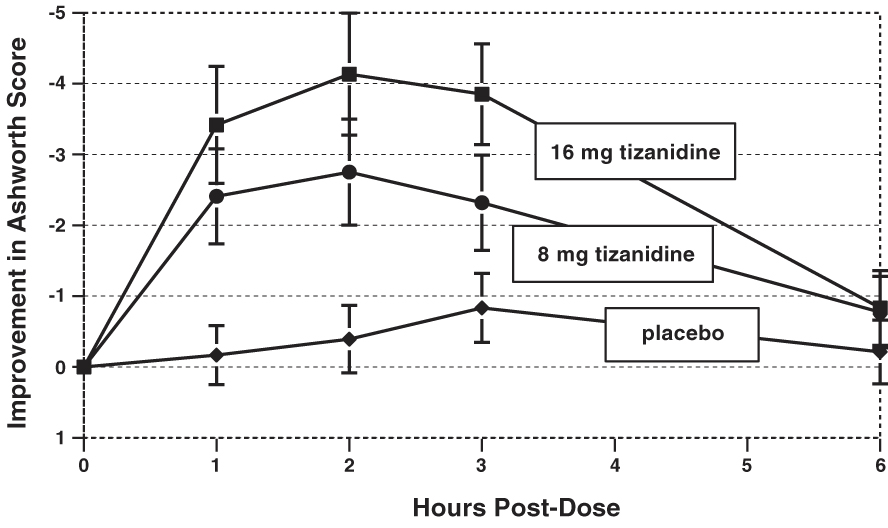
The effect appears to be dose related. In a single dose study, 92% of the patients receiving 16 mg, when asked, reported that they were drowsy during the 6 hour study. This compares to 76% of the patients on 8 mg and 35% of the patients on placebo. Patients began noting this effect 30 minutes following dosing. The effect peaked 1.5 hours following dosing. Of the patients who received a single dose of 16 mg, 51% continued to report drowsiness 6 hours following dosing compared to 13% in the patients receiving placebo or 8 mg of tizanidine.
In the multiple dose studies, the prevalence of patients with sedation peaked following the first week of titration and then remained stable for the duration of the maintenance phase of the study.
Hallucinosis/Psychotic-like Symptoms
Tizanidine use has been associated with hallucinations. Formed, visual hallucinations or delusions have been reported in 5 of 170 patients (3%) in two North American controlled clinical studies. These 5 cases occurred within the first 6 weeks. Most of the patients were aware that the events were unreal. One patient developed psychoses in association with the hallucinations. One patient among these 5 continued to have problems for at least 2 weeks following discontinuation of tizanidine.
Cardiovascular
Prolongation of the QT interval and bradycardia were noted in chronic toxicity studies in dogs at doses equal to the maximum human dose on a mg/m2 basis. ECG evaluation was not performed in the controlled clinical studies. Reduction in pulse rate has been noted in association with decreases in blood pressure in the single dose controlled study (see WARNINGS).
Ophthalmic
Dose-related retinal degeneration and corneal opacities have been found in animal studies at doses equivalent to approximately the maximum recommended dose on a mg/m2 basis. There have been no reports of corneal opacities or retinal degeneration in the clinical studies.
Use in Renally Impaired Patients
Tizanidine should be used with caution in patients with renal insufficiency (creatinine clearance < 25 mL/min), as clearance is reduced by more than 50%. In these patients, during titration, the individual doses should be reduced. If higher doses are required, individual doses rather than dosing frequency should be increased. These patients should be monitored closely for the onset or increase in severity of the common adverse events (dry mouth, somnolence, asthenia and dizziness) as indicators of potential overdose.
Use in Women Taking Oral Contraceptives
Tizanidine should be used with caution in women taking oral contraceptives, as clearance of tizanidine is reduced by approximately 50% in such patients. In these patients, during titration, the individual doses should be reduced.
Acetaminophen
Tizanidine delayed the Tmax of acetaminophen by 16 minutes. Acetaminophen did not affect the pharmacokinetics of tizanidine.
Alcohol
Alcohol increased the AUC of tizanidine by approximately 20% while also increasing its Cmax by approximately 15%. This was associated with an increase in side effects of tizanidine. The CNS depressant effects of tizanidine and alcohol are additive.
Oral Contraceptives
No specific pharmacokinetic study was conducted to investigate interaction between oral contraceptives and tizanidine, but retrospective analysis of population pharmacokinetic data following single and multiple dose administration of 4 mg tizanidine showed that women concurrently taking oral contraceptives had 50% lower clearance of tizanidine than women not on oral contraceptives.
Pregnancy Category C
Reproduction studies performed in rats at a dose of 3 mg/kg, equal to the maximum recommended human dose on a mg/m2 basis, and in rabbits at 30 mg/kg, 16 times the maximum recommended human dose on a mg/m basis, did not show evidence of teratogenicity. Tizanidine at doses that are equal to and up to 8 times the maximum recommended human dose on a mg/m2 basis increased gestation duration in rats. Prenatal and postnatal pup loss was increased and developmental retardation occurred. Post-implantation loss was increased in rabbits at doses of 1 mg/kg or greater, equal to or greater than 0.5 times the maximum recommended human dose on a mg/m2 basis. Tizanidine has not been studied in pregnant women. Tizanidine should be given to pregnant women only if clearly needed.
Common Adverse Events Leading to Discontinuation
Forty-five of 264 (17%) patients receiving tizanidine and 13 of 261 (5%) of patients receiving placebo in three multiple dose, placebo-controlled clinical studies discontinued treatment for adverse events. When patients withdrew from the study, they frequently had more than one reason for discontinuing. The adverse events most frequently leading to withdrawal of tizanidine treated patients in the controlled clinical studies were asthenia (weakness, fatigue and/or tiredness) (3%), somnolence (3%), dry mouth (3%), increased spasm or tone (2%) and dizziness (2%).
Most Frequent Adverse Clinical Events Seen in Association with the Use of Tizanidine
In multiple dose, placebo-controlled clinical studies involving 264 patients with spasticity, the most frequent adverse effects were dry mouth, somnolence/sedation, asthenia (weakness, fatigue and/or tiredness) and dizziness. Three-quarters of the patients rated the events as mild to moderate and one-quarter of the patients rated the events as being severe. These events appeared to be dose related.
Adverse Events Reported in Controlled Studies
The events cited reflect experience gained under closely monitored conditions of clinical studies in a highly selected patient population. In actual clinical practice or in other clinical studies, these frequency estimates may not apply, as the conditions of use, reporting behavior, and the kinds of patients treated may differ. Table 1 lists treatment emergent signs and symptoms that were reported in greater than 2% of patients in three multiple dose, placebo-controlled studies who received tizanidine where the frequency in the tizanidine group was at least as common as in the placebo group. These events are not necessarily related to tizanidine treatment. For comparison purposes, the corresponding frequency of the event (per 100 patients) among placebo treated patients is also provided.
Table 1: Multiple Dose, Placebo-Controlled Studies - Frequent (> 2%) Adverse Events Reported for Which Tizanidine Incidence is Greater Than Placebo
| Event | Placebo N=261 % | Tizanidine Tablet N=264 % |
|---|---|---|
| Dry Mouth | 10 | 49 |
| Somnolence | 10 | 48 |
| Asthenia (weakness, fatigue, and/or tiredness) | 16 | 41 |
| Dizziness | 4 | 16 |
| UTI | 7 | 10 |
| Infection | 5 | 6 |
| Constipation | 1 | 4 |
| Liver function tests abnormal | <1 | 3 |
| Vomiting | 0 | 3 |
| Speech disorder | 0 | 3 |
| Amblyopia (blurred vision) | <1 | 3 |
| Urinary frequency | 2 | 3 |
| Flu syndrome | 2 | 3 |
| SGPT/ALT increased | <1 | 3 |
| Dyskinesia | 0 | 3 |
| Nervousness | <1 | 3 |
| Pharyngitis | 1 | 3 |
| Rhinitis | 2 | 3 |
In the single dose, placebo-controlled study involving 142 patients with spasticity, the patients were specifically asked if they had experienced any of the four most common adverse events: dry mouth, somnolence (drowsiness), asthenia (weakness, fatigue and/or tiredness) and dizziness. In addition, hypotension and bradycardia were observed. The occurrence of these adverse events are summarized in Table 2. Other events were, in general, reported at a rate of 2% or less.
Table 2: Single Dose, Placebo-Controlled Study-Common Adverse Events Reported
| Event | Placebo N = 48 % | Tizanidine Tablet 8 mg, N = 45 % | Tizanidine Tablet 16 mg, N = 49 % |
|---|---|---|---|
| Somnolence | 31 | 78 | 92 |
| Dry mouth | 35 | 76 | 88 |
| Asthenia (weakness, fatigue and/or tiredness) | 40 | 67 | 78 |
| Dizziness | 4 | 22 | 45 |
| Hypotension | 0 | 16 | 33 |
| Bradycardia | 0 | 2 | 10 |
Other Adverse Events Observed During the Evaluation of Tizanidine
Tizanidine was administered to 1385 patients in additional clinical studies where adverse event information was available. The conditions and duration of exposure varied greatly, and included (in overlapping categories) double-blind and open-label studies, uncontrolled and controlled studies, inpatient and outpatient studies, and titration studies. Untoward events associated with this exposure were recorded by clinical investigators using terminology of their own choosing. Consequently, it is not possible to provide a meaningful estimate of the proportion of individuals experiencing adverse events without first grouping similar types of untoward events into a smaller number of standardized event categories.
In the tabulations that follow, reported adverse events were classified using a standard COSTART-based dictionary terminology. The frequencies presented, therefore, represent the proportion of the 1385 patients exposed to tizanidine who experienced an event of the type cited on at least one occasion while receiving tizanidine. All reported events are included except those already listed in Table 1. If the COSTART term for an event was so general as to be uninformative, it was replaced with a more informative term. It is important to emphasize that, although the events reported occurred during treatment with tizanidine, they were not necessarily caused by it.
Events are further categorized by body system and listed in order of decreasing frequency according to the following definitions: frequent adverse events are those occurring on one or more occasions in at least 1/100 patients (only those not already listed in the tabulated results from placebo-controlled studies appear in this listing); infrequent adverse events are those occurring in 1/100 to 1/1000 patients.
Body as a Whole
Frequent: Fever
Infrequent: Allergic reaction, moniliasis, malaise, abscess, neck pain, sepsis, cellulites, death, overdose
Rare: Carcinoma, congenital anomaly, suicide attempt
Cardiovascular System
Infrequent: Vasodilatation postural hypotension, syncope, migraine, arrhythmia
Rare: Angina pectoris, coronary artery disorder, heart failure, myocardial infarct, phlebitis, pulmonary embolus, ventricular extrasystoles, ventricular tachycardia
Digestive System
Frequent: Abdomen pain, diarrhea, dyspepsia
Infrequent: Dysphagia, cholelithiasis, fecal impaction, flatulence, gastrointestinal hemorrhage, hepatitis, melena
Rare: Gastroenteritis, hematemesis, hepatoma, intestinal obstruction, liver damage
Hemic and Lymphatic System
Infrequent: Ecchymosis, hypercholesteremia, anemia, hyperlipemia, leukopenia, leukocytosis, sepsis
Rare: Petechia, purpura, thrombocythemia, thrombocytopenia
Metabolic and Nutritional System
Infrequent: Edema, hypothyroidism, weight loss
Rare: Adrenal cortex insufficiency, hyperglycemia, hypokalemia, hyponatremia, hypoproteinemia, respiratory acidosis
Musculoskeletal System
Frequent: Myasthenia, back pain
Infrequent: Pathological fracture, arthralgia, arthritis, bursitis
Nervous System
Frequent: Depression, anxiety, paresthesia
Infrequent: Tremor, emotional lability, convulsion, paralysis, thinking abnormal, vertigo, abnormal dreams, agitation, depersonalization, euphoria, migraine, stupor, dysautonomia, neuralgia
Rare: Dementia, hemiplegia, neuropathy
Respiratory System
Infrequent: Sinusitis, pneumonia, bronchitis
Rare: Asthma
Skin and Appendages
Frequent: Rash, sweating, skin ulcer
Infrequent: Pruritus, dry skin, acne, alopecia, urticaria
Rare: Exfoliative dermatitis, herpes simplex, herpes zoster, skin carcinoma
Special Senses
Infrequent: Ear pain, tinnitus, deafness, glaucoma, conjunctivitis, eye pain, optic neuritis, otitis media, retinal hemorrhage, visual field defect
Rare: Iritis, keratitis, optic atrophy
Urogential System
Infrequent: Urinary urgency, cystitis, menorrhagia, pyelonephritis, urinary retention, kidney calculus, uterine fibroids enlarged, vaginal moniliasis, vaginitis
Rare: Albuminuria, glycosuria, hematuria, metrorrhagia