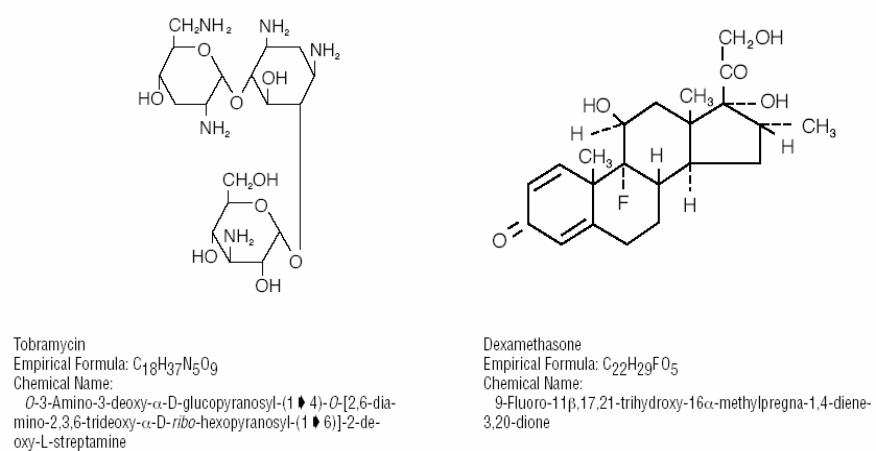
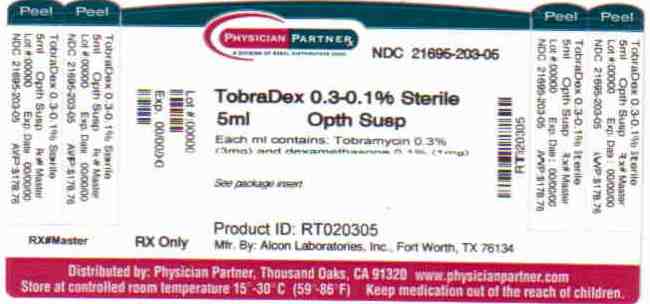
Corticoids suppress the inflammatory response to a variety of agents and they probably delay or slow healing. Since corticoids may inhibit the body’s defense mechanism against infection, a concomitant antimicrobial drug may be used when this inhibition is considered to be clinically significant. Dexamethasone is a potent corticoid.
The antibiotic component in the combination (tobramycin) is included to provide action against susceptible organisms. In vitro studies have demonstrated that tobramycin is active against susceptible strains of the following microorganisms:
Staphylococci, including S. aureusand S. epidermidis(coagulase-positive and coagulase-negative), including penicillin-resistant strains.
Streptococci, including some of the Group A-beta-hemolytic species, some nonhemolytic species, and some Streptococcus pneumoniae.
Pseudomonas aeruginosa, Escherichia coli, Klebsiella pneumoniae, Enterobacter aerogenes, Proteus mirabilis, Morganella morganii,most Proteus vulgarisstrains, Haemophilus influenzae and H. aegyptius, Moraxella lacunata, Acinetobacter calcoaceticus and some Neisseria species.
Bacterial susceptibility studies demonstrate that in some cases microorganisms resistant to gentamicin remain susceptible to tobramycin.
No data are available on the extent of systemic absorption from TOBRADEX Ophthalmic Suspension; however, it is known that some systemic absorption can occur with ocularly applied drugs. If the maximum dose of TOBRADEX Ophthalmic Suspension is given for the first 48 hours (two drops in each eye every 2 hours) and complete systemic absorption occurs, which is highly unlikely, the daily dose of dexamethasone would be 2.4 mg. The usual physiologic replacement dose is 0.75 mg daily. If TOBRADEX Ophthalmic Suspension is given after the first 48 hours as two drops in each eye every 4 hours, the administered dose of dexamethasone would be 1.2 mg daily.