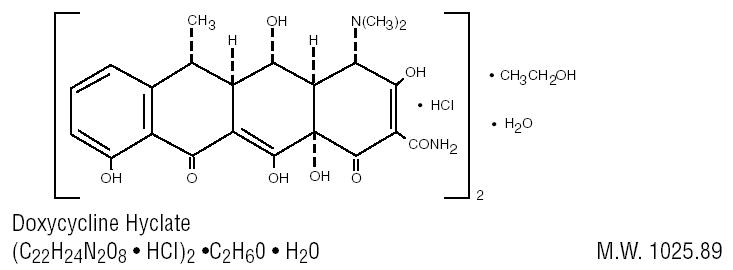
Other
Rev. 06/04
Rx Only
To reduce the development of drug-resistant bacteria and maintain the effectiveness of Doxycycline and other antibacterial drugs, Doxycycline should be used only to treat or prevent infections that are proven or strongly suspected to be caused by bacteria.
Susceptibility tests: Diffusion techniques: Quantitative methods that require measurement of zone diameters give the most precise estimate of the susceptibility of bacteria to antimicrobial agents. One such standard procedure1 has been recommended for use with disks to test susceptibility of organisms to doxycycline, uses the 30-mcg tetracycline-class disk or the 30-mcg doxycycline disk. Interpretation involves the correlation of the diameter obtained in the disk test with the minimum inhibitory concentration (MIC) for tetracycline or doxycycline, respectively. Reports from the laboratory giving results of the standard single-disk susceptibility test with a 30-mcg tetracycline-class disk the 30-mcg doxycycline disk should be interpreted according to the following criteria:
| Zone Diameter (mm) | Interpretation | ||
| tetracycline | doxycycline | ||
| ≥19 | ≥16 | Susceptible | |
| 15-18 | 13-15 | Intermediate | |
| ≤14 | ≤12 | Resistant | |
A report of "Susceptible" indicates that the pathogen is likely to be inhibited by generally achievable blood levels. A report of "Intermediate" suggests that the organism would be susceptible if a high dosage is used or if the infection is confined to tissues and fluids in which antimicrobial levels are attained. A report of "Resistant" indicates that achievable concentrations are unlikely to be inhibitory, and other therapy should be selected.
Standardized procedures require the use of laboratory control organisms. The 30-mcg tetracycline-class disk or the 30-mcg doxycycline disk should give the following zone diameters:
| Organism | Zone Diameter (mm) | |
| tetracycline | doxycycline | |
| E. coli ATCC 25922 | 18-25 | 18-24 |
| S. aureus ATCC 25923 | 19-28 | 23-29 |
Adults: The usual dose of oral doxycycline is 200 mg on the first day of treatment (administered 100 mg every 12 hours) followed by a maintenance dose of 100 mg/day. The maintenance dose may be administered as a single dose or as 50 mg every 12 hours.
In the management of more severe infections (particularly chronic infections of the urinary tract), 100 mg every 12 hours is recommended.
For children above eight years of age: The recommended dosage schedule for children weighing 100 pounds or less is 2 mg/lb of body weight divided into two doses on the first day of treatment, followed by 1 mg/lb of body weight given as a single daily dose or divided into two doses, on subsequent days. For more severe infections up to 2 mg/lb of body weight may be used. For children over 100 lb the usual adult dose should be used.
The therapeutic antibacterial serum activity will usually persist for 24 hours following recommended dosage.
When used in streptococcal infections, therapy should be continued for 10 days.
Administration of adequate amounts of fluid along with capsule and tablet forms of drugs in the tetracycline class is recommended to wash down the drugs and reduce the risk of esophageal irritation and ulceration. (See ADVERSE REACTIONS).
If gastric irritation occurs, it is recommended that doxycycline be given with food or milk. The absorption of doxycycline is not markedly influenced by simultaneous ingestion of food or milk.
Studies to date have indicated that administration of doxycycline at the usual recommended doses does not lead to excessive accumulation of the antibiotic in patients with renal impairment.
Uncomplicated gonococcal infections in adults (except anorectal infections in men): 100 mg, by mouth, twice a day for 7 days. As an alternate single visit dose, administer 300 mg stat followed in one hour by a second 300 mg dose. The dose may be administered with food, including milk or carbonated beverage, as required.
Uncomplicated urethral, endocervical, or rectal infection in adults caused by Chlamydia trachomatis:
100 mg, by mouth, twice a day for 7 days.
Nongonococcal urethritis (NGU) caused by C. trachomatis and U. urealyticum: 100 mg, by mouth, twice a day for 7 days.
Syphilis - early: Patients who are allergic to penicillin should be treated with doxycycline 100 mg by mouth twice a day for 2 weeks.
Syphilis of more than one year's duration: Patients who are allergic to penicillin should be treated with doxycycline 100 mg, by mouth, twice a day for 4 weeks.
Acute epididymo-orchitis caused by N. gonorrhoeae: 100 mg, by mouth, twice a day for at least 10 days.
Acute epididymo-orchitis caused by C. trachomatis: 100 mg, by mouth, twice a day for at least 10 days.
For the prophylaxis of malaria: For adults, the recommended dose is 100 mg daily. For children over 8 years of age, the recommended dose is 2 mg/kg given once daily up to the adult dose. Prophylaxis should begin 1 to 2 days before travel to the malarious area. Prophylaxis should be continued daily during travel in the malarious area and for 4 weeks after the traveler leaves the malarious area.
Inhalational anthrax (post-exposure):
ADULTS: 100 mg of doxycycline, by mouth, twice a day for 60 days.
CHILDREN: weighing less than 100 lb (45 kg); 1 mg/lb (2.2 mg/kg) of body weight, by mouth, twice a day for 60 days. Children weighing 100 lb or more should receive the adult dose.