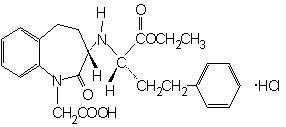
ACE inhibitors can cause fetal and neonatal morbidity and death when administered to pregnant women. Several dozen cases have been reported in the world literature. When pregnancy is detected, benazepril hydrochloride should be discontinued as soon as possible and monitoring of the fetal development should be performed on a regular basis.
The use of ACE inhibitors during the second and third trimesters of pregnancy has been associated with fetal and neonatal injury, including hypotension, neonatal skull hypoplasia, anuria, reversible or irreversible renal failure and death. Oligohydramnios has also been reported, presumably resulting from decreased fetal renal function; oligohydramnios in this setting has been associated with fetal limb contractures, craniofacial deformation and hypoplastic lung development. Prematurity, intrauterine growth retardation, and patent ductus arteriosus have also been reported, although it is not clear whether these occurrences were due to the ACE inhibitor exposure.
In addition, use of ACE inhibitors during the first trimester of pregnancy has been associated with a potentially increased risk of birth defects. In women planning to become pregnant, ACE inhibitors (including benazepril hydrochloride) should not be used. Women of child-bearing age should be made aware of the potential risk and ACE inhibitors (including benazepril hydrochloride) should only be given after careful counseling and consideration of individual risks and benefits.
Rarely (probably less often than once in every thousand pregnancies), no alternative to ACE inhibitors will be found. In these rare cases, the mothers should be apprised of the potential hazards to their fetuses, and serial ultrasound examinations should be performed to assess the intraamniotic environment.
If oligohydramnios is observed, benazepril should be discontinued unless it is considered life-saving for the mother. Contraction stress testing (CST), a nonstress test (NST), or biophysical profiling (BPP) may be appropriate, depending upon the week of pregnancy. Patients and physicians should be aware, however, that oligohydramnios may not appear until after the fetus has sustained irreversible injury.
Infants with histories of in utero exposure to ACE inhibitors should be closely observed for hypotension, oliguria and hyperkalemia. If oliguria occurs, attention should be directed toward support of blood pressure and renal perfusion. Exchange transfusion or dialysis may be required as means of reversing hypotension and/or substituting for disordered renal function. Benazepril, which crosses the placenta, can theoretically be removed from the neonatal circulation by these means; there are occasional reports of benefit from these maneuvers with another ACE inhibitor, but experience is limited.
No teratogenic effects of benazepril hydrochloride were seen in studies of pregnant rats, mice and rabbits. On a mg/m2 basis, the doses used in these studies were 60 times (in rats), 9 times (in mice) and more than 0.8 times (in rabbits) the maximum recommended human dose (assuming a 50 kg woman). On a mg/kg basis these multiples are 300 times (in rats), 90 times (in mice) and more than 3 times (in rabbits) the maximum recommended human dose.
See WARNINGS, Fetal/Neonatal Morbidity and Mortality.