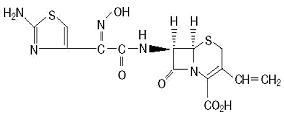
Cefdinir pharmacokinetics were investigated in 21 adult subjects with varying degrees of renal function. Decreases in cefdinir elimination rate, apparent oral clearance (CL/F), and renal clearance were approximately proportional to the reduction in creatinine clearance (CL
cr
). As a result, plasma cefdinir concentrations were higher and persisted longer in subjects with renal impairment than in those without renal impairment. In subjects with CL
cr
between 30 and 60 mL/min, C
max
and t
½
increased by approximately 2-fold and AUC by approximately 3-fold. In subjects with CL
cr
<30 mL/min, C
max
increased by approximately 2-fold, t
½
by approximately 5-fold, and AUC by approximately 6-fold. Dosage adjustment is recommended in patients with markedly compromised renal function (creatinine clearance <30 mL/min; see
DOSAGE AND ADMINISTRATION
).
For adult patients with creatinine clearance <30 mL/min, the dose of cefdinir should be 300 mg given once daily.
Creatinine clearance is difficult to measure in outpatients. However, the following formula may be used to estimate creatinine clearance (CL
cr
) in adult patients. For estimates to be valid, serum creatinine levels should reflect steady-state levels of renal function.
Males: CL
cr
=
(weight) (140 – age)
(72) (serum creatinine)
Females: CL
cr
= 0.85 x above value
where creatinine clearance is in mL/min, age is in years, weight is in kilograms, and serum creatinine is in mg/dL
(3)
.
The following formula may be used to estimate creatinine clearance in pediatric patients:
CL
cr
= K x
body length or height
serum creatinine
Where K=0.55 for pediatric patients older than 1 year
(4)
and 0.45 for infants (up to 1 year)
(5)
.
In the above equation, creatinine clearance is in mL/min/1.73 m
2
, body length or height is in centimeters, and serum creatinine is in mg/dL.
For pediatric patients with a creatinine clearance of <30 mL/min/1.73 m
2
, the dose of cefdinir should be 7 mg/kg (up to 300 mg) given once daily.