5.1 Myopathy/Rhabdomyolysis
Simvastatin, like other statins, occasionally causes myopathy manifested as muscle pain, tenderness or weakness with creatine kinase (CK) above ten times the upper limit of normal (ULN). Myopathy sometimes takes the form of rhabdomyolysis with or without acute renal failure secondary to myoglobinuria, and rare fatalities have occurred. The risk of myopathy is increased by high levels of statin activity in plasma. Predisposing factors for myopathy include advanced age (greater than or equal to 65 years), uncontrolled hypothyroidism, and renal impairment.
As with other statins, the risk of myopathy/rhabdomyolysis is dose related. In a clinical trial database in which 41,050 patients were treated with simvastatin with 24,747 (approximately 60%) treated for at least 4 years, the incidence of myopathy was approximately 0.02%, 0.08% and 0.53% at 20, 40 and 80 mg/day, respectively. In these trials, patients were carefully monitored and some interacting medicinal products were excluded.
All patients starting therapy with simvastatin, or whose dose of simvastatin is being increased, should be advised of the risk of myopathy and told to report promptly any unexplained muscle pain, tenderness or weakness. Simvastatin therapy should be discontinued immediately if myopathy is diagnosed or suspected. In most cases, muscle symptoms and CK increases resolved when treatment was promptly discontinued. Periodic CK determinations may be considered in patients starting therapy with simvastatin or whose dose is being increased, but there is no assurance that such monitoring will prevent myopathy.
Many of the patients who have developed rhabdomyolysis on therapy with simvastatin have had complicated medical histories, including renal insufficiency usually as a consequence of long-standing diabetes mellitus. Such patients merit closer monitoring. Therapy with simvastatin should be temporarily stopped a few days prior to elective major surgery and when any major medical or surgical condition supervenes.
Drug Interactions
The risk of myopathy and rhabdomyolysis is increased by high levels of statin activity in plasma. Simvastatin is metabolized by the cytochrome P450 isoform 3A4. Certain drugs which inhibit this metabolic pathway can raise the plasma levels of simvastatin and may increase the risk of myopathy. These include itraconazole, ketoconazole, and other antifungal azoles, the macrolide antibiotics erythromycin and clarithromycin, and the ketolide antibiotic telithromycin, HIV protease inhibitors, the antidepressant nefazodone, or large quantities of grapefruit juice (greater than 1 quart daily). The use of simvastatin concomitantly with these CYP3A4 inhibitors should be avoided. If treatment with itraconazole, ketoconazole, erythromycin, clarithromycin or telithromycin is unavoidable, therapy with simvastatin should be suspended during the course of treatment. [See Drug Interactions (7).]
The benefits of the combined use of simvastatin with the following drugs should be carefully weighed against the potential risks of combinations: gemfibrozil, other lipid-lowering drugs (other fibrates or greater than or equal to 1 g/day of niacin), cyclosporine, danazol, amiodarone, or verapamil.
Caution should be used when prescribing other fibrates or lipid-lowering doses (greater than or equal to 1 g/day) of niacin with simvastatin, as these agents can cause myopathy when given alone.
Prescribing recommendations for interacting agents are summarized in Table 1
[see also
Dosage and Administration (2.5)
,
Drug Interactions (7)
,
Clinical Pharmacology (12.3)
.
TABLE 1: Drug Interactions Associated with Increased Risk of Myopathy/RhabdomyolysisInteracting Agents
| Prescribing Recommendations
|
Itraconazole Ketoconazole Erythromycin Clarithromycin Telithromycin HIV protease inhibitors Nefazodone | Avoid simvastatin
|
Gemfibrozil* Cyclosporine† Danazol† | Do not exceed 10 mg simvastatin daily
|
Amiodarone‡ Verapamil‡ | Do not exceed 20 mg simvastatin daily
|
Grapefruit juice
| Avoid large quantities of grapefruit juice
(greater than 1 quart daily)
|
*
The combined use of simvastatin with gemfibrozil should be avoided, unless the benefits are likely to outweigh the increased risks of this drug combination.
† The benefits of the use of simvastatin in patients receiving cyclosporine or danazol should be carefully weighed against the risks of these combinations.
‡
The combined use of simvastatin at doses higher than 20 mg daily with amiodarone or verapamil should be avoided unless the clinical benefit is likely to outweigh the increased risk of myopathy.
5.2 Liver Dysfunction
Persistent increases (to more than 3X the ULN) in serum transaminases have occurred in approximately 1% of patients who received simvastatin in clinical studies. When drug treatment was interrupted or discontinued in these patients, the transaminase levels usually fell slowly to pretreatment levels. The increases were not associated with jaundice or other clinical signs or symptoms. There was no evidence of hypersensitivity.
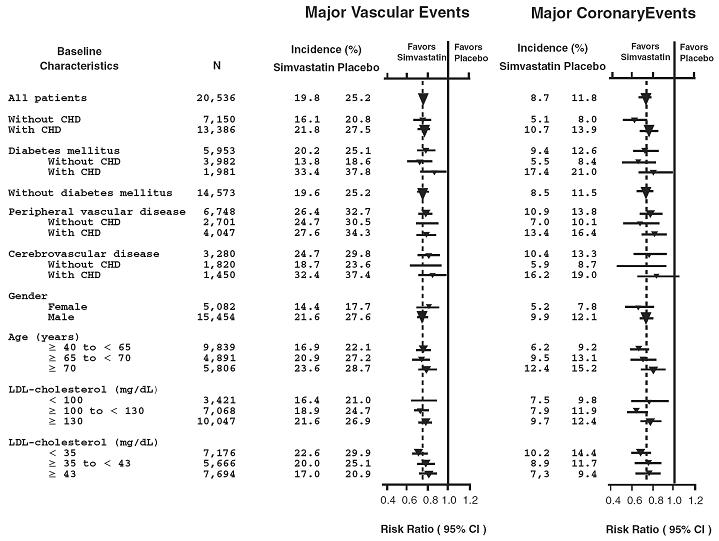
In the Scandinavian Simvastatin Survival Study (4S) [see Clinical Studies (14.1)], the number of patients with more than one transaminase elevation to greater than 3X ULN, over the course of the study, was not significantly different between the simvastatin and placebo groups (14 [0.7%] vs. 12 [0.6%]). Elevated transaminases resulted in the discontinuation of 8 patients from therapy in the simvastatin group (n=2,221) and 5 in the placebo group (n=2,223). Of the 1,986 simvastatin treated patients in 4S with normal liver function tests (LFTs) at baseline, 8 (0.4%) developed consecutive LFT elevations to greater than 3X ULN and/or were discontinued due to transaminase elevations during the 5.4 years (median follow-up) of the study. Among these 8 patients, 5 initially developed these abnormalities within the first year. All of the patients in this study received a starting dose of 20 mg of simvastatin; 37% were titrated to 40 mg.
In 2 controlled clinical studies in 1,105 patients, the 12-month incidence of persistent hepatic transaminase elevation without regard to drug relationship was 0.9% and 2.1% at the 40- and 80-mg dose, respectively. No patients developed persistent liver function abnormalities following the initial 6 months of treatment at a given dose.
It is recommended that liver function tests be performed before the initiation of treatment, and thereafter when clinically indicated. Patients titrated to the 80-mg dose should receive an additional test prior to titration, 3 months after titration to the 80-mg dose, and periodically thereafter (e.g., semiannually) for the first year of treatment. Patients who develop increased transaminase levels should be monitored with a second liver function evaluation to confirm the finding and be followed thereafter with frequent liver function tests until the abnormality(ies) return to normal. Should an increase in AST or ALT of 3X ULN or greater persist, withdrawal of therapy with simvastatin is recommended.
The drug should be used with caution in patients who consume substantial quantities of alcohol and/or have a past history of liver disease. Active liver diseases or unexplained transaminase elevations are contraindications to the use of simvastatin.
As with other lipid-lowering agents, moderate (less than 3X ULN) elevations of serum transaminases have been reported following therapy with simvastatin. These changes appeared soon after initiation of therapy with simvastatin, were often transient, were not accompanied by any symptoms and did not require interruption of treatment.