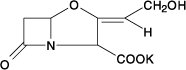
Amoxicillin and clavulanate potassium are well absorbed from the gastrointestinal tract after oral administration of amoxicillin and clavulanate potassium for oral suspension and chewable tablets. Dosing in the fasted or fed state has minimal effect on the pharmacokinetics of amoxicillin. While amoxicillin and clavulanate potassium for oral suspension and chewable tablets can be given without regard to meals, absorption of clavulanate potassium when taken with food is greater relative to the fasted state. In one study, the relative bioavailability of clavulanate was reduced when amoxicillin and clavulanate potassium for oral suspension and chewable tablets were dosed at 30 and 150 minutes after the start of a high fat breakfast. The safety and efficacy of amoxicillin and clavulanate potassium have been established in clinical trials where amoxicillin and clavulanate potassium for oral suspension and chewable tablets were taken without regard to meals.
Oral administration of single doses of 400 mg/57 mg amoxicillin and clavulanate potassium chewable tablets and 400 mg/57 mg per 5 mL suspension to 28 adult volunteers yielded comparable pharmacokinetic data:
| Dose Administered at the start of a light meal. | AUC0-∞ (mcg.hr./mL) | Cmax (mcg/mL) Mean values of 28 normal volunteers. Peak concentrations occurred approximately 1 hour after the dose. |
(amoxicillin and clavulanate potassium) | amoxicillin (± S.D.) | clavulanate potassium (± S.D.) | amoxicillin (± S.D.) | clavulanate potassium (± S.D.) |
400 mg/57 mg (5 mL of suspension) | 17.29 ± 2.28 | 2.34 ± 0.94 | 6.94 ± 1.24 | 1.10 ± 0.42 |
400 mg/57 mg (one chewable tablet) | 17.24 ± 2.64 | 2.17 ± 0.73 | 6.67 ± 1.37 | 1.03 ± 0.33 |
Oral administration of 5 mL of amoxicillin and clavulanate potassium 250 mg/62.5 mg suspension or the equivalent dose of 10 mL amoxicillin and clavulanate potassium 125 mg/31.25 mg suspension provides average peak serum concentrations approximately 1 hour after dosing of 6.9 mcg/mL for amoxicillin and 1.6 mcg/mL for clavulanic acid. The areas under the serum concentration curves obtained during the first 4 hours after dosing were 12.6 mcg.hr./mL for amoxicillin and 2.9 mcg.hr./mL for clavulanic acid when 5 mL of amoxicillin and clavulanate potassium 250 mg/62.5 mg suspension or equivalent dose of 10 mL of amoxicillin and clavulanate potassium 125 mg/31.25 mg suspension was administered to adult volunteers. One amoxicillin and clavulanate potassium 250 mg/62.5 mg chewable tablet or 2 amoxicillin and clavulanate potassium 125 mg/31.25 mg chewable tablets are equivalent to 5 mL of amoxicillin and clavulanate potassium 250 mg/62.5 mg suspension and provide similar serum levels of amoxicillin and clavulanic acid.
Amoxicillin serum concentrations achieved with amoxicillin and clavulanate potassium for oral suspension and chewable tablets are similar to those produced by the oral administration of equivalent doses of amoxicillin alone. The half-life of amoxicillin after the oral administration of amoxicillin and clavulanate potassium for oral suspension and chewable tablets is 1.3 hours and that of clavulanic acid is 1.0 hour. Time above the minimum inhibitory concentration of 1.0 mcg/mL for amoxicillin has been shown to be similar after corresponding q12h and q8h dosing regimens of amoxicillin and clavulanate potassium for oral suspension and chewable tablets in adults and children.
Approximately 50% to 70% of the amoxicillin and approximately 25% to 40% of the clavulanic acid are excreted unchanged in urine during the first 6 hours after administration of 10 mL of amoxicillin and clavulanate potassium 250 mg/62.5 mg suspension.
Concurrent administration of probenecid delays amoxicillin excretion but does not delay renal excretion of clavulanic acid.
Neither component in amoxicillin and clavulanate potassium for oral suspension and chewable tablets is highly protein-bound; clavulanic acid has been found to be approximately 25% bound to human serum and amoxicillin approximately 18% bound.
Amoxicillin diffuses readily into most body tissues and fluids with the exception of the brain and spinal fluid. The results of experiments involving the administration of clavulanic acid to animals suggest that this compound, like amoxicillin, is well distributed in body tissues.
Two hours after oral administration of a single 35 mg/kg dose of amoxicillin and clavulanate potassium suspension to fasting children, average concentrations of 3 mcg/mL of amoxicillin and 0.5 mcg/mL of clavulanic acid were detected in middle ear effusions.