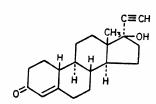
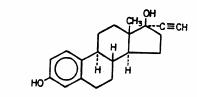
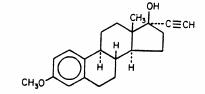
Other
Patients should be counseled that this product does not protect against HIV infection (AIDS) and other sexually transmitted diseases.
The use of oral contraceptives is associated with increased risks of several serious conditions including myocardial infarction, thromboembolism, stroke, hepatic neoplasia and gallbladder disease, although the risk of serious morbidity and mortality is very small in healthy women without underlying risk factors. The risk of morbidity and mortality increases significantly in the presence of other underlying risk factors such as hypertension, hyperlipidemias, obesity, and diabetes.
Practitioners prescribing oral contraceptives should be familiar with the following information relating to these risks.
The information contained in this package insert is principally based on studies carried out in patients who used oral contraceptives with higher formulations of estrogens and progestogens than those in common use today. The effect of long-term use of the oral contraceptives with lower formulations of both estrogens and progestogens remains to be determined.
Throughout this labeling, epidemiological studies reported are of two types: retrospective or case control studies and prospective or cohort studies. Case control studies provide a measure of the relative risk of a disease, namely, a ratio of the incidence of a disease among oral contraceptive users to that among nonusers. The relative risk does not provide information on the actual clinical occurrence of a disease. Cohort studies provide a measure of attributable risk, which is the difference in the incidence of disease between oral contraceptive users and nonusers. The attributable risk does provide information about the actual occurrence of a disease in the population (adapted from refs. 2 and 3 with the author’s permission). For further information, the reader is referred to a text on epidemiological methods.
Oral contraceptives may compound the effects of well-known risk factors, such as hypertension, diabetes, hyperlipidemias, age and obesity (13). In particular, some progestogens are known to decrease HDL cholesterol and cause glucose intolerance, while estrogens may create a state of hyperinsulinism (14-18). Oral contraceptives have been shown to increase blood pressure among users (see section 9 in WARNINGS). Similar effects on risk factors have been associated with an increased risk of heart disease. Oral contraceptives must be used with caution in women with cardiovascular disease risk factors.
Most side effects of the pill are not serious. The most common such effects are nausea, vomiting, bleeding between menstrual periods, weight gain, breast tenderness, and difficulty wearing contact lenses. These side effects, especially nausea and vomiting, may subside within the first three months of use.
The serious side effects of the pill occur very infrequently, especially if you are in good health and are young. However, you should know that the following medical conditions have been associated with or made worse by the pill:
Before you start taking your pills.
Anytime you are not sure what to do.
If you miss pills you could get pregnant. This includes starting the dispenser late. The more pills you miss, the more likely you are to get pregnant.
On the days you take 2 pills to make up for missed pills, you could also feel a little sick to your stomach.
The 28-pill dispenser has 21 “active” pills (with hormones) to take for 3 weeks. This is followed by 1 week of reminder white pills (without hormones). To remove a pill press down on it with the flat of your finger. The pill will drop through a hole in the bottom of the dispenser.
Necon® 1/35: There are 21 dark yellow “active” pills.
1) where on the dispenser to start taking pills,
2) in what order to take the pills
CHECK ADDITIONAL INSTRUCTIONS FOR USING THIS DISPENSER IN THE BRIEF SUMMARY PATIENT PACKAGE INSERT.
AN EXTRA, FULL PILL DISPENSER.
Do not skip pills even if you are spotting or bleeding between monthly periods or feel sick to your stomach (nausea).
Do not skip pills even if you do not have sex very often.
Start the next dispenser on the day after your last “reminder” pill. Do not wait any days between dispensers.
Keep taking 1 pill every day until Sunday. On Sunday, THROW OUT the rest of the dispenser and start a new dispenser of pills that same day.
If you are a Day 1 Starter:
THROW OUT the rest of the pill dispenser and start a new dispenser that same day.
Keep taking 1 pill every day until Sunday. On Sunday, THROW OUT the rest of the dispenser and start a new dispenser of pills that same day.
If you are a Day 1 Starter:
THROW OUT the rest of the pill dispenser and start a new dispenser of pills that same day.
The symptoms associated with these serious side effects are discussed in the detailed leaflet given to you with your supply of pills. Notify your doctor or health care provider if you notice any unusual physical disturbances while taking the pill. In addition, drugs such as rifampin, as well as some anti-convulsants and some antibiotics may decrease oral contraceptive effectiveness. There is conflict among studies regarding breast cancer and oral contraceptive use. Some studies have reported an increase in the risk of developing breast cancer, particularly at a younger age. This increased risk appears to be related to duration of use. The majority of studies have found no overall increase in the risk of developing breast cancer. Some studies have found an increase in the incidence of cancer of the cervix in women who use oral contraceptives. However, this finding may be related to factors other than the use of oral contraceptives. There is insufficient evidence to rule out the possibility pills may cause such cancers.
Taking the combination pill provides some important non-contraceptive benefits. These include less painful menstruation, less menstrual blood loss and anemia, fewer pelvic infections, and fewer cancers of the ovary and the lining of the uterus.
Be sure to discuss any medical condition you may have with your health care provider. Your health care provider will take a medical and family history before prescribing oral contraceptives and will examine you. The physical examination may be delayed to another time if you request it and the health care provider believes that it is a good medical practice to postpone it. You should be reexamined at least once a year while taking oral contraceptives. Your pharmacist should have given you the detailed patient information labeling which gives you further information which you should read and discuss with your health care provider.
This product (like all oral contraceptives) is intended to prevent pregnancy. It does not protect against transmission of HIV (AIDS) and other sexually transmitted diseases such as chlamydia, genital herpes, genital warts, gonorrhea, hepatitis B, and syphilis.
Some women should not use the pill. For example, you should not take the pill if you are pregnant or think you may be pregnant. You should also not use the pill if you have any of the following conditions:
Tell your health care provider if you have ever had any of these conditions. Your health care provider can recommend a safer method of birth control.
BEFORE YOU START TAKING THE PILLS:
You have a choice of which day to start taking your first dispenser of pills. Decide with your doctor or clinic which is the best day for you. Pick a time of day which will be easy to remember.
SUNDAY START:
| Necon® 1/35: | Take the first “active” dark yellow pill of the first dispenser on the Sunday after your period starts, even if you are still bleeding. If your period begins on Sunday, start the dispenser the same day. |
Use another method of birth control as back-up method if you have sex anytime from the Sunday you start your first dispenser until the next Sunday (7 days). Condoms, foam, or the sponge are good back-up methods of birth control.
DAY 1 START:
| Necon® 1/35: | Take the first “active” dark yellow pill of the first dispenser during the first 24 hours of your period. |
You will not need to use a back-up method of birth control, since you are starting the pill at the beginning of your period.
Necon® 1/35:
If you MISS 1 dark yellow “active” pill:
If you MISS 2 dark yellow “active” pills in a row in WEEK 1 or WEEK 2 of your dispenser:
If you MISS 2 dark yellow “active” pills in a row in THE 3RD WEEK:
If you MISS 3 OR MORE dark yellow “active” pills in a row (during the first 3 weeks):
If you forget any of the 7 white “reminder” pills in Week 4:
THROW AWAY the pills you missed.
Keep taking 1 pill each day until the dispenser is empty.
You do not need a back-up method.
Use a BACK-UP METHOD anytime you have sex. KEEP TAKING ONE “ACTIVE” PILL EACH DAY until you can reach your doctor or clinic.