Other
Equivalent to 375mg, 500mg and 750mg naproxen
NAPRELAN® Controlled-Release Tablets, 375mg, 500mg and 750mg
Absorption
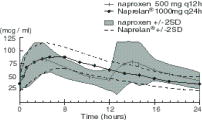
Naproxen itself is rapidly and completely absorbed from the GI tract with an in vivo bioavailability of 95%. Based on the pharmacokinetic profile, the absorption phase of NAPRELAN® Tablets occurs in the first 4-6 hours after administration. This coincides with disintegration of the tablet in the stomach, the transit of the sustained release microparticles through the small intestine and into the proximal large intestine. An in vivo imaging study has been performed in healthy volunteers that confirms rapid disintegration of the tablet matrix and dispersion of the microparticles.
The absorption rate from the sustained release particulate component of NAPRELAN® Tablets is slower than that for conventional naproxen sodium tablets. It is this prolongation of drug absorption processes that maintains plasma levels and allows for once daily dosing.
Food Effects
No significant food effects were observed when twenty-four subjects were given a single dose of NAPRELAN® Tablets 500 mg either after an overnight fast or 30 minutes after a meal. In common with conventional naproxen and naproxen sodium formulations, food causes a slight decrease in the rate of naproxen absorption following NAPRELAN® Tablets administration.
Distribution
Naproxen has a volume of distribution of 0.16 L/kg. At therapeutic levels, naproxen is greater than 99% albumin-bound. At doses of naproxen greater than 500 mg/day, there is a less than proportional increase in plasma levels due to an increase in clearance caused by saturation of plasma protein binding at higher doses. However the concentration of unbound naproxen continues to increase proportionally to dose. NAPRELAN® Tablets exhibit similar dose proportional characteristics.
Metabolism
Naproxen is extensively metabolized to 6-0-desmethyl naproxen and both parent and metabolites do not induce metabolizing enzymes.
Elimination
The elimination half-life of NAPRELAN® Tablets and conventional naproxen is approximately 15 hours. Steady state conditions are attained after 2-3 doses of NAPRELAN® Tablets. Most of the drug is excreted in the urine, primarily as unchanged naproxen (less than 1%), 6-0-desmethyl naproxen (less than 1%) and their glucuronide or other conjugates (66-92%). A small amount (<5%) of the drug is excreted in the feces. The rate of excretion has been found to coincide closely with the rate of clearance from the plasma. In patients with renal failure, metabolites may accumulate.
Special Populations
Pediatric Use
No pediatric studies have been performed with NAPRELAN® Tablets, thus safety of NAPRELAN® Tablets in pediatric populations has not been established.
Renal Insufficiency
Naproxen pharmacokinetics have not been determined in subjects with renal insufficiency. Given that naproxen is metabolized and conjugates are primarily excreted by the kidneys, the potential exists for naproxen metabolites to accumulate in the presence of renal insufficiency. Elimination of naproxen is decreased in patients with severe renal impairment. Naproxen-containing products are not recommended for use in patients with moderate to severe and severe renal impairment (creatinine clearance <30mL/min)(see WARNINGS – Renal Effects).