Other
Rx only
Prescribing Information
Absorption
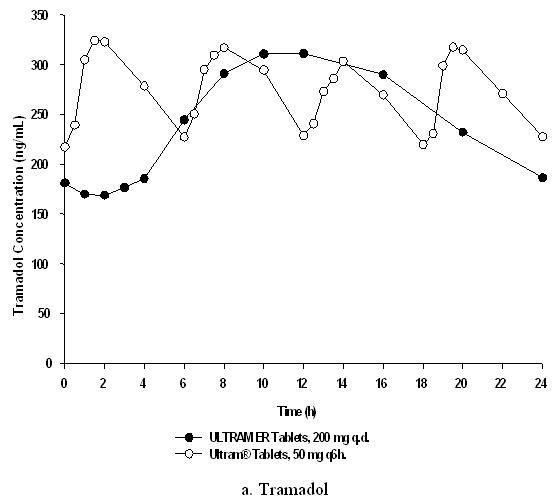
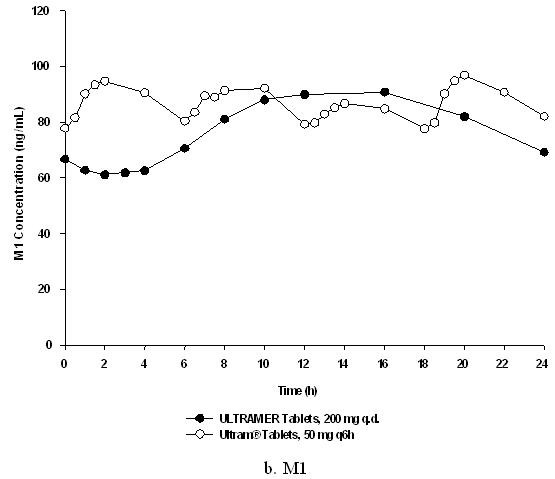
In healthy subjects, the bioavailability of a ULTRAM ER 200 mg tablet relative to a 50 mg every six hours dosing regimen of the immediate-release dosage form (ULTRAM) was approximately 85-90%. Consistent with the extended-release nature of the formulation, there is a lag time in drug absorption following ULTRAM ER administration. The mean peak plasma concentrations of tramadol and M1 after administration of ULTRAM ER tablets to healthy volunteers are attained at about 12 h and 15 h, respectively, after dosing (see Table 1 and Figure 2). Following administration of the ULTRAM ER, steady-state plasma concentrations of both tramadol and M1 are achieved within four days with once daily dosing.
The mean (%CV) pharmacokinetic parameter values for ULTRAM ER 200 mg administered once daily and tramadol HCl immediate-release (ULTRAM) 50 mg administered every six hours are provided in Table 1.
| Mean (%CV) Steady-State Pharmacokinetic Parameter Values (n=32) | ||||
| Tramadol | M1 Metabolite | |||
| Pharma- cokinetic Parameter | ULTRAM ER 200-mg Tablet Once-Daily | ULTRAM 50-mg Tablet Every 6 Hours | ULTRAM ER 200-mg Tablet Once-Daily | ULTRAM 50-mg Tablet Every 6 Hours |
| AUC0-24: Area Under the Curve in a 24-hour dosing interval; Cmax: Peak Concentration in a 24-hour dosing interval; | ||||
| Cmin: Trough Concentration in a 24-hour dosing interval; Tmax: Time to Peak Concentration | ||||
| AUC0-24 (ng∙h/mL) | 5975 (34) | 6613 (27) | 1890 (25) | 2095 (26) |
| Cmax (ng/mL) | 335 (35) | 383 (21) | 95 (24) | 104 (24) |
| Cmin (ng/mL) | 187 (37) | 228 (32) | 69 (30) | 82 (27) |
| Tmax (h) | 12 (27) | 1.5 (42) | 15 (27) | 1.9 (57) |
| % Fluctuation | 61 (57) | 59 (35) | 34 (72) | 26 (47) |
Figure 2: Mean Steady-State Tramadol (a) and M1 (b) Plasma Concentrations on Day 8 Post Dose after Administration of 200 mg ULTRAM ER Once-Daily and 50 mg ULTRAM Every 6 Hours.
Graph #1 (2fd193e2 7aa7 4119 B540 7e28e82fbd13 02)
Graph #2 (2fd193e2 7aa7 4119 B540 7e28e82fbd13 03)
Food Effects
After a single dose administration of 200 mg ULTRAM ER tablet with a high fat meal, the Cmax and AUC0-∞ of tramadol decreased 28% and 16%, respectively, compared to fasting conditions. Mean Tmax was increased by 3 hr (from 14 hr under fasting conditions to 17 hr under fed conditions). While ULTRAM ER may be taken without regard to food, it is recommended that it be taken in a consistent manner.
Distribution
The volume of distribution of tramadol was 2.6 and 2.9 liters/kg in male and female subjects, respectively, following a 100-mg intravenous dose. The binding of tramadol to human plasma proteins is approximately 20% and binding also appears to be independent of concentration up to 10 µg/mL. Saturation of plasma protein binding occurs only at concentrations outside the clinically relevant range.
Metabolism
Tramadol is extensively metabolized after oral administration. The major metabolic pathways appear to be N – (mediated by CYP3A4 and CYP2B6) and O – (mediated by CYP2D6) demethylation and glucuronidation or sulfation in the liver. One metabolite (O-desmethyl tramadol, denoted M1) is pharmacologically active in animal models. Formation of M1 is dependent on CYP2D6 and as such is subject to inhibition, which may affect the therapeutic response (see PRECAUTIONS, Drug Interactions).
Elimination
Tramadol is eliminated primarily through metabolism by the liver and the metabolites are eliminated primarily by the kidneys. Approximately 30% of the dose is excreted in the urine as unchanged drug, whereas 60% of the dose is excreted as metabolites. The remainder is excreted either as unidentified or as unextractable metabolites. The mean terminal plasma elimination half-lives of racemic tramadol and racemic M1 after administration of ULTRAM ER are approximately 7.9 and 8.8 hours, respectively.
Renal
Impaired renal function results in a decreased rate and extent of excretion of tramadol and its active metabolite, M1. The pharmacokinetics of tramadol were studied in patients with mild or moderate renal impairment after receiving multiple doses of ULTRAM ER 100 mg. There is no consistent trend observed for tramadol exposure related to renal function in patients with mild (CLcr: 50-80 mL/min) or moderate (CLcr: 30-50 mL/min) renal impairment in comparison to patients with normal renal function. However, exposure of M1 increased 20-40% with increased severity of the renal impairment (from normal to mild and moderate). ULTRAM ER has not been studied in patients with severe renal impairment (CLcr < 30 mL/min). The limited availability of dose strengths of ULTRAM ER does not permit the dosing flexibility required for safe use in patients with severe renal impairment. Therefore, ULTRAM ER should not be used in patients with severe renal impairment (see PRECAUTIONS, Use in Renal and Hepatic Disease and DOSAGE AND ADMINISTRATION). The total amount of tramadol and M1 removed during a 4-hour dialysis period is less than 7% of the administered dose.
Hepatic
Pharmacokinetics of tramadol was studied in patients with mild or moderate hepatic impairment after receiving multiple doses of ULTRAM ER 100 mg. The exposure of (+)- and (-)-tramadol was similar in mild and moderate hepatic impairment patients in comparison to patients with normal hepatic function. However, exposure of (+)- and (-)-M1 decreased ~50% with increased severity of the hepatic impairment (from normal to mild and moderate). The pharmacokinetics of tramadol after the administration of ULTRAM ER has not been studied in patients with severe hepatic impairment. After the administration of tramadol immediate-release tablets to patients with advanced cirrhosis of the liver, tramadol area under the plasma concentration time curve was larger and the tramadol and M1 half-lives were longer than subjects with normal hepatic function. The limited availability of dose strengths of ULTRAM ER does not permit the dosing flexibility required for safe use in patients with severe hepatic impairment. Therefore, ULTRAM ER should not be used in patients with severe hepatic impairment (see PRECAUTIONS, Use in Renal and Hepatic Disease and DOSAGE AND ADMINISTRATION).
Geriatric
The effect of age on the absorption of tramadol from ULTRAM ER in patients over the age of 65 years has not been studied and is unknown (see PRECAUTIONS and DOSAGE AND ADMINISTRATION).
Gender
Based on pooled multiple-dose pharmacokinetics studies for ULTRAM ER in 166 healthy subjects (111 males and 55 females), the dose-normalized AUC values for tramadol were somewhat higher in females than in males. There was a considerable degree of overlap in values between male and female groups. Dosage adjustment based on gender is not recommended.
Quinidine
Tramadol is metabolized to M1 by CYP2D6. A study was conducted to examine the effect of quinidine, a selective inhibitor of CYP2D6, on the pharmacokinetics of tramadol by administering 200 mg quinidine two hours before the administration of ULTRAM ER 100 mg. The results demonstrated that the exposure of tramadol increased 50-60% and the exposure of M1 decreased 50-60% (see PRECAUTIONS, Drug Interactions). In vitro drug interaction studies in human liver microsomes indicate that tramadol has no effect on quinidine metabolism.
Carbamazepine
Carbamazepine, a CYP3A4 inducer, increases tramadol metabolism. Patients taking carbamazepine may have a significantly reduced analgesic effect of tramadol. Because of the seizure risk associated with tramadol, concomitant administration of ULTRAM ER and carbamazepine is not recommended (see PRECAUTIONS, Drug Interactions).
Cimetidine
Concomitant administration of tramadol immediate-release tablets with cimetidine does not result in clinically significant changes in tramadol pharmacokinetics. No alteration of the ULTRAM ER dosage regimen with cimetidine is recommended.
Increased Intracranial Pressure or Head Trauma
ULTRAM ER should be used with caution in patients with increased intracranial pressure or head injury. The respiratory depressant effects of opioids include carbon dioxide retention and secondary elevation of cerebrospinal fluid pressure, and may be markedly exaggerated in these patients. Additionally, pupillary changes (miosis) from tramadol may obscure the existence, extent, or course of intracranial pathology. Clinicians should also maintain a high index of suspicion for adverse drug reaction when evaluating altered mental status in these patients if they are receiving ULTRAM ER. (see WARNINGS, Respiratory Depression.)
Use in Ambulatory Patients
ULTRAM ER may impair the mental and or physical abilities required for the performance of potentially hazardous tasks such as driving a car or operating machinery. The patient using this drug should be cautioned accordingly.
Use With MAO Inhibitors and Serotonin Re-uptake Inhibitors
Use ULTRAM ER with great caution in patients taking monoamine oxidase inhibitors. Animal studies have shown increased deaths with combined administration. Concomitant use of ULTRAM ER with MAO inhibitors or SSRIs increases the risk of adverse events, including seizure and serotonin syndrome.
Misuse, Abuse and Diversion of Opioids
Tramadol is an opioid agonist of the morphine-type. Such drugs are sought by drug abusers and people with addiction disorders and are subject to criminal diversion.
Tramadol can be abused in a manner similar to other opioid agonists, legal or illicit. This should be considered when prescribing or dispensing ULTRAM ER in situations where the physician or pharmacist is concerned about an increased risk of misuse, abuse, or diversion.
ULTRAM ER could be abused by crushing, chewing, snorting, or injecting the dissolved product. These practices will result in the uncontrolled delivery of the opioid and pose a significant risk to the abuser that could result in overdose and death (see WARNINGS and DRUG ABUSE AND ADDICTION).
Concerns about abuse, addiction, and diversion should not prevent the proper management of pain. The development of addiction to opioid analgesics in properly managed patients with pain has been reported to be rare. However, data are not available to establish the true incidence of addiction in chronic pain patients.
Healthcare professionals should contact their State Professional Licensing Board or State Controlled Substances Authority for information on how to prevent and detect abuse or diversion of this product.
Interactions with Alcohol and Drugs of Abuse
Tramadol may be expected to have additive effects when used in conjunction with alcohol, other opioids, or illicit drugs that cause central nervous system depression.
Risk of Overdosage
Serious potential consequences of overdosage with ULTRAM ER are central nervous system depression, respiratory depression and death. In treating an overdose, primary attention should be given to maintaining adequate ventilation along with general supportive treatment (see OVERDOSAGE).
Use in Drug and Alcohol Addiction
ULTRAM ER is an opioid with no approved use in the management of addictive disorders. Its proper usage in individuals with drug or alcohol dependence, either active or in remission, is for the management of pain requiring opioid analgesia.
CYP2D6 and CYP3A4 inhibitors: Concomitant administration of CYP2D6 and/or CYP3A4 inhibitors (see CLINICAL PHARMACOLOGY, Pharmacokinetics), such as quinidine, fluoxetine, paroxetine and amitriptyline (CYP2D6 inhibitors), and ketoconazole and erythromycin (CYP3A4 inhibitors), may reduce metabolic clearance of tramadol increasing the risk for serious adverse events including seizures and serotonin syndrome.
Serotonergic Drugs: There have been postmarketing reports of serotonin syndrome with use of tramadol and SSRIs/SNRIs or MAOIs and α2-adrenergic blockers. Caution is advised when ULTRAM ER is coadministered with other drugs that may affect the serotonergic neurotransmitter systems, such as SSRIs, MAOIs, triptans, linezolid (an antibiotic which is a reversible non-selective MAOI), lithium, or St. John's Wort. If concomitant treatment of ULTRAM ER with a drug affecting the serotonergic neurotransmitter system is clinically warranted, careful observation of the patient is advised, particularly during treatment initiation and dose increases (see Warnings, Serotonin Syndrome Risk).
Triptans: Based on the mechanism of action of tramadol and the potential for serotonin syndrome, caution is advised when ULTRAM ER is coadministered with a triptan. If concomitant treatment of ULTRAM ER with a triptan is clinically warranted, careful observation of the patient is advised, particularly during treatment initiation and dose increases (see WARNINGS, Serotonin Syndrome Risk).
Use With Carbamazepine
Patients taking carbamazepine, a CYP3A4 inducer, may have a significantly reduced analgesic effect of tramadol. Because carbamazepine increases tramadol metabolism and because of the seizure risk associated with tramadol, concomitant administration of ULTRAM ER and carbamazepine is not recommended.
Use With Quinidine
Coadministration of quinidine with ULTRAM ER resulted in a 50-60% increase in tramadol exposure and a 50-60% decrease in M1 exposure (see CLINICAL PHARMACOLOGY, Drug Interactions). The clinical consequences of these findings are unknown.
Use With Digoxin and Warfarin
Post-marketing surveillance of tramadol has revealed rare reports of digoxin toxicity and alteration of warfarin effect, including elevation of prothrombin times.
Potential for Other Drugs to Affect Tramadol
In vitro drug interaction studies in human liver microsomes indicate that concomitant administration with inhibitors of CYP2D6 such as fluoxetine, paroxetine, and amitriptyline could result in some inhibition of the metabolism of tramadol.
Administration of CYP3A4 inhibitors, such as ketoconazole and erythromycin, or inducers, such as rifampin and St. John's Wort, with ULTRAM ER may affect the metabolism of tramadol leading to altered tramadol exposure.
Potential for Tramadol to Affect Other Drugs
In vitro drug interaction studies in human liver microsomes indicate that tramadol has no effect on quinidine metabolism. In vitro studies indicate that tramadol is unlikely to inhibit the CYP3A4-mediated metabolism of other drugs when administered concomitantly at therapeutic doses. Tramadol is a mild inducer of selected drug metabolism pathways measured in animals.
Adverse events with incidence rates of 1.0% to <5.0%
Eye disorders: vision blurred
Gastrointestinal disorders: abdominal pain upper, dyspepsia, abdominal pain, sore throat
General disorders: weakness, pain, feeling hot, influenza like illness, fall, rigors, lethargy, pyrexia, chest pain
Infections and infestations: nasopharyngitis, upper respiratory tract infection, sinusitis, influenza, gastroenteritis viral, urinary tract infection, bronchitis
Investigations: blood creatine phosphokinase increased, weight decreased
Metabolism and nutrition disorders: appetite decreased
Musculoskeletal, connective tissue and bone disorders: arthralgia, back pain, pain in limb, neck pain
Nervous system disorders: tremor, paresthesia, hypoesthesia
Psychiatric disorders: nervousness, anxiety, depression, restlessness
Respiratory, thoracic and mediastinal disorders: sneezing, cough, rhinorrhea, nasal congestion, dyspnea, sinus congestion
Skin and subcutaneous tissue disorders: sweating increased, dermatitis
Vascular disorders: hot flushes, vasodilatation
Adverse events with incidence rates of 0.5% to <1.0% and serious adverse events reported in at least 2 patients.
Cardiac disorders: palpitations, myocardial infarction
Ear and labyrinth disorders: tinnitus, vertigo
Gastrointestinal disorders: flatulence, toothache, constipation aggravated, appendicitis, pancreatitis
General disorders: feeling jittery, edema lower limb, shivering, joint swelling, malaise, drug withdrawal syndrome, peripheral swelling
Hepato-biliary disorders: cholelithiasis, cholecystitis
Infections and infestations: cellulitis, ear infection, gastroenteritis, pneumonia, viral infection
Injury and poisoning: joint sprain, muscle injury
Investigations: alanine aminotransferase increased, blood pressure increased, aspartate aminotransferase increased, heart rate increased, blood glucose increased, liver function tests abnormal ,
Musculoskeletal, connective tissue and bone disorders: muscle cramps, muscle spasms, joint stiffness, muscle twitching, myalgia, osteoarthritis aggravated
Nervous system disorders: migraine, sedation, syncope, disturbance in attention, dizziness aggravated
Psychiatric disorders: euphoric mood, irritability, libido decreased, sleep disorder, agitation, disorientation, abnormal dreams
Renal and urinary disorders: difficulty in micturition, urinary frequency, hematuria, dysuria, urinary retention
Respiratory, thoracic and mediastinal disorders: yawning
Skin and subcutaneous tissue disorders: contusion, piloerection, clamminess, night sweats, urticaria
Vascular disorders: hypertension aggravated, hypertension, peripheral ischemia
Adults (18 years of age and over)
Patients Not Currently on Tramadol Immediate-Release Products
For patients not currently treated with tramadol immediate-release (IR) products, ULTRAM ER should be initiated at a dose of 100 mg once daily and titrated up as necessary by 100-mg increments every five days to relief of pain and depending upon tolerability. ULTRAM ER should not be administered at a dose exceeding 300 mg per day.
Patients Currently on Tramadol Immediate-Release Products
For patients maintained on tramadol IR products, calculate the 24-hour tramadol IR dose and initiate a total daily dose of ULTRAM ER rounded down to the next lowest 100 mg increment. The dose may subsequently be individualized according to patient need. Due to limitations in flexibility of dose selection with ULTRAM ER, some patients maintained on tramadol IR products may not be able to convert to ULTRAM ER. ULTRAM ER should not be administered at a dose exceeding 300 mg per day. The concomitant use of ULTRAM ER with other tramadol products is not recommended (see WARNINGS).
Individualization of Dose
Good pain management practice dictates that the dose be individualized according to patient need using the lowest beneficial dose. Start at the lowest possible dose and titrate upward as tolerated to achieve an adequate effect. Clinical studies of ULTRAM ER have not demonstrated a clinical benefit at a total daily dose exceeding 300 mg.
In general, dosing of an elderly patient (over 65 years of age) should be initiated cautiously, usually starting at the low end of the dosing range, reflecting the greater frequency of decreased hepatic, renal or cardiac function and of concomitant disease or other drug therapy. ULTRAM ER should be administered with even greater caution in patients over 75 years, due to the greater frequency of adverse events seen in this population.
Manufactured by:
Biovail Corporation, Mississauga, ON L5N 8M5, Canada
Made in Canada
Distributed by:
PriCara, a unit of Ortho-McNeil, Inc., Raritan, NJ 08869
Repackaged by:
Rebel Distributors Corp
Thousand Oaks, CA 91320