Reduction in the Risk of Stroke: The Losartan Intervention For Endpoint reduction in hypertension (LIFE) study was a multinational, double-blind study comparing losartan and atenolol in 9193 hypertensive patients with ECG-documented left ventricular hypertrophy. Patients with myocardial infarction or stroke within six months prior to randomization were excluded. Patients were randomized to receive once daily losartan 50 mg or atenolol 50 mg. If goal blood pressure (<140/90 mmHg) was not reached, hydrochlorothiazide (12.5 mg) was added first and, if needed, the dose of losartan or atenolol was then increased to 100 mg once daily. If necessary, other antihypertensive treatments (e.g., increase in dose of hydrochlorothiazide therapy to 25 mg or addition of other diuretic therapy, calcium-channel blockers, alpha-blockers, or centrally acting agents, but not ACE inhibitors, angiotensin II antagonists, or beta-blockers) were added to the treatment regimen to reach the goal blood pressure.
In efforts to control blood pressure, the patients in both arms of the LIFE study were coadministered hydrochlorothiazide the majority of time they were on study drug (73.9% and 72.4% of days in the losartan and atenolol arms, respectively).
Of the randomized patients, 4963 (54%) were female and 533 (6%) were Black. The mean age was 67 with 5704 (62%) age ≥65. At baseline, 1195 (13%) had diabetes, 1326 (14%) had isolated systolic hypertension, 1469 (16%) had coronary heart disease, and 728 (8%) had cerebrovascular disease. Baseline mean blood pressure was 174/98 mmHg in both treatment groups. The mean length of follow-up was 4.8 years. At the end of study or at the last visit before a primary endpoint, 77% of the group treated with losartan and 73% of the group treated with atenolol were still taking study medication. Of the patients still taking study medication, the mean doses of losartan and atenolol were both about 80 mg/day, and 15% were taking atenolol or losartan as monotherapy, while 77% were also receiving hydrochlorothiazide (at a mean dose of 20 mg/day in each group). Blood pressure reduction measured at trough was similar for both treatment groups but blood pressure was not measured at any other time of the day. At the end of study or at the last visit before a primary endpoint, the mean blood pressures were 144.1/81.3 mmHg for the group treated with losartan and 145.4/80.9 mmHg for the group treated with atenolol [the difference in SBP of 1.3 mmHg was significant (p<0.001), while the difference of 0.4 mmHg in DBP was not significant (p=0.098)].
The primary endpoint was the first occurrence of cardiovascular death, nonfatal stroke, or nonfatal myocardial infarction. Patients with nonfatal events remained in the trial, so that there was also an examination of the first event of each type even if it was not the first event (e.g., a stroke following an initial myocardial infarction would be counted in the analysis of stroke). Treatment with losartan resulted in a 13% reduction (p=0.021) in risk of the primary endpoint compared to the atenolol group; this difference was primarily the result of an effect on fatal and nonfatal stroke. Treatment with losartan reduced the risk of stroke by 25% relative to atenolol (p=0.001).
For additional details on the LIFE study see the label for Losartan Potassium Tablets.
Race: In the LIFE study, Black patients treated with atenolol were at lower risk of experiencing the primary composite endpoint compared with Black patients treated with losartan. In the subgroup of Black patients (n=533, 6% of the LIFE study patients), there were 29 primary endpoints among 263 patients on atenolol (11%, 26 per 1000 patient-years) and 46 primary endpoints among 270 patients (17%, 42 per 1000 patient-years) on losartan. This finding could not be explained on the basis of differences in the populations other than race or on any imbalances between treatment groups. In addition, blood pressure reductions in both treatment groups were consistent between Black and non-Black patients. Given the difficulty in interpreting subset differences in large trials, it cannot be known whether the observed difference is the result of chance. However, the LIFE study provides no evidence that the benefits of losartan on reducing the risk of cardiovascular events in hypertensive patients with left ventricular hypertrophy apply to Black patients.
Fetal/Neonatal Morbidity and Mortality
Drugs that act directly on the renin-angiotensin system can cause fetal and neonatal morbidity and death when administered to pregnant women. Several dozen cases have been reported in the world literature in patients who were taking angiotensin converting enzyme inhibitors. When pregnancy is detected, Losartan Potassium and Hydrochlorothiazide Tablets should be discontinued as soon as possible.
The use of drugs that act directly on the renin-angiotensin system during the second and third trimesters of pregnancy has been associated with fetal and neonatal injury, including hypotension, neonatal skull hypoplasia, anuria, reversible or irreversible renal failure, and death. Oligohydramnios has also been reported, presumably resulting from decreased fetal renal function; oligohydramnios in this setting has been associated with fetal limb contractures, craniofacial deformation, and hypoplastic lung development. Prematurity, intrauterine growth retardation, and patent ductus arteriosus have also been reported, although it is not clear whether these occurrences were due to exposure to the drug.
These adverse effects do not appear to have resulted from intrauterine drug exposure that has been limited to the first trimester.
Mothers whose embryos and fetuses are exposed to an angiotensin II receptor antagonist only during the first trimester should be so informed. Nonetheless, when patients become pregnant, physicians should have the patient discontinue the use of Losartan Potassium and Hydrochlorothiazide Tablets as soon as possible.
Rarely (probably less often than once in every thousand pregnancies), no alternative to an angiotensin II receptor antagonist will be found. In these rare cases, the mothers should be apprised of the potential hazards to their fetuses, and serial ultrasound examinations should be performed to assess the intra-amniotic environment.
If oligohydramnios is observed, Losartan Potassium and Hydrochlorothiazide Tablets should be discontinued unless it is considered life-saving for the mother. Contraction stress testing (CST), a non-stress test (NST), or biophysical profiling (BPP) may be appropriate, depending upon the week of pregnancy. Patients and physicians should be aware, however, that oligohydramnios may not appear until after the fetus has sustained irreversible injury.
Infants with histories of in utero exposure to an angiotensin II receptor antagonist should be closely observed for hypotension, oliguria, and hyperkalemia. If oliguria occurs, attention should be directed toward support of blood pressure and renal perfusion. Exchange transfusion or dialysis may be required as means of reversing hypotension and/or substituting for disordered renal function.
There was no evidence of teratogenicity in rats or rabbits treated with a maximum losartan potassium dose of 10 mg/kg/day in combination with 2.5 mg/kg/day of hydrochlorothiazide. At these dosages, respective exposures (AUCs) of losartan, its active metabolite, and hydrochlorothiazide in rabbits were approximately 5, 1.5, and 1.0 times those achieved in humans with 100 mg losartan in combination with 25 mg hydrochlorothiazide. AUC values for losartan, its active metabolite and hydrochlorothiazide, extrapolated from data obtained with losartan administered to rats at a dose of 50 mg/kg/day in combination with 12.5 mg/kg/day of hydrochlorothiazide, were approximately 6, 2, and 2 times greater than those achieved in humans with 100 mg of losartan in combination with 25 mg of hydrochlorothiazide. Fetal toxicity in rats, as evidenced by a slight increase in supernumerary ribs, was observed when females were treated prior to and throughout gestation with 10 mg/kg/day losartan in combination with 2.5 mg/kg/day hydrochlorothiazide. As also observed in studies with losartan alone, adverse fetal and neonatal effects, including decreased body weight, renal toxicity, and mortality, occurred when pregnant rats were treated during late gestation and/or lactation with 50 mg/kg/day losartan in combination with 12.5 mg/kg/day hydrochlorothiazide. Respective AUCs for losartan, its active metabolite and hydrochlorothiazide at these dosages in rats were approximately 35, 10 and 10 times greater than those achieved in humans with the administration of 100 mg of losartan in combination with 25 mg hydrochlorothiazide. When hydrochlorothiazide was administered without losartan to pregnant mice and rats during their respective periods of major organogenesis, at doses up to 3000 and 1000 mg/kg/day, respectively, there was no evidence of harm to the fetus.
Thiazides cross the placental barrier and appear in cord blood. There is a risk of fetal or neonatal jaundice, thrombocytopenia, and possibly other adverse reactions that have occurred in adults.
The following adverse events were also reported at a rate of 1% or greater, but were as, or more, common in the placebo group in studies of essential hypertension: asthenia/fatigue, diarrhea, nausea, headache, bronchitis, pharyngitis.
Adverse events occurred at about the same rates in men and women. Adverse events were somewhat more frequent in the elderly compared to non-elderly patients and somewhat more frequent in Blacks compared to non-Blacks for both the losartan-hydrochlorothiazide and the control groups.
A patient with known hypersensitivity to aspirin and penicillin, when treated with losartan potassium, was withdrawn from study due to swelling of the lips and eyelids and facial rash, reported as angioedema, which returned to normal 5 days after therapy was discontinued.
Superficial peeling of palms and hemolysis were reported in one subject treated with losartan potassium.
Severe Hypertension: In a clinical study in patients with severe hypertension (SiDBP ≥110 mmHg), the overall pattern of adverse events reported through six weeks of follow-up was similar in patients treated with Losartan Potassium and Hydrochlorothiazide Tablets as initial therapy and in patients treated with losartan as initial therapy. There were no reported cases of syncope in either treatment group. There were 2 (0.6%) and 0 (0.0%) cases of hypotension reported in the group treated with Losartan Potassium and Hydrochlorothiazide Tablets and the group treated with losartan, respectively. There were 3 (0.8%) and 2 (1.2%) cases of increased serum creatinine (>0.5 mg/dL) in the group treated with Losartan Potassium and Hydrochlorothiazide Tablets and the group treated with losartan, respectively, during the same time period (See CLINICAL PHARMACOLOGY, Pharmacodynamics and Clinical Effects, Severe Hypertension).
Replacement Therapy: The combination may be substituted for the titrated components.
Dose Titration by Clinical Effect: A patient whose blood pressure is not adequately controlled with losartan monotherapy (see above) or hydrochlorothiazide alone, may be switched to Losartan Potassium and Hydrochlorothiazide Tablets 50 mg/12.5 mg (losartan 50 mg/hydrochlorothiazide 12.5 mg) once daily. If blood pressure remains uncontrolled after about 3 weeks of therapy, the dose may be increased to two tablets of Losartan Potassium and Hydrochlorothiazide 50 mg/12.5 mg once daily or one tablet of Losartan Potassium and Hydrochlorothiazide 100 mg/25 mg (losartan 100 mg/hydrochlorothiazide 25 mg) once daily. A patient whose blood pressure is not adequately controlled with losartan 100 mg monotherapy (see above) may be switched to Losartan Potassium and Hydrochlorothiazide Tablets 100 mg/12.5 mg once daily. If blood pressure remains uncontrolled after about 3 weeks of therapy, the dose may be increased to two tablets of Losartan Potassium and Hydrochlorothiazide 50 mg/12.5 mg once daily or one tablet of Losartan Potassium and Hydrochlorothiazide 100 mg/25 mg (losartan 100 mg/hydrochlorothiazide 25 mg) once daily.
A patient whose blood pressure is inadequately controlled by 25 mg once daily of hydrochlorothiazide, or is controlled but who experiences hypokalemia with this regimen, may be switched to Losartan Potassium and Hydrochlorothiazide Tablets 50 mg/12.5 mg (losartan 50 mg/hydrochlorothiazide 12.5 mg) once daily, reducing the dose of hydrochlorothiazide without reducing the overall expected antihypertensive response. The clinical response to Losartan Potassium and Hydrochlorothiazide Tablets 50 mg/12.5 mg should be subsequently evaluated, and if blood pressure remains uncontrolled after about 3 weeks of therapy, the dose may be increased to two tablets of Losartan Potassium and Hydrochlorothiazide Tablets 50 mg/12.5 mg once daily or one tablet of Losartan Potassium and Hydrochlorothiazide Tablets 100 mg/25 mg (losartan 100 mg/hydrochlorothiazide 25 mg) once daily.
The usual dose of Losartan Potassium and Hydrochlorothiazide is one tablet of Losartan Potassium and Hydrochlorothiazide 50 mg/12.5 mg once daily. More than two tablets of Losartan Potassium and Hydrochlorothiazide 50 mg/12.5 mg once daily or more than one tablet of Losartan Potassium and Hydrochlorothiazide 100 mg/25 mg once daily is not recommended. The maximal antihypertensive effect is attained about 3 weeks after initiation of therapy.
Use in Patients with Renal Impairment: The usual regimens of therapy with Losartan Potassium and Hydrochlorothiazide Tablets may be followed as long as the patient's creatinine clearance is >30 mL/min. In patients with more severe renal impairment, loop diuretics are preferred to thiazides, so Losartan Potassium and Hydrochlorothiazide Tablets are not recommended.
Patients with Hepatic Impairment: Losartan Potassium and Hydrochlorothiazide Tablets are not recommended for titration in patients with hepatic impairment (see WARNINGS, Impaired Hepatic function) because the appropriate 25 mg starting dose of losartan cannot be given.
Severe Hypertension
The starting dose of Losartan Potassium and Hydrochlorothiazide Tablets for initial treatment of severe hypertension is one tablet of Losartan Potassium and Hydrochlorothiazide 50 mg/12.5 mg once daily (see CLINICAL PHARMACOLOGY, Pharmacodynamics and Clinical Effects). For patients who do not respond adequately to Losartan Potassium and Hydrochlorothiazide Tablets 50 mg/12.5 mg after 2 to 4 weeks of therapy, the dosage may be increased to one tablet of Losartan Potassium and Hydrochlorothiazide 100 mg/25 mg once daily. The maximum dose is one tablet of Losartan Potassium and Hydrochlorothiazide 100 mg/25 mg once daily. Losartan Potassium and Hydrochlorothiazide Tablets are not recommended as initial therapy in patients with hepatic impairment (see WARNINGS, Impaired Hepatic Function) because the appropriate 25 mg starting dose of losartan cannot be given. It is also not recommended for use as initial therapy in patients with intravascular volume depletion (e.g., patients treated with diuretics, see WARNINGS, Hypotension ─ Volume-Depleted Patients).
Hypertensive Patients with Left Ventricular Hypertrophy
Treatment should be initiated with losartan potassium tablets 50 mg once daily. Hydrochlorothiazide 12.5 mg should be added or Losartan Potassium and Hydrochlorothiazide Tablets 50 mg/12.5 mg substituted if the blood pressure reduction is inadequate. If additional blood pressure reduction is needed, losartan potassium tablets 100 mg and hydrochlorothiazide 12.5 mg or Losartan Potassium and Hydrochlorothiazide Tablets 100 mg/12.5 mg may be substituted, followed by losartan potassium tablets 100 mg and hydrochlorothiazide 25 mg or Losartan Potassium and Hydrochlorothiazide Tablets 100 mg/25 mg. For further blood pressure reduction other antihypertensives should be added (see CLINICAL PHARMACOLOGY, Pharmacodynamics and Clinical Effects, Losartan Potassium, Reduction in the Risk of Stroke).
Losartan Potassium and Hydrochlorothiazide Tablets may be administered with other antihypertensive agents.
Losartan Potassium and Hydrochlorothiazide Tablets may be administered with or without food.
Manufactured by:
TORRENT PHARMACEUTICALS LTD., Indrad-382 721, Dist. Mehsana, INDIA.
For:
TORRENT PHARMA INC., 5380 Holiday Terrace, Suite 40, Kalamazoo, Michigan 49009.
8030314 Revised September 2011
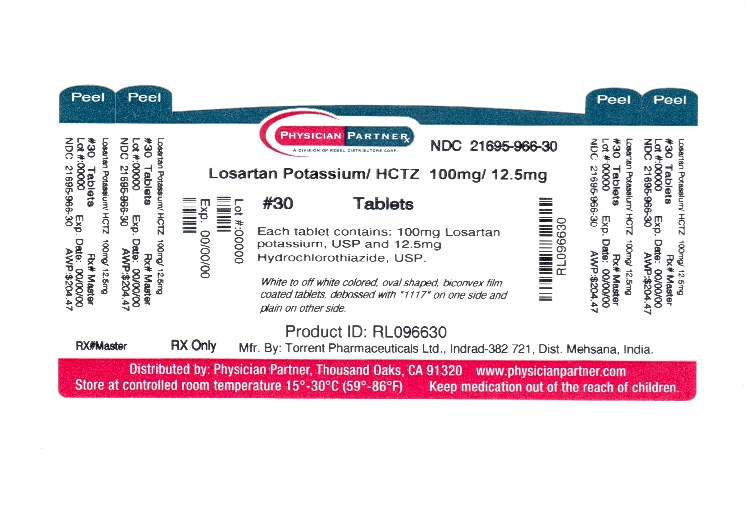
Repackaged by:
REBEL DISTRIBUTORS CORP, Thousand Oaks, CA 91320
Manufactured by:
TORRENT PHARMACEUTICALS LTD., Indrad-382 721, Dist. Mehsana, INDIA.
For:
TORRENT PHARMA INC., 5380 Holiday Terrace, Suite 40, Kalamazoo, Michigan 49009.
8030314 Revised September 2011
Repackaged by:
REBEL DISTRIBUTORS CORP, Thousand Oaks, CA 91320