Paclitaxel Injection, Solution
Product Images NDC 23155-883

13 FDA label images from Heritage Pharmaceuticals Inc. D/b/a Avet Pharmaceuticals Inc. · Packaging, Regulatory Labels, and Product Appearance

Product Visual Gallery

This gallery contains 13 technical images submitted to the FDA as part of the official labeling for Paclitaxel (NDC 23155-883). Unlike standard consumer photos, these assets often include clinical data figures, molecular chemical structures, and official manufacturer packaging layouts.

As provided by Heritage Pharmaceuticals Inc. D/b/a Avet Pharmaceuticals Inc., these visuals offer a comprehensive scientific overview of the product's physical and chemical identity, aiding pharmacists and researchers in product verification and study.

FDA Label Image

Paclitaxel-image1 (Paclitaxel Image1)
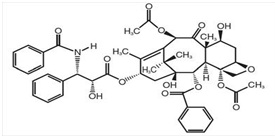
Paclitaxel-image1 (Paclitaxel Image1)
Chemical structure of paclitaxel, the active ingredient in PACLITAXEL PACLITAXEL injection, solution for intravenous use by Heritage Pharmaceuticals Inc. d/b/a Avet Pharmaceuticals Inc.*
FDA Label Image

Paclitaxel-image2 (Paclitaxel Image2)

Paclitaxel-image2 (Paclitaxel Image2)
A Kaplan-Meier survival curve graph depicting the proportion surviving over a period of up to 5 years for two groups labeled Cc and Tc. The graph includes a table showing sample sizes (N), number of events, and hazard ratio (HR) with confidence interval (CI) for the comparison between groups. Number at risk data is displayed for each year up to 4 years.*
FDA Label Image

Paclitaxel-image3 (Paclitaxel Image3)

Paclitaxel-image3 (Paclitaxel Image3)
A Kaplan-Meier survival curve graph showing the proportion surviving over 5 years for two groups labeled Cc and Tc. The graph includes number at risk data at multiple time points and a small inset table summarizing group sizes, number of events, and hazard ratio with 95% confidence interval.*
FDA Label Image

Paclitaxel-image4 (Paclitaxel Image4)

Paclitaxel-image4 (Paclitaxel Image4)
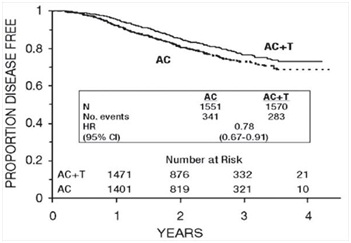
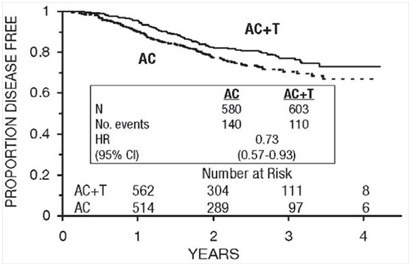
A line graph showing the proportion of disease-free patients over a four-year period, comparing two groups labeled AC and AC+T. The vertical axis represents the proportion disease-free, and the horizontal axis represents time in years. The chart includes a table with numerical data for number of events, hazard ratios, and confidence intervals for both groups, as well as the number of patients at risk at different time points.*
FDA Label Image

Paclitaxel-image5 (Paclitaxel Image5)

Paclitaxel-image5 (Paclitaxel Image5)
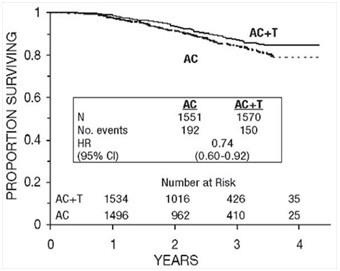
A survival curve chart comparing the proportion surviving over 4 years for two treatment groups labeled AC and AC+T. The graph includes a table with number of events, hazard ratio (HR), and 95% confidence interval (CI) for these groups, as well as numbers at risk at various time points.*
FDA Label Image

Paclitaxel-image6 (Paclitaxel Image6)

Paclitaxel-image6 (Paclitaxel Image6)
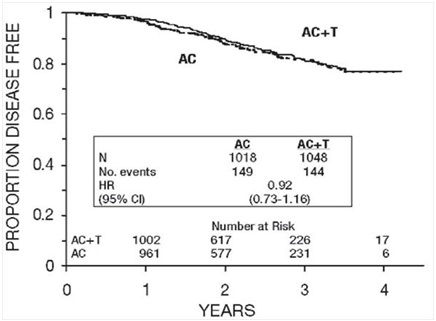
A survival curve graph displaying the proportion of patients disease free over a 4-year period, comparing two groups labeled AC and AC+T. The vertical axis shows proportion disease free from 0 to 1, and the horizontal axis shows time in years from 0 to 4. The chart includes hazard ratio data and number of events, along with numbers at risk for each group at different time points.*
FDA Label Image

Paclitaxel-image7 (Paclitaxel Image7)

Paclitaxel-image7 (Paclitaxel Image7)
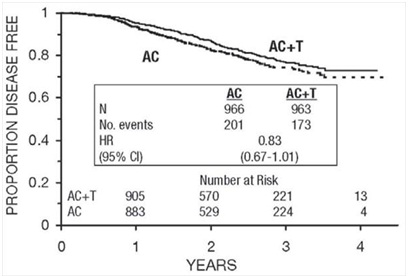
A Kaplan-Meier survival curve chart comparing the proportion of patients remaining disease-free over a period of 4 years between two treatment groups labeled AC and AC+T. The x-axis represents years, and the y-axis shows the proportion disease-free. The chart includes a small table displaying number of events, hazard ratio (HR), and confidence interval (CI) for each group, along with numbers at risk at various time points.*
FDA Label Image

Paclitaxel-image8 (Paclitaxel Image8)

Paclitaxel-image8 (Paclitaxel Image8)
A Kaplan-Meier survival curve comparing proportion disease-free over time (years) between two treatment groups labeled AC and AC+T. The graph includes the number at risk at various time points and a hazard ratio with confidence interval from a tabulated inset within the figure.*
FDA Label Image

Paclitaxel-image9 (Paclitaxel Image9)

Paclitaxel-image9 (Paclitaxel Image9)
A Kaplan-Meier survival curve showing the proportion of patients disease-free over four years comparing two treatments labeled AC and AC+T. The graph includes a risk table and hazard ratio data comparing events in each treatment group.*
FDA Label Image
FDA Label Image

30mg (Pacli Carton)

30mg (Pacli Carton)
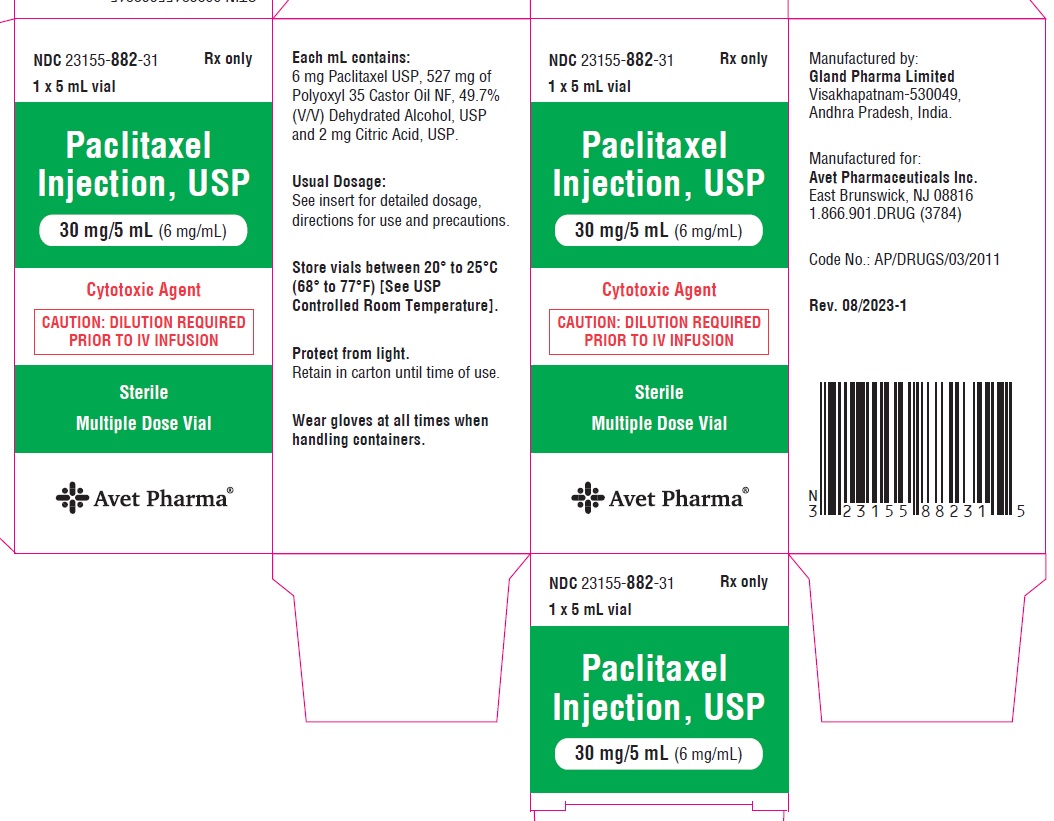
Packaging label for Paclitaxel Injection, USP 30 mg/5 mL (6 mg/mL) intravenous injection solution. The label indicates a sterile, multiple dose vial with NDC 23155-882-31, manufactured by Gland Pharma Limited and labeled by Avet Pharmaceuticals Inc. The label includes warnings for dilution prior to IV infusion and instructions to store between 20° to 25°C, protect from light, and wear gloves when handling.*
FDA Label Image

100mg (Pacli Carton 100 mg)

100mg (Pacli Carton 100 mg)
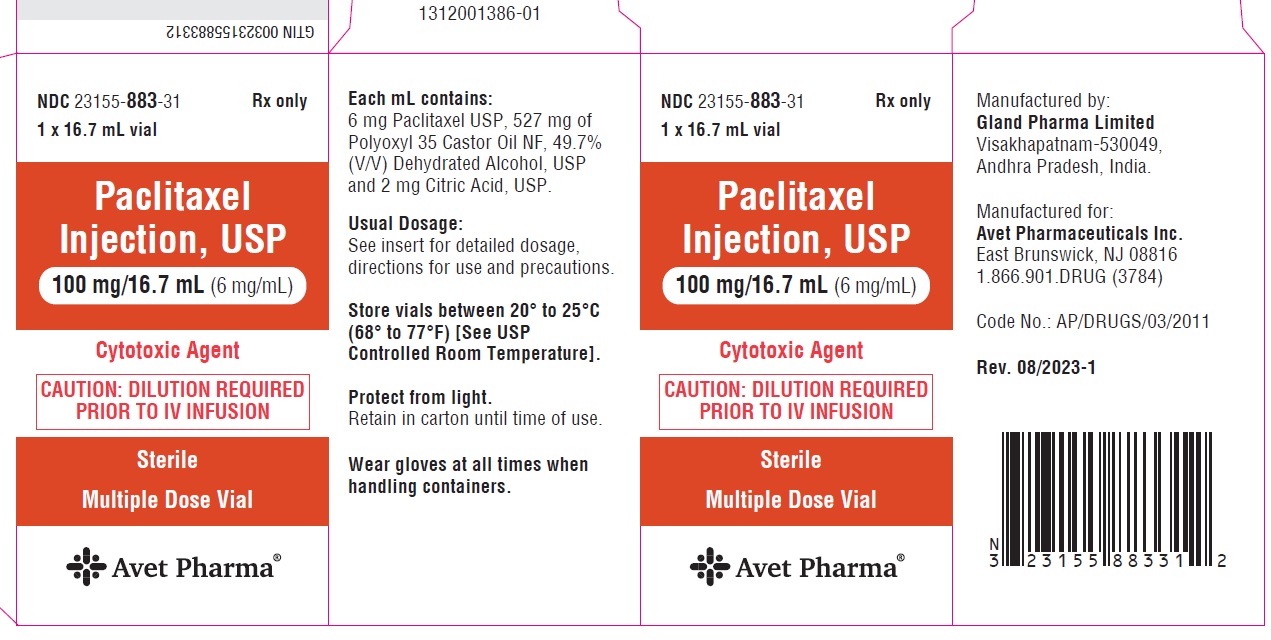
Packaging label for Paclitaxel Injection, USP, 100 mg/16.7 mL (6 mg/mL) solution for intravenous injection. The label states it is a sterile, multiple dose vial containing the cytotoxic agent paclitaxel. It includes instructions for dilution prior to IV infusion, storage conditions between 20° to 25°C, and handling precautions. Manufactured by Gland Pharma Limited and labeled by Avet Pharmaceuticals Inc.*
FDA Label Image

300mg (Pacli Carton 300 mg)

300mg (Pacli Carton 300 mg)
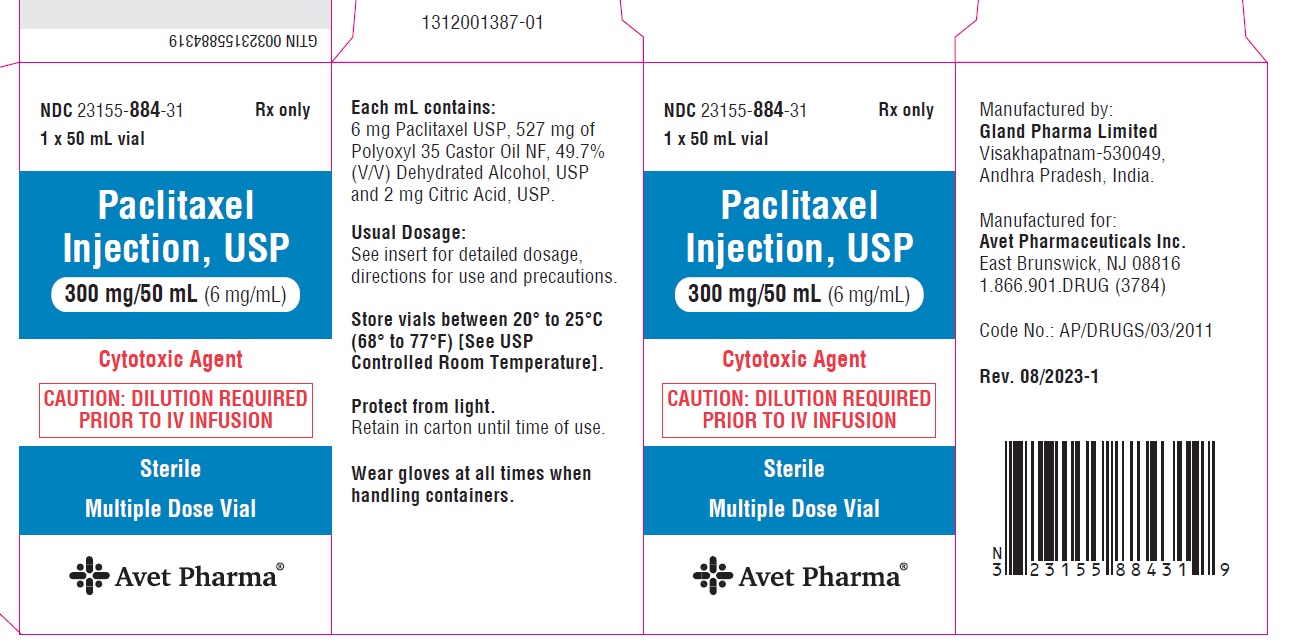
Label for Paclitaxel Injection, USP 300 mg/50 mL (6 mg/mL) sterile multiple dose vial. NDC 23155-884-31. The label highlights that it is a cytotoxic agent and requires dilution prior to intravenous infusion. Manufactured by Gland Pharma Limited, India, for Avet Pharmaceuticals Inc. The label includes storage instructions, warnings to wear gloves, and a barcode.*

* About these descriptions: Image descriptions on this page are generated by automated AI analysis of the product label images from the manufacturer's FDA label submission (SPL). They are provided for reference only and may contain errors or omissions. Always rely on the printed label itself and the official FDA labeling, and consult a pharmacist or healthcare professional with any questions about this product.