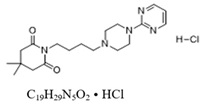
The pharmacokinetics of EXXUA are linear and dose proportional from 18.2 mg to 72.6 mg. Steady-state plasma concentration are typically achieved within two to four days of daily dosing.
Absorption
The absolute bioavailability is 14% to 17%. The maximal plasma EXXUA concentration (C
max) after dosing is reached within 6 hours post dose (T
max).
Effect of Food
After a high fat meal, T
maxis reached at 3 hours. A significant effect of food has been observed on the peak plasma concentration (C
max) of EXXUA and, to a lesser extent, on the total exposure (AUC0-tlast, AUC0-∞) to EXXUA. The magnitude of the food-effect was dependent of the fat content of the meal. The systemic exposure of EXXUA and major metabolites was consistently higher under fed conditions as compared to the fasted state. Gepirone C
maxafter intake of low-fat (~ 200 calories) breakfast was 27% higher, after medium-fat (~500 calories) breakfast 55% higher and after a high-fat (~ 850 calories) breakfast 62% higher as compared to the fasted state. The AUC after intake of low-fat breakfast was about 14% higher, after a medium-fat breakfast 22% higher and after a high-fat breakfast 32 to 37% higher as compared to the fasted state. The effect of varying amounts of fat on C
maxand AUC of the major metabolites 3’-OH-gepirone and 1-PP were similar to that found for gepirone
[see
Dosage and Administration (2.2)].
Distribution
The apparent volume of distribution of EXXUA is approximately 94.5L. The
in vitroplasma protein binding in human is 72% and is not concentration dependent. The
in vitroplasma proteinbinding for metabolite 3’-OH-gepirone is 59%and 42% for 1-PP.
Elimination
The mean terminal half-life is approximately 5 hours.
Metabolism
EXXUA is extensively metabolized and both major metabolites 1-PP and 3’-OH-gepirone are present in plasma in higher concentrations than the parent compound. CYP3A4 is the primary enzyme catalyzing the metabolism of EXXUA to its major pharmacologically active metabolites.
Excretion
Following a single oral dose of [
14C]-labeled gepirone, approximately 81% and 13% of the administered radioactivity was recovered in the urine and feces, respectively as metabolites. 60% of the gepirone was eliminated in the urine within the first 24 hours. The presence of hepatic or renal impairment did affect the apparent clearance of EXXUA.
Specific Populations
Exposures of gepirone in specific populations are summarized in Figure 1
[see
Dosage and Administration(2.3,
2.4,
2.5),
Contraindications (4), and
Use in Specific Populations (8.5,
8.6,
8.7)]
.
Figure 1 Effects of Specific Populations on the Pharmacokinetics of Gepirone
Gepirone dose: 36.3 mg in renal, 18.2 mg in hepatic; steady-state at 18.2 mg for race and 18.2-72.6 mg for age.
Data are GMRs and 90% CIs, except for Age groups (arithmetic mean ratios). AUC = area under the plasma concentration-time curve; CI = confidence interval; C
max= maximum plasma concentration; GMR = geometric mean ratio.
Drug Interactions Studies
In Vivo Studies
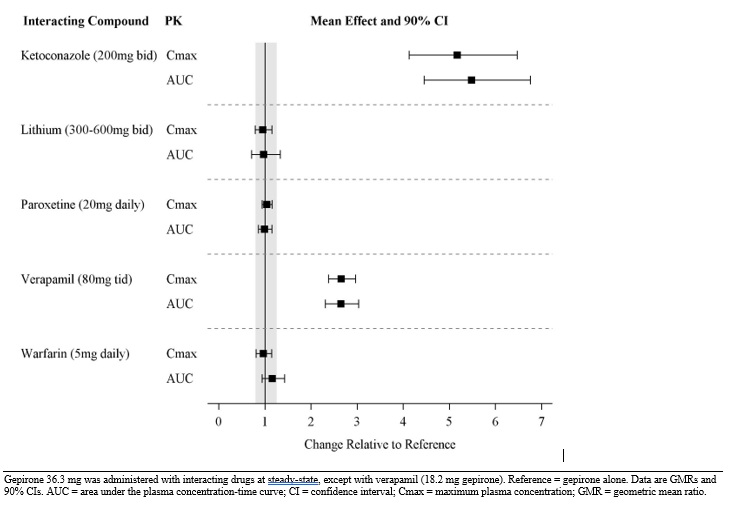
The effect of co-administered drugs on the pharmacokinetics of gepirone is summarized in Figure 2
[see
Dosage and Administration (2.6) and
Drug Interactions (7)]
.
Figure 2 Effect of Co-Administered Drugs on the Pharmacokinetics of Gepirone
Rifampin
The effect of multiple oral dosing of potent cytochrome P450 3A4 inducer rifampin on the steady-state pharmacokinetics of EXXUA and its major metabolites 1-PP and 3’-OH-gepirone was investigated in 24 subjects. Combined therapy with rifampin (600 mg daily) and EXXUA (20 mg for two days, then 40 mg daily) decreased C
maxand AUC0-24 of EXXUA 20 times (EXXUA C
maxalone 9.63 ng/mL, with rifampin 0.491 ng/mL) and 29 times (EXXUA AUC0-24 alone 123 ng·hr/mL, with rifampin 4.19 ng·hr/mL), respectively. The C
maxand AUC0-24 of 3’-OH gepirone were decreased 2.5 times (3’-OH gepirone C
maxalone 23.0 ng/mL, with rifampin 9.30 ng/mL) and three times (3’-OH gepirone AUC0-24 alone 371 ng·hr/mL, with rifampin 126 ng·hr/mL), respectively. There was no effect on the pharmacokinetics of 1-PP (1-PP C
maxalone 6.37 ng/mL, with rifampin 6.02 ng/mL; 1-PP AUC0-24 alone 92.5 ng·hr/mL, with rifampin 81.1 ng·hr/mL).
Glyburide
Under steady-state conditions for glyburide, the addition of 36.3 mg daily of EXXUA for six days in 16 patients with stable Type II diabetes resulted in statistically significantly lower AUC (glyburide AUC
0-12alone 574.8 ng·h/mL, with EXXUA 483.0 ng·h/mL) and C
max(glyburide C
maxalone 121.0 ng/mL, with EXXUA 96.6 ng/mL) values for glyburide.
Drugs that Interfere with Hemostasis
Following coadministration of stable dose of warfarin (INR 1.4 to 2.0) with multiple daily doses of EXXUA, no significant effect was observed in INR, prothrombin values, or total warfarin (protein bound plus free drug) pharmacokinetics for warfarin.
Drugs that Interfere with Protein Binding
Gepirone is not highly bound to plasma protein and is not likely to be involved in interactions due to altered protein binding. In a clinical study with coadministration of EXXUA (18.2 mg) and warfarin, a highly protein-bound drug, no significant change in international normalized ratio (INR) was observed.
In Vitro Studies
Gepirone at concentrations of 0.5, 5, and 50 ng/mL was shown to have no significant impact on the plasma protein binding of chlorpromazine, desipramine, diazepam, phenytoin, prazosin, propranolol, verapamil, or warfarin. The binding of digoxin and haloperidol were decreased (at maximum) by 5% and 9%, respectively. The plasma protein binding of lidocaine appeared to be increased by 4.9% in the presence of gepirone.
Alcohol:An
in vitrostudy showed dissolution rate for both 18.2 mg and 72.6 mg gepirone ER tablets decreased slightly as ethanol concentration increased in 0.01N HCl and 0.1N HCl at 0%, 5%, 10%, 20% and 40% alcohol. At 20 hours and 40% alcohol, approximately (mean) 76.8% and 80.7% were dissolved for the 18.2 mg and 72.6 mg gepirone ER tablets, respectively.
Transporter Systems: EXXUA and its metabolites are unlikely to cause clinically significant inhibition of the following transporters based on
in vitrodata: P-gp, BCRP, BSEP, OATP1B1, OATP1B3, OAT1, OAT3, OCT2, MATE1, and MATE2-K. As such, no clinically relevant interactions with drugs metabolized/transported by these CYP enzymes or transporters would be expected.
Enzyme systems: In addition, EXXUA has not been shown to be an inhibitor or inducer of any of the cytochrome P450 enzymes
[see
Clinical Pharmacology (12.3)]
. Chronic administration of EXXUA is unlikely to induce the metabolism of drugs metabolized by these CYP isoforms.