Limitations of Use:
The use of medroxyprogesterone acetate injectable suspension is not recommended as a long-term (i.e., longer than 2 years) birth control method unless other options are considered inadequate [see Dosage and Administration (2.1) and Warnings and Precautions (5.1)].
Breast Cancer
Women who have or have had a history of breast cancer should not use hormonal contraceptives, including medroxyprogesterone acetate injectable suspension, because breast cancer may be hormonally sensitive [see Contraindications (4)]. Women with a strong family history of breast cancer should be monitored with particular care.
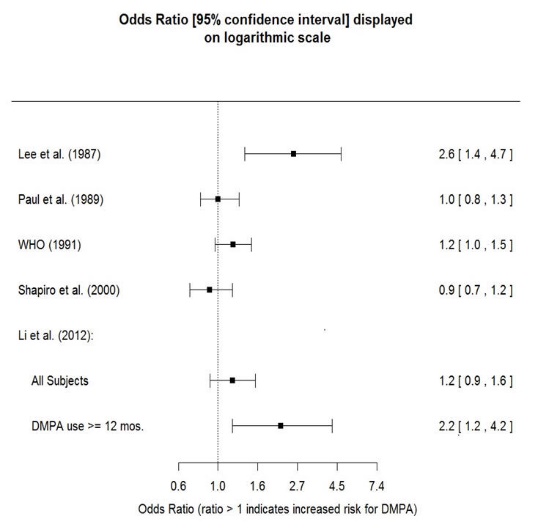
The results of five large case-control studies1, 2 assessing the association between depo-medroxyprogesterone acetate (DMPA) use and the risk of breast cancer are summarized in Figure 1. Three of the studies suggest a slightly increased risk of breast cancer in the overall population of users; these increased risks were statistically significant in one study. One recent US study1 evaluated the recency and duration of use and found a statistically significantly increased risk of breast cancer in recent users (defined as last use within the past five years) who used DMPA for 12 months or longer; this is consistent with results of a previous study2.
Figure 1 Risk estimates for breast cancer in DMPA users
| Odds ratio estimates were adjusted for the following covariates: |
| Lee et al. (1987): age, parity, and socioeconomic status. |
| Paul et al. (1989): age, parity, ethnic group, and year of interview. |
| WHO (1991): age, center, and age at first live birth. |
| Shapiro et al. (2000): age, ethnic group, socioeconomic status, and any combined estrogen/progestogen oral contraceptive use. |
| Li et al. (2012): age, year, BMI, duration of OC use, number of full-term pregnancies, family history of breast cancer, and history of screening mammography. |
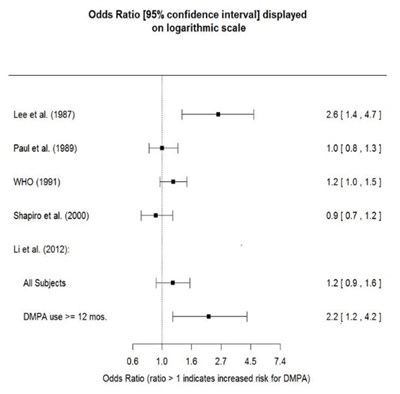 Figure 1 (Spl Img 01 Fig 1) |
Based on the published SEER-18 2011 incidence rate (age-adjusted to the 2000 US Standard Population) of breast cancer for US women, all races, age 20 to 49 years, a doubling of risk would increase the incidence of breast cancer in women who use medroxyprogesterone acetate injectable suspension from about 72 to about 144 cases per 100,000 women.
Cervical Cancer
A statistically nonsignificant increase in RR estimates of invasive squamous-cell cervical cancer has been associated with the use of medroxyprogesterone acetate injectable suspension in women who were first exposed before the age of 35 years (RR 1.22 to 1.28 and 95% CI 0.93 to 1.70). The overall, nonsignificant relative rate of invasive squamous-cell cervical cancer in women who ever used medroxyprogesterone acetate injectable suspension was estimated to be 1.11 (95% CI 0.96 to 1.29). No trends in risk with duration of use or times since initial or most recent exposure were observed.
Other Cancers
Long-term case-controlled surveillance of users of medroxyprogesterone acetate injectable suspension found no overall increased risk of ovarian or liver cancer.
HIV protease inhibitors and non-nucleoside reverse transcriptase inhibitors: Significant changes (increase or decrease) in the plasma levels of progestin have been noted in some cases of co-administration of HIV protease inhibitors. Significant changes (increase or decrease) in the plasma levels of the progestin have been noted in some cases of co-administration with non-nucleoside reverse transcriptase inhibitors.
Antibiotics: There have been reports of pregnancy while taking hormonal contraceptives and antibiotics, but clinical pharmacokinetic studies have not shown consistent effects of antibiotics on plasma concentrations of synthetic steroids.
Consult the labeling of all concurrently-used drugs to obtain further information about interactions with hormonal contraceptives or the potential for enzyme alterations.
Absorption
Following a single 150 mg IM dose of medroxyprogesterone acetate injectable suspension in eight women between the ages of 28 and 36 years old, medroxyprogesterone acetate concentrations, measured by an extracted radioimmunoassay procedure, increase for approximately 3 weeks to reach peak plasma concentrations of 1 to 7 ng/mL.
Distribution
Plasma protein binding of MPA averages 86%. MPA binding occurs primarily to serum albumin. No binding of MPA occurs with sex-hormone-binding globulin (SHBG).
Metabolism
MPA is extensively metabolized in the liver by P450 enzymes. Its metabolism primarily involves ring A and/or side-chain reduction, loss of the acetyl group, hydroxylation in the 2-, 6-, and 21-positions or a combination of these positions, resulting in more than 10 metabolites.
Excretion
The concentrations of medroxyprogesterone acetate decrease exponentially until they become undetectable (<100 pg/mL) between 120 to 200 days following injection. Using an unextracted radioimmunoassay procedure for the assay of medroxyprogesterone acetate in serum, the apparent half-life for medroxyprogesterone acetate following IM administration of medroxyprogesterone acetate injectable suspension is approximately 50 days. Most medroxyprogesterone acetate metabolites are excreted in the urine as glucuronide conjugates with only minor amounts excreted as sulfates.
Specific Populations
The effect of hepatic and/or renal impairment on the pharmacokinetics of medroxyprogesterone acetate injectable suspension is unknown.
BMD Recovery Post-Treatment in Adolescents
Longer duration of treatment and smoking were associated with less recovery of BMD following the last injection of medroxyprogesterone acetate injectable suspension. Table 6 shows the extent of recovery of BMD up to 60 months post-treatment for adolescents who received medroxyprogesterone acetate injectable suspension for two years or less compared to more than two years. Post-treatment follow-up showed that, in women treated for more than two years, only lumbar spine BMD recovered to baseline levels after treatment was discontinued. Adolescents treated with medroxyprogesterone acetate injectable suspension for more than two years did not recover to their baseline BMD level at femoral neck and total hip even up to 60 months post-treatment. Adolescents in the untreated cohort gained BMD throughout the trial period (data not shown) [see Warnings and Precautions (5.1)].
Table 6: BMD Recovery (Months Post-Treatment) in Adolescents by Years of Medroxyprogesterone Acetate Injectable Suspension Use (2 Years or Less vs. More than 2 Years)| Duration of Treatment | 2 years or less | More than 2 years |
|---|
| N | Mean % Change from baseline | N | Mean % Change from baseline |
|---|
Total Hip BMD |
End of Treatment | 49 | -1.5% | 49 | -6.2% |
12 M post-treatment | 33 | -1.4% | 24 | -4.6% |
24 M post-treatment | 18 | 0.3% | 17 | -3.6% |
36 M post-treatment | 12 | 2.1% | 11 | -4.6% |
48 M post-treatment | 10 | 1.3% | 9 | -2.5% |
60 M post-treatment | 3 | 0.2% | 2 | -1.0% |
Femoral Neck BMD |
End of Treatment | 49 | -1.6% | 49 | -5.8% |
12 M post-treatment | 33 | -1.4% | 24 | -4.3% |
24 M post-treatment | 18 | 0.5% | 17 | -3.8% |
36 M post-treatment | 12 | 1.2% | 11 | -3.8% |
48 M post-treatment | 10 | 2.0% | 9 | -1.7% |
60 M post-treatment | 3 | 1.0% | 2 | -1.9% |
Lumbar Spine BMD |
End of Treatment | 49 | -0.9% | 49 | -3.5% |
12 M post-treatment | 33 | 0.4% | 23 | -1.1% |
24 M post-treatment | 18 | 2.6% | 17 | 1.9% |
36 M post-treatment | 12 | 2.4% | 11 | 0.6% |
48 M post-treatment | 10 | 6.5% | 9 | 3.5% |
60 M post-treatment | 3 | 6.2% | 2 | 5.7% |