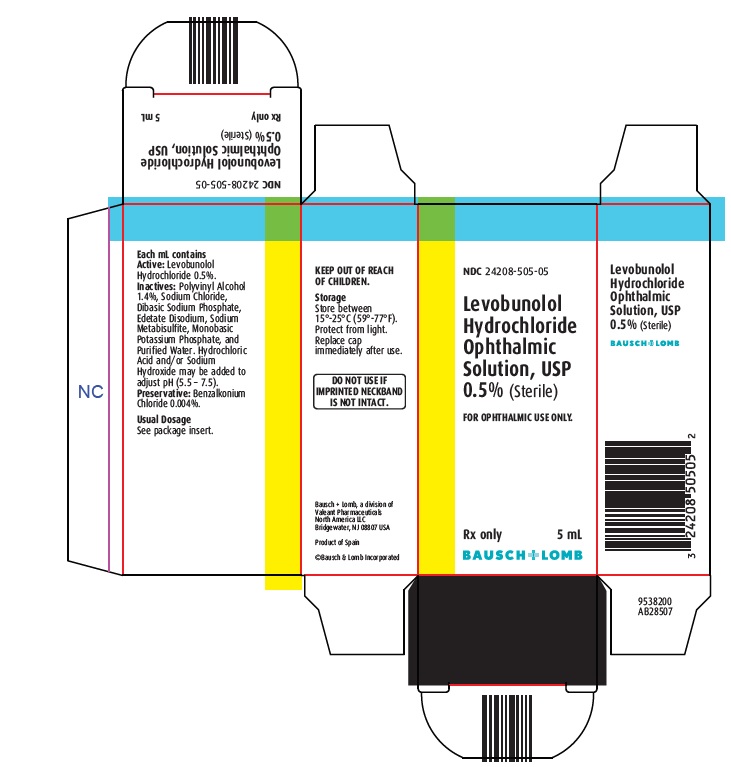
Levobunolol hydrochloride is a noncardioselective beta-adrenoceptor blocking agent, equipotent at both beta1 and beta2 receptors. Levobunolol hydrochloride is greater than 60 times more potent than its dextro isomer in its beta-blocking activity, yet equipotent in its potential for direct myocardial depression. Accordingly, the levo isomer, levobunolol hydrochloride, is used. Levobunolol hydrochloride does not have significant local anesthetic (membrane-stabilizing) or intrinsic sympathomimetic activity.
Beta-adrenergic receptor blockade reduces cardiac output in both healthy subjects and patients with heart disease. In patients with severe impairment of myocardial function, beta-adrenergic receptor blockade may inhibit the stimulatory effect of the sympathetic nervous system necessary to maintain adequate cardiac function.
Beta-adrenergic receptor blockade in the bronchi and bronchioles results in increased airway resistance from unopposed parasympathetic activity. Such an effect in patients with asthma or other bronchospastic conditions is potentially dangerous.
Levobunolol Hydrochloride Ophthalmic Solution has been shown to be an active agent in lowering elevated as well as normal intraocular pressure (IOP) whether or not accompanied by glaucoma. Elevated IOP presents a major risk factor in glaucomatous field loss. The higher the level of IOP, the greater the likelihood of optic nerve damage and visual field loss.
The onset of action with one drop of Levobunolol Hydrochloride Ophthalmic Solution can be detected within one hour after treatment, with maximum effect seen between 2 and 6 hours.
A significant decrease in IOP can be maintained for up to 24 hours following a single dose.
In two separate, controlled studies (one three-month and one up to 12 months duration) Levobunolol Hydrochloride Ophthalmic Solution 0.25% twice a day controlled the IOP of approximately 64% and 70% of the subjects. The overall mean decrease from baseline was 5.4 mm Hg and 5.1 mm Hg respectively. In an open-label study Levobunolol Hydrochloride Ophthalmic Solution 0.25% daily controlled the IOP of 72% of the subjects while achieving an overall mean decrease of 5.9 mm Hg.
In controlled clinical studies of approximately two years duration, intraocular pressure was well-controlled in approximately 80% of subjects treated with Levobunolol Hydrochloride Ophthalmic Solution 0.5% twice a day. The mean IOP decrease from baseline was between 6.87 mm Hg and 7.81 mm Hg. No significant effects on pupil size, tear production or corneal sensitivity were observed. Levobunolol Hydrochloride Ophthalmic Solution at the concentrations tested, when applied topically, decreased heart rate and blood pressure in some patients. The IOP-lowering effect of levobunolol was well maintained over the course of these studies.
In a three-month clinical study, a single daily application of Levobunolol Hydrochloride Ophthalmic Solution 0.5% controlled the IOP of 72% of subjects achieving an overall mean decrease in IOP of 7.0 mm Hg.
The primary mechanism of the ocular hypotensive action of levobunolol hydrochloride in reducing IOP is most likely a decrease in aqueous humor production. Levobunolol Hydrochloride Ophthalmic Solution reduces IOP with little or no effect on pupil size or accommodation in contrast to the miosis which cholinergic agents are known to produce. The blurred vision and night blindness often associated with miotics would not be expected and have not been reported with the use of Levobunolol Hydrochloride Ophthalmic Solution. This is particularly important in cataract patients with central lens opacities who would experience decreased visual acuity with pupillary constriction.