Absorption
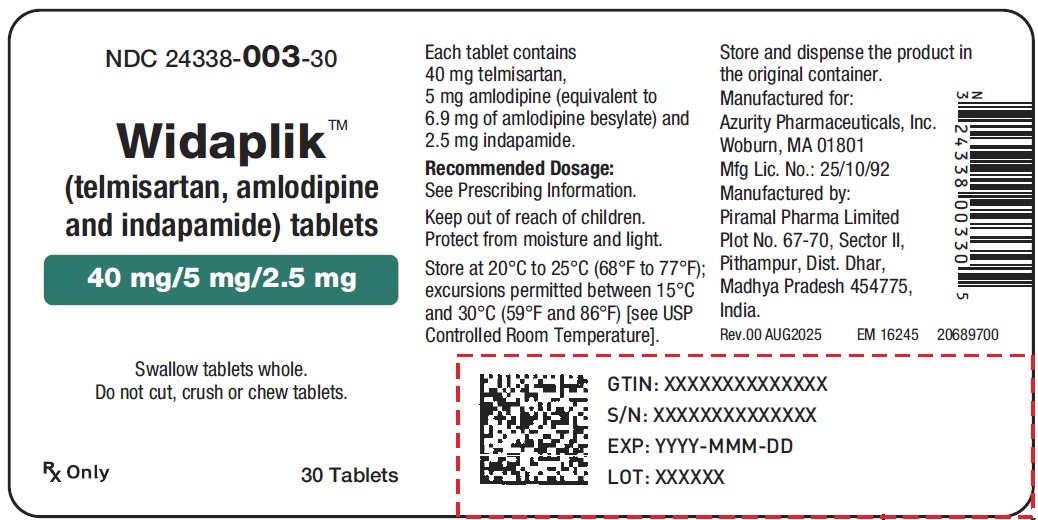
Following single-dose oral administration of Widaplik (40 mg/5 mg/2.5 mg) to healthy subjects in the fasted state, the extent of absorption (AUC) and rate of absorption (Cmax) of telmisartan was 750 ng.h/mL and 64.7 ng/mL, the AUC and Cmax of amlodipine was 102,000 pg.h/mL and 2,850 pg/mL, and the AUC and Cmax of indapamide was 2,170 ng.h/mL and 144 ng/mL, respectively. The peak plasma concentrations of telmisartan, amlodipine and indapamide are achieved at approximately 1.8 hours, 7.5 hours, and 0.9 hours, respectively, under fasting conditions.
Effect of Food
A food-effect study involving administration of Widaplik (40 mg/5 mg/2.5 mg) to healthy subjects after a high-fat, high calorie breakfast indicated that the Cmax of telmisartan decreased 41%, while AUC remained unchanged, the Cmax and AUC of amlodipine and indapamide remained unchanged, when compared to administration under fasting conditions. The Tmax of telmisartan, amlodipine and indapamide was delayed by approximately 2 hours, 1 hour, and 1.5 hours, respectively, under fed conditions.
Distribution
Telmisartan
Telmisartan is highly bound to plasma proteins (>99.5%), mainly albumin and α1-acid glycoprotein. Plasma protein binding is constant over the concentration range achieved with recommended doses. The volume of distribution for telmisartan is approximately 500 L indicating additional tissue binding.
Amlodipine
The apparent volume of distribution of amlodipine is 21 L/kg. Approximately 93% of circulating amlodipine is bound to plasma proteins in hypertensive patients.
Indapamide
Indapamide is preferentially and reversibly taken up by the erythrocytes in the peripheral blood. The whole blood/plasma ratio is approximately 6:1 at the time of peak concentration and decreases to 3.5:1 at eight hours. From 71 to 79% of the indapamide in plasma is reversibly bound to plasma proteins.
Metabolism and Elimination
Telmisartan
Following either intravenous or oral administration of 14C-labeled telmisartan, most of the administered dose (>97%) was eliminated unchanged in feces via biliary excretion; only minute amounts were found in the urine (0.91% and 0.49% of total radioactivity, respectively).
Telmisartan is metabolized by conjugation to form a pharmacologically inactive acylglucuronide; the glucuronide of the parent compound is the only metabolite that has been identified in human plasma and urine. After a single dose, the glucuronide represents approximately 11% of the measured radioactivity in plasma. The cytochrome P450 isoenzymes are not involved in the metabolism of telmisartan.
Total plasma clearance of telmisartan is >800 mL/min. Terminal half-life and total clearance appear to be independent of dose.
Amlodipine
Amlodipine is extensively (about 90%) converted to inactive metabolites via hepatic metabolism with 10% of the parent compound and 60% of the metabolites excreted in the urine.
Elimination of amlodipine from the plasma is biphasic with a terminal elimination half-life of about 30 to 50 hours. Steady state plasma levels of amlodipine are reached after 7 to 8 days of consecutive daily dosing.
Indapamide
Indapamide is an extensively metabolized drug, with only about 7% of the total dose administered, recovered in the urine as unchanged drug during the first 48 hours after administration. The urinary elimination of 14C-labeled indapamide and metabolites is biphasic with a terminal half-life of excretion of total radioactivity of 26 hours.
A minimum of 70% of a single oral dose is eliminated by the kidneys and an additional 23% by the gastrointestinal tract, probably including the biliary route. The half-life of indapamide in whole blood is approximately 14 hours.
Specific Populations
Geriatric Patients
Telmisartan: The pharmacokinetics of telmisartan do not differ between the elderly and those younger than 65 years.
Amlodipine: Elderly patients have decreased clearance of amlodipine with a resulting increase in AUC of approximately 40% to 60%.
Indapamide: The pharmacokinetics of indapamide in geriatric patients is unknown.
Male and Female Patients
Telmisartan: Plasma concentrations of telmisartan are generally 2 to 3 times higher in females than in males. In clinical trials, however, no significant increases in blood pressure response or in the incidence of orthostatic hypotension were found in women. No dosage adjustment is necessary.
Patients with Renal Impairment
Telmisartan: Renal impairment does not increase the AUC of telmisartan. Telmisartan is not removed from blood by hemodialysis.
Amlodipine: The pharmacokinetics of amlodipine are not significantly influenced by renal impairment.
Indapamide: The effect of renal impairment on the pharmacokinetics of indapamide is unknown.
Patients with Hepatic Impairment
Telmisartan: In patients with hepatic insufficiency, plasma concentrations of telmisartan are increased, and absolute bioavailability approaches 100% [see Use in Specific Populations (8.6)].
Amlodipine: Patients with hepatic insufficiency have decreased clearance of amlodipine with a resulting increase in AUC of approximately 40% to 60%.
Indapamide: The effect of hepatic impairment on the pharmacokinetics of indapamide is unknown [see Use in Specific Populations (8.6)].
Drug Interaction Studies
Telmisartan
Ramipril and Ramiprilat: Co-administration of telmisartan 80 mg once daily and ramipril 10 mg once daily to healthy subjects increases steady-state Cmax and AUC of ramipril 2.3- and 2.1-fold, respectively, and Cmax and AUC of ramiprilat 2.4- and 1.5-fold, respectively. In contrast, Cmax and AUC of telmisartan decrease by 31% and 16%, respectively. When co-administering telmisartan and ramipril, the response may be greater because of the possibly additive pharmacodynamic effects of the combined drugs, and also because of the increased exposure to ramipril and ramiprilat in the presence of telmisartan.
Other Drugs: Co-administration of telmisartan did not result in a clinically significant interaction with acetaminophen, amlodipine, glyburide, simvastatin, hydrochlorothiazide, warfarin, or ibuprofen. Telmisartan is not metabolized by the cytochrome P450 system and had no effects in vitro on cytochrome P450 enzymes, except for some inhibition of CYP2C19. Telmisartan is not expected to interact with drugs that inhibit cytochrome P450 enzymes; it is also not expected to interact with drugs metabolized by cytochrome P450 enzymes, except for possible inhibition of the metabolism of drugs metabolized by CYP2C19.
Amlodipine
In vitro data indicate that amlodipine has no effect on the human plasma protein binding of digoxin, phenytoin, warfarin, and indomethacin.
Impact of other drugs on amlodipine
Co-administered cimetidine, magnesium- and aluminum hydroxide antacids, sildenafil, and grapefruit juice have no impact on the exposure to amlodipine.
CYP3A inhibitors: Co-administration of a 180 mg daily dose of diltiazem with 5 mg amlodipine in elderly hypertensive patients resulted in a 60% increase in amlodipine systemic exposure. Erythromycin co-administration in healthy volunteers did not significantly change amlodipine systemic exposure. However, strong inhibitors of CYP3A (e.g., itraconazole, clarithromycin) may increase the plasma concentrations of amlodipine to a greater extent [see Drug Interactions (7.2)].
Impact of amlodipine on other drugs
Amlodipine is a weak inhibitor of CYP3A and may increase exposure to CYP3A substrates.
Co-administered amlodipine does not affect the exposure to atorvastatin, digoxin, ethanol and the warfarin prothrombin response time.
Simvastatin: Co-administration of multiple doses of 10 mg of amlodipine with 80 mg simvastatin resulted in a 77% increase in exposure to simvastatin compared to simvastatin alone [see Drug Interactions (7.2)].
Cyclosporine: A prospective study in renal transplant patients (N=11) showed on an average of 40% increase in trough cyclosporine levels when concomitantly treated with amlodipine [see Drug Interactions (7.2)].
Tacrolimus: A prospective study in healthy Chinese volunteers (N=9) with CYP3A5 expressers showed a 2.5- to 4-fold increase in tacrolimus exposure when concomitantly administered with amlodipine compared to tacrolimus alone. This finding was not observed in CYP3A5 non-expressers (N= 6). However, a 3-fold increase in plasma exposure to tacrolimus in a renal transplant patient (CYP3A5 non-expresser) upon initiation of amlodipine for the treatment of post-transplant hypertension resulting in reduction of tacrolimus dose has been reported. Irrespective of the CYP3A5 genotype status, the possibility of an interaction cannot be excluded with these drugs [see Drug Interactions (7.2)].