Bidil Tablet, Film Coated
Product Images NDC 24338-010

View Photos of Packaging, Regulatory Labels, and Product Appearance

Product Visual Gallery

This gallery contains 7 technical images submitted to the FDA as part of the official labeling for Bidil (NDC 24338-010). Unlike standard consumer photos, these assets often include clinical data figures, molecular chemical structures, and official manufacturer packaging layouts.

As provided by Azurity Pharmaceuticals, Inc., these visuals offer a comprehensive scientific overview of the product's physical and chemical identity, aiding pharmacists and researchers in product verification and study.

FDA Label Image

Chemical Structure (Bidil 01)

Chemical Structure (Bidil 01)
Chemical structure of isosorbide dinitrate, one of the active ingredients in BiDil (hydralazine hydrochloride and isosorbide dinitrate). The structure shows a bicyclic ring with two nitrate ester groups attached.*
FDA Label Image

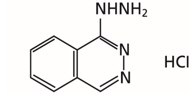
Chemical Structure (Bidil 02)

Chemical Structure (Bidil 02)
Chemical structure of hydralazine hydrochloride.*
FDA Label Image

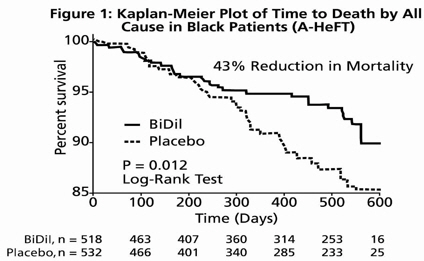
Figure 1 (Bidil 03)

Figure 1 (Bidil 03)
A Kaplan-Meier survival plot depicting percent survival over time in days for Black patients treated with BiDil versus placebo. The solid line represents BiDil, showing higher survival compared to the dashed placebo line, with a noted 43% reduction in mortality. The chart includes patient numbers at risk over time and a p-value from the log-rank test indicating statistical significance.*
FDA Label Image

Figure 2 (Bidil 04)

Figure 2 (Bidil 04)
Kaplan-Meier plot showing the time to first hospitalization for heart failure in Black patients treated with BiDil versus placebo. The y-axis represents percent without hospitalization, and the x-axis shows time in days. The graph indicates a 39% risk reduction in first hospitalization for heart failure with BiDil compared to placebo, with statistical significance (P < 0.001, Log-Rank Test).*
FDA Label Image

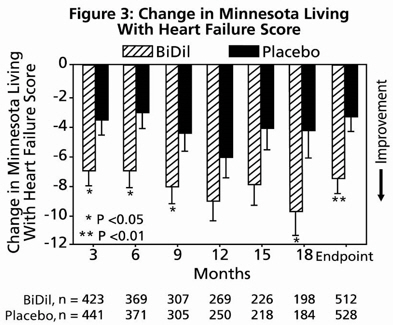
Figure 3 (Bidil 05)

Figure 3 (Bidil 05)
A bar graph titled 'Change in Minnesota Living With Heart Failure Score' comparing BiDil and placebo groups over time in months. The y-axis measures change in the score, with downward bars indicating improvement. Data points are shown at 3, 6, 9, 12, 15, 18 months, and at the endpoint. BiDil bars are patterned, placebo bars solid black. Statistical significance indicators (* and **) are present for certain months and the endpoint.*
FDA Label Image

Figure 4 (Bidil 06)

Figure 4 (Bidil 06)
A forest plot showing results for demographic, baseline medication, and clinical characteristic subgroups in Black patients from the A-HeFT study. It compares BiDil versus placebo for all-cause mortality and first hospitalization for heart failure, presenting relative risk and 95% confidence intervals across various categories such as age, gender, ischemic etiology, hypertension, diabetes, and medication use.*
FDA Label Image

Principal Display Panel (180 Tablet Bottle Label)

Principal Display Panel (180 Tablet Bottle Label)
BiDil 20 mg/37.5 mg tablet film-coated cardboard carton label. The label includes the NDC 24338-010-09, product name, and strength of isosorbide dinitrate and hydralazine HCl. It indicates storage conditions at 15°C - 30°C (59°F - 86°F), Rx only status, and a package quantity of 90 tablets. The labeler is Azurity Pharmaceuticals, Inc. The side panel shows tablet content per dose and includes lot, expiration, serial numbers, and QR code.*

* About these descriptions: Image descriptions on this page are generated by automated AI analysis of the product label images from the manufacturer's FDA label submission (SPL). They are provided for reference only and may contain errors or omissions. Always rely on the printed label itself and the official FDA labeling, and consult a pharmacist or healthcare professional with any questions about this product.