Limitation of Use
SOTYLIZE may not enhance survival in patients with ventricular arrhythmias. Because of the proarrhythmic effects of SOTYLIZE [see Warnings and Precautions (5.1)], including a 1.5 to 2% rate of Torsade de Pointes or new VT/VF in patients with either NSVT or supraventricular arrhythmias, its use in patients with less severe arrhythmias, even if the patients are symptomatic, is generally not recommended. Treatment of patients with asymptomatic ventricular premature contractions should be avoided.
Limitation of Use
Because sotalol can cause life-threatening ventricular arrhythmias, reserve it for patients in whom AFIB/AFL is highly symptomatic. Patients with paroxysmal AFIB whose AFIB/AFL that is easily reversed (by Valsalva maneuver, for example) should usually not be given SOTYLIZE.
Pediatrics
As in adults, initiate in the hospital after appropriate clinical assessment, gradually increase dose as required, and monitor QTc and heart rate.
For children aged 2 years and greater, with normal renal function, doses normalized for body surface area are appropriate for both initial and incremental dosing.
For initiation of treatment, 30 mg/m2 three times a day (90 mg/m2 total daily dose) is approximately equivalent to the initial 160 mg total daily dose for adults. Subsequent titration to a maximum of 60 mg/m2 (approximately equivalent to the 360 mg total daily dose for adults) can then occur. Allow at least 36 hours between dose increments to attain steady-state plasma concentrations of sotalol in patients with normal renal function.
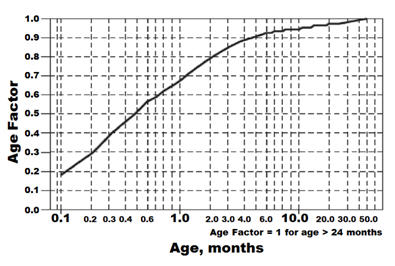
For children aged 2 years or younger, reduce the dose as shown in Figure 1.
Figure 1: Factor For Dose Adjustment by AgeFor a child with normal renal function aged 1 month, the initial starting dose would be (30 × 0.7) = 21 mg/m2, administered three times daily. For a child aged about 1 week, the initial starting dose should be multiplied by 0.3; the starting dose would be (30 × 0.3) = 9 mg/m2. Use similar calculations for dose titration.
Since the half-life of sotalol increases below about 2 years, time to steady-state will also increase. Thus, in neonates the time to steady-state may be a week or longer.
Ventricular arrhythmias
SOTYLIZE can cause serious ventricular arrhythmias, primarily Torsade de Pointes (TdP) type ventricular tachycardia, a polymorphic ventricular tachycardia associated with QT interval prolongation. QT interval prolongation is directly related to the concentration of sotalol. Factors such as reduced creatinine clearance, gender (female) and larger doses increase the risk of TdP. The risk of TdP can be reduced by adjustment of the sotalol dose according to creatinine clearance and by monitoring the ECG for excessive increases in the QT interval [see Dosage and Administration (2)].
Use with Drugs that Prolong QT Interval and Antiarrhythmic Agents
The use of SOTYLIZE in conjunction with other drugs that prolong the QT interval has not been studied and is not recommended. Such drugs include many antiarrhythmics, some phenothiazines, tricyclic antidepressants, certain oral macrolides and certain quinolone antibiotics. Class I or Class III antiarrhythmic agents should be withheld for at least three half-lives prior to dosing with sotalol. In clinical trials, sotalol was not administered to patients previously treated with oral amiodarone for >1 month in the previous three months. Class Ia antiarrhythmic drugs, such as disopyramide, quinidine and procainamide and other Class III drugs (e.g., amiodarone) are not recommended as concomitant therapy with sotalol because of their potential to prolong refractoriness. There is only limited experience with the concomitant use of Class Ib or Ic antiarrhythmics.
Adults:
Adverse reactions that are clearly related to sotalol are those which are typical of its Class II (beta-blocking) and Class III (cardiac action potential duration prolongation) effects. The common documented beta-blocking adverse reactions (bradycardia, dyspnea, and fatigue) and Class III effects (QT interval prolongation) are dose related.
Serious Adverse Reactions
SOTYLIZE can cause serious ventricular arrhythmias, primarily Torsade de Pointes (TdP) type ventricular tachycardia, a polymorphic ventricular tachycardia associated with QT interval prolongation. QT interval prolongation is directly related to the plasma level of sotalol. Factors such as reduced creatinine clearance, gender (female) and larger doses increase the risk of TdP [see Warnings and Precautions (5.1)].
Proarrhythmia in Atrial Fibrillation Patients. In eight controlled trials of patients with AFIB/AFL and other supraventricular arrhythmias (N=659) there were four cases of TdP reported (0.6%) during the controlled phase of treatment with oral sotalol.
Prolongation of the QT interval is dose related, increasing from baseline an average of 25, 40, and 50 msec in the 80, 120, and 160 mg groups, respectively, in the oral dose-response study [see Clinical Trials (14.2)].
Proarrhythmia in Ventricular Arrhythmia Patients. In patients with a history of sustained ventricular tachycardia, the incidence of Torsade de Pointes during oral sotalol treatment was 4% and worsened VT was about 1%; in patients with other less serious ventricular arrhythmias the incidence of Torsade de Pointes was 1% and new or worsened VT was about 0.7%. Additionally, in approximately 1% of patients, deaths were considered possibly drug related; such cases, although difficult to evaluate, may have been associated with proarrhythmic events. Torsade de Pointes arrhythmias in patients with VT/VF were dose related, as was the prolongation of QT (QTc) interval, as shown in Table 2 below.
Table 2: Percent Incidence of Torsade de Pointes and Mean QTc Interval by Dose For Patients With Sustained VT/VF| Daily Dose (mg) | Incidence of Torsade de Pointes | Mean QTc Highest on-therapy value (msec) |
|---|
| ( ) Number of patients assessed |
| 80 | 0 (69) | 463 (17) |
| 160 | 0.5 (832) | 467 (181) |
| 320 | 1.6 (835) | 473 (344) |
| 480 | 4.4 (459) | 483 (234) |
| 640 | 3.7 (324) | 490 (185) |
| >640 | 5.8 (103) | 512 (62) |
Table 3 below relates the incidence of Torsade de Pointes to on-therapy QTc and change in QTc from baseline. It should be noted, however, that the highest on-therapy QTc was in many cases the one obtained at the time of the Torsade de Pointes event, so that the table overstates the predictive value of a high QTc.
Table 3: Relationship Between QTc Interval Prolongation and Torsade de Pointes| On-Therapy QTc Interval (msec) | Incidence of Torsade de Pointes | Change in QTc Interval From Baseline (msec) | Incidence of Torsade de Pointes |
|---|
| ( ) Number of patients assessed |
| less than 500 | 1.3% (1787) | less than 65 | 1.6% (1516) |
| 500-525 | 3.4% (236) | 65-80 | 3.2% (158) |
| 525-550 | 5.6% (125) | 80-100 | 4.1% (146) |
| >550 | 10.8% (157) | 100-130 | 5.2% (115) |
| | >130 | 7.1% (99) |
In addition to dose and presence of sustained VT, other risk factors for Torsade de Pointes were gender (females had a higher incidence), excessive prolongation of the QTc interval and history of cardiomegaly or congestive heart failure. Patients with sustained ventricular tachycardia and a history of congestive heart failure appear to have the highest risk for serious proarrhythmia (7%). Of the ventricular arrhythmia patients experiencing Torsade de Pointes, approximately two-thirds spontaneously reverted to their baseline rhythm. The others were either converted electrically (D/C cardioversion or overdrive pacing) or treated with other drugs [see Overdosage (10)]. It is not possible to determine whether some sudden deaths represented episodes of Torsade de Pointes, but in some instances sudden death did follow a documented episode of Torsade de Pointes. Although sotalol therapy was discontinued in most patients experiencing Torsade de Pointes, 17% were continued on a lower dose.
Other Adverse Reactions
In a pooled clinical trial population consisting of four placebo-controlled studies with 275 patients with AFIB/AFL treated with 160-320 mg of oral sotalol, the following adverse events were reported at least 2% more frequently in the 160-240 mg sotalol treated patients than in placebo patients (see Table 4). The data are presented by incidence of events in the oral sotalol and placebo groups by body system and daily dose.
Table 4: Incidence (%) of Common Adverse Reactions (≥2% more frequent in patients treated in the 160-240 mg group than on placebo) in Four Placebo-Controlled Studies of Patients with AFIB/AFL Treated with Oral Sotalol | Placebo | Oral Sotalol
Total Daily Dose |
|---|
Body System/
Adverse Reactions (Preferred Term) | N=282 | 160-240
N=153 | >240-320
N=122 |
|---|
| CARDIOVASCULAR |
| Bradycardia | 2.5 | 13.1 | 12.3 |
| Abnormality ECG | 0.4 | 3.3 | 2.5 |
| GASTROINTESTINAL |
| Nausea/Vomiting | 5.3 | 7.8 | 5.7 |
| Diarrhea | 2.1 | 5.2 | 5.7 |
| GENERAL |
| Fatigue | 8.5 | 19.6 | 18.9 |
| Hyperhidrosis | 3.2 | 5.2 | 4.9 |
| Weakness | 3.2 | 5.2 | 4.9 |
| NERVOUS SYSTEM |
| Dizziness | 12.4 | 16.3 | 13.1 |
In AFIB/AFL patients, discontinuation because of unacceptable adverse reactions was necessary in 17% of the patients, and occurred in 10% of patients less than two weeks after starting treatment. The most common adverse reactions leading to discontinuation of sotalol were: fatigue 4.6%, bradycardia 2.4%, proarrhythmia 2.2%, dyspnea 2%, and QT interval prolongation 1.4%.
In clinical trials involving 1292 patients with sustained VT/VF, the common adverse events were similar to those described for the AFIB/AFL population.
One case of peripheral neuropathy which resolved on discontinuation of sotalol and recurred when the patient was rechallenged with the drug was reported in an early dose tolerance study. Elevated blood glucose levels and increased insulin requirements can occur in diabetic patients.
Pediatric Patients:
In an unblinded multicenter trial of 25 patients with SVT and/or VT receiving daily doses of 30, 90 and 210 mg/m2 with dosing every 8 hours for a total of 9 doses, no Torsade de Pointes or other serious new arrhythmias were observed. One (1) patient, receiving 30 mg/m2 daily, was discontinued because of increased frequency of sinus pauses/bradycardia. Additional cardiovascular adverse events were seen at the 90 and 210 mg/m2 daily dose levels. They included QT prolongations (2 patients), sinus pauses/bradycardia (1 patient), increased severity of atrial flutter and reported chest pain (1 patient). Values for QTc ≥525 msec were seen in 2 patients at the 210 mg/m2 daily dose level. Serious adverse events including death, Torsade de Pointes, other proarrhythmias, high-degree A-V blocks and bradycardia have been reported in infants and/or children.
Symptoms and Treatment of Overdosage:
The most common signs to be expected are bradycardia, congestive heart failure, hypotension, bronchospasm and hypoglycemia. In cases of massive intentional overdosage (2-16 grams) of sotalol the following clinical findings were seen: hypotension, bradycardia, cardiac asystole, prolongation of QT interval, Torsade de Pointes, ventricular tachycardia, and premature ventricular complexes. If overdosage occurs, therapy with sotalol should be discontinued and the patient observed closely. Because of the lack of protein binding, hemodialysis is useful for reducing sotalol plasma concentrations. Patients should be carefully observed until QT intervals are normalized and the heart rate returns to levels >50 bpm. The occurrence of hypotension following an overdose may be associated with an initial slow drug elimination phase (half-life of 30 hours) thought to be due to a temporary reduction of renal function caused by the hypotension. In addition, if required, the following therapeutic measures are suggested:
Bradycardia or Cardiac Asystole: Atropine, another anticholinergic drug, a beta-adrenergic agonist or transvenous cardiac pacing.
Heart Block: (second and third degree) transvenous cardiac pacemaker.
Hypotension: (depending on associated factors) epinephrine rather than isoproterenol or norepinephrine may be useful.
Bronchospasm: Aminophylline or aerosol beta-2-receptor stimulant.
Torsade de Pointes: DC cardioversion, magnesium sulfate, potassium replacement. Once Torsade de Pointes is terminated, transvenous cardiac pacing or an isoproterenol infusion to increase heart rate can be employed.
Electrophysiology
Sotalol prolongs the plateau phase of the cardiac action potential in the isolated myocyte, as well as in isolated tissue preparations of ventricular or atrial muscle (Class III activity). In intact animals it slows heart rate, decreases AV nodal conduction and increases the refractory periods of atrial and ventricular muscle and conduction tissue.
In man, the Class II (beta-blockade) electrophysiological effects of sotalol are manifested by increased sinus cycle length (slowed heart rate), decreased AV nodal conduction and increased AV nodal refractoriness. The Class III electrophysiological effects in man include prolongation of the atrial and ventricular monophasic action potentials, and effective refractory period prolongation of atrial muscle, ventricular muscle, and atrio-ventricular accessory pathways (where present) in both the anterograde and retrograde directions. With oral doses of 160 to 640 mg/day, the surface ECG shows dose-related mean increases of 40-100 msec in QT and 10-40 msec in QTc. In a study of patients with atrial fibrillation/flutter (AFIB/AFL) receiving three different oral doses of sotalol given q12h (or q24h in patients with a reduced creatinine clearance), mean increases in QT intervals measured from 12-lead ECGs of 25 msec, 40 msec and 54 msec were found in the 80 mg, 120 mg, and 160 mg dose groups, respectively [see Warnings and Precautions (5.1)]. No significant alteration in QRS interval was observed.
In a small study (n=25) of patients with implanted defibrillators treated concurrently with sotalol, the average defibrillatory threshold was 6 joules (range 2-15 joules) compared to a mean of 16 joules for a non-randomized comparative group primarily receiving amiodarone.
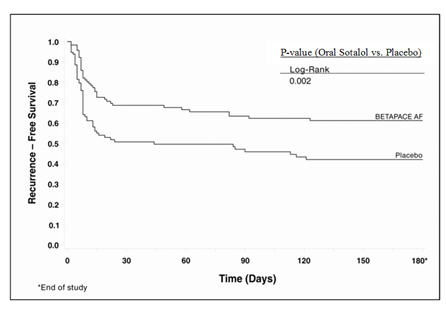
In a dose-response trial comparing three dose levels of sotalol, 80 mg, 120 mg, and 160 mg with placebo given every 12 hours (or every 24 hours in patients with a reduced renal creatinine clearance) for the prevention of recurrence of symptomatic atrial fibrillation (AFIB)/flutter (AFL), the mean ventricular rate during recurrence of AFIB/AFL was 125, 107, 110 and 99 beats/min in the placebo, 80 mg, 120 mg and 160 mg dose groups, respectively (p<0.017 for each sotalol dose group versus placebo). In another placebo- controlled trial in which sotalol was titrated to a dose between 160 and 320 mg/day in patients with chronic AFIB, the mean ventricular rate during recurrence of AFIB was 107 and 84 beats/min in the placebo and sotalol groups, respectively (p<0.001).
Twenty-five children in an unblinded, multicenter trial with supraventricular (SVT) and/or ventricular (VT) tachyarrhythmias, aged between 3 days and 12 years (mostly neonates and infants), received an ascending titration regimen with daily doses of 30, 90 and 210 mg/m2 with dosing every 8 hours for a total of 9 doses. During steady-state, the respective average increases above baseline of the QTc interval, in msec (%), were 2(+1%), 14(+4%) and 29(+7%) msec at the 3 dose levels. The respective mean maximum increases above baseline of the QTc interval, in msec (%), were 23(+6%), 36(+9%) and 55(+14%) msec at the 3 dose levels. The steady-state percent increases in the RR interval were 3, 9 and 12%. The smallest children (BSA<0.33m2) showed a tendency for larger Class III effects (∆QTc) and an increased frequency of prolongations of the QTc interval as compared with the larger children (BSA≥0.33m2). The beta-blocking effects also tended to be greater in the smaller children (BSA<0.33m2). Both the Class III and beta-blocking effects of sotalol were linearly related with the plasma concentrations.
Hemodynamics
In a study of systemic hemodynamic function measured invasively in 12 patients with a mean LV ejection fraction of 37% and ventricular tachycardia (9 sustained and 3 non-sustained), a median dose of 160 mg twice daily of sotalol produced a 28% reduction in heart rate and a 24% decrease in cardiac index at 2 hours post-dosing at steady-state. Concurrently, systemic vascular resistance and stroke volume showed non-significant increases of 25% and 8%, respectively. Pulmonary capillary wedge pressure increased significantly from 6.4 mmHg to 11.8 mmHg in the 11 patients who completed the study. One patient was discontinued because of worsening congestive heart failure. Mean arterial pressure, mean pulmonary artery pressure and stroke work index did not significantly change. Exercise and isoproterenol induced tachycardia are antagonized by sotalol, and total peripheral resistance increases by a small amount.
In hypertensive patients, sotalol produces significant reductions in both systolic and diastolic blood pressures. Although sotalol is usually well-tolerated hemodynamically, in patients with marginal cardiac compensation, deterioration in cardiac performance may occur [see Warnings and Precautions (5.4)].
QT Prolongation and Proarrhythmia
Advise patients to contact their healthcare provider in the event of syncope, pre-syncopal symptoms and cardiac palpitations such as fainting, dizziness or fast heartbeats. Advise patients that their healthcare provider will monitor their electrolytes and ECG during treatment [see Warnings and Precautions (5.1)].
Diarrhea, Unusual Sweating, Vomiting, Reduced Appetite, Excessive Thirst
Advise patients to contact their healthcare provider in the event of conditions conducive to electrolyte changes such as severe diarrhea, unusual sweating, vomiting, less appetite than normal or excessive thirst [see Warnings and Precautions (5.7)].
Administration
Advise patients to not change the SOTYLIZE dose prescribed by their healthcare provider.
Advise patients that, to be sure doses are accurately measured, doses for children and infants should be measured using an appropriate measuring device such as an oral syringe. Advise them that a teaspoon or tablespoon should not be used to measure SOTYLIZE doses since doing so might lead to confusion and the wrong dose.
Advise patients that they should not miss a dose, but if they do miss a dose they should not double the next dose to compensate for the missed dose; they should take the next dose at the regularly scheduled time [see Dosage and Administration (2)].
Advise patients to not interrupt or discontinue SOTYLIZE without their physician's advice, that they should get their prescription for sotalol filled and refilled on time so they do not interrupt treatment [see Dosage and Administration (2.1)].
Advise patients that they should not take SOTYLIZE if they also take another medicine that contains sotalol.
Advise patients that if overdose occurs or they take too much SOTYLIZE, take their SOTYLIZE medicine bottle with them and go to the nearest emergency room immediately. Overdoses can potentially cause life-threatening abnormal heart beats and possibly death.
Advise patients to contact their healthcare provider if they develop bradycardia.
Drug Interactions
Advise patients not to start taking other medications without first discussing new medications with their healthcare provider.
Antacids
Advise patients that they should avoid taking SOTYLIZE within 2 hours of taking antacids that contain aluminum oxide or magnesium hydroxide [see Drug Interactions (7.8)].
Rx Only
Manufactured for:
arbor
PHARMACEUTICALS, LLC
Atlanta, GA 30328
Manufactured by:
Patheon Inc.
Whitby Region Operations
111 Consumers Drive
Whitby, ON L1N 5Z5 Canada
Distributed by: Arbor Pharmaceuticals, LLC, Atlanta, GA 30328
SOTYLIZE® is a registered trademark of Arbor Pharmaceuticals, LLC
© 2015 Arbor Pharmaceuticals, LLC
SOT-PI-02