Other
Paclitaxel Protein-Bound Particles for Injectable Suspension (Albumin-Bound)
Non-Small Cell Lung Cancer
Adverse reactions were assessed in 514 Paclitaxel Protein-Bound Particles for Injectable Suspension (Albumin-Bound)/carboplatin-treated patients and 524 paclitaxel injection/carboplatin-treated patients receiving first-line systemic treatment for locally advanced (stage IIIB) or metastatic (IV) non-small cell lung cancer (NSCLC) in a multicenter, randomized, open-label trial. Paclitaxel Protein-Bound Particles for Injectable Suspension (Albumin-Bound) was administered as an intravenous infusion over 30 minutes at a dose of 100 mg/m2 on Days 1, 8, and 15 of each 21-day cycle. Paclitaxel injection was administered as an intravenous infusion over 3 hours at a dose of 200 mg/m2, following premedication. In both treatment arms carboplatin at a dose of AUC = 6 mg•min/mL was administered intravenously on Day 1 of each 21-day cycle after completion of Paclitaxel Protein-Bound Particles for Injectable Suspension (Albumin-Bound)/paclitaxel infusion.
The differences in paclitaxel dose and schedule between the two arms limit direct comparison of dose- and schedule-dependent adverse reactions. Among patients evaluable for adverse reactions, the median age was 60 years, 75% were men, 81% were White, 49% had adenocarcinoma, 43% had squamous cell lung cancer, 76% were ECOG PS 1. Patients in both treatment arms received a median of 6 cycles of treatment.
The following common (≥ 10% incidence) adverse reactions were observed at a similar incidence in Paclitaxel Protein-Bound Particles for Injectable Suspension (Albumin-Bound) plus carboplatin-treated and paclitaxel injection plus carboplatin-treated patients: alopecia 56%, nausea 27%, fatigue 25%, decreased appetite 17%, asthenia 16%, constipation 16%, diarrhea 15%, vomiting 12%, dyspnea 12%, and rash 10% (incidence rates are for the Paclitaxel Protein-Bound Particles for Injectable Suspension (Albumin-Bound) plus carboplatin treatment group).
Table 7 provides the frequency and severity of laboratory-detected abnormalities which occurred with a difference of ≥ 5% for all grades (1-4) or ≥ 2% for Grade 3-4 toxicity between Paclitaxel Protein-Bound Particles for Injectable Suspension (Albumin-Bound) plus carboplatin-treated patients or paclitaxel injection plus carboplatin-treated patients.
| 1 508 patients assessed in Paclitaxel Protein-Bound Particles for Injectable Suspension (Albumin-Bound)/carboplatin-treated group. 2 514 patients assessed in paclitaxel injection/carboplatin-treated group. 3 513 patients assessed in paclitaxel injection/carboplatin-treated group. | ||||
Paclitaxel Protein-Bound Particles for Injectable Suspension (Albumin-Bound) (100 mg/m2 weekly) | Paclitaxel Injection (200 mg/m2 every 3 weeks) | |||
Grades 1-4 (%) | Grade 3-4 (%) | Grades 1-4 (%) | Grade 3-4 (%) | |
Anemia1,2 | 98 | 28 | 91 | 7 |
Neutropenia1,3 | 85 | 47 | 83 | 58 |
Thrombocytopenia1,3 | 68 | 18 | 55 | 9 |
Table 8 provides the frequency and severity of adverse reactions, which occurred with a difference of ≥ 5% for all grades (1-4) or ≥ 2% for Grade 3-4 between either treatment group for the 514 Paclitaxel Protein-Bound Particles for Injectable Suspension (Albumin-Bound) plus carboplatin-treated patients compared with the 524 patients who received paclitaxel injection plus carboplatin.
| a Peripheral neuropathy is defined by the MedDRA Version 14.0 SMQ neuropathy (broad scope). | ||||||||||
System Organ | Adverse Reaction | Paclitaxel Protein-Bound Particles for Injectable Suspension (Albumin-Bound) (100 mg/m2 weekly) | Paclitaxel Injection (200 mg/m2 | |||||||
Grade 1-4 | Grade 3-4 | Grades 1-4 | Grade 3-4 | |||||||
Nervous system disorders | Peripheral neuropathya | 48 | 3 | 64 | 12 | |||||
General disorders and administration site conditions | Edema peripheral | 10 | 0 | 4 | <1 | |||||
Respiratory thoracic and mediastinal disorders | Epistaxis | 7 | 0 | 2 | 0 | |||||
Musculoskeletal and connective tissue disorders | Arthralgia | 13 | <1 | 25 | 2 | |||||
Myalgia | 10 | <1 | 19 | 2 | ||||||
For the Paclitaxel Protein-Bound Particles for Injectable Suspension (Albumin-Bound) plus carboplatin treated group, 17/514 (3%) patients developed Grade 3 peripheral neuropathy and no patients developed Grade 4 peripheral neuropathy. Grade 3 neuropathy improved to Grade 1 or resolved in 10/17 patients (59%) following interruption or discontinuation of Paclitaxel Protein-Bound Particles for Injectable Suspension (Albumin-Bound).
Adenocarcinoma of the Pancreas
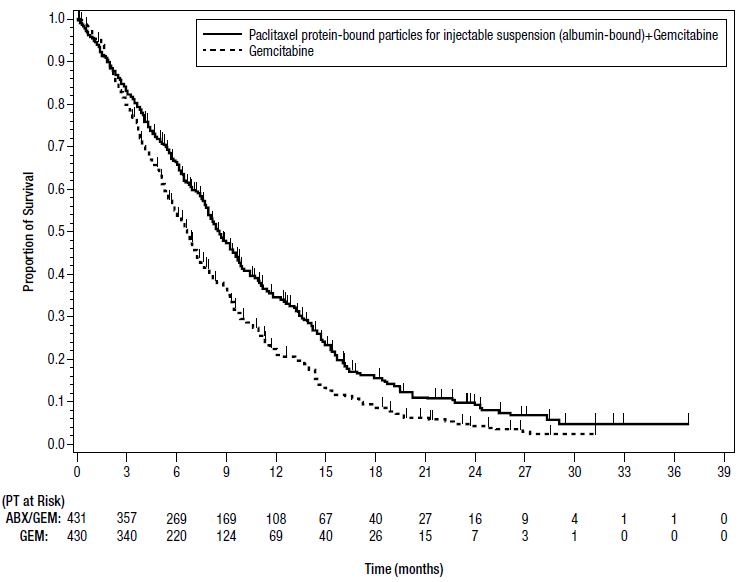
Adverse reactions were assessed in 421 patients who received Paclitaxel Protein-Bound Particles for Injectable Suspension (Albumin-Bound) plus gemcitabine and 402 patients who received gemcitabine for the first-line systemic treatment of metastatic adenocarcinoma of the pancreas in a multicenter, multinational, randomized, controlled, open-label trial. Patients received a median treatment duration of 3.9 months in the Paclitaxel Protein-Bound Particles for Injectable Suspension (Albumin-Bound)/gemcitabine group and 2.8 months in the gemcitabine group. For the treated population, the median relative dose intensity for gemcitabine was 75% in the Paclitaxel Protein-Bound Particles for Injectable Suspension (Albumin-Bound)/gemcitabine group and 85% in the gemcitabine group. The median relative dose intensity of Paclitaxel Protein-Bound Particles for Injectable Suspension (Albumin-Bound) was 81%.
Table 9 provides the frequency and severity of laboratory-detected abnormalities which occurred at a higher incidence for Grades 1-4 (≥ 5%) or for Grade 3-4 (≥ 2%) toxicity in Paclitaxel Protein-Bound Particles for Injectable Suspension (Albumin-Bound) plus gemcitabine-treated patients.
| a 405 patients assessed in Paclitaxel Protein-Bound Particles for Injectable Suspension (Albumin-Bound)/gemcitabine-treated group. b 388 patients assessed in gemcitabine-treated group. c 404 patients assessed in Paclitaxel Protein-Bound Particles for Injectable Suspension (Albumin-Bound)/gemcitabine-treated group. d Neutrophil growth factors were administered to 26% of patients in the Paclitaxel Protein-Bound Particles for Injectable Suspension (Albumin-Bound)/gemcitabine group. | ||||
Paclitaxel Protein-Bound Particles for Injectable Suspension (Albumin-Bound) (125 mg/m2)/ | Gemcitabine | |||
Grades 1-4 | Grade 3-4 | Grades 1-4 | Grade 3-4 | |
Neutropeniaa,b | 73 | 38 | 58 | 27 |
Thrombocytopeniab,c | 74 | 13 | 70 | 9 |
Table 10 provides the frequency and severity of adverse reactions which occurred with a difference of ≥ 5% for all grades or ≥ 2% for Grade 3 or higher in the Paclitaxel Protein-Bound Particles for Injectable Suspension (Albumin-Bound) plus gemcitabine-treated group compared to the gemcitabine group.
| a Peripheral neuropathy is defined by the MedDRA Version 15.0 Standard MedDRA Query neuropathy (broad scope). b Urinary tract infections includes the preferred terms of: urinary tract infection, cystitis, urosepsis, urinary tract infection bacterial, and urinary tract infection enterococcal. | ||||||||||
System Organ Class | Adverse Reaction | Paclitaxel Protein-Bound Particles for Injectable Suspension (Albumin-Bound) (125 mg/m2) and | Gemcitabine (N=402) | |||||||
All Grades | Grade 3 or | All Grades | Grade 3 or | |||||||
General disorders and | Fatigue | 248 (59%) | 77 (18%) | 183 (46%) | 37 (9%) | |||||
Peripheral edema | 194 (46%) | 13 (3%) | 122 (30%) | 12 (3%) | ||||||
Pyrexia | 171 (41%) | 12 (3%) | 114 (28%) | 4 (1%) | ||||||
Asthenia | 79 (19%) | 29 (7%) | 54 (13%) | 17 (4%) | ||||||
Mucositis | 42 (10%) | 6 (1%) | 16 (4%) | 1 (<1%) | ||||||
Gastrointestinal disorders | Nausea | 228 (54%) | 27 (6%) | 192 (48%) | 14 (3%) | |||||
Diarrhea | 184 (44%) | 26 (6%) | 95 (24%) | 6 (1%) | ||||||
Vomiting | 151 (36%) | 25 (6%) | 113 (28%) | 15 (4%) | ||||||
Skin and subcutaneous | Alopecia | 212 (50%) | 6 (1%) | 21 (5%) | 0 | |||||
Rash | 128 (30%) | 8 (2%) | 45 (11%) | 2 (<1%) | ||||||
Nervous system disorders | Peripheral neuropathya | 227 (54%) | 70 (17%) | 51 (13%) | 3 (1%) | |||||
Dysgeusia | 68 (16%) | 0 | 33 (8%) | 0 | ||||||
Headache | 60 (14%) | 1 (<1%) | 38 (9%) | 1 (<1%) | ||||||
Metabolism and nutrition | Decreased appetite | 152 (36%) | 23 (5%) | 104 (26%) | 8 (2%) | |||||
Dehydration | 87 (21%) | 31 (7%) | 45 (11%) | 10 (2%) | ||||||
Hypokalemia | 52 (12%) | 18 (4%) | 28 (7%) | 6 (1%) | ||||||
Respiratory, thoracic and | Cough | 72 (17%) | 0 | 30 (7%) | 0 | |||||
Epistaxis | 64 (15%) | 1 (<1%) | 14 (3%) | 1 (<1%) | ||||||
Infections and infestations | Urinary tract infections b | 47 (11%) | 10 (2%) | 20 (5%) | 1 (<1%) | |||||
Musculoskeletal and | Pain in extremity | 48 (11%) | 3 (1%) | 24 (6%) | 3 (1%) | |||||
Arthralgia | 47 (11%) | 3 (1%) | 13 (3%) | 1 (<1%) | ||||||
Myalgia | 44 (10%) | 4 (1%) | 15 (4%) | 0 | ||||||
Psychiatric disorders | Depression | 51 (12%) | 1 (<1%) | 24 (6%) | 0 | |||||
Additional clinically relevant adverse reactions that were reported in < 10% of the patients with adenocarcinoma of the pancreas who received Paclitaxel Protein-Bound Particles for Injectable Suspension (Albumin-Bound)/gemcitabine included:
Infections & infestations: oral candidiasis, pneumonia
Vascular disorders: hypertension
Cardiac disorders: tachycardia, congestive cardiac failure
Eye disorders: cystoid macular edema
Peripheral Neuropathy
Grade 3 peripheral neuropathy occurred in 17% of patients who received Paclitaxel Protein-Bound Particles for Injectable Suspension (Albumin-Bound)/gemcitabine compared to 1% of patients who received gemcitabine only; no patients developed Grade 4 peripheral neuropathy. The median time to first occurrence of Grade 3 peripheral neuropathy in the Paclitaxel Protein-Bound Particles for Injectable Suspension (Albumin-Bound) arm was 140 days. Upon suspension of Paclitaxel Protein-Bound Particles for Injectable Suspension (Albumin-Bound) dosing, the median time to improvement from Grade 3 peripheral neuropathy to ≤ Grade 1 was 29 days. Of Paclitaxel Protein-Bound Particles for Injectable Suspension (Albumin-Bound)-treated patients with Grade 3 peripheral neuropathy, 44% resumed Paclitaxel Protein-Bound Particles for Injectable Suspension (Albumin-Bound) at a reduced dose.
Sepsis
Sepsis occurred in 5% of patients who received Paclitaxel Protein-Bound Particles for Injectable Suspension (Albumin-Bound)/gemcitabine compared to 2% of patients who received gemcitabine alone. Sepsis occurred both in patients with and without neutropenia. Risk factors for sepsis included biliary obstruction or presence of biliary stent.
Pneumonitis
Pneumonitis occurred in 4% of patients who received Paclitaxel Protein-Bound Particles for Injectable Suspension (Albumin-Bound)/gemcitabine compared to 1% of patients who received gemcitabine alone. Two of 17 patients in the Paclitaxel Protein-Bound Particles for Injectable Suspension (Albumin-Bound) arm with pneumonitis died.
Accidental Exposure
Upon inhalation of paclitaxel, dyspnea, chest pain, burning eyes, sore throat, and nausea have been reported.
Following topical exposure, tingling, burning, and redness have been reported.
Risk Summary
Based on its mechanism of action and findings in animals, Paclitaxel Protein-Bound Particles for Injectable Suspension (Albumin-Bound) can cause fetal harm when administered to a pregnant woman [see Clinical Pharmacology (12.1)]. There are no available human data on Paclitaxel Protein-Bound Particles for Injectable Suspension (Albumin-Bound) use in pregnant women to inform the drug-associated risk.
In animal reproduction studies, administration of paclitaxel formulated as albumin-bound particles to pregnant rats during the period of organogenesis resulted in embryo-fetal toxicity at doses approximately 2% of the daily maximum recommended human dose on a mg/m2 basis (see Data). Advise females of reproductive potential of the potential risk to a fetus.
The background rate of major birth defects and miscarriage is unknown for the indicated population. In the U.S. general population, the estimated background risk of major birth defects and miscarriage in clinically recognized pregnancies is 2% to 4% and 15% to 20%, respectively.
Data
Animal Data
In embryo-fetal development studies, intravenous administration of paclitaxel formulated as albumin-bound particles to rats during pregnancy, on gestation days 7 to 17 at doses of 6 mg/m2 (approximately 2% of the daily maximum recommended human dose on a mg/m2 basis) caused embryo-fetal toxicities, as indicated by intrauterine mortality, increased resorptions (up to 5-fold), reduced numbers of litters and live fetuses, reduction in fetal body weight, and increase in fetal anomalies. Fetal anomalies included soft tissue and skeletal malformations, such as eye bulge, folded retina, microphthalmia, and dilation of brain ventricles.
Risk Summary
There are no data on the presence of paclitaxel in human milk, or its effect on the breastfed child or on milk production. In animal studies, paclitaxel and/or its metabolites were excreted into the milk of lactating rats (see Data). Because of the potential for serious adverse reactions in a breastfed child from Paclitaxel Protein-Bound Particles for Injectable Suspension (Albumin-Bound), advise lactating women not to breastfeed during treatment with Paclitaxel Protein-Bound Particles for Injectable Suspension (Albumin-Bound) and for two weeks after the last dose.
Data
Animal Data
Following intravenous administration of radiolabeled paclitaxel to rats on days 9 to 10 postpartum, concentrations of radioactivity in milk were higher than in plasma and declined in parallel with the plasma concentrations.
Pregnancy Testing
Verify the pregnancy status of females of reproductive potential prior to starting treatment with Paclitaxel Protein-Bound Particles for Injectable Suspension (Albumin-Bound).
Contraception
Females
Advise females of reproductive potential to use effective contraception and avoid becoming pregnant during treatment with Paclitaxel Protein-Bound Particles for Injectable Suspension (Albumin-Bound) and for at least six months after the last dose of Paclitaxel Protein-Bound Particles for Injectable Suspension (Albumin-Bound).
Males
Based on findings in genetic toxicity and animal reproduction studies, advise males with female partners of reproductive potential to use effective contraception and avoid fathering a child during treatment with Paclitaxel Protein-Bound Particles for Injectable Suspension (Albumin-Bound) and for at least three months after the last dose of Paclitaxel Protein-Bound Particles for Injectable Suspension (Albumin-Bound) [see Use in Specific Populations (8.1) and Nonclinical Toxicology (13.1)].
Infertility
Females and Males
Based on findings in animals, Paclitaxel Protein-Bound Particles for Injectable Suspension (Albumin-Bound) may impair fertility in females and males of reproductive potential [see Nonclinical Toxicology (13.1)].
Severe Myelosuppression
- Patients must be informed of the risk of low blood cell counts and severe and life-threatening infections and instructed to contact their healthcare provider immediately for fever or evidence of infection [see Warnings and Precautions (5.1), (5.3)].
- Patients must be informed that sensory neuropathy occurs frequently with Paclitaxel Protein-Bound Particles for Injectable Suspension (Albumin-Bound) and patients should advise their healthcare providers of numbness, tingling, pain, or weakness involving the extremities [see Warnings and Precautions (5.2)].
- Instruct patients to contact their healthcare provider immediately for sudden onset of dry persistent cough, or shortness of breath [see Warnings and Precautions (5.4)].
- Instruct patients to contact their healthcare provider for signs of an allergic reaction, which could be severe and sometimes fatal [see Warnings and Precautions (5.5)].
- Explain to patients that alopecia, fatigue/asthenia, and myalgia/arthralgia occur frequently with Paclitaxel Protein-Bound Particles for Injectable Suspension (Albumin-Bound).
- Instruct patients to contact their healthcare providers for persistent vomiting, diarrhea, or signs of dehydration [see Adverse Reactions (6)].
- Paclitaxel Protein-Bound Particles for Injectable Suspension (Albumin-Bound) injection can cause fetal harm. Advise patients to avoid becoming pregnant while receiving this drug. Females of reproductive potential should use effective contraception during treatment with Paclitaxel Protein-Bound Particles for Injectable Suspension (Albumin-Bound) and for at least six months after the last dose of Paclitaxel Protein-Bound Particles for Injectable Suspension (Albumin-Bound) [see Warnings and Precautions (5.8) and Use in Specific Populations (8.1, 8.3)].
- Advise male patients with female partners of reproductive potential to use effective contraception and avoid fathering a child during treatment with Paclitaxel Protein-Bound Particles for Injectable Suspension (Albumin-Bound) and for at least three months after the last dose of Paclitaxel Protein-Bound Particles for Injectable Suspension (Albumin-Bound) [see Use in Specific Populations (8.3)].
- Advise patients not to breastfeed while taking Paclitaxel Protein-Bound Particles for Injectable Suspension (Albumin-Bound) and for two weeks after receiving the last dose [see Use in Specific Populations (8.2)].
- Advise males and females of reproductive potential that Paclitaxel Protein-Bound Particles for Injectable Suspension (Albumin-Bound) may impair fertility [see Use in Specific Populations (8.3)].
Severe Neuropathy
Pneumonitis
Severe Hypersensitivity
Common Adverse Reactions
Embryo-Fetal Toxicity
Lactation
Infertility
Manufactured for: TWi Pharmaceuticals USA, Inc.
Paramus, NJ 07652
PACTWIPI.012/PPI.012