14.1 Monotherapy
Dutasteride 0.5 mg/day (n = 2,167) or placebo (n = 2,158) was evaluated in male subjects with BPH in three 2-year multicenter, placebo-controlled, double-blind trials, each with 2-year open-label extensions (n = 2,340). More than 90% of the trial population was white. Subjects were aged at least 50 years with a serum PSA ≥1.5 ng/mL and <10 ng/mL and BPH diagnosed by medical history and physical examination, including enlarged prostate (≥30 cc) and BPH symptoms that were moderate to severe according to the American Urological Association Symptom Index (AUA-SI). Most of the 4,325 subjects randomly assigned to receive either dutasteride or placebo completed 2 years of double-blind treatment (70% and 67%, respectively). Most of the 2,340 subjects in the trial extensions completed 2 additional years of open-label treatment (71%).
Effect on Symptom Scores
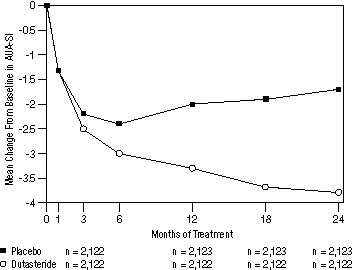
Symptoms were quantified using the AUA-SI, a questionnaire that evaluates urinary symptoms (incomplete emptying, frequency, intermittency, urgency, weak stream, straining, and nocturia) by rating on a 0 to 5 scale for a total possible score of 35, with higher numerical total symptom scores representing greater severity of symptoms. The baseline AUA-SI score across the 3 trials was approximately 17 units in both treatment groups.
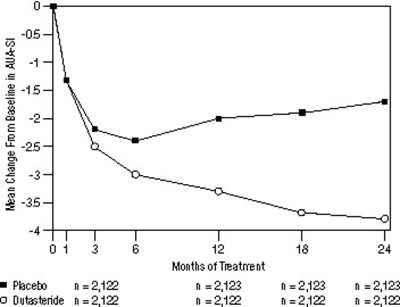
Subjects receiving dutasteride achieved statistically significant improvement in symptoms versus placebo by Month 3 in 1 trial and by Month 12 in the other 2 pivotal trials. At Month 12, the mean decrease from baseline in AUA-SI total symptom scores across the 3 trials pooled was -3.3 units for dutasteride and -2.0 units for placebo with a mean difference between the 2 treatment groups of -1.3 (range: -1.1 to -1.5 units in each of the 3 trials, P<0.001) and was consistent across the 3 trials. At Month 24, the mean decrease from baseline was -3.8 units for dutasteride and -1.7 units for placebo with a mean difference of -2.1 (range: -1.9 to -2.2 units in each of the 3 trials, P<0.001). See Figure 1. The improvement in BPH symptoms seen during the first 2 years of double-blind treatment was maintained throughout an additional 2 years of open-label extension trials.
These trials were prospectively designed to evaluate effects on symptoms based on prostate size at baseline. In men with prostate volumes ≥40 cc, the mean decrease was -3.8 units for dutasteride and -1.6 units for placebo, with a mean difference between the 2 treatment groups of -2.2 at Month 24. In men with prostate volumes <40 cc, the mean decrease was -3.7 units for dutasteride and -2.2 units for placebo, with a mean difference between the 2 treatment groups of -1.5 at Month 24.
Figure 1. AUA-SI Scorea Change from Baseline (Randomized, Double-blind, Placebo-Controlled Trials Pooled)
Dutasteride-pic1 (Dutasteride Pic1)
aAUA-SI score ranges from 0 to 35.
Effect on Acute Urinary Retention and the Need for BPH-Related Surgery
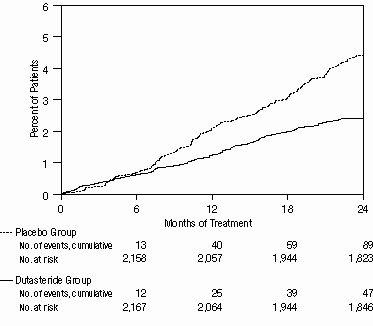
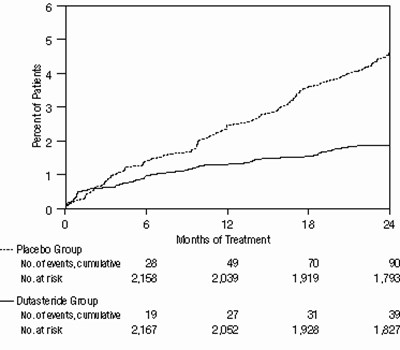
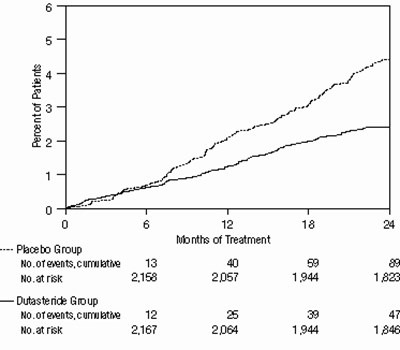
Efficacy was also assessed after 2 years of treatment by the incidence of AUR requiring catheterization and BPH-related urological surgical intervention. Compared with placebo, Dutasteride was associated with a statistically significantly lower incidence of AUR (1.8% for Dutasteride versus 4.2% for placebo, P<0.001; 57% reduction in risk, [95% CI: 38% to 71%]) and with a statistically significantly lower incidence of surgery (2.2% for Dutasteride versus 4.1% for placebo, P<0.001; 48% reduction in risk, [95% CI: 26% to 63%]). See Figures 2 and 3.
Figure 2. Percent of Subjects Developing Acute Urinary Retention Over a 24-Month Period (Randomized, Double-blind, Placebo-Controlled Trials Pooled)
Dutasteride-pic2 (Dutasteride Pic2)
Figure 3. Percent of Subjects Having Surgery for Benign Prostatic Hyperplasia over a 24-Month Period (Randomized, Double-blind, Placebo-Controlled Trials Pooled)
Dutasteride-pic3 (Dutasteride Pic3)
Effect on Prostate Volume
A prostate volume of at least 30 cc measured by transrectal ultrasound was required for trial entry. The mean prostate volume at trial entry was approximately 54 cc.
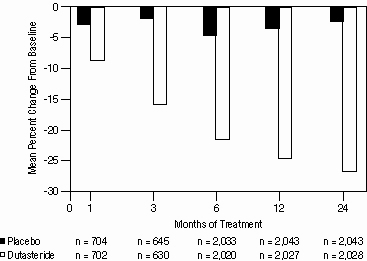
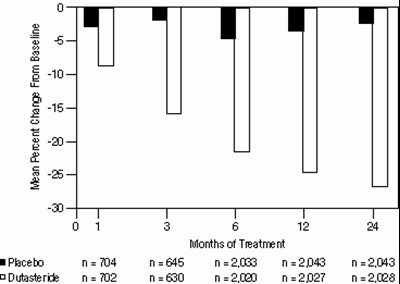
Statistically significant differences (Dutasteride versus placebo) were noted at the earliest post-treatment prostate volume measurement in each trial (Month 1, Month 3, or Month 6) and continued through Month 24. At Month 12, the mean percent change in prostate volume across the 3 trials pooled was -24.7% for dutasteride and -3.4% for placebo; the mean difference (dutasteride minus placebo) was -21.3% (range: -21.0% to -21.6% in each of the 3 trials, P<0.001). At Month 24, the mean percent change in prostate volume across the 3 trials pooled was -26.7% for dutasteride and -2.2% for placebo with a mean difference of -24.5% (range: -24.0% to -25.1% in each of the 3 trials, P<0.001). See Figure 4. The reduction in prostate volume seen during the first 2 years of double-blind treatment was maintained throughout an additional 2 years of open-label extension trials.
Figure 4. Prostate Volume Percent Change from Baseline (Randomized, Double-blind, Placebo-Controlled Trials Pooled)
Dutasteride-pic4 (Dutasteride Pic4)
Effect on Maximum Urine Flow Rate
A mean peak urine flow rate (Qmax) of ≤15 mL/sec was required for trial entry. Qmax was approximately 10 mL/sec at baseline across the 3 pivotal trials.
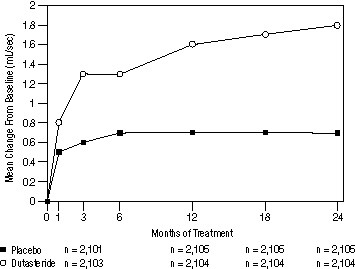
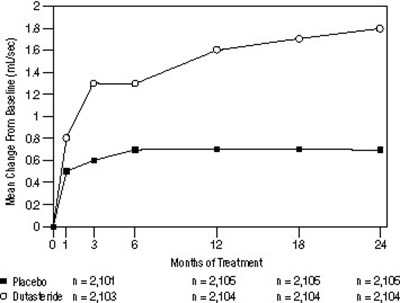
Differences between the 2 groups were statistically significant from baseline at Month 3 in all 3 trials and were maintained through Month 12. At Month 12, the mean increase in Qmax across the 3 trials pooled was 1.6 mL/sec for Dutasteride and 0.7 mL/sec for placebo; the mean difference (dutasteride minus placebo) was 0.8 mL/sec (range: 0.7 to 1.0 mL/sec in each of the 3 trials, P<0.001). At Month 24, the mean increase in Qmax was 1.8 mL/sec for dutasteride and 0.7 mL/sec for placebo, with a mean difference of 1.1 mL/sec (range: 1.0 to 1.2 mL/sec in each of the 3 trials, P<0.001). See Figure 5. The increase in maximum urine flow rate seen during the first 2 years of double-blind treatment was maintained throughout an additional 2 years of open-label extension trials.
Figure 5. Qmax Change from Baseline (Randomized, Double-blind, Placebo-Controlled Trials Pooled)
Dutasteride-pic5 (Dutasterie Pic5)
Summary of Clinical Trials
Data from 3 large, well-controlled efficacy trials demonstrate that treatment with Dutasteride (0.5 mg once daily) reduces the risk of both AUR and BPH-related surgical intervention relative to placebo, improves BPH-related symptoms, decreases prostate volume, and increases maximum urinary flow rates. These data suggest that Dutasteride arrests the disease process of BPH in men with an enlarged prostate.
14.2 Combination with Alpha-blocker Therapy (CombAT)
The efficacy of combination therapy (Dutasteride 0.5 mg/day plus tamsulosin 0.4 mg/day, n = 1,610) was compared with Dutasteride alone (n = 1,623) or tamsulosin alone (n = 1,611) in a 4-year multicenter, randomized, double-blind trial. Trial entry criteria were similar to the double-blind, placebo-controlled monotherapy efficacy trials described in section 14.1. Eighty-eight percent (88%) of the enrolled trial population was white. Approximately 52% of subjects had previous exposure to 5 alpha-reductase-inhibitor or alpha-adrenergic-antagonist treatment. Of the 4,844 subjects randomly assigned to receive treatment, 69% of subjects in the combination group, 67% in the group receiving Dutasteride, and 61% in the tamsulosin group completed 4 years of double-blind treatment.
Effect on Symptom Score
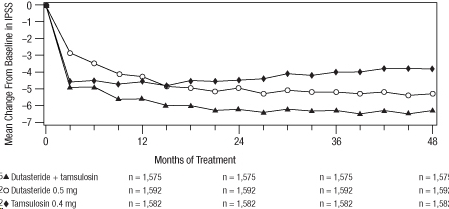
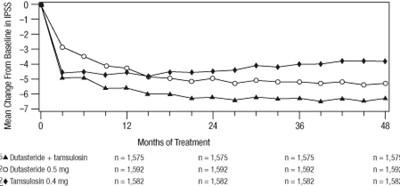
Symptoms were quantified using the first 7 questions of the International Prostate Symptom Score (IPSS) (identical to the AUA-SI). The baseline score was approximately 16.4 units for each treatment group. Combination therapy was statistically superior to each of the monotherapy treatments in decreasing symptom score at Month 24, the primary time point for this endpoint. At Month 24 the mean changes from baseline (±SD) in IPSS total symptom scores were -6.2 (±7.14) for combination, -4.9 (±6.81) for Dutasteride, and -4.3 (±7.01) for tamsulosin, with a mean difference between combination and Dutasteride of -1.3 units (P<0.001; [95% CI: -1.69, -0.86]), and between combination and tamsulosin of -1.8 units (P<0.001; [95% CI: -2.23, -1.40]). A significant difference was seen by Month 9 and continued through Month 48. At Month 48 the mean changes from baseline (±SD) in IPSS total symptom scores were -6.3 (±7.40) for combination, -5.3 (±7.14) for Dutasteride, and -3.8 (±7.74) for tamsulosin, with a mean difference between combination and Dutasteride of -0.96 units (P<0.001; [95% CI: -1.40, -0.52]), and between combination and tamsulosin of -2.5 units (P<0.001; [95% CI: -2.96, -2.07]). See Figure 6.
Figure 6. International Prostate Symptom Score Change from Baseline Over a 48-Month Period (Randomized, Double-blind, Parallel-Group Trial [CombAT Trial])
Dutasteride-pic6 (Dutasteride Pic6)
Effect on Acute Urinary Retention or the Need for BPH-Related Surgery
After 4 years of treatment, combination therapy with Dutasteride and tamsulosin did not provide benefit over monotherapy with Dutasteride in reducing the incidence of AUR or BPH-related surgery.
Effect on Maximum Urine Flow Rate
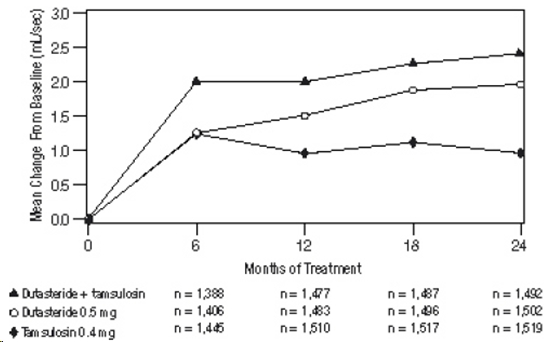
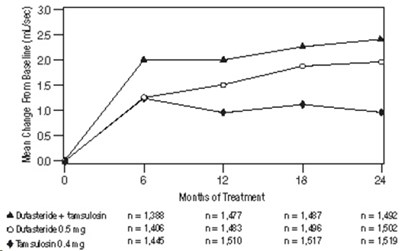
The baseline Qmax was approximately 10.7 mL/sec for each treatment group. Combination therapy was statistically superior to each of the monotherapy treatments in increasing Qmax at Month 24, the primary time point for this endpoint. At Month 24, the mean increases from baseline (±SD) in Qmax were 2.4 (±5.26) mL/sec for combination, 1.9 (±5.10) mL/sec for Dutasteride, and 0.9 (±4.57) mL/sec for tamsulosin, with a mean difference between combination and Dutasteride of 0.5 mL/sec (P = 0.003; [95% CI: 0.17, 0.84]), and between combination and tamsulosin of 1.5 mL/sec (P<0.001; [95% CI: 1.19, 1.86]). This difference was seen by Month 6 and continued through Month 24. See Figure 7.
The additional improvement in Qmax of combination therapy over monotherapy with Dutasteride was no longer statistically significant at Month 48.
Figure7. Qmax Change from Baseline Over a 24-Month Period (Randomized, Double-blind, Parallel Group Trial [CombAT Trial])
Dutasteride-pic7 (Dutasteride Pic7)
Effect on Prostate Volume
The mean prostate volume at trial entry was approximately 55 cc. At Month 24, the primary time point for this endpoint, the mean percent changes from baseline (±SD) in prostate volume were -26.9% (±22.57) for combination therapy, -28.0% (±24.88) for Dutasteride, and 0% (±31.14) for tamsulosin, with a mean difference between combination and Dutasteride of 1.1% (P = NS; [95% CI: -0.6, 2.8]), and between combination and tamsulosin of -26.9% (P<0.001; [95% CI: -28.9, -24.9]). Similar changes were seen at Month 48: -27.3% (±24.91) for combination therapy, -28.0% (±25.74) for Dutasteride, and +4.6% (±35.45) for tamsulosin.