Adjust the dose of cefepime for injection in patients with creatinine clearance less than or equal to 60 mL/min to compensate for the slower rate of renal elimination. In these patients, the recommended initial dose of cefepime for injection should be the same as in patients with CrCL greater than 60 mL/min except in patients undergoing hemodialysis. The recommended doses of cefepime for injection in patients with renal impairment are presented in Table 2.
When only serum creatinine is available, the following formula (Cockcroft and Gault equation)1 may be used to estimate creatinine clearance. The serum creatinine should represent a steady state of renal function:
In patients undergoing Continuous Ambulatory Peritoneal Dialysis (CAPD), cefepime for injection may be administered at the recommended doses at a dosage interval of every 48 hours (see Table 2).
In patients undergoing hemodialysis, approximately 68% of the total amount of cefepime present in the body at the start of dialysis will be removed during a 3-hour dialysis period. The dosage of cefepime for injection for hemodialysis patients is 1 g on Day 1 followed by 500 mg every 24 hours for the treatment of all infections except febrile neutropenia, which is 1 g every 24 hours.
Cefepime for injection should be administered at the same time each day and following the completion of hemodialysis on hemodialysis days (see Table 2).
Data in pediatric patients with impaired renal function are not available; however, since cefepime pharmacokinetics are similar in adults and pediatric patients [see Clinical Pharmacology (12.3)], changes in the dosing regimen proportional to those in adults (see Tables 1 and 2) are recommended for pediatric patients.
- Constitute the 1 gram or 2 grams vial, of cefepime for injection with the one of the following diluents:
- Sterile Water for Injection
- 0.9% Sodium Chloride Injection
- 5% Dextrose Injection
- 0.5% or 1% Lidocaine Hydrochloride Injection
- Sterile Bacteriostatic Water for Injection with Parabens or Benzyl Alcohol
- Dilute the reconstituted solution with one of the following compatible infusion solutions prior to intravenous infusion (Refer to Table 3 below for the amount of diluent to be added to each vial and the amount of the reconstituted solution to be withdrawn):
- 0.9% Sodium Chloride Injection
- 5% and 10% Dextrose Injection
- M/6 Sodium Lactate Injection
- 5% Dextrose and 0.9% sodium Chloride Injection
- Lactated Ringers and 5% Dextrose Injection
- Normosol®-R and Normosol®-M in 5% Dextrose Injection
- Parenteral drugs should be inspected visually for particulate matter before administration. If particulate matter is evident in reconstituted fluids, the drug solution should be discarded.
- Administer the resulting intravenous infusion over approximately 30 minutes.
- Intermittent intravenous infusion with a Y-type administration set can be accomplished with compatible solutions. However, during infusion of a solution containing cefepime, it is desirable to discontinue the other solution.
Intravenous Cefepime for Injection
Intravenous Infusion Compatibility
Cefepime for injection vials are compatible at concentrations between 1 mg per mL and 40 mg per mL with the following intravenous infusion fluids: 0.9% Sodium Chloride Injection, 5% and 10% Dextrose Injection, M/6 Sodium Lactate Injection, 5% Dextrose and 0.9% Sodium Chloride Injection, Lactated Ringers and 5% Dextrose Injection, Normosol®-R, and Normosol®-M in 5% Dextrose Injection. These solutions may be stored up to 24 hours at controlled room temperature 20°C to 25°C (68°F to 77°F) or 7 days in a refrigerator 2°C to 8°C (36°F to 46°F).
Admixture Compatibility
Cefepime for injection admixture compatibility information is summarized in Table 4.
Table 4: Cefepime Admixture Stability
|
|
|
|
| | | | |
Cefepime for
injection
Concentration | Admixture and
Concentration | Intravenous (IV)
Infusion Solutions | RT/L
(20° to 25°C) | Stability Time for Refrigeration
(2° to 8°C) |
| 40 mg/mL
| Amikacin
6 mg/mL
| NS or D5W
| 24 hours
| 7 days
|
| 40 mg/mL
| Ampicillin
1 mg/mL
| D5W
| 8 hours
| 8 hours
|
| 40 mg/mL
| Ampicillin
10 mg/mL
| D5W
| 2 hours
| 8 hours
|
| 40 mg/mL
| Ampicillin
1 mg/mL
| NS
| 24 hours
| 48 hours
|
| 40 mg/mL
| Ampicillin
10 mg/mL
| NS
| 8 hours
| 48 hours
|
| 4 mg/mL
| Ampicillin
40 mg/mL
| NS
| 8 hours
| 8 hours
|
| 4 to 40 mg/mL
| Clindamycin
Phosphate
0.25 to 6 mg/mL
| NS or D5W
| 24 hours
| 7 days
|
| 4 mg/mL
| Heparin
10 to 50 units/mL
| NS or D5W
| 24 hours
| 7 days
|
| 4 mg/mL
| Potassium Chloride
10 to 40 mEq/L
| NS or D5W
| 24 hours
| 7 days
|
| 4 mg/mL
| Theophylline
0.8
mg/mL
| D5W
| 24 hours
| 7 days
|
| 1 to 4 mg/mL
| na
| Aminosyn™ II
4.25% with
electrolytes and
calcium
| 8 hours
| 3 days
|
0.125 to 0.25
mg/mL
| na
| Inpersol™ with
4.25% dextrose
| 24 hours
| 7 days
|
Cefepime for Injection Admixture Incompatibility
Do not add solutions of cefepime for injection to solutions of ampicillin at a concentration greater than 40 mg per mL, or to metronidazole, vancomycin, gentamicin, tobramycin, netilmicin sulfate, or aminophylline because of potential interaction. However, if concurrent therapy with cefepime for injection is indicated, each of these antibacterial drugs can be administered separately.
Intramuscular Cefepime for Injection
Cefepime for injection constituted as directed is stable for 24 hours at controlled room temperature 20°C to 25°C (68°F to 77°F) or for 7 days in a refrigerator 2°C to 8°C (36°F to 46°F) with the following diluents: Sterile Water for Injection, 0.9% Sodium Chloride Injection, 5% Dextrose Injection, Sterile Bacteriostatic Water for Injection with Parabens or Benzyl Alcohol, or 0.5% or 1% Lidocaine Hydrochloride.
Intramuscular and Intravenous Cefepime for Injection
As with other cephalosporins, the color of cefepime for injection powder, as well as its solutions tend to darken depending on storage conditions; however, when stored as recommended, the product potency is not adversely affected.
Urinary Glucose
The administration of cefepime may result in a false-positive reaction for glucose in the urine when using some methods (e.g. ClinitestTM tablets) [see Drug Interactions (7.1)].
Coombs' Tests
Positive direct Coombs' tests have been reported during treatment with cefepime for injection. In patients who develop hemolytic anemia, discontinue the drug and institute appropriate therapy. Positive Coombs' test may be observed in newborns whose mothers have received cephalosporin antibacterial drugs before parturition.
Prothrombin Time
Many cephalosporins, including cefepime, have been associated with a fall in prothrombin activity. Those at risk include patients with renal or hepatic impairment, or poor nutritional state, as well as patients receiving a protracted course of antimicrobial therapy. Prothrombin time should be monitored in patients at risk, and exogenous vitamin K administered as indicated.
Risk Summary
There are no cases of cefepime exposure during pregnancy reported from postmarketing experience or from clinical trials. Available data from published observational studies and case reports over several decades with cephalosporin use in pregnant women have not established drug-associated risks of major birth defects, miscarriage or adverse maternal or fetal outcomes (see Data).
Cefepime was not associated with adverse developmental outcomes in rats, mice, or rabbits when administered parenterally during organogenesis. The doses used in these studies were 1.6 (rats), approximately equal to (mice), and 0.3 times (rabbits) the recommended maximum human dose (see Data).
The estimated background risk of major birth defects and miscarriage for the indicated population is unknown. All pregnancies have a background risk of birth defect, loss, or other adverse outcomes. In the U.S. general population, the estimated background risk of major birth defects and miscarriage in clinically recognized pregnancies is 2% to 4% and 15% to 20%, respectively.
Data
Human Data
While available studies cannot definitively establish the absence of risk, published data from case-control studies and case reports over several decades have not identified an association with cephalosporin use during pregnancy and major birth defects, miscarriage, or other adverse maternal or fetal outcomes. Available studies have methodologic limitations, including small sample size, retrospective data collection, and inconsistent comparator groups.
Animal Data
Cefepime was not embryocidal and did not cause fetal malformations when administered parenterally during the period of organogenesis to rats at doses up to 1000 mg/kg/day, to mice at doses up to 1200 mg/kg/day, or to rabbits at doses up to 100 mg/kg/day. These doses are 1.6 times (rats), approximately equal to (mice), and 0.3 times (rabbits) the maximum recommended clinical dose based on body surface area.
Risk Summary
Cefepime is present in human breast milk at low concentrations (approximately 0.5 mcg/mL) following a single intravenous dose of 1000 mg. A nursing infant consuming approximately 1000 mL of human milk per day would receive approximately 0.5 mg of cefepime per day (see Data). There is no information regarding the effects of cefepime on the breastfed infant or on milk production.
The developmental and health benefits of breastfeeding should be considered along with the mother's clinical need for cefepime and any potential adverse effects on the breastfed child from cefepime or from the underlying maternal condition.
Data
A pharmacokinetic study was conducted in 9 healthy lactating women to evaluate the concentrations of cefepime in plasma and breast milk following a single intravenous dose of 1000 mg. The mean breast milk concentrations of cefepime during the first 8 hours post-dose were approximately 0.5 mcg/mL and then declined and became undetectable between 12- and 24-hours post-dose. The mean cumulative breast milk excretion of cefepime over 24 hours was 0.01% of the administered dose. The pharmacokinetics of cefepime are similar between lactating and non-lactating women.
Absorption
Following intramuscular (IM) administration, cefepime is completely absorbed.
Distribution
The average steady-state volume of distribution of cefepime is 18 (±2) L. The serum protein binding of cefepime is approximately 20% and is independent of its concentration in serum.
Concentrations of cefepime achieved in specific tissues and body fluids are listed in Table 9.
Table 9: Mean Concentrations of Cefepime in Specific Body Fluids (mcg/mL) or Tissues (mcg/g)
| Tissue or Fluid | Dose/
Route | # of Patients | Mean Time of Sample Post-Dose (h) | Mean Concentration |
| Blister Fluid
| 2 g IV
| 6
| 1.5
| 81.4 mcg/mL
|
| Bronchial Mucosa
| 2 g IV
| 20
| 4.8
| 24.1 mcg/g
|
| Sputum
| 2 g IV
| 5
| 4
| 7.4 mcg/mL
|
| Urine
| 500 mg IV
1 g IV
2 g IV
| 8
12
12
| 0 to 4
0 to 4
0 to 4
| 292 mcg/mL
926 mcg/mL
3120 mcg/mL
|
| Bile
| 2 g IV
| 26
| 9.4
| 17.8 mcg/mL
|
| Peritoneal Fluid
| 2 g IV
| 19
| 4.4
| 18.3 mcg/mL
|
| Appendix
| 2 g IV
| 31
| 5.7
| 5.2 mcg/g
|
| Gallbladder
| 2 g IV
| 38
| 8.9
| 11.9 mcg/g
|
| Prostate
| 2 g IV
| 5
| 1
| 31.5 mcg/g
|
Data suggest that cefepime does cross the inflamed blood-brain barrier. The clinical relevance of these data is uncertain at this time.
Metabolism and Excretion
Cefepime is metabolized to N-methylpyrrolidine (NMP) which is rapidly converted to the N-oxide (NMP-N-oxide). Urinary recovery of unchanged cefepime accounts for approximately 85% of the administered dose. Less than 1% of the administered dose is recovered from urine as NMP, 6.8% as NMP-N-oxide, and 2.5% as an epimer of cefepime. Because renal excretion is a significant pathway of elimination, patients with renal dysfunction and patients undergoing hemodialysis require dosage adjustment [see Dosage and Administration (2.3)].
Specific Populations
Patients with Renal impairment
Cefepime pharmacokinetics have been investigated in patients with various degrees of renal impairment (n=30). The average half-life in patients requiring hemodialysis was 13.5 (±2.7) hours and in patients requiring continuous peritoneal dialysis was 19 (±2) hours. Cefepime total body clearance decreased proportionally with creatinine clearance in patients with abnormal renal function, which serves as the basis for dosage adjustment recommendations in this group of patients [see Dosage and Administration (2.3)].
Patients with Hepatic impairment
The pharmacokinetics of cefepime were unaltered in patients with hepatic impairment who received a single 1 g dose (n=11).
Geriatric patients
Cefepime pharmacokinetics have been investigated in elderly (65 years of age and older) men (n=12) and women (n=12) whose mean (SD) creatinine clearance was 74 (±15) mL/min. There appeared to be a decrease in cefepime total body clearance as a function of creatinine clearance. Therefore, dosage administration of cefepime in the elderly should be adjusted as appropriate if the patient's creatinine clearance is 60 mL/min or less [see Dosage and Administration (2.3)].
Pediatric patients
Cefepime pharmacokinetics have been evaluated in pediatric patients from 2 months to 11 years of age following single and multiple doses on every 8 hours (n=29) and every 12 hours (n=13) schedules. Following a single intravenous dose, total body clearance and the steady-state volume of distribution averaged 3.3 (±1) mL/min/kg and 0.3 (±0.1) L/kg, respectively. The urinary recovery of unchanged cefepime was 60.4 (±30.4)% of the administered dose, and the average renal clearance was 2 (±1.1) mL/min/kg. There were no significant effects of age or gender (25 male vs. 17 female) on total body clearance or volume of distribution, corrected for body weight. No accumulation was seen when cefepime was given at 50 mg per kg every 12 hours (n=13), while Cmax, AUC, and t½ were increased about 15% at steady state after 50 mg per kg every 8 hours. The exposure to cefepime following a 50 mg per kg intravenous dose in a pediatric patient is comparable to that in an adult treated with a 2 g intravenous dose. The absolute bioavailability of cefepime after an intramuscular dose of 50 mg per kg was 82.3 (±15)% in eight patients.
Mechanism of Action
Cefepime is a bactericidal drug that acts by inhibition of bacterial cell wall synthesis. Cefepime has a broad spectrum of in vitro activity that encompasses a wide range of Gram-positive and Gram-negative bacteria. Within bacterial cells, the molecular targets of cefepime are the penicillin binding proteins (PBP).
Antimicrobial Activity
Cefepime has been shown to be active against most isolates of the following microorganisms, both in vitro and in clinical infections as described in the Indications and Usage section (1).
Gram-negative Bacteria
Enterobacter spp.
Escherichia coli
Klebsiella pneumoniae
Proteus mirabilis
Pseudomonas aeruginosa
Gram-positive Bacteria
Staphylococcus aureus (methicillin-susceptible isolates only)
Streptococcus pneumoniae
Streptococcus pyogenes
Viridans group streptococci
The following in vitro data are available, but their clinical significance is unknown. At least 90 percent of the following bacteria exhibit an in vitro minimum inhibitory concentration (MIC) less than or equal to the susceptible breakpoint for cefepime against isolates of similar genus or organism group. However, the efficacy of cefepime in treating clinical infections due to these bacteria has not been established in adequate and well-controlled clinical trials.
Gram-positive Bacteria
Staphylococcus epidermidis (methicillin-susceptible isolates only)
Staphylococcus saprophyticus
Streptococcus agalactiae
NOTE: Most isolates of enterococci, e.g., Enterococcus faecalis, and methicillin-resistant staphylococci are resistant to cefepime.
Gram-negative Bacteria
Acinetobacter calcoaceticus subsp. lwoffii
Citrobacter diversus
Citrobacter freundii
Enterobacter agglomerans
Haemophilus influenzae
Hafnia alvei
Klebsiella oxytoca
Moraxella catarrhalis
Morganella morganii
Proteus vulgaris
Providencia rettgeri
Providencia stuartii
Serratia marcescens
NOTE: Cefepime is inactive against many isolates of Stenotrophomonas maltophilia.
Susceptibility Testing
For specific information regarding susceptibility test interpretive criteria and associated test methods and quality control standards recognized by FDA for this drug, please see: https://www.fda.gov/STIC.
How Supplied
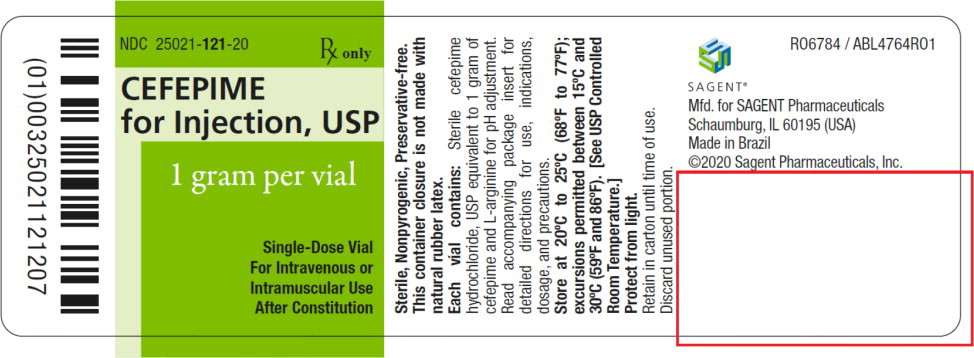
Cefepime for Injection, USP is supplied as follows:
Cefepime for Injection, USP in the dry state, is a white to pale yellow powder. Constituted solution of Cefepime for Injection, USP can range in color from pale yellow to amber.
|
| NDC | Cefepime for Injection, USP | Package Factor |
| 25021-121-20
| 1 gram* Single-Dose Vial
| 10 vials per carton
|
| 25021-122-50
| 2 gram* Single-Dose Vial
| 10 vials per carton
|