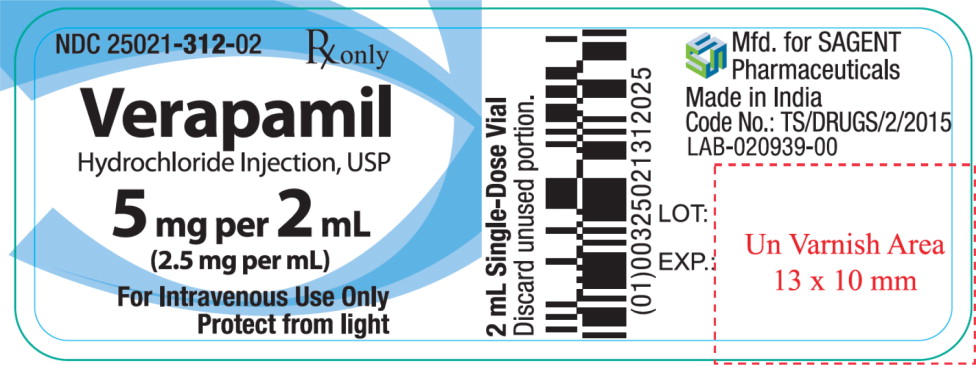
Other
SAGENT®
Rx only
Digitalis: Verapamil hydrochloride injection has been used concomitantly with digitalis preparations without the occurrence of serious adverse effects. However, since both drugs slow AV conduction, patients should be monitored for AV block or excessive bradycardia.
Procainamide: Verapamil hydrochloride injection has been administered to a small number of patients receiving oral procainamide without the occurrence of serious adverse effects.
Quinidine: Verapamil hydrochloride injection has been administered to a small number of patients receiving oral quinidine without the occurrence of serious adverse effects. However, three patients have been described in whom the combination resulted in an exaggerated hypotensive response presumably from the combined ability of both drugs to antagonize the effects of catecholamines on α-adrenergic receptors. Caution should therefore be used when employing this combination of drugs.
Beta-Adrenergic Blocking Drugs: Verapamil hydrochloride injection has been administered to patients receiving oral beta-blockers without the development of serious adverse effects. However, since both drugs may depress myocardial contractility and AV conduction, the possibility of detrimental interactions should be considered. The concomitant administration of intravenous beta-blockers and intravenous verapamil has resulted in serious adverse reactions (see CONTRAINDICATIONS), especially in patients with severe cardiomyopathy, congestive heart failure, or recent myocardial infarction.
Disopyramide: Until data on possible interactions between verapamil and all forms of disopyramide phosphate are obtained, disopyramide should not be administered within 48 hours before or 24 hours after verapamil administration.
Flecainide: A study in healthy volunteers showed that the concomitant administration of flecainide and verapamil may have additive effects reducing myocardial contractility, prolonging AV conduction, and prolonging repolarization.
Heart Block: Verapamil prolongs AV conduction time. While high-degree AV block has not been observed in controlled clinical trials in the United States, a low percentage (less than 0.5%) has been reported in the world literature. Development of second- or third-degree AV block or unifascicular, bifascicular, or trifascicular bundle branch block requires reduction in subsequent doses or discontinuation of verapamil and institution of appropriate therapy, if needed. (See ADVERSE REACTIONS, Suggested Treatment of Acute Cardiovascular Adverse Reactions.)
Hepatic and Renal Failure: Significant hepatic and renal failure should not increase the effects of a single intravenous dose of verapamil hydrochloride but may prolong its duration. Repeated injections of verapamil hydrochloride injection in such patients may lead to accumulation and an excessive pharmacologic effect of the drug. There is no experience to guide use of multiple doses in such patients, and this generally should be avoided. If repeated injections are essential, blood pressure and PR interval should be closely monitored and smaller repeat doses should be utilized.
Verapamil cannot be removed by hemodialysis.
Premature Ventricular Contractions: During conversion to normal sinus rhythm, or marked reduction in ventricular rate, a few benign complexes of unusual appearance (sometimes resembling premature ventricular contractions) may be seen after treatment with verapamil hydrochloride. Similar complexes are seen during spontaneous conversion of supraventricular tachycardias, after D.C.-cardioversion and other pharmacologic therapy. These complexes appear to have no clinical significance.
Duchenne's Muscular Dystrophy: Verapamil hydrochloride injection can precipitate respiratory muscle failure in these patients and should, therefore, be used with caution.
Increased Intracranial Pressure: Verapamil hydrochloride injection has been seen to increase intracranial pressure in patients with supratentorial tumors at the time of anesthesia induction. Caution should be taken and appropriate monitoring performed.
Cimetidine: The interaction between cimetidine and chronically administered verapamil has not been studied. In acute studies of healthy volunteers, clearance of verapamil was either reduced or unchanged.
Lithium: Increased sensitivity to the effects of lithium (neurotoxicity) has been reported during concomitant verapamil-lithium therapy with either no change or an increase in serum lithium levels. The addition of verapamil, however, has also resulted in the lowering of serum lithium levels in patients receiving chronic stable oral lithium. Patients receiving both drugs must be monitored carefully.
Carbamazepine: Verapamil therapy may increase carbamazepine concentrations during combined therapy. This may produce carbamazepine side effects such as diplopia, headache, ataxia, or dizziness.
Rifampin: Therapy with rifampin may markedly reduce oral verapamil bioavailability.
Phenobarbital: Phenobarbital therapy may increase verapamil clearance.
Cyclosporin: Verapamil therapy may increase serum levels of cyclosporin.
Inhalation Anesthetics: Animal experiments have shown that inhalation anesthetics depress cardiovascular activity by decreasing the inward movement of calcium ions. When used concomitantly, inhalation anesthetics and calcium antagonists (such as verapamil) should be titrated carefully to avoid excessive cardiovascular depression.
Neuromuscular Blocking Agents: Clinical data and animal studies suggest that verapamil may potentiate the activity of depolarizing and nondepolarizing neuromuscular blocking agents. It may be necessary to decrease the dose of verapamil and/or the dose of the neuromuscular blocking agent when the drugs are used concomitantly.
Dantrolene: Two animal studies suggest concomitant intravenous use of verapamil and dantrolene sodium may result in cardiovascular collapse. There has been one report of hyperkalemia and myocardial depression following the coadministration of oral verapamil and intravenous dantrolene.
Initial dose − 5 to 10 mg (0.075 to 0.15 mg/kg body weight) given as an intravenous bolus over at least 2 minutes.
Repeat dose − 10 mg (0.15 mg/kg body weight) 30 minutes after the first dose if the initial response is not adequate. An optimal interval for subsequent intravenous doses has not been determined, and should be individualized for each patient.
Older patients − The dose should be administered over at least 3 minutes to minimize the risk of untoward drug effects.
Initial dose
0 to 1 year: 0.1 to 0.2 mg/kg body weight (usual single dose range: 0.75 to 2 mg) should be administered as an intravenous bolus over at least 2 minutes under continuous ECG monitoring.
1 to 15 years: 0.1 to 0.3 mg/kg body weight (usual single dose range: 2 to 5 mg) should be administered as an intravenous bolus over at least 2 minutes. Do not exceed 5 mg.
Repeat dose
0 to 1 year: 0.1 to 0.2 mg/kg body weight (usual single dose range: 0.75 to 2 mg) 30 minutes after the first dose if the initial response is not adequate (under continuous ECG monitoring). An optimal interval for subsequent intravenous doses has not been determined, and should be individualized for each patient.
1 to 15 years: 0.1 to 0.3 mg/kg body weight (usual single dose range: 2 to 5 mg) 30 minutes after the first dose if the initial response is not adequate. Do not exceed 10 mg as a single dose. An optimal interval for subsequent intravenous doses has not been determined, and should be individualized for each patient.
Note: Parenteral drug products should be inspected visually for particulate matter and discoloration prior to administration, whenever solution and container permit. Use only if solution is clear and vial seal is intact. Unused amount of solution should be discarded immediately following withdrawal of any portion of contents.
For stability reasons this product is not recommended for dilution with Sodium Lactate Injection, USP in polyvinyl chloride bags. Verapamil is physically compatible and chemically stable for at least 24 hours at 25°C protected from light in most common large volume parenteral solutions. Admixing verapamil hydrochloride injection with albumin, amphotericin B, hydralazine hydrochloride and trimethoprim with sulfamethoxazole should be avoided. Verapamil hydrochloride injection will precipitate in any solution with a pH above 6.0.