Levetiracetam Injection, Solution
Product Images NDC 25021-795

View Photos of Packaging, Regulatory Labels, and Product Appearance

Product Visual Gallery

This gallery contains 8 technical images submitted to the FDA as part of the official labeling for Levetiracetam (NDC 25021-795). Unlike standard consumer photos, these assets often include clinical data figures, molecular chemical structures, and official manufacturer packaging layouts.

As provided by Sagent Pharmaceuticals, these visuals offer a comprehensive scientific overview of the product's physical and chemical identity, aiding pharmacists and researchers in product verification and study.

FDA Label Image

Figure (Lev21 0000 01)

Figure (Lev21 0000 01)
Chemical structure of levetiracetam showing molecular connectivity including a pyrrolidone ring and side chains with labeled atoms and bonds.*
FDA Label Image

Figure 1 (Lev21 0000 02)

Figure 1 (Lev21 0000 02)
A bar chart comparing the percentage of patients among three groups: placebo, levetiracetam 1000 mg/day, and levetiracetam 3000 mg/day. The y-axis shows the percentage of patients from 0% to 45%. The chart highlights statistically significant differences between placebo and both levetiracetam dosage groups.*
FDA Label Image

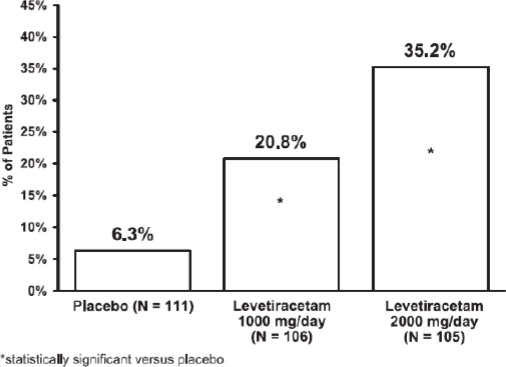
Figure 2 (Lev21 0000 03)

Figure 2 (Lev21 0000 03)
A bar graph comparing the percentage of patients across three groups: Placebo (N=111) at 6.3%, Levetiracetam 1000 mg/day (N=106) at 20.8%, and Levetiracetam 2000 mg/day (N=105) at 35.2%. The y-axis represents the percentage of patients, and a note indicates statistical significance versus placebo.*
FDA Label Image

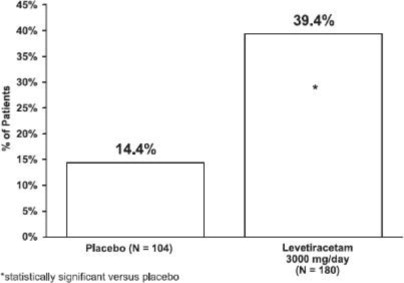
Figure 3 (Lev21 0000 04)

Figure 3 (Lev21 0000 04)
Bar chart comparing the percentage of patients between placebo and levetiracetam 3000 mg/day groups. The chart shows approximately 14.4% for the placebo group (N=104) and 39.4% for the levetiracetam group (N=180), with a notation indicating statistical significance versus placebo.*
FDA Label Image

Figure 4 (Lev21 0000 05)

Figure 4 (Lev21 0000 05)
A bar chart comparing the percentage of patients for placebo and levetiracetam groups. The placebo group (N=84) shows approximately 45.2% of patients, while the levetiracetam group (N=79) shows approximately 72.2% of patients. A note indicates the difference is statistically significant versus placebo.*
FDA Label Image

Package Label – Principal Display Panel – Bag Label (Lev21 0000 06)

Package Label – Principal Display Panel – Bag Label (Lev21 0000 06)
Label for Levetiracetam Injection in 0.82% Sodium Chloride, 500 mg per 100 mL (5 mg/mL) intravenous solution. The label includes dosage instructions, cautions about plastic container connections, storage recommendations (20° to 25°C), and references Sagent Pharmaceuticals as the manufacturer. The package size shown is 100 mL in a single-dose dual port bag.*
FDA Label Image

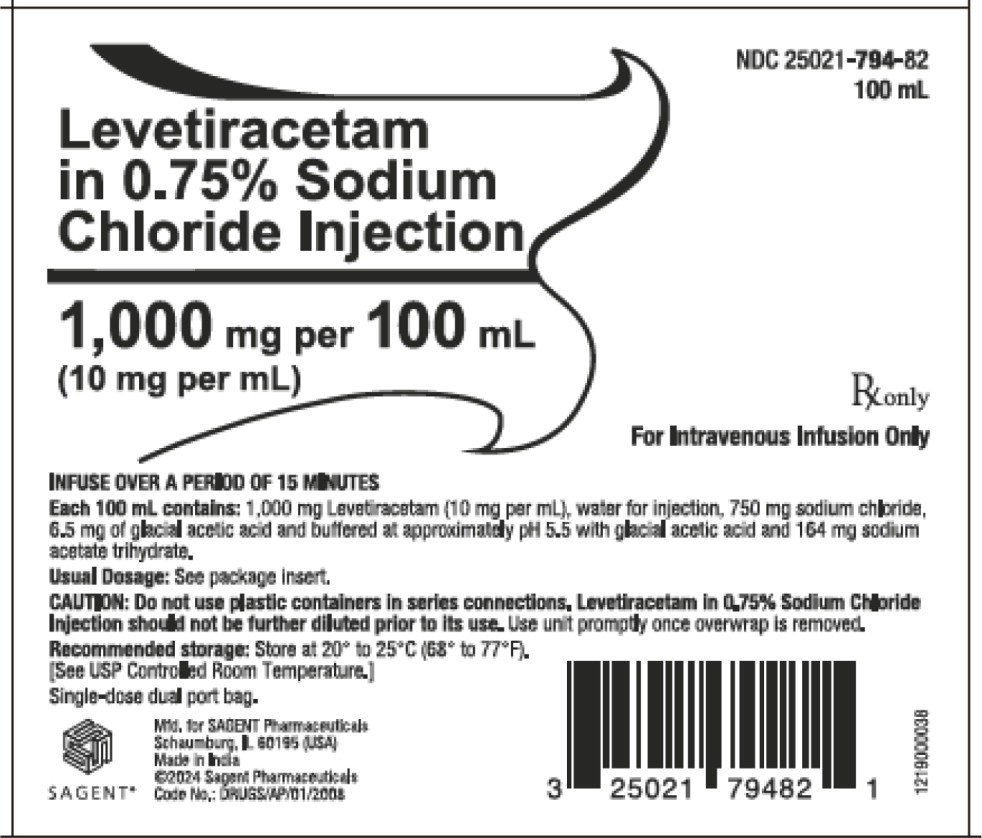
Package Label – Principal Display Panel – Bag Label (Lev21 0000 07)

Package Label – Principal Display Panel – Bag Label (Lev21 0000 07)
Label for Levetiracetam in 0.75% Sodium Chloride Injection, 10 mg/mL, 100 mL intravenous injection solution. The label shows dosage strength as 1,000 mg per 100 mL, indicates use for intravenous infusion only, storage instructions, and is manufactured by Sagent Pharmaceuticals. Includes a barcode and NDC 25021-794-82.*
FDA Label Image

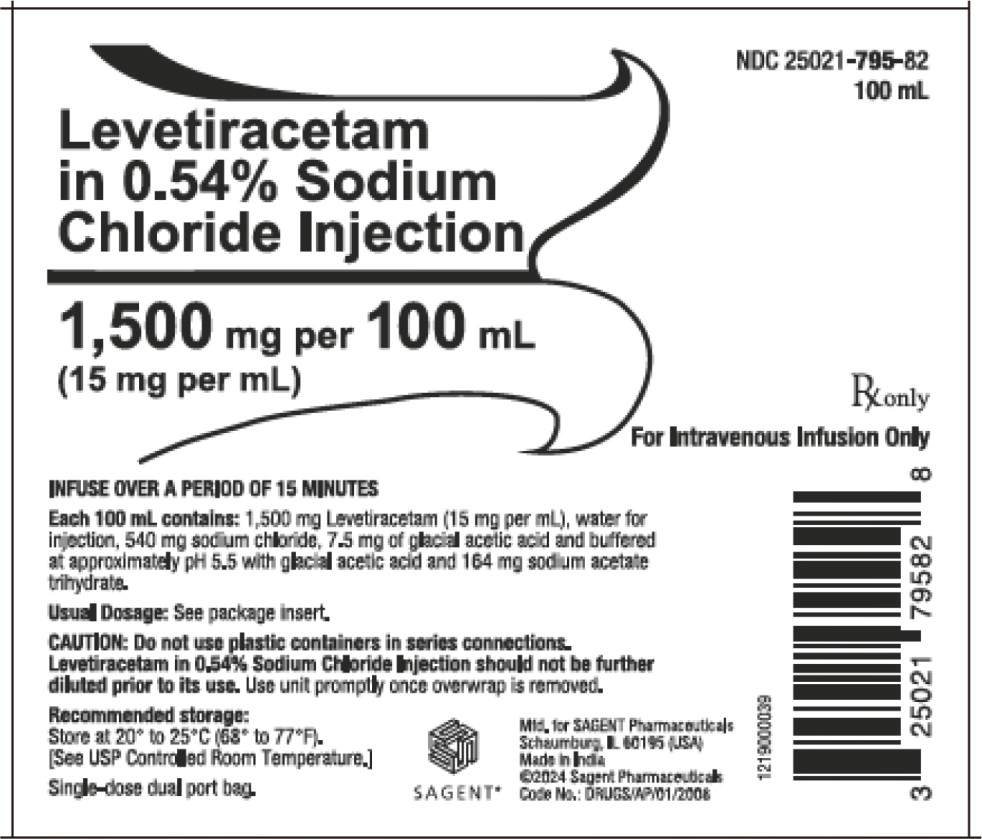
Package Label – Principal Display Panel – Bag Label (Lev21 0000 08)

Package Label – Principal Display Panel – Bag Label (Lev21 0000 08)
Label for Levetiracetam Injection, 15 mg/mL (1,500 mg per 100 mL) in 0.54% Sodium Chloride, packaged in a 100 mL single-dose dual port bag. It is for intravenous infusion only, labeled by Sagent Pharmaceuticals, with instructions to infuse over 15 minutes and storage at 20° to 25°C (68° to 77°F).*

* About these descriptions: Image descriptions on this page are generated by automated AI analysis of the product label images from the manufacturer's FDA label submission (SPL). They are provided for reference only and may contain errors or omissions. Always rely on the printed label itself and the official FDA labeling, and consult a pharmacist or healthcare professional with any questions about this product.