Interference with Thyroid Radioactive Iodine Uptake Studies
Because ZYOGREEN contains sodium iodide, the iodine-binding capacity of thyroid tissue may be reduced for at least one week following administration. Do not perform radioactive iodine uptake studies for at least one week following administration of ZYOGREEN.
Risk Summary
There are no adequate and well-controlled studies of ZYOGREEN in pregnant women. Available data from a very small number of scientific literature studies with indocyanine green use in pregnant women over several decades have not reported any drug associated risks for major birth defects, miscarriage, or adverse maternal or fetal outcomes. Data from one small study in which indocyanine green was administered intravenously to pregnant women during labor suggest there is no placental transfer of the drug. Animal reproduction studies have not been conducted with indocyanine green.
All pregnancies have a background risk of birth defects, loss, or other adverse outcomes. In the U.S. general population, the estimated background risk of major birth defects and miscarriage in clinically recognized pregnancies is 2 to 4% and 15 to 20%, respectively.
Risk Summary
Seventeen cases of indocyanine green use in lactating women have been reported in the scientific literature with no adverse events observed in the breastfed infant.
However, there are no data on the presence of indocyanine green in human milk or the effects on milk production. Therefore, the developmental and health benefits of breastfeeding should be considered along with the mother's clinical need for ZYOGREEN and any potential adverse effects on the breastfed infant from ZYOGREEN or from the underlying maternal condition.
Use in Pediatric Patients for Visualization of Vessels, Blood Flow and Tissue Perfusion
The safety and effectiveness of ZYOGREEN for fluorescence imaging of vessels (micro- and macro-vasculature), blood flow and tissue perfusion before, during and after vascular, gastrointestinal, organ transplant, plastic, micro- and reconstructive surgeries, including general minimally invasive surgical procedures have been established in pediatric patients. Use of ZYOGREEN for this indication in pediatric patients is supported by evidence from clinical trials in adults and published studies that demonstrated the utility of indocyanine green for blood vessel evaluation and assessment of tissue perfusion in 59 pediatric patients, including 6 neonates, during surgeries within the indicated surgical categories.
Use in Pediatric Patients for Visualization of Extrahepatic Biliary Ducts
The safety and effectiveness of ZYOGREEN for fluorescence imaging of extrahepatic biliary ducts have been established in pediatric patients from birth to less than 1 year of age and in those 6 years of age and older. Use of ZYOGREEN for this indication in these age groups is supported by evidence from clinical trials in adults and from the following published studies in pediatric patients.
For patients less than 1 year of age, supporting publications included two prospective observational studies and one retrospective case series evaluating a total of 34 pediatric patients (age range: 2 to 119 days) with jaundice undergoing Kasai portoenterostomy who received indocyanine green for fluorescence imaging of biliary structures.
For patients 6 years of age and older, a supporting publication consisted of a prospective, single institution case series in 31 pediatric patients (age range: 6 to 18 years) undergoing cholangiography with indocyanine green during laparoscopic cholecystectomy.
The safety and effectiveness of ZYOGREEN have not been established for fluorescence imaging of extrahepatic biliary ducts in pediatric patients 1 year to less than 6 years of age.
Use in Pediatric Patients for Ophthalmic Angiography
ZYOGREEN is indicated for ophthalmic angiography in pediatric patients.
Use in Pediatric Patients for Lymphatic Mapping of Cervical and Uterine Cancer
The safety and effectiveness of ZYOGREEN for fluorescence imaging of lymph nodes and lymphatic vessels during lymphatic mapping for cervical and uterine cancer have not been established in pediatric patients.
Distribution
Following intravenous injection, indocyanine green binds to plasma proteins (98%) and is largely confined to the intravascular compartment. Indocyanine green undergoes no significant extrahepatic or enterohepatic circulation; simultaneous arterial and venous blood estimations have shown negligible renal, peripheral, lung or cerebrospinal uptake of the dye. After biliary obstruction, the dye appears in the hepatic lymph, independently of the bile, suggesting that the biliary mucosa is sufficiently intact to prevent diffusion of the dye, though allowing diffusion of bilirubin.
Following interstitial injection, indocyanine green binds to proteins in lymph fluid and the interstitial space, is taken up by the lymphatic vessels, and drains to the lymph nodes.
Since excessive dye extravasation does not take place in the highly fenestrated choroidal vasculature, ZYOGREEN is useful in both absorption and fluorescence infrared angiography of the choroidal vasculature when using appropriate filters and film in a fundus camera.
Elimination
Indocyanine green is taken up from the plasma almost exclusively by the hepatic parenchymal cells and is secreted entirely into the bile.
How Supplied
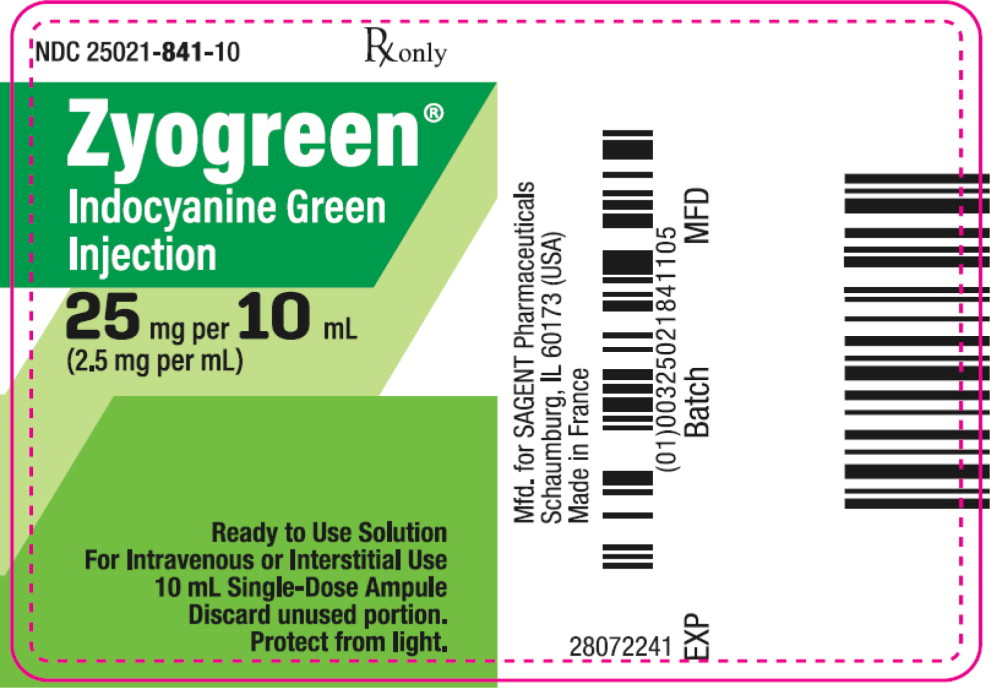
ZYOGREEN (Indocyanine Green Injection), is a deep emerald-green ready-to-use solution in amber glass ampules supplied as follows:
NDC
| ZYOGREEN®
(Indocyanine Green Injection)
(2.5 mg per mL) | Package Factor |
| 25021-841-10
| 25 mg per 10 mL Single-Dose Ampules
| 5 ampules per carton
|
Storage and Handling
Store at 20°C to 25°C (68°F to 77°F); excursions permitted to 15°C to 30°C (59°F to 86°F) [See USP Controlled Room Temperature].
Store in original carton to protect from light.
Do not refrigerate or freeze.
Use immediately after opening ampule. Discard unused portion.
Sterile, Nonpyrogenic, Preservative-free.
Not made with natural rubber latex.
Hypersensitivity Reactions
Advise patients to seek medical attention for reactions following injection of ZYOGREEN such as difficulty breathing, swollen tongue or throat, skin reactions including hives, itching and flushed or pale skin, low blood pressure, a weak and rapid pulse and other symptoms or signs of an anaphylactic reaction [see Warnings and Precautions (5.1)].
sagent®
Mfd. for SAGENT Pharmaceuticals
Schaumburg, IL 60173 (USA)
Made in France
©2026 Sagent Pharmaceuticals
June 2026