VOYDEYA has not been shown to be effective as monotherapy and should only be prescribed as an add-on to ravulizumab or eculizumab.
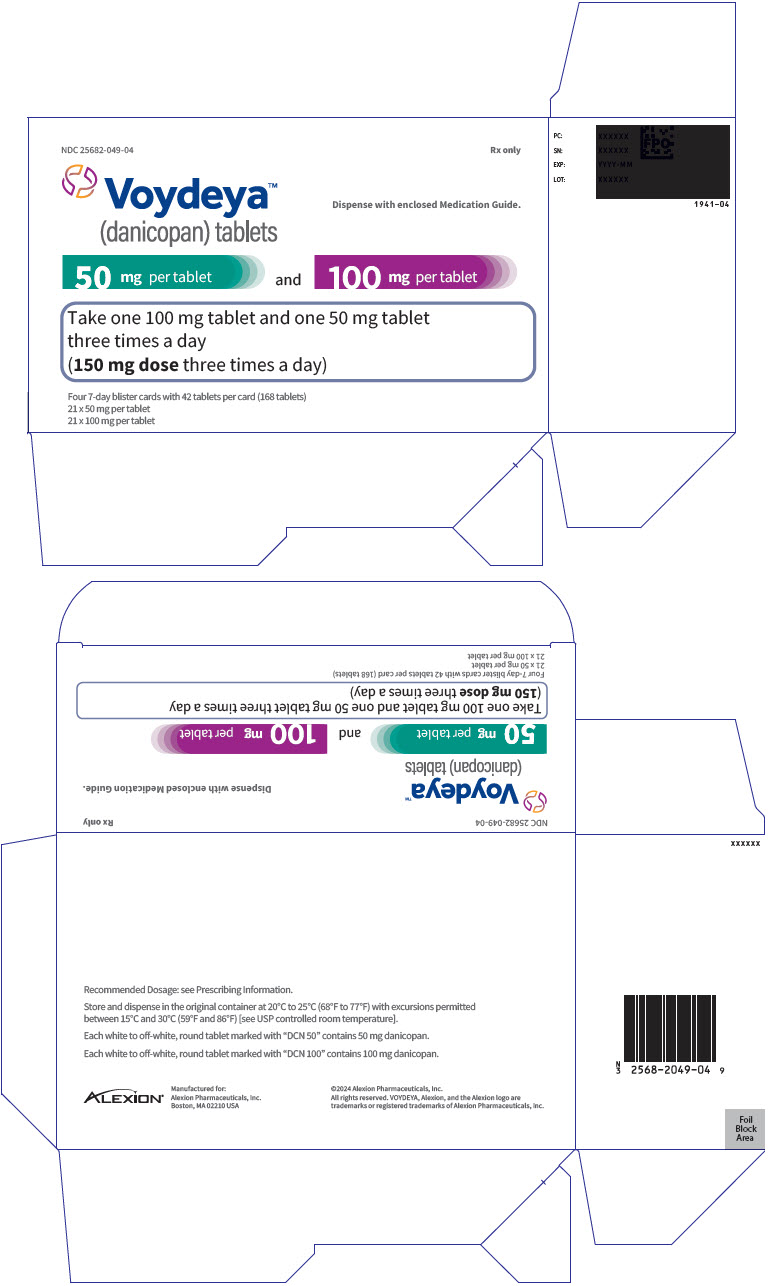
The recommended dosage of VOYDEYA is 150 mg three times a day administered orally.
VOYDEYA can be taken with or without food.
The dose can be increased to 200 mg three times a day if the patient's hemoglobin (Hgb) level has not increased by greater than 2 g/dL after 4 weeks of therapy, if the patient required a transfusion during the previous 4 weeks, or to achieve an appropriate Hgb response based on clinical judgement.
A patient who misses a dose of VOYDEYA should take it as soon as they remember unless it is within 3 hours prior to their next dose, in which case the patient should skip the missed dose and take VOYDEYA at the next regularly scheduled time. Patients should not take two or more doses of VOYDEYA at the same time.
- 50 mg, white to off-white, round, film-coated, printed with "DCN" above "50" debossed on one side, plain on the other side.
- 100 mg, white to off-white, round film-coated, printed with "DCN" above "100" debossed on one side, plain on the other side.
Rosuvastatin
Danicopan significantly increased rosuvastatin exposure. The dose of rosuvastatin should not exceed 10 mg once daily when concomitantly used with VOYDEYA [see Clinical Pharmacology (12.3)].
Risk Summary
There are no available data on VOYDEYA use in pregnant individuals to evaluate for a drug-associated risk of major birth defects, miscarriage or adverse maternal or fetal outcomes. There are risks to the mother and fetus associated with untreated PNH in pregnancy (see Clinical Considerations). The use of VOYDEYA in pregnant women or women planning to become pregnant may be considered following an assessment of the risks and benefits.
In animal reproduction studies, oral administration of danicopan to pregnant New Zealand White (NZW) rabbits and Wistar Hans (WH) rats during organogenesis at exposures 18 or 25-times, respectively, above the human exposure at the maximum recommended human dose (MRHD) of 200 mg three times a day (based on AUC) resulted in no adverse developmental effects (see Data).
The estimated background risk of major birth defects and miscarriage for the indicated population is unknown. All pregnancies have a background risk of birth defect, loss, or other adverse outcomes. In the U.S. general population, the estimated background risk of major birth defects and miscarriage in clinically recognized pregnancies is 2-4% and 15-20%, respectively.
Clinical Considerations
Disease-Associated Maternal and/or Fetal/Neonatal Risk
PNH in pregnancy is associated with adverse maternal outcomes, including worsening cytopenias, thrombotic events, infections, bleeding, miscarriages, and increased maternal mortality, and adverse fetal outcomes, including fetal death and premature delivery.
Data
Animal Data
There were no effects on early embryonic development and fetal development in NZW rabbits (where danicopan is pharmacodynamically active) up to a mean maternal systemic exposure 18-times the exposure at the MRHD (based on AUC) or during post-natal development up to a mean maternal systemic exposure 9-times the exposure at the MRHD (based on AUC). In WH rats (where danicopan lacks pharmacodynamic activity), there were no effects on embryo-fetal development up to a mean maternal exposure 25-times the exposure at the MRHD (based on AUC).
Risk Summary
There are no data on the presence of danicopan in human milk, the effects on the breastfed child, or the effect on milk production. Danicopan is present in animal milk. When a drug is present in animal milk, it is likely that the drug will be present in human milk.
Because of the potential for serious adverse reactions in the breastfed child, including serious infections with encapsulated bacteria and liver enzyme increases, advise patients not to breastfeed during treatment with VOYDEYA, and for 3-days after the last dose.
Data
Animal Data
Danicopan was excreted into the milk of lactating rabbits following oral administration from lactation day 4 to lactation day 10, with mean milk concentrations at approximately 2 hours following dose administration 5- and 3.5-times higher than the mean maternal plasma concentrations at 50 and 250 mg/kg/day, respectively. Mean milk concentrations in dams were 19- and 43-times higher than the systemic exposure at the MRHD (based on rabbit concentration at 2 hours vs. human Cmax).
Cardiac Electrophysiology
At a single-dose of 1200 mg that results in approximately 2 times the peak concentration achieved following 200 mg three times a day, VOYDEYA does not prolong the QTc interval to any clinically relevant extent.
Absorption
The median time to maximum drug concentration (Tmax) is 3.7 hours following oral administration of 150 mg danicopan in patients with PNH.
Effect of Food
When the danicopan tablet was administered with a high-fat meal, danicopan AUC and Cmax were approximately 25%, and 93% higher, respectively, compared to the fasted state. Median time to maximum drug concentration (Tmax) was comparable when danicopan was administered in the fed or fasted state at approximately 3.0 and 2.5 hours, respectively.
Distribution
Plasma protein binding of danicopan is 91.5% to 94.3%. Danicopan is mainly distributed in plasma with a whole blood to plasma distribution ratio of 0.545. The apparent volume of distribution for a 75 kg person was 395 L.
Elimination
The mean half-life (t½) is 7.9 hours. The mean apparent clearance of danicopan is 63 L/h.
Metabolism
Danicopan is extensively metabolized (96%) via oxidation, reduction, and hydrolysis pathways, with amide hydrolysis being the major pathway of elimination. Metabolism by CYP-mediated pathways is minimal.
Excretion
After a single oral administration of 150 mg [14C]-danicopan in humans, 69% of total radioactivity (danicopan plus metabolites) was excreted in feces and 25% was excreted in urine. Unchanged danicopan accounted for 3.57% and 0.48% of the dose excreted in feces and urine, respectively.
Specific Populations
No clinically significant differences in the pharmacokinetics of danicopan were observed based on sex, age (16.9 to 82 years), or race (Caucasians and Asians) based on population pharmacokinetic (PK) assessment.
Renal Impairment
Following oral administration of danicopan 200 mg in subjects with severe renal impairment (eGFR < 30 mL/min/1.73 m2), the extent of danicopan exposure (AUC0-inf) increased by 52% as compared to subjects with normal renal function. There was no clinically meaningful change in Cmax and Tmax.
Hepatic Impairment
Danicopan Cmax decreased by 27% and AUC0-inf decreased by 8% in subjects with moderate hepatic impairment (Child-Pugh B). Studies have not been conducted in patients with severe hepatic impairment (Child-Pugh Class C).
Drug Interaction Studies
Clinical Studies
Effect of Danicopan on the Pharmacokinetics of Other Drugs:
Dedicated clinical drug interaction studies showed no clinically significant drug interactions with danicopan as an inhibitor or inducer of CYP2B6 (bupropion), CYP2C9 (warfarin), CYP2C19 (omeprazole), CYP3A4 (midazolam), and UGT1A1 and UGT2B7 (mycophenolic acid).
BCRP Substrates
Co-administration of a single oral dose of rosuvastatin 20 mg with danicopan dosed to steady state (200 mg three times a day for 4 days) resulted in increased rosuvastatin Cmax and AUC0-inf by 3.3-fold and 2.2-fold, respectively.
P-gp Substrates
Co-administration of a single oral dose of fexofenadine 180 mg with danicopan dosed to steady state (150 mg three times a day for 4 days) resulted in increased fexofenadine Cmax and AUC0-inf by 1.4-fold and 1.6-fold, respectively.
Co-administration of a single oral dose of tacrolimus 2 mg with danicopan dosed to steady state (200 mg three times a day for 5 days) resulted in increased tacrolimus Cmax and AUC0-inf by 1.1-fold and 1.5-fold, respectively.
Effect of Other Drugs on the Pharmacokinetics of Danicopan:
No clinically significant drug interactions were observed for danicopan as a victim when co-administered with antacid drugs (calcium carbonate, aluminum/magnesium hydroxide/simethicone) or a proton pump inhibitor (omeprazole).
In Vitro Studies
Non-CYP based metabolism is the predominant clearance pathway for danicopan. The minimal contribution of CYP metabolism in human hepatocytes is suggestive of a very low likelihood of danicopan as a victim of CYP-based drug-drug interactions.
Danicopan is a substrate of P-gp, but not a substrate of BCRP, Organic Anion Transporting Polypeptide 1B1 (OATP1B1), or OATP1B3. Danicopan is not an inducer of CYP1A2, CYP2B6 or CYP2C9.
Danicopan is an inhibitor of BCRP and P-gp, but not an inhibitor of transporters OATP1B1, OATP1B3, Organic Anion Transporter (OAT)1, OAT3, Organic Cation Transporter 2 (OCT2), or Multidrug And Toxin Extrusion 1 and 2K (MATE1 and MATE2-K).
Carcinogenesis
Danicopan was not carcinogenic in the 6-month carcinogenicity study in the TgRasH2 mouse model. Danicopan was not carcinogenic in the 2-year rat carcinogenicity study at exposures 15- to 23-times the exposure at the MRHD (based on AUC).
Mutagenesis
Danicopan was not genotoxic in the Ames bacterial reverse mutation assay, in vitro micronucleus assay in human peripheral blood lymphocytes, or in the in vivo micronucleus assay in rats.
Impairment of Fertility
In a rabbit study, reductions in male and female fertility and copulation/conception indices were observed at mean exposures 13-times the exposure at the MRHD (based on AUC).
Paroxysmal Nocturnal Hemoglobinuria (PNH)
The efficacy of VOYDEYA in adults with PNH and clinically significant EVH was assessed in a multiple-region, randomized, double-blind, placebo-controlled study (ALXN2040-PNH-301; NCT04469465). Clinically significant EVH was defined by anemia (hemoglobin [Hgb] ≤ 9.5 g/dL) with absolute reticulocyte count ≥ 120 × 109/L with or without transfusion support. The study enrolled patients with PNH who had been treated with a stable dose of ravulizumab or eculizumab for at least the previous 6 months.
VOYDEYA was administered orally at 150 mg three times a day, escalated to 200 mg three times a day depending on the clinical response.
Patients were vaccinated against meningococcal infection prior to or at the time of initiating treatment with VOYDEYA if vaccination status within 3 years could not be verified.
Patients were randomized to VOYDEYA or placebo in a 2:1 ratio for 12 weeks in addition to background ravulizumab or eculizumab treatment. After Week 12, all patients received VOYDEYA in combination with their background ravulizumab or eculizumab treatment up to Week 24. After Week 24, patients could enter a long-term extension period and continue to receive VOYDEYA with background ravulizumab or eculizumab.
Efficacy was based on the change in Hgb level from Baseline to Week 12. Other efficacy measures included the proportion of patients with Hgb increase of ≥ 2 g/dL at Week 12 in the absence of transfusions, the proportion of patients with transfusion avoidance through Week 12, the change from Baseline in Functional Assessment of Chronic Illness Therapy (FACIT)-Fatigue scores at Week 12, and change from Baseline in absolute reticulocyte count at Week 12. Transfusion avoidance was considered as achieved only by the patients who did not receive a transfusion and did not meet the protocol specified guidelines for transfusion from Baseline through Week 12.
A pre-specified interim analysis was performed when 63 participants reached the end (either completed or discontinued) of Week 12.
Baseline demographic and disease history characteristics were generally balanced between treatment groups.
Table 2 presents the baseline characteristics of the patients with PNH enrolled in the study.
Table 2 Baseline Characteristics in PNH Study (ALXN2040-PNH-301)| Parameter | Statistics | VOYDEYA
(Add-on to ravulizumab or eculizumab)
N = 42 | Placebo
(Add-on to ravulizumab or eculizumab)
N = 21 |
|---|
| Abbreviations: FACIT = Functional Assessment of Chronic Illness Therapy; LDH = lactate dehydrogenase; N = number of patients; pRBC = packed red blood cell; SD = standard deviation |
| Age (years) | Mean (SD) | 55 (16) | 53 (14) |
| Median | 58 | 53 |
| Min, max | 25, 80 | 29, 75 |
| Sex | n (%) | | |
| Male | | 19 (45.2) | 7 (33.3) |
| Female | | 23 (54.8) | 14 (66.7) |
| Race | n (%) | | |
| American Indian or Alaska Native | | 1 (2.4) | 0 |
| Asian | | 18 (42.9) | 7 (33.3) |
| Black or African American | | 1 (2.4) | 0 |
| White | | 19 (45.2) | 9 (42.9) |
| Other | | 1 (2.4) | 0 |
| Unknown | | 0 | 1 (4.8) |
| Not Reported | | 2 (4.8) | 4 (19.0) |
| Ethnicity | n (%) | | |
| Hispanic or Latino | | 4 (9.5) | 0 |
| Not Hispanic or Latino | | 34 (81.0) | 17 (81.0) |
| Not reported | | 4 (9.5) | 4 (19.0) |
| Hemoglobin level (g/dL) | Mean (SD) | 7.7 (0.9) | 7.7 (1.0) |
| Reticulocyte count (109/L) | N | 42 | 20 |
| Mean (SD) | 236 (91) | 241 (120) |
| Number of patients with pRBC/whole blood transfusions within 24 weeks prior to first dose | n (%) | 38 (90) | 17 (81) |
| pRBC/whole blood Transfusions within 24 weeks prior to first dose | Mean (SD) | 2.5 (2.2) | 2.6 (2.1) |
| LDH (U/L) | N | 42 | 20 |
| Mean (SD) | 299 (106) | 278 (68) |
| FACIT-Fatigue score Fatigue-related symptoms and impacts were assessed using a patient reported outcome instrument, FACIT-Fatigue (score range from 0 to 52 with higher scores indicating less fatigue). | Mean (SD) | 33 (11) | 34 (11) |
| Background treatment with: | n (%) | | |
| Ravulizumab | | 27 (64.3) | 10 (47.6) |
| Eculizumab | | 15 (35.7) | 11 (52.4) |
Efficacy was established based on demonstration of superiority of VOYDEYA in combination with ravulizumab or eculizumab compared to placebo in combination with ravulizumab or eculizumab in all efficacy measures with statistically significant results (Table 3).
Table 3 Efficacy Results for Patients with PNH (Study ALXN2040-PNH-301) | VOYDEYA (Add-on to ravulizumab or eculizumab)
(N = 42) | Placebo (Add-on to ravulizumab or eculizumab)
(N = 21) |
|---|
| Abbreviations: CI = confidence interval; FACIT = Functional Assessment of Chronic Illness Therapy |
| Change in Hemoglobin Level The model included the fixed, categorical effects of treatment group, study visit, and study visit-by-treatment group interaction, as well as the fixed, continuous covariate of baseline value and the randomization stratification factor of transfusion history. An unstructured covariance matrix was used to model the within-patient errors. |
| Mean change from Baseline to Week 12 (g/dL) | 2.9 | 0.5 |
| Treatment difference | 2.4 (95% CI: 1.7, 3.2) |
| P-value | 0.0007 Statistical significance of the treatment group difference was evaluated via a re-randomization test method. The p-value for the re-randomization test was calculated as the number of re-randomized treatment group differences that were more extreme than the treatment group difference calculated under the actual randomization divided by the total number of simulated re-randomizations. |
| Proportion of Patients with Hemoglobin Increase of ≥ 2 g/dL in the Absence of Transfusion |
| At Week 12 (%) | 59.5 | 0 |
| Treatment difference | 46.9 (95% CI: 29.2, 64.7) |
| P-value | < 0.0001 |
| Proportion of Patients with Transfusion Avoidance |
| Through 12-Week Treatment Period (%) | 83.3 | 38.1 |
| Treatment difference | 41.7 (95% CI: 22.7, 60.8) |
| P-value | 0.0004 |
| Change in FACIT-Fatigue Score |
| Mean change from Baseline to Week 12 | 8.0 | 1.9 |
| Treatment difference | 6.1 (95% CI: 2.3, 9.9) |
| P-value | 0.002 |
| Change in Absolute Reticulocyte Count |
| Mean change from Baseline to Week 12 (109/L) | -84 | 4 |
| Treatment difference | -87 (95% CI: -118, -57) |
| P-value | < 0.0001 |
Serious Infections Caused by Encapsulated Bacteria
Advise patients of the risk of serious infection. Inform patients of the need to complete or update their vaccinations against encapsulated bacteria at least 2 weeks prior to receiving the first dose of VOYDEYA or receive antibacterial drug prophylaxis if VOYDEYA treatment must be initiated immediately and they have not previously been vaccinated. Inform patients of the requirement to be revaccinated according to ACIP recommendations for encapsulated bacteria while on VOYDEYA therapy [see Warnings and Precautions (5.1)].
Inform patients that vaccination may not prevent serious infection and to seek immediate medical attention if the following signs or symptoms occur [see Warnings and Precautions (5.1)]:
- fever with or without chills
- fever and a rash
- fever with chest pain and cough
- fever with breathlessness/fast breathing
- fever with high heart rate
- headache with nausea or vomiting
- headache and a fever
- headache with a stiff neck or stiff back
- confusion
- body aches with flu-like symptoms
- clammy skin
- eyes sensitive to light
Inform patients that they will be given a Patient Safety Card for VOYDEYA that they should carry with them at all times during and for 1 week following treatment with VOYDEYA. This card describes symptoms which, if experienced, should prompt the patient to seek immediate medical evaluation.
VOYDEYA REMS
VOYDEYA is available only through a restricted program called VOYDEYA REMS [see Warnings and Precautions (5.2)].
Inform the patient of the following notable requirements:
- Patients must receive counseling about the risk of serious infections caused by encapsulated bacteria.
- Patients must receive written educational materials about this risk.
- Patients must be instructed to carry the Patient Safety Card with them at all times during treatment and for 1 week following the last dose of VOYDEYA.
- Patients must be instructed to complete or update vaccines against encapsulated bacteria per ACIP recommendations as directed by the prescriber prior to treatment with VOYDEYA.
- Patients must receive antibiotics as directed by the prescriber if they are not up to date on vaccinations against encapsulated bacteria and have to start VOYDEYA right away.
Importance of Adherence to Dosing Schedule
Inform patients with PNH of the importance of taking VOYDEYA as prescribed to minimize the risk of hemolysis.
Discontinuation
Inform patients with PNH that they may develop serious hemolysis due to PNH if VOYDEYA is discontinued and that they should be monitored by their healthcare providers for at least 2 weeks following discontinuation of VOYDEYA.
Inform patients who discontinue VOYDEYA to keep the Patient Safety Card with them for 1 week after the last dose of VOYDEYA. The increased risk of serious infection may continue for a few days after the last dose of VOYDEYA.
Hepatic Enzyme Elevations
Inform patients that elevation in liver enzymes have occurred in patients treated with VOYDEYA, and liver tests will be obtained before and during VOYDEYA treatment [see Warnings and Precautions (5.3)].
Hyperlipidemia
Inform patients that VOYDEYA may increase their cholesterol and that monitoring of these parameters will be needed periodically during treatment [see Warnings and Precautions (5.4)].
Manufactured for:
Alexion Pharmaceuticals, Inc.
121 Seaport Boulevard
Boston, MA 02210 USA
This product, or its use, may be covered by one or more US patents, including US Patent No. 9,796,741 B2 in addition to others including patents pending.
VOYDEYA is a trademark of Alexion Pharmaceuticals, Inc.
© 2024 Alexion Pharmaceuticals, Inc.