Because clinical studies are conducted under widely varying conditions, adverse reaction rates observed in the clinical studies of a drug cannot be directly compared to rates in the clinical studies of another drug and may not predict the rates observed in a broader patient population in clinical practice.
Rheumatoid Arthritis
The clinical studies described in the following sections were conducted using tofacitinib. Although other doses of tofacitinib have been studied, the recommended dose of tofacitinib tablets is 5 mg twice daily. The recommended dose for tofacitinib extended-release tablets is 11 mg once daily. A dosage of tofacitinib tablets 10 mg twice daily or tofacitinib extended-release tablets 22 mg once daily is not a recommended regimen for the treatment of rheumatoid arthritis [see Dosage and Administration (2.2)]. In RA Safety Study 1, 1,455 patients were treated with tofacitinib 5 mg twice daily, 1,456 patients were treated with 10 mg twice daily, and 1,451 patients were treated with a TNF blocker for a median of 4.0 years [see Clinical Studies (14.6)].
The following data includes two Phase 2 and five Phase 3 double-blind, placebo-controlled, multicenter trials. In these trials, patients were randomized to doses of tofacitinib 5 mg twice daily (292 patients) and 10 mg twice daily (306 patients) monotherapy, tofacitinib 5 mg twice daily (1,044 patients) and 10 mg twice daily (1,043 patients) in combination with DMARDs (including methotrexate) and placebo (809 patients). All seven placebo-controlled protocols included provisions for patients taking placebo to receive treatment with tofacitinib at Month 3 or Month 6 either by patient response (based on uncontrolled disease activity) or by design, so that adverse events cannot always be unambiguously attributed to a given treatment. Therefore, some analyses that follow include patients who changed treatment by design or by patient response from placebo to tofacitinib in both the placebo and tofacitinib group of a given interval. Comparisons between placebo and tofacitinib were based on the first 3 months of exposure, and comparisons between tofacitinib 5 mg twice daily and tofacitinib 10 mg twice daily were based on the first 12 months of exposure.
The long-term safety population includes all patients who participated in a double-blind, placebo-controlled trial (including earlier development phase studies) and then participated in one of two long-term safety studies. The design of the long-term safety studies allowed for modification of tofacitinib doses according to clinical judgment. This limits the interpretation of the long-term safety data with respect to dose.
The most common serious adverse reactions were serious infections [see Warnings and Precautions (5.1)].
The proportion of patients who discontinued treatment due to any adverse reaction during the 0 month to 3 months exposure in the double-blind, placebo-controlled trials was 4% for patients taking tofacitinib and 3% for placebo-treated patients.
Overall Infections
In the seven placebo-controlled trials, during the 0 month to 3 months exposure, the overall frequency of infections was 20% and 22% in the 5 mg twice daily and 10 mg twice daily groups, respectively, and 18% in the placebo group.
The most commonly reported infections with tofacitinib were upper respiratory tract infections, nasopharyngitis, and urinary tract infections (4%, 3%, and 2% of patients, respectively).
Serious Infections
In the seven placebo-controlled trials, during the 0 month to 3 months exposure, serious infections were reported in 1 patient (0.5 events per 100 patient-years) who received placebo and 11 patients (1.7 events per 100 patient-years) who received tofacitinib 5 mg or 10 mg twice daily. The rate difference between treatment groups (and the corresponding 95% confidence interval) was 1.1 (-0.4, 2.5) events per 100 patient-years for the combined 5 mg twice daily and 10 mg twice daily tofacitinib group minus placebo.
In the seven placebo-controlled trials, during the 0 month to 12 months exposure, serious infections were reported in 34 patients (2.7 events per 100 patient-years) who received 5 mg twice daily of tofacitinib and 33 patients (2.7 events per 100 patient-years) who received 10 mg twice daily of tofacitinib. The rate difference between tofacitinib doses (and the corresponding 95% confidence interval) was -0.1 (-1.3, 1.2) events per 100 patient-years for 10 mg twice daily tofacitinib minus 5 mg twice daily tofacitinib.
The most common serious infections included pneumonia, cellulitis, herpes zoster, and urinary tract infection [see Warnings and Precautions (5.1)].
Tuberculosis
In the seven placebo-controlled trials, during the 0 month to 3 months exposure, tuberculosis was not reported in patients who received placebo, 5 mg twice daily of tofacitinib, or 10 mg twice daily of tofacitinib.
In the seven placebo-controlled trials, during the 0 month to 12 months exposure, tuberculosis was reported in 0 patients who received 5 mg twice daily of tofacitinib and 6 patients (0.5 events per 100 patient-years) who received 10 mg twice daily of tofacitinib. The rate difference between tofacitinib doses (and the corresponding 95% confidence interval) was 0.5 (0.1, 0.9) events per 100 patient-years for 10 mg twice daily tofacitinib minus 5 mg twice daily tofacitinib.
Cases of disseminated tuberculosis were also reported. The median tofacitinib exposure prior to diagnosis of tuberculosis was 10 months (range from 152 days to 960 days) [see Warnings and Precautions (5.1)].
Opportunistic Infections (excluding tuberculosis)
In the seven placebo-controlled trials, during the 0 month to 3 months exposure, opportunistic infections were not reported in patients who received placebo, 5 mg twice daily of tofacitinib, or 10 mg twice daily of tofacitinib.
In the seven placebo-controlled trials, during the 0 month to 12 months exposure, opportunistic infections were reported in 4 patients (0.3 events per 100 patient-years) who received 5 mg twice daily of tofacitinib and 4 patients (0.3 events per 100 patient-years) who received 10 mg twice daily of tofacitinib. The rate difference between tofacitinib doses (and the corresponding 95% confidence interval) was 0 (-0.5, 0.5) events per 100 patient-years for 10 mg twice daily tofacitinib minus 5 mg twice daily tofacitinib.
The median tofacitinib exposure prior to diagnosis of an opportunistic infection was 8 months (range from 41 days to 698 days) [see Warnings and Precautions (5.1)].
Malignancy
In the seven placebo-controlled trials, during the 0 month to 3 months exposure, malignancies excluding NMSC were reported in 0 patients who received placebo and 2 patients (0.3 events per 100 patient-years) who received either tofacitinib 5 mg or 10 mg twice daily. The rate difference between treatment groups (and the corresponding 95% confidence interval) was 0.3 (-0.1, 0.7) events per 100 patient-years for the combined 5 mg and 10 mg twice daily tofacitinib group minus placebo.
In the seven placebo-controlled trials, during the 0 month to 12 months exposure, malignancies excluding NMSC were reported in 5 patients (0.4 events per 100 patient-years) who received 5 mg twice daily of tofacitinib and 7 patients (0.6 events per 100 patient-years) who received 10 mg twice daily of tofacitinib. The rate difference between tofacitinib doses (and the corresponding 95% confidence interval) was 0.2 (-0.4, 0.7) events per 100 patient-years for 10 mg twice daily tofacitinib minus 5 mg twice daily tofacitinib. One of these malignancies was a case of lymphoma that occurred during the 0 month to 12 month period in a patient treated with tofacitinib 10 mg twice daily.
The most common types of malignancy, including malignancies observed during the long-term extension, were lung and breast cancer, followed by gastric, colorectal, renal cell, prostate cancer, lymphoma, and malignant melanoma [see Warnings and Precautions (5.3)].
Laboratory Abnormalities
Lymphopenia
In the placebo-controlled clinical trials, confirmed decreases in absolute lymphocyte counts below 500 cells/mm3 occurred in 0.04% of patients for the 5 mg twice daily and 10 mg twice daily tofacitinib groups combined during the first 3 months of exposure.
Confirmed lymphocyte counts less than 500 cells/mm3 were associated with an increased incidence of treated and serious infections [see Warnings and Precautions (5.8)].
Neutropenia
In the placebo-controlled clinical trials, confirmed decreases in ANC below 1000 cells/mm3 occurred in 0.07% of patients for the 5 mg twice daily and 10 mg twice daily tofacitinib groups combined during the first 3 months of exposure.
There were no confirmed decreases in ANC below 500 cells/mm3 observed in any treatment group.
There was no clear relationship between neutropenia and the occurrence of serious infections.
In the long-term safety population, the pattern and incidence of confirmed decreases in ANC remained consistent with what was seen in the placebo-controlled clinical trials [see Warnings and Precautions (5.8)].
Liver Enzyme Elevations
Confirmed increases in liver enzymes greater than 3 times the upper limit of normal (3x ULN) were observed in patients treated with tofacitinib. In patients experiencing liver enzyme elevation, modification of treatment regimen, such as reduction in the dose of concomitant DMARD, interruption of tofacitinib, or reduction in tofacitinib dose, resulted in decrease or normalization of liver enzymes.
In the placebo-controlled monotherapy trials (0 month to 3 months), no differences in the incidence of ALT or AST elevations were observed between the placebo, and tofacitinib 5 mg, and 10 mg twice daily groups.
In the placebo-controlled background DMARD trials (0 month to 3 months), ALT elevations greater than 3x ULN were observed in 1.0%, 1.3% and 1.2% of patients receiving placebo, 5 mg, and 10 mg twice daily, respectively. In these trials, AST elevations greater than 3x ULN were observed in 0.6%, 0.5% and 0.4% of patients receiving placebo, 5 mg, and 10 mg twice daily, respectively.
One case of drug-induced liver injury was reported in a patient treated with tofacitinib 10 mg twice daily for approximately 2.5 months. The patient developed symptomatic elevations of AST and ALT greater than 3x ULN and bilirubin elevations greater than 2x ULN, which required hospitalizations and a liver biopsy.
Lipid Elevations
In the placebo-controlled clinical trials, dose-related elevations in lipid parameters (total cholesterol, LDL cholesterol, HDL cholesterol, triglycerides) were observed at one month of exposure and remained stable thereafter. Changes in lipid parameters during the first 3 months of exposure in the placebo-controlled clinical trials are summarized below:
Mean LDL cholesterol increased by 15% in the tofacitinib 5 mg twice daily arm and 19% in the tofacitinib 10 mg twice daily arm.
Mean HDL cholesterol increased by 10% in the tofacitinib 5 mg twice daily arm and 12% in the tofacitinib 10 mg twice daily arm.
Mean LDL/HDL ratios were essentially unchanged in tofacitinib-treated patients.
In a placebo-controlled clinical trial, elevations in LDL cholesterol and ApoB decreased to pretreatment levels in response to statin therapy.
In the long-term safety population, elevations in lipid parameters remained consistent with what was seen in the placebo-controlled clinical trials.
Serum Creatinine Elevations
In the placebo-controlled clinical trials, dose-related elevations in serum creatinine were observed with tofacitinib treatment. The mean increase in serum creatinine was <0.1 mg/dL in the 12-month pooled safety analysis; however with increasing duration of exposure in the long-term extensions, up to 2% of patients were discontinued from tofacitinib treatment due to the protocol-specified discontinuation criterion of an increase in creatinine by more than 50% of baseline. The clinical significance of the observed serum creatinine elevations is unknown.
Other Adverse Reactions
Adverse reactions occurring in 2% or more of patients on 5 mg twice daily or 10 mg twice daily tofacitinib and at least 1% greater than that observed in patients on placebo with or without DMARD are summarized in Table 4.
Table 4: Common Adverse Reactions* in Clinical Trials of Tofacitinib for the Treatment of Rheumatoid Arthritis With or Without Concomitant DMARDs (0 Month to 3 Months)
N reflects randomized and treated patients from the seven placebo-controlled clinical trials.
* reported in ≥2% of patients treated with either dose of tofacitinib and ≥1% greater than that reported for placebo.
** The recommended dose of tofacitinib for the treatment of rheumatoid arthritis is 5 mg twice daily [see Dosage and Administration (2)].
|
Preferred Term
| Tofacitinib
5 mg Twice Daily
| Tofacitinib
10 mg Twice Daily**
| Placebo
|
N = 1,336
(%)
| N = 1,349
(%)
| N = 809
(%)
|
Upper respiratory tract infection
| 4
| 4
| 3
|
Nasopharyngitis
| 4
| 3
| 3
|
Diarrhea
| 4
| 3
| 2
|
Headache
| 4
| 3
| 2
|
Hypertension
| 2
| 2
| 1
|
Other adverse reactions occurring in placebo-controlled and open-label extension studies included:
Blood and lymphatic system disorders: Anemia
Infections and infestations: Diverticulitis
Metabolism and nutrition disorders: Dehydration
Psychiatric disorders: Insomnia
Nervous system disorders: Paresthesia
Respiratory, thoracic and mediastinal disorders: Dyspnea, cough, sinus congestion, interstitial lung disease (cases were limited to patients with rheumatoid arthritis and some were fatal)
Gastrointestinal disorders: Abdominal pain, dyspepsia, vomiting, gastritis, nausea
Hepatobiliary disorders: Hepatic steatosis
Skin and subcutaneous tissue disorders: Rash, erythema, pruritus
Musculoskeletal, connective tissue and bone disorders: Musculoskeletal pain, arthralgia, tendonitis, joint swelling
Neoplasms benign, malignant and unspecified (including cysts and polyps): Non-melanoma skin cancers
General disorders and administration site conditions: Pyrexia, fatigue, peripheral edema
Clinical Experience in Methotrexate-Naïve Patients
Study RA-VI was an active-controlled clinical trial in methotrexate-naïve patients [see Clinical Studies (14)]. The safety experience in these patients was consistent with Studies RA-I through V.
Psoriatic Arthritis
Tofacitinib 5 mg twice daily and 10 mg twice daily were studied in 2 double-blind Phase 3 clinical trials in patients with active psoriatic arthritis (PsA). Although other doses of tofacitinib have been studied, the recommended dose of tofacitinib is 5 mg twice daily. The recommended dose for tofacitinib extended-release tablets is 11 mg once daily. A dosage of tofacitinib extended-release tablets 22 mg once daily is not recommended for the treatment of PsA [see Dosage and Administration (2.2)].
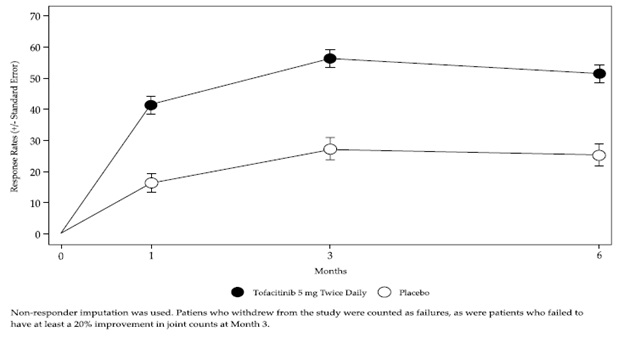
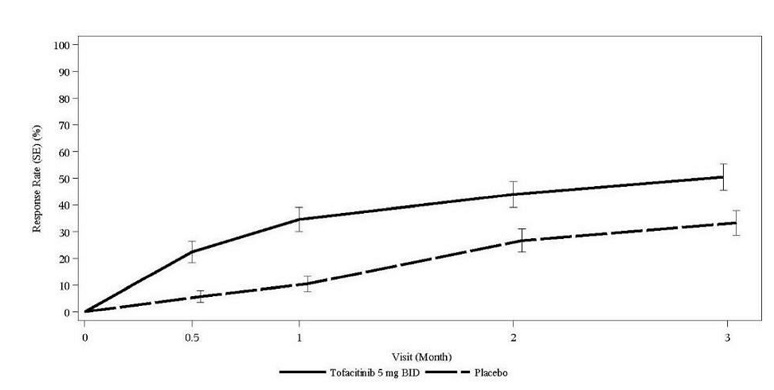
Study PsA-I (NCT01877668) had a duration of 12 months and enrolled patients who had an inadequate response to a nonbiologic DMARD and who were naïve to treatment with a TNF blocker. Study PsA-I included a 3-month placebo- controlled period and also included adalimumab 40 mg subcutaneously once every 2 weeks for 12 months.
Study PsA-II (NCT01882439) had a duration of 6 months and enrolled patients who had an inadequate response to at least one approved TNF blocker. This clinical trial included a 3-month placebo-controlled period.
In these combined Phase 3 clinical trials, 238 patients were randomized and treated with tofacitinib 5 mg twice daily and 236 patients were randomized and treated with tofacitinib 10 mg twice daily. All patients in the clinical trials were required to receive treatment with a stable dose of a nonbiologic DMARD [the majority (79%) received methotrexate]. The study population randomized and treated with tofacitinib (474 patients) included 45 (9.5%) patients aged 65 years or older and 66 (13.9%) patients with diabetes at baseline.
During the 2 PsA controlled clinical trials, there were 3 malignancies (excluding NMSC) in 474 patients receiving tofacitinib plus non-biologic DMARD (6 months to 12 months exposure) compared with 0 malignancies in 236 patients in the placebo plus non-biologic DMARD group (3 months exposure) and 0 malignancies in 106 patients in the adalimumab plus non-biologic DMARD group (12 months exposure). No lymphomas were reported. Malignancies have also been observed in the long-term extension study in psoriatic arthritis patients treated with tofacitinib.
The safety profile observed in patients with active psoriatic arthritis treated with tofacitinib was consistent with the safety profile observed in rheumatoid arthritis patients.
Ankylosing Spondylitis
Tofacitinib 5 mg twice daily was studied in patients with active ankylosing spondylitis (AS) in a confirmatory double-blind placebo-controlled Phase 3 clinical trial (Study AS-I) and in a dose-ranging Phase 2 clinical trial (Study AS-II).
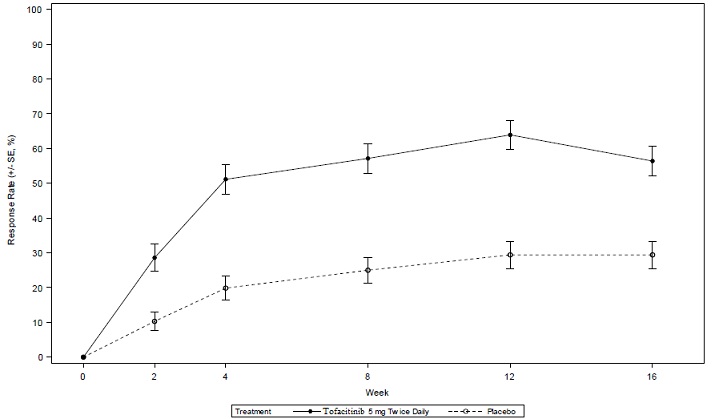
Study AS-I (NCT03502616) had a duration of 48 weeks and enrolled patients who had an inadequate response to at least 2 NSAIDs. Study AS-I included a 16-week double-blind period in which patients received tofacitinib 5 mg or placebo twice daily and a 32-week open-label treatment period in which all patients received tofacitinib 5 mg twice daily.
Study AS-II (NCT01786668) had a duration of 16 weeks and enrolled patients who had an inadequate response to at least 2 NSAIDs. This clinical trial included a 12-week treatment period in which patients received either tofacitinib 2 mg, 5 mg, 10 mg, or placebo twice daily.
In the combined Phase 2 and Phase 3 clinical trials, a total of 420 patients were treated with either tofacitinib 2 mg, 5 mg, or 10 mg twice daily. Of these, 316 patients were treated with tofacitinib 5 mg twice daily for up to 48 weeks. In the combined double-blind period, 185 patients were randomized to and treated with tofacitinib 5 mg twice daily and 187 to placebo for up to 16 weeks. Concomitant treatment with stable doses of nonbiologic DMARDs, NSAIDs, or corticosteroids (≤10 mg/day) was permitted. The study population randomized and treated with tofacitinib included 13 (3.1%) patients aged 65 years or older and 18 (4.3%) patients with diabetes at baseline.
The safety profile observed in patients with AS treated with tofacitinib was consistent with the safety profile observed in RA and PsA patients.