Reductions in Risk of CHD Mortality and Cardiovascular Events
In 4S, the effect of therapy with simvastatin on total mortality was assessed in 4,444 patients with CHD and baseline total cholesterol
212-309 mg/dL (5.5 to 8.0 mmol/L). In this multicenter, randomized, double-blind, placebo-controlled study, patients were treated
with standard care, including diet, and either simvastatin 20 to 40 mg/day (n=2,221) or placebo (n=2,223) for a median duration of 5.4
years. Over the course of the study, treatment with simvastatin led to mean reductions in total-C, LDL-C and TG of 25%, 35%, and
10%, respectively, and a mean increase in HDL-C of 8%. Simvastatin significantly reduced the risk of mortality by 30% (p=0.0003,
182 deaths in the simvastatin group vs 256 deaths in the placebo group). The risk of CHD mortality was significantly reduced by 42%
(p=0.00001, 111 vs 189 deaths). There was no statistically significant difference between groups in non-cardiovascular mortality.
Simvastatin significantly decreased the risk of having major coronary events (CHD mortality plus hospital-verified and silent non-fatal
myocardial infarction [MI]) by 34% (p<0.00001, 431 vs 622 patients with one or more events). The risk of having a hospital-verified
non-fatal MI was reduced by 37%. Simvastatin significantly reduced the risk for undergoing myocardial revascularization procedures
(coronary artery bypass grafting or percutaneous transluminal coronary angioplasty) by 37% (p<0.00001, 252 vs 383 patients).
Simvastatin significantly reduced the risk of fatal plus non-fatal cerebrovascular events (combined stroke and transient ischemic
attacks) by 28% (p=0.033, 75 vs 102 patients). Simvastatin reduced the risk of major coronary events to a similar extent across the
range of baseline total and LDL cholesterol levels. Because there were only 53 female deaths, the effect of simvastatin on mortality in
women could not be adequately assessed. However, simvastatin significantly lessened the risk of having major coronary events by
34% (60 vs 91 women with one or more event). The randomization was stratified by angina alone (21% of each treatment group) or a
previous MI. Because there were only 57 deaths among the patients with angina alone at baseline, the effect of simvastatin on
mortality in this subgroup could not be adequately assessed. However, trends in reduced coronary mortality, major coronary events
and revascularization procedures were consistent between this group and the total study cohort. Additionally, simvastatin resulted in
similar decreases in relative risk for total mortality, CHD mortality, and major coronary events in elderly patients (≥65 years),
compared with younger patients.
The Heart Protection Study (HPS) was a large, multi-center, placebo-controlled, double-blind study with a mean duration of 5 years
conducted in 20,536 patients (10,269 on simvastatin 40 mg and 10,267 on placebo). Patients were allocated to treatment using a
covariate adaptive method3 which took into account the distribution of 10 important baseline characteristics of patients already
enrolled and minimized the imbalance of those characteristics across the groups. Patients had a mean age of 64 years (range 40 to 80
years), were 97% Caucasian and were at high risk of developing a major coronary event because of existing CHD (65%), diabetes
(Type 2, 26%; Type 1, 3%), history of stroke or other cerebrovascular disease (16%), peripheral vessel disease (33%), or hypertension
in males ≥65 years (6%). At baseline, 3,421 patients (17%) had LDL-C levels below 100 mg/dL, of whom 953 (5%) had LDL-C
levels below 80 mg/dL; 7,068 patients (34%) had levels between 100 and 130 mg/dL; and 10,047 patients (49%) had levels greater
than 130 mg/dL.
The HPS results showed that simvastatin 40 mg/day significantly reduced: total and CHD mortality; non-fatal MI, stroke, and
revascularization procedures (coronary and non-coronary) (see Table 4).
3D.R. Taves, Minimization: a new method of assigning patients to treatment and control groups. Clin. Pharmacol. Ther. 15 (1974), pp. 443-453
Table 4:Summary of Heart Protection Study Results
Endpoint | Simvastatin
(N=10,269)
n (%) n = number of patients with indicated event | Placebo
(N=10,267)
n (%) | Risk Reduction
(%) (95% CI) | p-Value |
Primary | | | | |
| 1,328 (12.9) | 1,507 (14.7) | 13 (6 - 19) | p=0.0003 |
| 587 (5.7) | 707 (6.9) | 18 (8 - 26) | p=0.0005 |
Secondary | | | | |
| 357 (3.5) | 574 (5.6) | 38 (30 - 46) | p<0.0001 |
| 444 (4.3) | 585 (5.7) | 25 (15 - 34) | p<0.0001 |
Tertiary | | | | |
- Coronary revascularization
| 513 (5) | 725 (7.1) | 30 (22 - 38) | p<0.0001 |
- Peripheral and other non-coronary revascularization
| 450 (4.4) | 532 (5.2) | 16 (5 - 26) | p=0.006 |
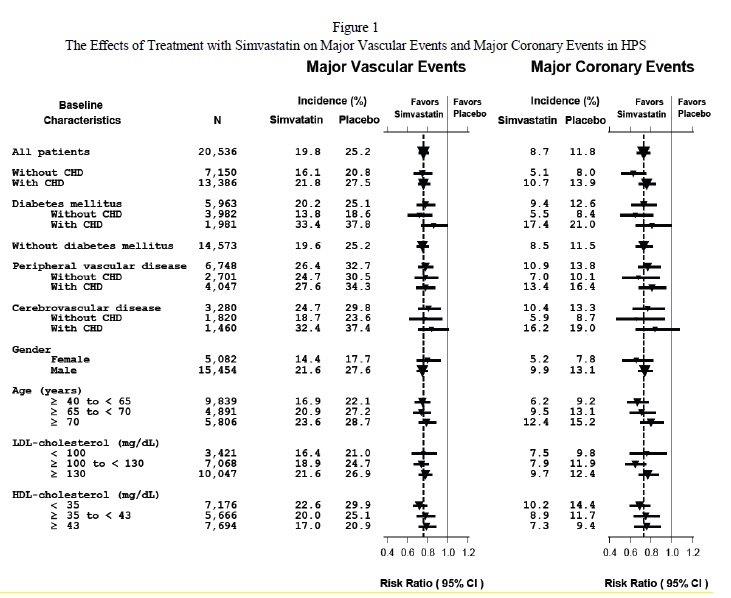
Two composite endpoints were defined in order to have sufficient events to assess relative risk reductions across a range of baseline characteristics (see Figure 1). A composite of major coronary events (MCE) was comprised of CHD mortality and non-fatal MI
(analyzed by time-to-first event; 898 patients treated with simvastatin had events and 1,212 patients on placebo had events). A
composite of major vascular events (MVE) was comprised of MCE, stroke and revascularization procedures including coronary,
peripheral and other non-coronary procedures (analyzed by time-to-first event; 2,033 patients treated with simvastatin had events and
2,585 patients on placebo had events). Significant relative risk reductions were observed for both composite endpoints (27% for MCE
and 24% for MVE, p<0.0001). Treatment with simvastatin produced significant relative risk reductions for all components of the
composite endpoints. The risk reductions produced by simvastatin in both MCE and MVE were evident and consistent regardless of
cardiovascular disease related medical history at study entry (i.e., CHD alone; or peripheral vascular disease, cerebrovascular disease,
diabetes or treated hypertension, with or without CHD), gender, age, creatinine levels up to the entry limit of 2.3 mg/dL, baseline
levels of LDL-C, HDL-C, apolipoprotein B and A-1, baseline concomitant cardiovascular medications (i.e., aspirin, beta blockers, or
calcium channel blockers), smoking status, alcohol intake, or obesity. Diabetics showed risk reductions for MCE and MVE due to
simvastatin treatment regardless of baseline HbA1c levels or obesity with the greatest effects seen for diabetics without CHD.
Figure 1 The Effects of Treatment with Simvastatin on Major Vascular Events and Major Coronary Events in HPS
N = number of patients in each subgroup. The inverted triangles are point estimates of the relative risk, with their 95% confidence intervals represented as a line.
The area of a triangle is proportional to the number of patients with MVE or MCE in the subgroup relative to the number with MVE or MCE, respectively, in the
entire study population. The vertical solid line represents a relative risk of one. The vertical dashed line represents the point estimate of relative risk in the entire
study population.
Angiographic Studies
In the Multicenter Anti-Atheroma Study, the effect of simvastatin on atherosclerosis was assessed by quantitative coronary
angiography in hypercholesterolemic patients with CHD. In this randomized, double-blind, controlled study, patients were treated
with simvastatin 20 mg/day or placebo. Angiograms were evaluated at baseline, two and four years. The co-primary study endpoints
were mean change per-patient in minimum and mean lumen diameters, indicating focal and diffuse disease, respectively. Simvastatin
significantly slowed the progression of lesions as measured in the Year 4 angiogram by both parameters, as well as by change in
percent diameter stenosis. In addition, simvastatin significantly decreased the proportion of patients with new lesions and with new
total occlusions.
Modifications of Lipid Profiles
Primary Hyperlipidemia (Fredrickson type IIa and IIb)
Simvastatin has been shown to be effective in reducing total-C and LDL-C in heterozygous familial and non-familial forms of
hyperlipidemia and in mixed hyperlipidemia. Maximal to near maximal response is generally achieved within 4 to 6 weeks and
maintained during chronic therapy. Simvastatin significantly decreased total-C, LDL-C, total-C/HDL-C ratio, and LDL-C/HDL-C
ratio; simvastatin also decreased TG and increased HDL-C (see Table 5).
Table 5:Mean Response in Patients with Primary Hyperlipidemia and Combined (mixed) Hyperlipidemia (Mean Percent Change from Baseline After 6 to 24 Weeks)
| | TOTAL-C | LDL-C | HDL-C | TG* |
Lower Dose Comparative Study† | | | | | |
- (Mean % Change at Week 6)
| | | | | |
| | -19 | -26 | 10 | -12 |
| | -23 | -30 | 12 | -15 |
Scandinavian Simvastatin Survival Study‡
(Mean % Change at Week 6) | | | | | |
| | -1 | -1 | 0 | -2 |
| | -28 | -38 | 8 | -19 |
- Upper Dose Comparative Study§
| | | | | |
- (Mean % Change Averaged at Weeks 18 and 24)
| | | | | |
| | -31 | -41 | 9 | -18 |
- Simvastatin 80 mg q.p.m.¶
| | -36 | -47 | 8 | -24 |
- Multi-Center Combined Hyperlipidemia Study#
(Mean % Change at Week 6)
| | | | | |
| | 1 | 2 | 3 | -4 |
| | -25 | -29 | 13 | -28 |
| | -31 | -36 | 16 | -33 |
* median percent change
† mean baseline LDL-C 244 mg/dL and median baseline TG 168 mg/dL
‡ mean baseline LDL-C 188 mg/dL and median baseline TG 128 mg/dL
§ mean baseline LDL-C 226 mg/dL and median baseline TG 156 mg/dL
¶ 21% and 36% median reduction in TG in patients with TG ≤200 mg/dL and TG >200 mg/dL, respectively. Patients with TG >350 mg/dL were excluded
# mean baseline LDL-C 156 mg/dL and median baseline TG 391 mg/dL
Hypertriglyceridemia (Fredrickson type IV)
The results of a subgroup analysis in 74 patients with type IV hyperlipidemia from a 130-patient, double-blind, placebo-controlled, 3-period crossover study are presented in Table 6.
Table 6:Six-week, Lipid-lowering Effects of Simvastatin in Type IV Hyperlipidemia Median Percent Change (25th and 75th percentile) from Baseline*
| N | Total-C | LDL-C | HDL-C | TG | VLDL-C | Non- HDL-C |
| 74 | +2 | +1 | +3 | -9 | -7 | +1 |
| | (-7, +7) | (-8, +14) | (-3, +10) | (-25, +13) | (-25, +11) | (-9, +8) |
|
| 74 | -25 | -28 | +11 | -29 | -37 | -32 |
| | (-34, -19) | (-40, -17) | (+5, +23) | (-43, -16) | (-54, -23) | (-42, -23) |
|
| 74 | -32 | -37 | +15 | -34 | -41 | -38 |
| | (-38, -24) | (-46, -26) | (+5, +23) | (-45, -18) | (-57, -28) | (-49, -32) |
*The median baseline values (mg/dL) for the patients in this study were: total-C = 254, LDL-C = 135, HDL-C = 36, TG = 404, VLDL-C = 83, and non-HDL-C = 215.
Dysbetalipoproteinemia (Fredrickson type III)
The results of a subgroup analysis in 7 patients with type lll hyperlipidemia (dysbetalipoproteinemia) (apo E2/2) (VLDL-C/TG>0.25) from a 130-patient, double-blind, placebo-controlled, 3-period crossover study are presented in Table 7.
- Table 7:Six-week, Lipid-lowering Effects of Simvastatin in Type III Hyperlipidemia Median Percent Change (min, max) from Baseline
The median baseline values (mg/dL) were: total-C=324, LDL-C=121, HDL-C=31, TG=411, VLDL-C=170, and non-HDL-C = 291.
|
| N | Total-C | LDL-C + IDL | HDL-C | TG | VLDL-C + IDL | Non-HDL-C |
| 7 | -8 | -8 | -2 | +4 | -4 | -8 |
| | (-24, +34) | (-27, +23) | (-21, +16) | (-22, +90) | (-28, +78) | (-26, -39) |
|
| 7 | -50 | -50 | +7 | -41 | -58 | -57 |
| | (-66, -39) | (-60, -31) | (-8, +23) | (-74, -16) | (-90, -37) | (-72, -44) |
|
| 7 | -52 | -51 | +7 | -38 | -60 | -59 |
| | (-55, -41) | (-57, -28) | (-5, +59) | (-58, +2) | (-72, -39) | (-61, -46) |
Homozygous Familial Hypercholesterolemia
In a controlled clinical study, 12 patients 15 to 39 years of age with homozygous familial hypercholesterolemia received simvastatin
40 mg/day in a single dose or in 3 divided doses, or 80 mg/day in 3 divided doses. In 11 patients with reductions in LDL-C, the mean
LDL-C changes for the 40- and 80-mg doses were 14% (range 8% to 23%, median 12%) and 30% (range 14% to 46%, median 29%),
respectively. One patient had an increase of 15% in LDL-C. Another patient with absent LDL-C receptor function had an LDL-C
reduction of 41% with the 80-mg dose.
Endocrine Function
In clinical studies, simvastatin did not impair adrenal reserve or significantly reduce basal plasma cortisol concentration. Small
reductions from baseline in basal plasma testosterone in men were observed in clinical studies with simvastatin, an effect also
observed with other statins and the bile acid sequestrant cholestyramine. There was no effect on plasma gonadotropin levels. In a
placebo-controlled, 12-week study there was no significant effect of simvastatin 80 mg on the plasma testosterone response to human
chorionic gonadotropin. In another 24-week study, simvastatin 20 to 40 mg had no detectable effect on spermatogenesis. In 4S, in
which 4,444 patients were randomized to simvastatin 20 to 40 mg/day or placebo for a median duration of 5.4 years, the incidence of
male sexual adverse events in the two treatment groups was not significantly different. Because of these factors, the small changes in
plasma testosterone are unlikely to be clinically significant. The effects, if any, on the pituitary-gonadal axis in pre-menopausal
women are unknown.