Topiramate Tablet
Product Images NDC 31722-182

View Photos of Packaging, Regulatory Labels, and Product Appearance

Product Visual Gallery

This gallery contains 27 technical images submitted to the FDA as part of the official labeling for Topiramate (NDC 31722-182). Unlike standard consumer photos, these assets often include clinical data figures, molecular chemical structures, and official manufacturer packaging layouts.

As provided by Camber Pharmaceuticals, Inc., these visuals offer a comprehensive scientific overview of the product's physical and chemical identity, aiding pharmacists and researchers in product verification and study.

FDA Label Image

100mg-500s (100 mg 500s)

100mg-500s (100 mg 500s)
Topiramate Tablets USP 100 mg bottle label from Camber Pharmaceuticals, Inc. The label includes the NDC 31722-183-05 and indicates the package contains 500 tablets. Instructions for storage, prescription verification, pharmacist dispensing, and product manufacturing details are also shown.*
FDA Label Image

100mg-60s (100 mg 60s)

100mg-60s (100 mg 60s)
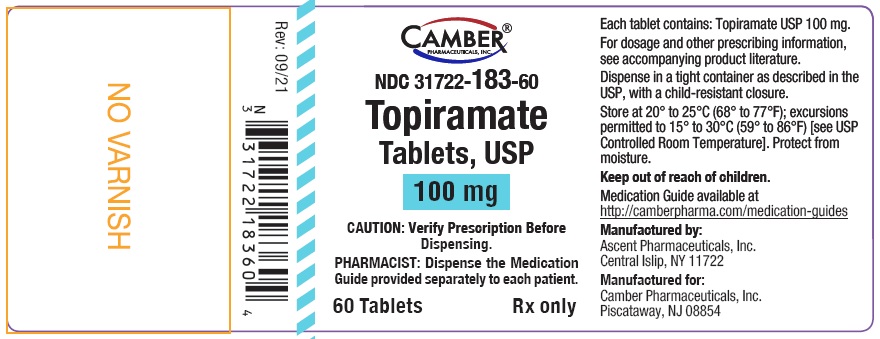
Topiramate Tablets USP 100 mg oral tablets label from Camber Pharmaceuticals, Inc. The label indicates 60 tablets per container, prescription only (Rx only), and includes handling instructions such as dosage verification by the pharmacist, storage conditions, and cautions to keep out of reach of children. The label also provides manufacturer information and directs users to additional medication guides online.*
FDA Label Image

200mg-500s (200 mg 500s)

200mg-500s (200 mg 500s)
Topiramate Tablets, USP 200 mg oral tablets packaging label from Camber Pharmaceuticals, Inc. The label features the NDC 31722-184-05, states a quantity of 500 tablets, and includes usage cautions, storage instructions, and manufacturer details. The label instructs to verify prescription before dispensing and references a medication guide online.*
FDA Label Image

200mg-60s (200 mg 60s)

200mg-60s (200 mg 60s)
Topiramate Tablets USP 200 mg oral tablets label from Camber Pharmaceuticals, Inc. The label indicates a package of 60 tablets, prescription only. It includes instructions for storage, caution to verify prescription before dispensing, and manufacturer details for Ascent Pharmaceuticals, Inc. and Camber Pharmaceuticals, Inc. The label highlights no varnish coating and includes a barcode and NDC 31722-184-60.*
FDA Label Image

25mg-500s (25 mg 500s)

25mg-500s (25 mg 500s)
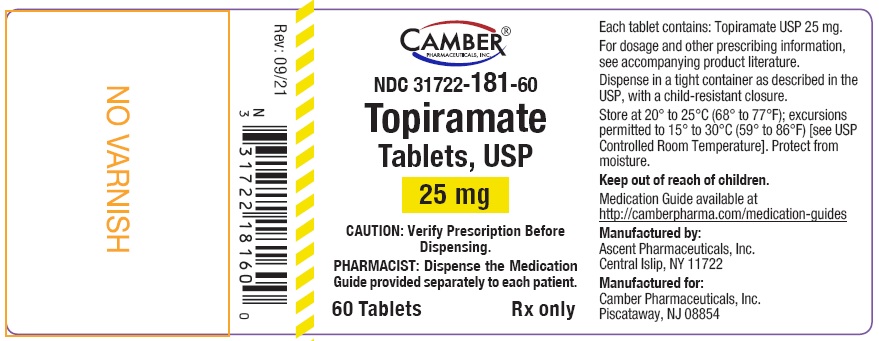
Label of Topiramate Tablets USP 25 mg by Camber Pharmaceuticals, Inc. The tablet bottle label states a quantity of 500 tablets and includes the NDC code 31722-181-05. Dosage instructions advise verifying prescription before dispensing and refer to accompanying product literature. Storage conditions and manufacturer details are provided on the right side of the label.*
FDA Label Image

25mg-60s (25 mg 60s)

25mg-60s (25 mg 60s)
The label for Topiramate Tablets, USP 25 mg by Camber Pharmaceuticals, Inc. Displays the NDC 31722-181-60 and indicates a 60 tablet count. Includes dosage strength (25 mg), dispensing cautions, storage instructions, and manufacturer information. Also notes prescription-only status and child-resistant packaging requirements.*
FDA Label Image

50mg-500s (50 mg 500s)

50mg-500s (50 mg 500s)
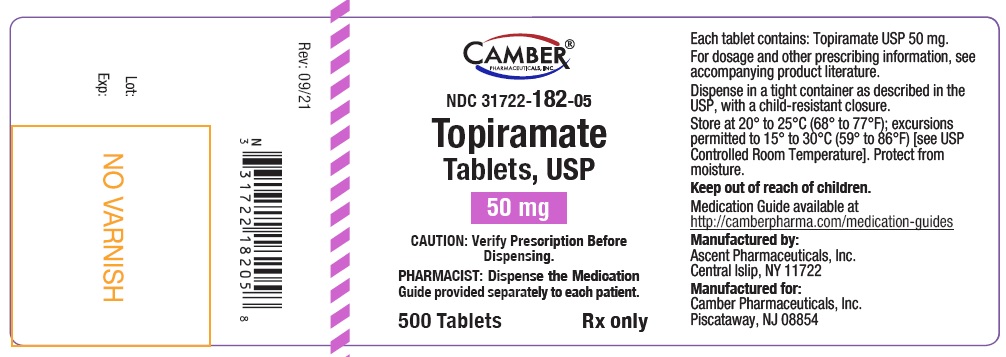
Topiramate Tablets, USP 50 mg oral tablets label from Camber Pharmaceuticals, Inc. The label highlights a 500 tablet count, includes cautionary dispensing instructions, and provides storage and handling information. Manufactured by Ascent Pharmaceuticals, Inc. and for Camber Pharmaceuticals, Inc.*
FDA Label Image

50mg-60s (50 mg 60s)

50mg-60s (50 mg 60s)
Topiramate 50 mg tablets label from Camber Pharmaceuticals, Inc. The label includes the proprietary name Topiramate, strength 50 mg, dosage form tablets USP, and prescription use (Rx only). It indicates the package contains 60 tablets and includes storage, dispensing, and safety instructions, along with manufacturer details for Ascent Pharmaceuticals, Inc. and Camber Pharmaceuticals, Inc.*
FDA Label Image

Common-side Effects (Common Side Effects)

Common-side Effects (Common Side Effects)
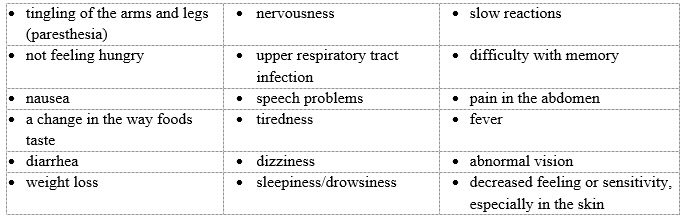
A data table listing various side effects associated with the drug Topiramate. The side effects are organized in three columns, including symptoms such as tingling of the arms and legs, nausea, diarrhea, nervousness, dizziness, sleepiness, slow reactions, difficulty with memory, fever, abnormal vision, and decreased skin sensitivity.*
FDA Label Image

Figure1 (Fig1)

Figure1 (Fig1)
A Kaplan-Meier curve showing cumulative rates for time to first seizure over 500 days comparing two dosages of Topiramate, 50 mg/day and 400 mg/day. The y-axis represents cumulative rates for time to first seizure, while the x-axis shows time in days. The graph compares seizure onset over time between the two dosage groups.*
FDA Label Image

Fig2 (Fig2)

Fig2 (Fig2)
A bar chart titled 'Reduction in 4-Week Migraine Headache Frequency' comparing Placebo, Topiramate 50 mg/day, 100 mg/day, and 200 mg/day across two studies (Study 11 and Study 12) for adults and adolescents. The chart shows changes from baseline to double-blind phase in average monthly migraine headache days, with Topiramate doses showing greater reduction compared to placebo.*
FDA Label Image

Metabolic-acidosis Symptoms (Metabolic Acidosis Symptoms)

Metabolic-acidosis Symptoms (Metabolic Acidosis Symptoms)
This image shows a partial drug facts panel listing potential side effects, including feeling tired, loss of appetite, changes in heartbeat, and trouble thinking clearly.*
FDA Label Image

Structure (Structure)

Structure (Structure)
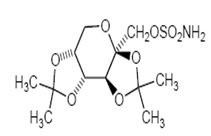
Chemical structure of Topiramate, showing its molecular framework with various functional groups including sulfamate and cyclic moieties, consistent with the active ingredient in the TOPIRAMATE product.*
FDA Label Image

Symptom (Symptom)

Symptom (Symptom)
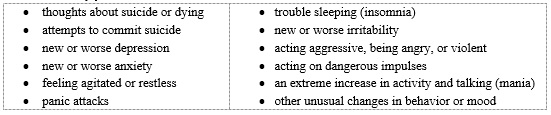
A text panel listing behavioral and mood-related symptoms such as thoughts about suicide, attempts to commit suicide, new or worse depression or anxiety, panic attacks, trouble sleeping, irritability, aggressive or violent behavior, dangerous impulses, mania, and other unusual behavior or mood changes. The content appears to be warnings or side effects related to medication use.*
FDA Label Image

Tab1 (Tab1)

Tab1 (Tab1)
A table presenting the monotherapy titration schedule for adults and pediatric patients aged 10 years and older, showing morning and evening doses of the medication across six weeks, with dosages increasing from 25 mg to 200 mg.*
FDA Label Image

Tab10 (Tab10)

Tab10 (Tab10)
A data table titled 'Summary of AED Interactions with Topiramate' showing the interaction effects between topiramate and various antiepileptic drugs (AEDs). It includes columns for co-administered AEDs, their concentration changes, and corresponding topiramate concentration changes, with notes on plasma concentrations and specific drug abbreviations.*
FDA Label Image

Tab11 (Tab11)

Tab11 (Tab11)
A data table titled 'Topiramate Dose Summary During the Stabilization Periods of Each of Six Double-Blind, Placebo-Controlled, Adjunctive Trials in Adults with Partial-Onset Seizures.' It summarizes stabilization dose numbers, mean doses, and median doses for placebo and different target topiramate dosages ranging from 200 to 1,000 mg/day across six clinical studies.*
FDA Label Image

Tab13 (Tab13)

Tab13 (Tab13)
A data table displaying the percent reduction from baseline to the last 12 weeks of the double-blind phase in average monthly attack rate. The table compares Placebo, Topiramate 50 mg/day, and Topiramate 100 mg/day groups, presenting median baseline, median values for the last 12 weeks, percent reduction, and corresponding p-values versus placebo in a clinical study context.*
FDA Label Image

Tab2 (Tab2)

Tab2 (Tab2)
A table showing monotherapy target total daily maintenance dosing for patients aged 2 to 9 years based on weight in kilograms. It lists minimum and maximum daily doses in mg/day, administered in two equally divided doses, for weight ranges up to greater than 38 kg.*
FDA Label Image

Tab3 (Tab3)

Tab3 (Tab3)
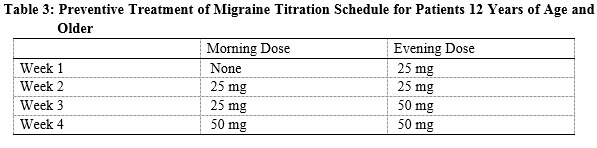
A table titled Preventive Treatment of Migraine Titration Schedule for Patients 12 Years of Age and Older, showing weekly dosage increments of Topiramate over four weeks with specified morning and evening doses ranging from none to 50 mg.*
FDA Label Image

Tab4 (Tab4)

Tab4 (Tab4)
A data table titled 'Risk by Indication for Antiepileptic Drugs in the Pooled Analysis.' It presents risk metrics including events per 1000 patients with Placebo and with drug treatment, relative risk comparing drug versus placebo patients, and risk difference, categorized by indication groups: Epilepsy, Psychiatric, Other, and Total.*
FDA Label Image

Tab5 (Tab5)

Tab5 (Tab5)
A detailed data table presenting adverse reactions in different age groups from a monotherapy epilepsy trial. It compares the high and low dose groups of Topiramate (25 mg, 50 mg, 100 mg, 200 mg) across various body systems and disorders, including nervous system, gastrointestinal, psychiatric, respiratory, and others, noting the frequency of reactions in pediatric and adult patients.*
FDA Label Image

Tab6 (Tab6)

Tab6 (Tab6)
A table titled 'Most Common Adverse Reactions in Pooled Placebo-Controlled, Adjunctive Epilepsy Trials in Adults' comparing adverse reaction frequencies between placebo and Topiramate (200-400 mg/day) across various body systems including general disorders, nervous system disorders, gastrointestinal, metabolic, psychiatric, reproductive, respiratory, and vision disorders.*
FDA Label Image

Tab7 (Tab7)

Tab7 (Tab7)
A data table titled 'Table 7: Adverse Reactions in Pooled Placebo-Controlled, Adjunctive Epilepsy Trials in Pediatric Patients 2 to 15 Years of Age.' The table compares percentages of various adverse reactions reported in patients receiving placebo (N=101) versus topiramate (N=98), categorized by body system and specific reaction, such as fatigue, injury, gait abnormal, nausea, weight loss, somnolence, and urinary incontinence.*
FDA Label Image

Tab8 (Tab8)

Tab8 (Tab8)
A data table titled 'Adverse Reactions in Pooled, Placebo-Controlled, Migraine Trials in Adults' showing percentages of various adverse reactions reported in patients receiving placebo, 50 mg/day, and 100 mg/day doses of Topiramate. The table categorizes reactions by body system, listing specific adverse reactions such as fatigue, paresthesia, nausea, anorexia, and viral infection, with corresponding incidence rates for each treatment group.*
FDA Label Image

Tab9 (Tab9)

Tab9 (Tab9)
A data table titled 'Adverse Reactions in Pooled Double-Blind Studies for the Preventive Treatment of Migraine in Pediatric Patients 12 to 17 Years of Age.' It lists adverse reactions by body system and compares the percentage of occurrences among patients receiving placebo, topiramate 50 mg/day, and topiramate 100 mg/day dosages.*
FDA Label Image

Table12 (Table 12)

Table12 (Table  12)
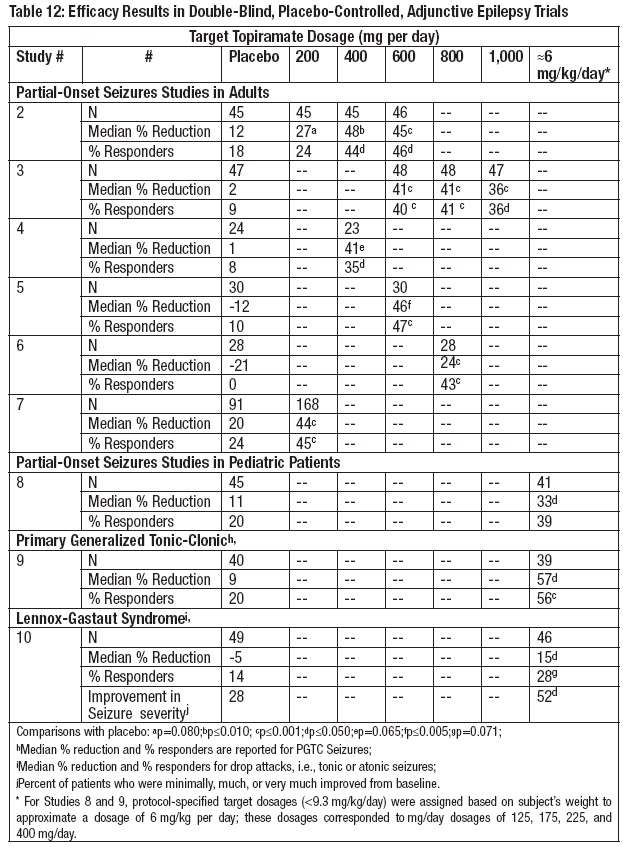
A data table titled 'Efficacy Results in Double-Blind, Placebo-Controlled, Adjunctive Epilepsy Trials' showing median percentage reduction and responder percentages in patients with partial-onset seizures (adults and pediatric), primary generalized tonic-clonic seizures, and Lennox-Gastaut Syndrome. The table compares different target daily dosages of Topiramate (200 mg to 1000 mg) and placebo across multiple studies.*

* About these descriptions: Image descriptions on this page are generated by automated AI analysis of the product label images from the manufacturer's FDA label submission (SPL). They are provided for reference only and may contain errors or omissions. Always rely on the printed label itself and the official FDA labeling, and consult a pharmacist or healthcare professional with any questions about this product.