Topiramate
Product Images NDC 31722-280

View Photos of Packaging, Regulatory Labels, and Product Appearance

Product Visual Gallery

This gallery contains 17 technical images submitted to the FDA as part of the official labeling for Topiramate (NDC 31722-280). Unlike standard consumer photos, these assets often include clinical data figures, molecular chemical structures, and official manufacturer packaging layouts.

As provided by Camber Pharmaceuticals, Inc., these visuals offer a comprehensive scientific overview of the product's physical and chemical identity, aiding pharmacists and researchers in product verification and study.

FDA Label Image

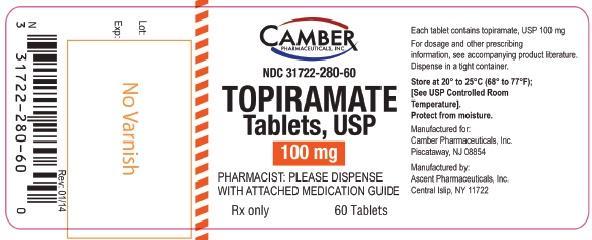
100mg (100 60)

100mg (100 60)
Topiramate is a USP tablet used for the treatment of seizures, migraine headaches, and preventing epileptic episodes. The package contains 60 tablets and must be dispensed with an attached medication guide. The tablets should be stored at a temperature below 25°C in a USP-compliant room. The remaining part of the text is not legible.*
FDA Label Image

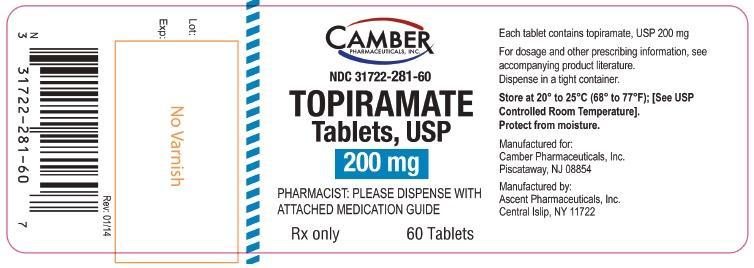
200mg (200 60)

200mg (200 60)
The text is a description of a medication called Topiramate. Each tablet contains 200 mg of the medication. The pharmacist is asked to dispense the medication with an attached medication guide. The product should be stored at a temperature between 20° to 28°C and protected from moisture. It is manufactured by Camber Pharmaceuticals, located in Piscataway, NJ and manufactured by Ascent Pharmaceuticals, located in Centereach, NY.*
FDA Label Image

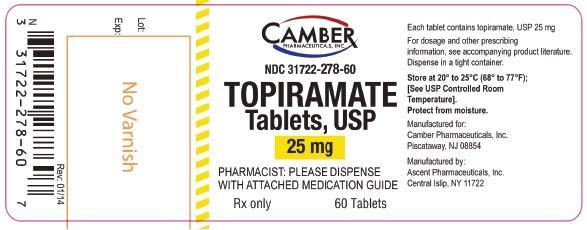
25mg (25 60)

25mg (25 60)
This appears to be a medicine label for Topiramate Tablets which is an FDA approved drug used to treat epilepsy and migraines. The tablets come in 3 quantities - 25mg, 50mg, and 100mg, and have been prescribed to be dispensed by a Pharmacist giving instructions for medication in conjunction with a medication guide. The label mentions the manufacturer McNeil Consumer Healthcare Division and the product was distributed in August 2010 as a prescription medicine.*
FDA Label Image

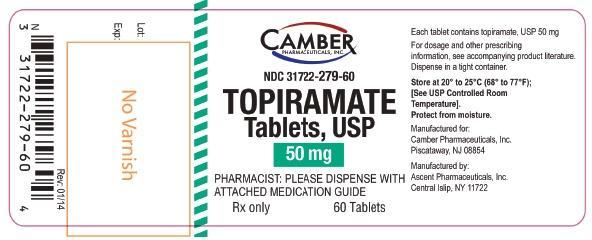
50mg (50 60)

FDA Label Image

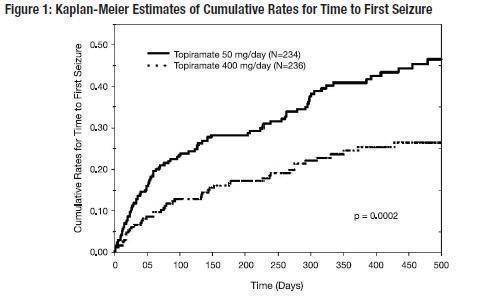
Fig1 (Fig1)

Fig1 (Fig1)
The text appears to be a figure caption or label with a graph showing Kaplan-Meler estimates of cumulative rates for time to first seizure, comparing two groups treated with different doses of topiramate. The graph displays cumulative rates over time in days, and there are different data points for each group (N=234 for topiramate 50mg/day and N=236 for topiramate 400mg/day). There is not enough information to provide a detailed description of the results or methods beyond this.*
FDA Label Image

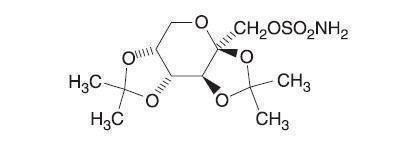
Struct (Struct)

FDA Label Image

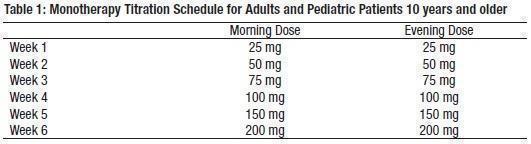
Tbl1 (Table1)

FDA Label Image

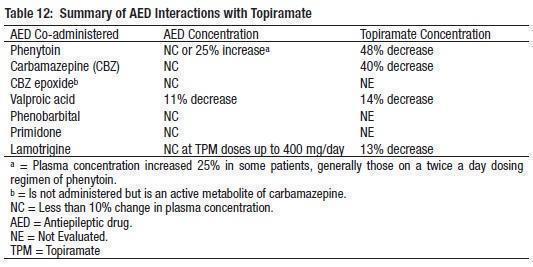
Tbl (Table12)

Tbl (Table12)
This is a summary of the interactions between Topiramate and various antiepileptic drugs such as Phenytoin, Carbamazepine, Valproic Acid, Phenobarbital, and Primidone. The table shows the concentration changes observed when these drugs are co-administered with Topiramate, in terms of decrease or increase in concentration. The text also mentions that Lamotrigine does not show any significant change when taken with TPM doses up to 400mg/day, and that Phenytoin plasma concentration can increase by 25% in some patients. However, some of the data is unclear and not evaluated.*
FDA Label Image

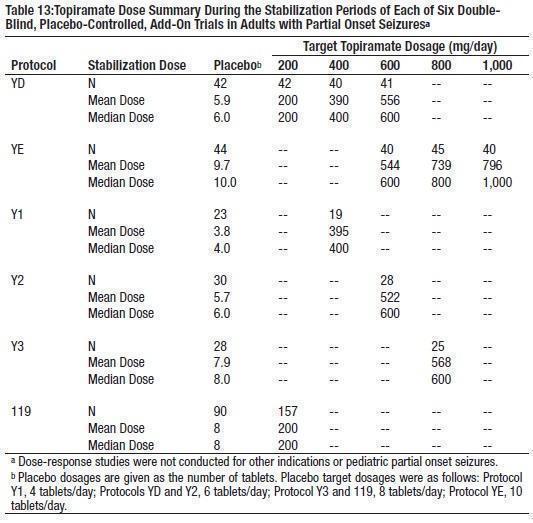
Tbl13 (Table13)

Tbl13 (Table13)
This is a table that summarizes the target topiramate dosages (in mg/day) during the stabilization periods of six double-blind, placebo-controlled, add-on trials in adults with partial onset seizures. The table shows the mean and median doses for each trial. Dose-response studies were not conducted for other indications or pediatric partial onset seizures. The placebo dosages are given as the number of tablets for each protocol.*
FDA Label Image

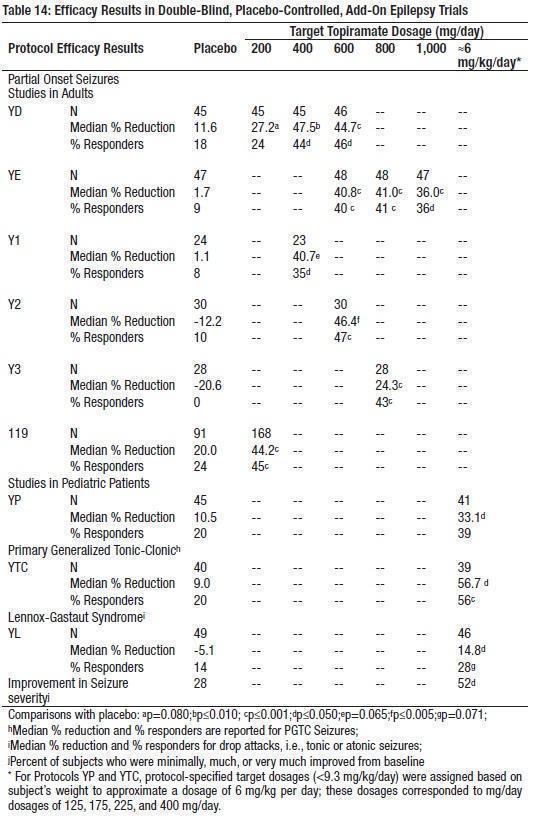
Tbl14 (Table14)

Tbl14 (Table14)
This is a table showing the efficacy results of add-on epilepsy trials with Topiramate dosages in double-blind, placebo-controlled protocols. The results are reported in terms of median % reduction and % responders for different types of seizures, including partial onset seizures in adults, primary generalized tonic-clonic seizures and Lennox-Gastaut Syndrome. The table also reports the percent of subjects who were minimally much or very much improved from baseline. The dosages assigned were based on the subject's weight to approximate a dosage of 6mg/kg per day.*
FDA Label Image

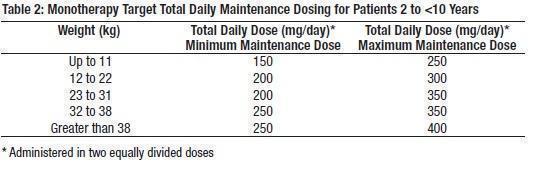
Tbl2 (Table2)

Tbl2 (Table2)
This is a table showing the recommended daily maintenance dosing for patients between 2 to less than 10 years old for monotherapy treatment. The dosing is based on the patients' weight and ranges from 150mg/day to 250mg/day. The doses are to be administered equally in two divided doses. If the weight is greater than 38kg, a maximum dose of 250mg/day is recommended.*
FDA Label Image

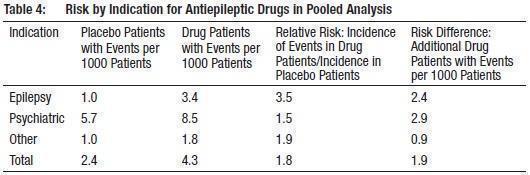
Tbl4 (Table4)

Tbl4 (Table4)
The given text seems to be a table with the title "Table 4" indicating the risk of antiepileptic drugs based on different indications. However, the output is not in a readable format, possibly due to errors in the process. Therefore, the description cannot be generated.*
FDA Label Image

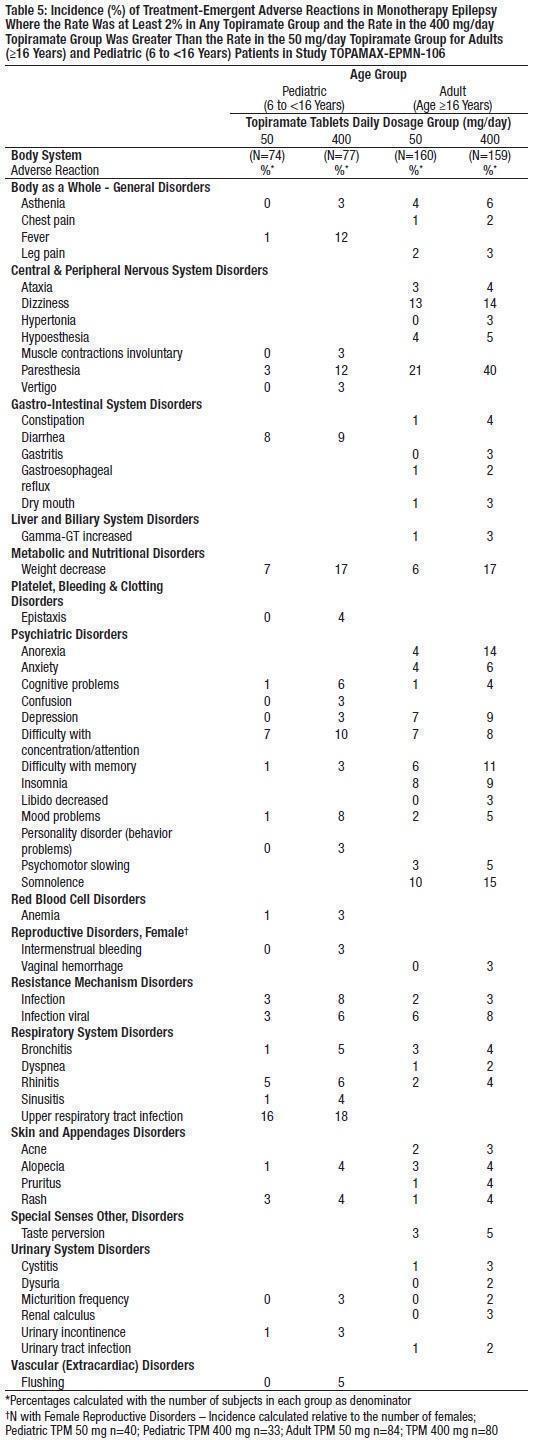
Tbl5 (Table5)

Tbl5 (Table5)
The text provides a table showing the incidence of treatment-emergent adverse reactions in monotherapy epilepsy for patients aged 6 to ≤16 years, and adults (216 years) in study TOPAMAX-EPMN-106, who were given Topiramate tablets at daily doses of 50mg or 400mg. The reactions with an incidence rate of at least 2% in any Topiramate group and with a higher rate in the 400mg/day Topiramate group than in the 50mg/day Topiramate group are shown. The table lists adverse reactions by body systems and symptoms, with the percentage calculated based on the number of subjects in each group as the denominator. The reactions for adults and pediatric patients are shown separately.*
FDA Label Image

Tbl6 (Table6)

Tbl6 (Table6)
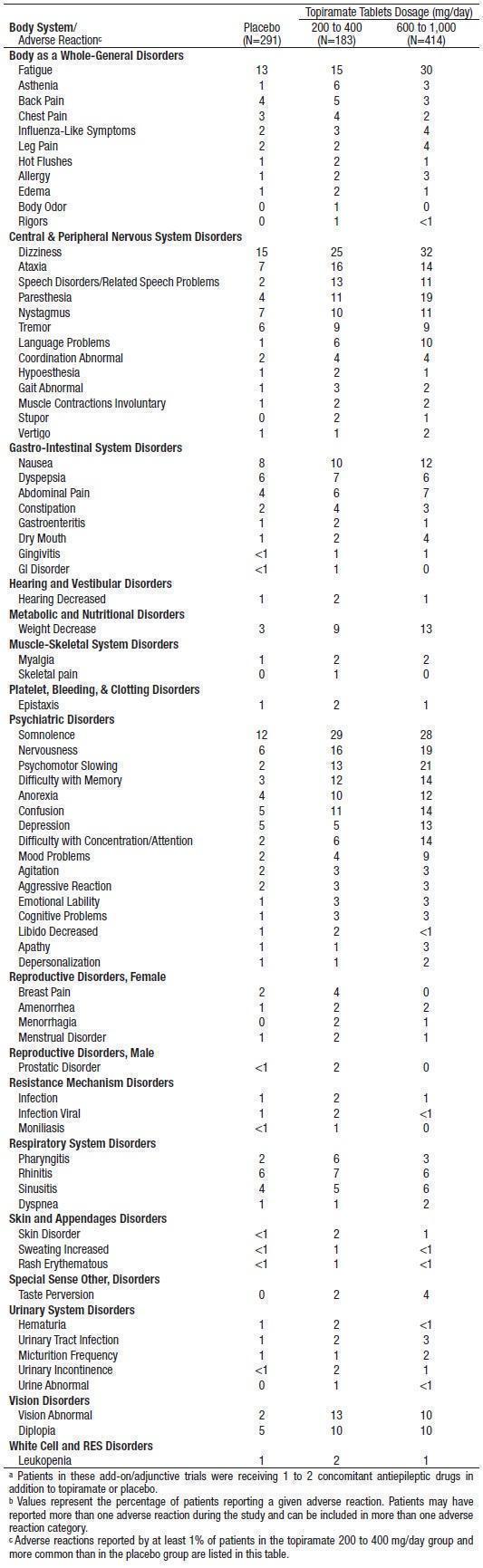
This is a table of adverse reactions to topiramate tablets, listed by dosage (mg/day) and the percentage of patients reporting each reaction. The reactions are grouped according to body system or location and numbered by prevalence. The trial patients were taking 1-2 concomitant antiepileptic drugs in addition to topiramate or placebo.*
FDA Label Image

Tbl7 (Table7)

Tbl7 (Table7)
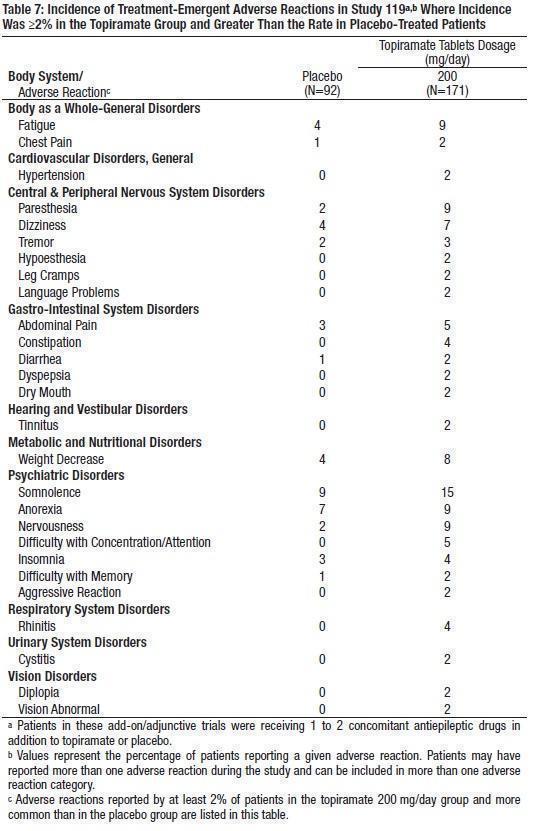
The text provides Table 7 showing the incidence of treatment-emergent adverse reactions in a study where the incidence rate was at least 2% higher in patients taking Topiramate compared to the placebo group. The table lists the body systems and adverse reactions observed, along with the number of patients in each group (placebo and Topiramate 200 mg/day) that experienced them. It also notes that the patients were receiving 1 to 2 concomitant antiepileptic drugs in addition to Topiramate or placebo.*
FDA Label Image

Tbl8 (Table8)

Tbl8 (Table8)
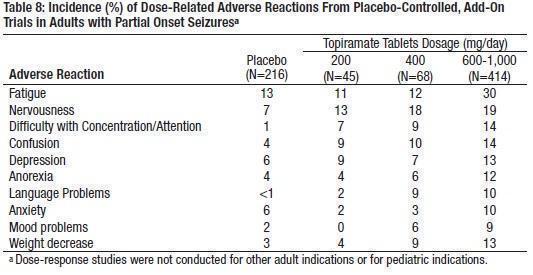
The text provides a table presenting the incidence of adverse reactions in adults with partial onset seizures who were administered different dosages of Topiramate. The adverse reactions were compared to a placebo group. The adverse reactions listed include fatigue, nervousness, difficulty with concentration/ attention, confusion, depression, anorexia, language problems, anxiety, mood problems, and weight decrease. The table indicates that dose-response studies were not conducted for other adult medications or for pediatric medications.*
FDA Label Image

Tbl9 (Table9)

Tbl9 (Table9)
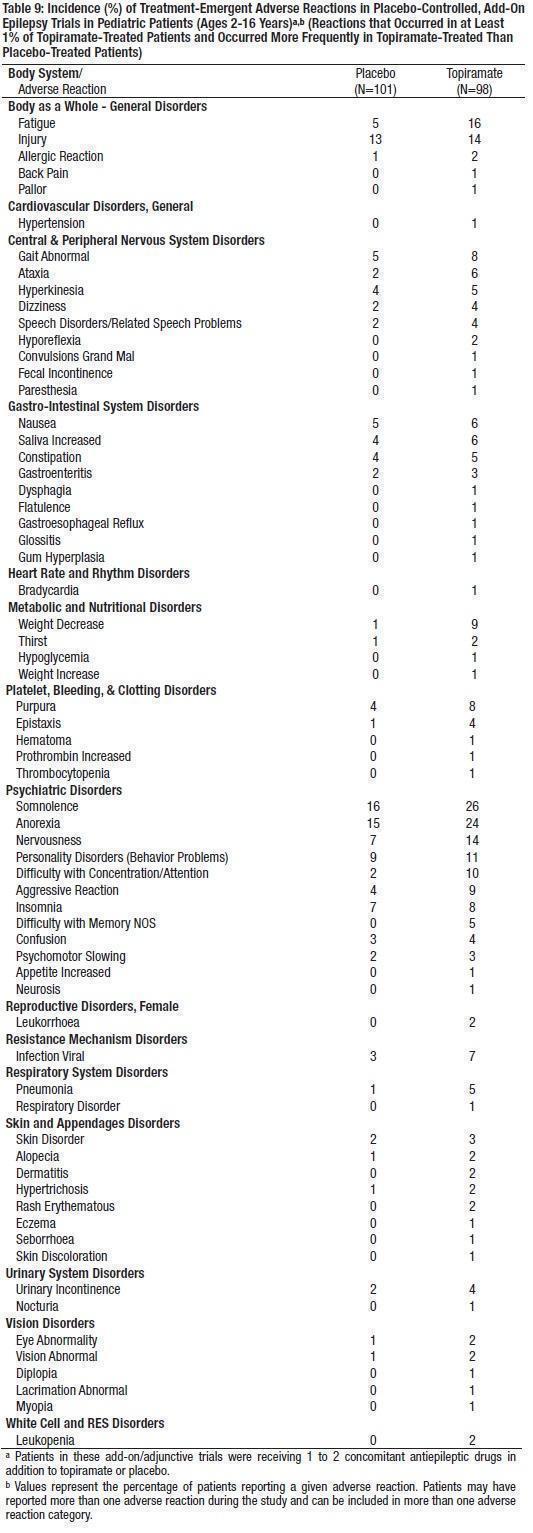
This table shows the incidence of treatment-emergent adverse reactions in pediatric patients aged 2 to 16 years with epilepsy. The table lists the adverse reactions that occurred in at least 1% of Topiramate-treated patients and occurred more frequently in Topiramate-treated than Placebo-treated patients. The adverse reactions are categorized by body system, and the percentage of patients reporting each reaction is shown. Patients in these trials were receiving 1-10 concomitant antiepileptic drugs in addition to topiramate or placebo.*

* These product label images have been analyzed using experimental machine learning. Please verify findings with the primary label text.