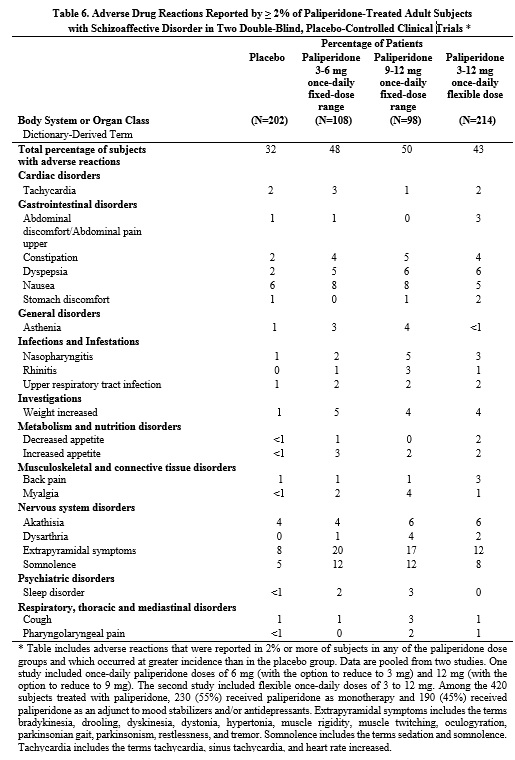
The most common adverse reactions in clinical trials in adult subjects with schizophrenia (reported in 5% or more of subjects treated with paliperidone and at least twice the placebo rate in any of the dose groups) were extrapyramidal symptoms, tachycardia, and akathisia. The most common adverse reactions in clinical trials in adult patients with schizoaffective disorder (reported in 5% or more of subjects treated with paliperidone and at least twice the placebo rate) were extrapyramidal symptoms, somnolence, dyspepsia, constipation, weight increased, and nasopharyngitis.
The most common adverse reactions that were associated with discontinuation from clinical trials in adult subjects with schizophrenia (causing discontinuation in 2% of paliperidone-treated subjects) were nervous system disorders. The most common adverse reactions that were associated with discontinuation from clinical trials in adult subjects with schizoaffective disorder were gastrointestinal disorders, which resulted in discontinuation in 1% of paliperidone-treated subjects. [See Adverse Reactions (6)].
The safety of paliperidone was evaluated in 1205 adult subjects with schizophrenia who participated in three placebo-controlled, 6-week, double-blind trials, of whom 850 subjects received paliperidone at fixed doses ranging from 3 mg to 12 mg once daily. The information presented in this section was derived from pooled data from these three trials. Additional safety information from the placebo-controlled phase of the long-term maintenance study, in which subjects received paliperidone at daily doses within the range of 3 mg to 15 mg (n=104), is also included.
The safety of paliperidone was evaluated in 150 adolescent subjects 12-17 years of age with schizophrenia who received paliperidone in the dose range of 1.5 mg to 12 mg/day in a 6-week, double-blind, placebo-controlled trial.
The safety of paliperidone was also evaluated in 622 adult subjects with schizoaffective disorder who participated in two placebo-controlled, 6-week, double-blind trials. In one of these trials, 206 subjects were assigned to one of two dose levels of paliperidone: 6 mg with the option to reduce to 3 mg (n=108) or 12 mg with the option to reduce to 9 mg (n=98) once daily. In the other study, 214 subjects received flexible doses of paliperidone (3-12 mg once daily). Both studies included subjects who received paliperidone either as monotherapy or as an adjunct to mood stabilizers and/or antidepressants. Adverse events during exposure to study treatment were obtained by general inquiry and recorded by clinical investigators using their own terminology. Consequently, to provide a meaningful estimate of the proportion of individuals experiencing adverse events, events were grouped in standardized categories using MedDRA terminology.
Throughout this section, adverse reactions are reported. Adverse reactions are adverse events that were considered to be reasonably associated with the use of paliperidone (adverse drug reactions) based on the comprehensive assessment of the available adverse event information. A causal association for paliperidone often cannot be reliably established in individual cases. Further, because clinical trials are conducted under widely varying conditions, adverse reaction rates observed in the clinical trials of a drug cannot be directly compared to rates in the clinical trials of another drug and may not reflect the rates observed in clinical practice.
Commonly-Observed Adverse Reactions in Double-Blind, Placebo-Controlled Clinical Trials – Schizophrenia in Adults and Adolescents
Adult Patients with Schizophrenia
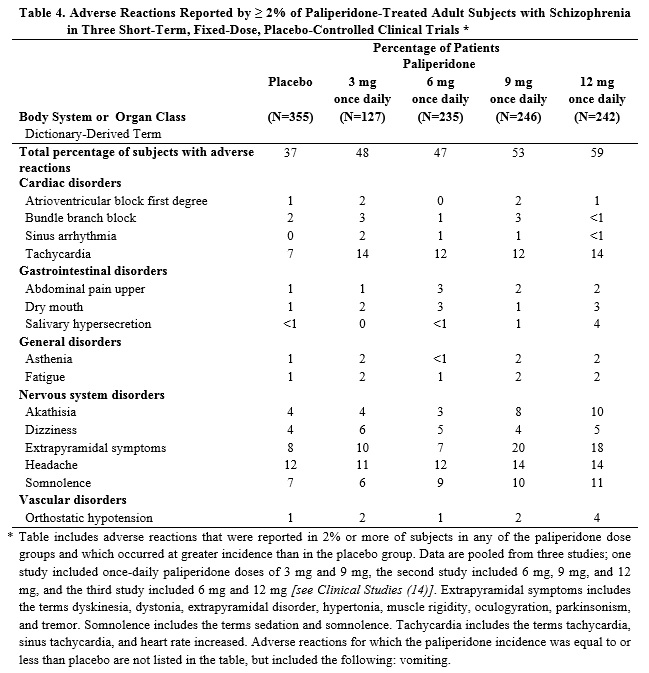
Table 4 enumerates the pooled incidences of adverse reactions reported in the three placebo-controlled, 6-week, fixed-dose studies in adults, listing those that occurred in 2% or more of subjects treated with paliperidone in any of the dose groups, and for which the incidence in paliperidone-treated subjects in any of the dose groups was greater than the incidence in subjects treated with placebo.
Adolescent Patients with Schizophrenia
Table 5 lists the adverse reactions reported in a fixed-dose, placebo-controlled study in adolescent subjects 12-17 years of age with schizophrenia, listing those that occurred in 2% or more of subjects treated with paliperidone in any of the dose groups, and for which the incidence in paliperidone-treated subjects in any of the dose groups was greater than the incidence in subjects treated with placebo.
Commonly-Observed Adverse Reactions in Double-Blind, Placebo-Controlled Clinical Trials – Schizoaffective Disorder in Adults
Table 6 enumerates the pooled incidences of adverse reactions reported in the two placebo-controlled 6-week studies in adult subjects, listing those that occurred in 2% or more of subjects treated with paliperidone and for which the incidence in paliperidone-treated subjects was greater than the incidence in subjects treated with placebo.
Monotherapy versus Adjunctive Therapy
The designs of the two placebo-controlled, 6-week, double-blind trials in adult subjects with schizoaffective disorder included the option for subjects to receive antidepressants (except monoamine oxidase inhibitors) and/or mood stabilizers (lithium, valproate, or lamotrigine). In the subject population evaluated for safety, 230 (55%) subjects received paliperidone as monotherapy and 190 (45%) subjects received paliperidone as an adjunct to mood stabilizers and/or antidepressants. When comparing these 2 subpopulations, only nausea occurred at a greater frequency (≥ 3% difference) in subjects receiving paliperidone as monotherapy.
Discontinuations Due to Adverse Reactions
Schizophrenia Trials
The percentages of subjects who discontinued due to adverse reactions in the three schizophrenia placebo-controlled, 6-week, fixed-dose studies in adults were 3% and 1% in paliperidone- and placebo-treated subjects, respectively. The most common reasons for discontinuation were nervous system disorders (2% and 0% in paliperidone- and placebo-treated subjects, respectively).
Among the adverse reactions in the 6-week, fixed-dose, placebo-controlled study in adolescents with schizophrenia, only dystonia led to discontinuation (<1% of paliperidone-treated subjects).
Schizoaffective Disorder Trials
The percentages of subjects who discontinued due to adverse reactions in the two schizoaffective disorder placebo-controlled 6-week studies in adults were 1% and <1% in paliperidone- and placebo-treated subjects, respectively. The most common reasons for discontinuation were gastrointestinal disorders (1% and 0% in paliperidone- and placebo-treated subjects, respectively).
Dose-Related Adverse Reactions
Schizophrenia Trials
Based on the pooled data from the three placebo-controlled, 6-week, fixed-dose studies in adult subjects with schizophrenia, among the adverse reactions that occurred with a greater than 2% incidence in the subjects treated with paliperidone, the incidences of the following adverse reactions increased with dose: somnolence, orthostatic hypotension, akathisia, dystonia, extrapyramidal disorder, hypertonia, parkinsonism, and salivary hypersecretion. For most of these, the increased incidence was seen primarily at the 12 mg dose, and, in some cases, the 9 mg dose.
In the 6-week, fixed-dose, placebo-controlled study in adolescents with schizophrenia, among the adverse reactions that occurred with >2% incidence in the subjects treated with paliperidone, the incidences of the following adverse reactions increased with dose: tachycardia, akathisia, extrapyramidal symptoms, somnolence, and headache.
Schizoaffective Disorder Trials
In a placebo-controlled, 6-week, high- and low-dose study in adult subjects with schizoaffective disorder, akathisia, dystonia, dysarthria, myalgia, nasopharyngitis, rhinitis, cough, and pharyngolaryngeal pain occurred more frequently (i.e., a difference of at least 2%) in subjects who received higher doses of paliperidone compared with subjects who received lower doses.
Demographic Differences
An examination of population subgroups in the three placebo-controlled, 6-week, fixed-dose studies in adult subjects with schizophrenia and in the two placebo-controlled, 6-week studies in adult subjects with schizoaffective disorder did not reveal any evidence of clinically relevant differences in safety on the basis of gender or race alone; there was also no difference on the basis of age [see Use in Specific Populations (8.5)].
Extrapyramidal Symptoms (EPS)
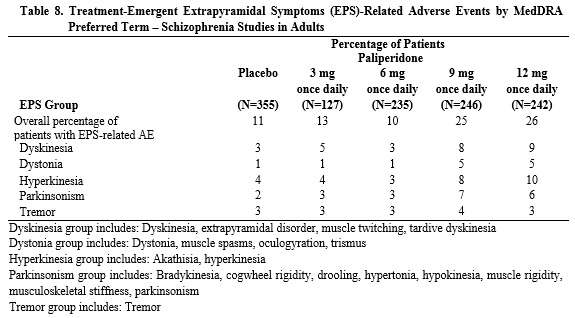
Pooled data from the three placebo-controlled, 6-week, fixed-dose studies in adult subjects with schizophrenia provided information regarding treatment-emergent EPS. Several methods were used to measure EPS: (1) the Simpson-Angus global score (mean change from baseline) which broadly evaluates Parkinsonism, (2) the Barnes Akathisia Rating Scale global clinical rating score (mean change from baseline) which evaluates akathisia, (3) use of anticholinergic medications to treat emergent EPS (Table 7), and (4) incidence of spontaneous reports of EPS (Table 8). For the Simpson-Angus Scale, spontaneous EPS reports and use of anticholinergic medications, there was a dose-related increase observed for the 9 mg and 12 mg doses. There was no difference observed between placebo and paliperidone 3 mg and 6 mg doses for any of these EPS measures.
Compared to data from the studies in adults subjects with schizophrenia, pooled data from the two placebo-controlled 6-week studies in adult subjects with schizoaffective disorder showed similar types and frequencies of EPS as measured by rating scales, anticholinergic medication use, and spontaneous reports of EPS-related adverse events. For subjects with schizoaffective disorder, there was no dose-related increase in EPS observed for parkinsonism with the Simpson-Angus scale or akathisia with the Barnes Akathisia Rating Scale. There was a dose-related increase observed with spontaneous EPS reports of hyperkinesia and dystonia and in the use of anticholinergic medications.
Table 9 shows the EPS data from the pooled schizoaffective disorder trials.
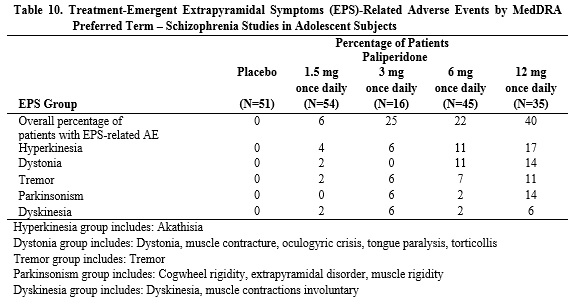
The incidences of EPS-related adverse events in the adolescent schizophrenia studies showed a similar dose-related pattern to those in the adult studies. There were notably higher incidences of dystonia, hyperkinesia, tremor, and parkinsonism in the adolescent population as compared to the adult studies (Table 10).
Dystonia
Class Effect: Symptoms of dystonia, prolonged abnormal contractions of muscle groups, may occur in susceptible individuals during the first few days of treatment. Dystonic symptoms include: spasm of the neck muscles, sometimes progressing to tightness of the throat, swallowing difficulty, difficulty breathing, and/or protrusion of the tongue. While these symptoms can occur at low doses, they occur more frequently and with greater severity with high potency and at higher doses of first generation antipsychotic drugs. An elevated risk of acute dystonia is observed in males and younger age groups.
Laboratory Test Abnormalities
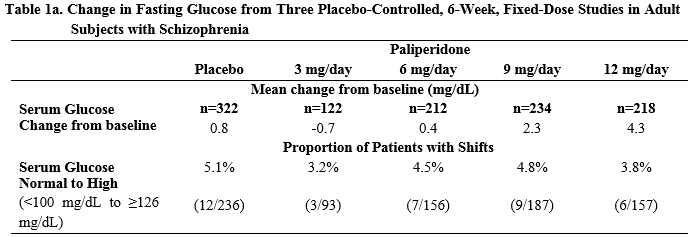
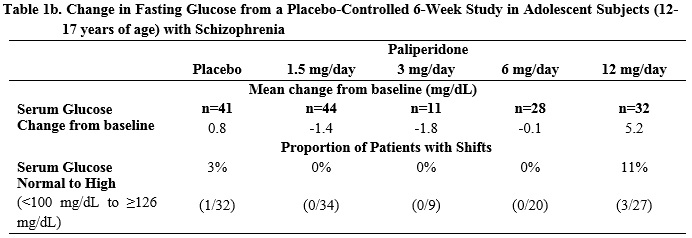
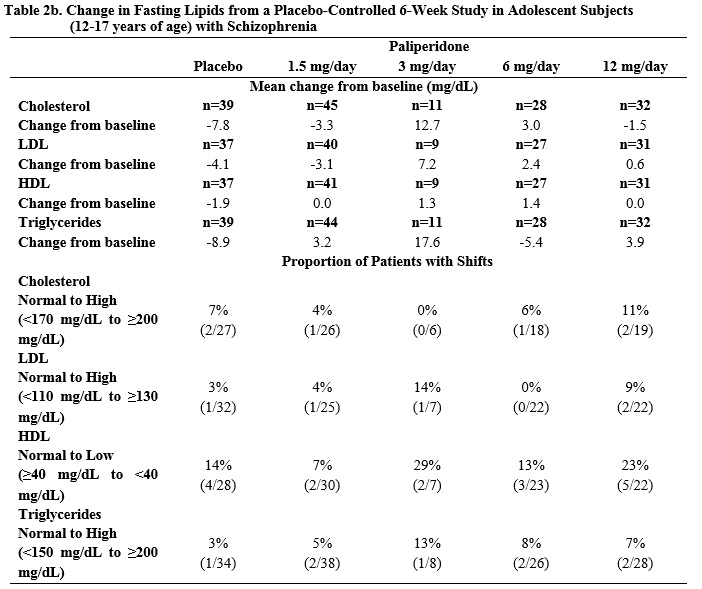
In the pooled data from the three placebo-controlled, 6-week, fixed-dose studies in adult subjects with schizophrenia and from the two placebo-controlled, 6-week studies in adult subjects with schizoaffective disorder, between-group comparisons revealed no medically important differences between paliperidone and placebo in the proportions of subjects experiencing potentially clinically significant changes in routine serum chemistry, hematology, or urinalysis parameters. Similarly, there were no differences between paliperidone and placebo in the incidence of discontinuations due to changes in hematology, urinalysis, or serum chemistry, including mean changes from baseline in fasting glucose, insulin, c-peptide, triglyceride, HDL, LDL, and total cholesterol measurements. However, paliperidone was associated with increases in serum prolactin [see Warnings and Precautions (5.7)].
Other Adverse Reactions Observed During Premarketing Evaluation of Paliperidone
The following additional adverse reactions occurred in < 2% of paliperidone-treated subjects in the above schizophrenia and schizoaffective disorder clinical trial datasets. The following also includes additional adverse reactions reported at any frequency by paliperidone-treated subjects who participated in other clinical studies.
Cardiac disorders: bradycardia, palpitations
Eye disorders: eye movement disorder
Gastrointestinal disorders: flatulence
General disorders: edema
Immune system disorders: anaphylactic reaction
Infections and infestations: urinary tract infection
Investigations: alanine aminotransferase increased, aspartate aminotransferase increased
Musculoskeletal and connective tissue disorders: arthralgia, pain in extremity
Nervous system disorders: opisthotonus
Psychiatric disorders: agitation, insomnia, nightmare
Reproductive system and breast disorders: breast discomfort, menstruation irregular, retrograde ejaculation
Respiratory, thoracic and mediastinal disorders: nasal congestion
Skin and subcutaneous tissue disorders: pruritus, rash
Vascular disorders: hypertension
The safety of paliperidone was also evaluated in a long-term trial designed to assess the maintenance of effect with paliperidone in adults with schizophrenia [see Clinical Studies (14)]. In general, adverse reaction types, frequencies, and severities during the initial 14-week open-label phase of this study were comparable to those observed in the 6-week, placebo-controlled, fixed-dose studies. Adverse reactions reported during the long-term double-blind phase of this study were similar in type and severity to those observed in the initial 14-week open-label phase.