Lisdexamfetamine Dimesylate Capsule
Product Images NDC 31722-352

24 FDA label images from Camber Pharmaceuticals, Inc. · Packaging, Regulatory Labels, and Product Appearance

Product Visual Gallery

This gallery contains 24 technical images submitted to the FDA as part of the official labeling for Lisdexamfetamine Dimesylate (NDC 31722-352). Unlike standard consumer photos, these assets often include clinical data figures, molecular chemical structures, and official manufacturer packaging layouts.

As provided by Camber Pharmaceuticals, Inc., these visuals offer a comprehensive scientific overview of the product's physical and chemical identity, aiding pharmacists and researchers in product verification and study.

FDA Label Image

Table3 (Table 3.1)

Table3 (Table 3.1)
A data table presenting adverse reactions reported by 2% or more of adult patients with ADHD taking Lisdexamfetamine dimesylate capsules compared to placebo in a 4-week clinical trial. The table lists various side effects with their incidence percentages for both Lisdexamfetamine dimesylate (n=358) and placebo (n=62) groups.*
FDA Label Image

Table4 (Table 4)

Table4 (Table 4)
Data table showing adverse reactions reported by 2% or more of adult patients with binge eating disorder (BED) taking Lisdexamfetamine Dimesylate capsules compared to placebo in 12-week clinical trials. It lists reactions such as dry mouth, insomnia, decreased appetite, increased heart rate, and others with corresponding incidence percentages for both treatment and placebo groups.*
FDA Label Image

Structure (Structural Formula)

Structure (Structural Formula)
Chemical structure diagram of lisdexamfetamine dimesylate, showing its molecular components including aromatic rings, amine groups, and the dimesylate moiety.*
FDA Label Image

Figure 1 (Figure1)

Figure 1 (Figure1)
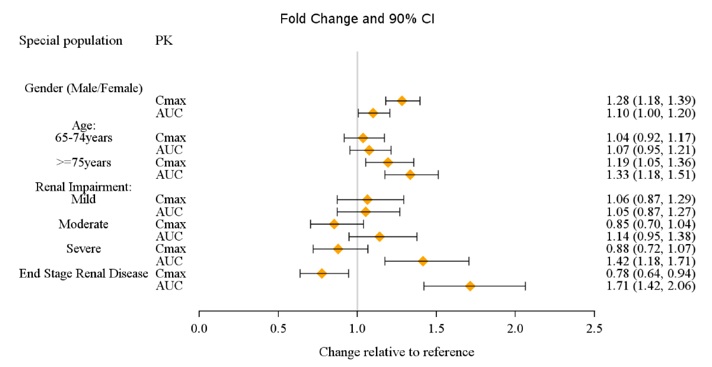
A forest plot displaying fold change and 90% confidence intervals for pharmacokinetic parameters (Cmax and AUC) of lisdexamfetamine dimesylate in special populations. The x-axis shows change relative to reference from 0.0 to 2.5. Populations include gender, two age groups (65-74 and 75+ years), and renal impairment levels (mild, moderate, severe, and end-stage renal disease). Orange diamonds represent point estimates with horizontal lines for confidence intervals, accompanied by numerical values to the right.*
FDA Label Image

Figure 2 (Figure2)

Figure 2 (Figure2)
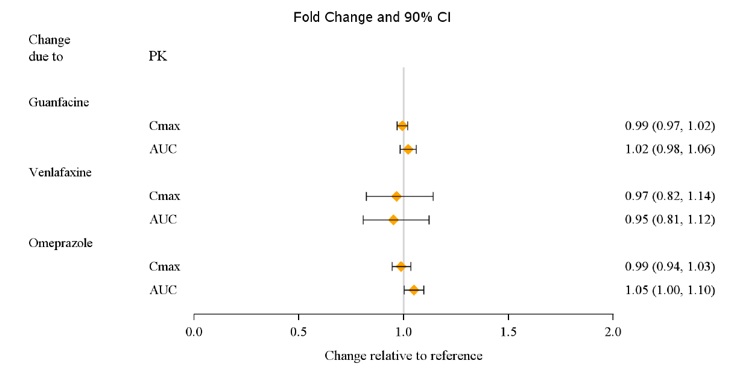
A chart titled 'Fold Change and 90% CI' depicting fold changes and 90% confidence intervals of pharmacokinetic parameters Cmax and AUC for three substances: Guanfacine, Venlafaxine, and Omeprazole. The horizontal axis is labeled 'Change relative to reference' ranging from 0.0 to 2.0. Data points with confidence intervals are plotted for each substance's Cmax and AUC values, showing numeric fold change values to the right of each point.*
FDA Label Image

Figure 3 (Figure3)

Figure 3 (Figure3)
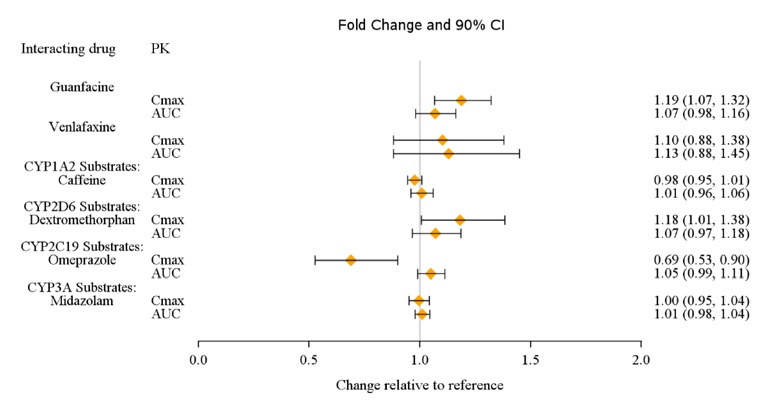
A pharmacokinetic chart depicting fold change and 90% confidence interval for drug interactions involving lisdexamfetamine dimesylate. It compares Cmax and AUC values for several interacting drugs including Guanfacine, Venlafaxine, Caffeine, Dextromethorphan, Omeprazole, and Midazolam, showing their relative change to reference on a horizontal axis ranging from 0.0 to 2.0.*
FDA Label Image

Table6 (Table 6)

Table6 (Table 6)
A data table summarizing primary efficacy results from short-term studies of Lisdexamfetamine Dimesylate Capsules in pediatric patients (ages 6 to 17) and adults with ADHD. It includes study numbers, age ranges, primary endpoints, treatment groups, mean baseline scores, mean change from baseline, and placebo-subtracted differences with confidence intervals.*
FDA Label Image

Table6.1 (Table 6.2)

Table6.1 (Table 6.2)
A line graph showing LS mean SKAMP Deportment subscale scores over time post-dose in hours, comparing placebo and lisdexamfetamine dimesylate capsules. The graph depicts pediatric patients aged 6 to 12 with ADHD after 1 week of double-blind treatment (Study 3), with lisdexamfetamine consistently showing lower scores, indicating fewer severe symptoms, over the 13-hour period.*
FDA Label Image

Figure 5&6 (Figure 5)

Figure 5&6 (Figure 5)
Two line graphs comparing lisdexamfetamine dimesylate capsules and placebo effects in ADHD studies. The first graph shows Kaplan-Meier estimates of treatment failure over 50 days in pediatric patients aged 6 to 17, with a lower failure proportion for lisdexamfetamine. The second graph plots LS mean PERMP total scores over 14 hours post-dose in adults aged 18 to 55, indicating less severe symptoms with lisdexamfetamine versus placebo.*
FDA Label Image

Figure 7 (Figure 7)

Figure 7 (Figure 7)
A Kaplan-Meier estimated survival curve showing the proportion of subjects with relapse or treatment failure over time in days after randomization, comparing lisdexamfetamine dimesylate capsules and placebo in adults with ADHD. The graph plots the relapse proportion (%) on the y-axis against time (days) on the x-axis, illustrating lower relapse rates for lisdexamfetamine dimesylate compared to placebo.*
FDA Label Image

Table 7 (Table 7)

Table 7 (Table 7)
A data table titled 'Summary of Primary Efficacy Results in BED' comparing binge days per week at week 12 for two studies. It lists treatment groups for lisdexamfetamine dimesylate capsules (50 or 70 mg/day) versus placebo, showing mean baseline scores, least squares mean change from baseline with standard errors, and placebo-subtracted differences with 95% confidence intervals. Footnotes explain abbreviations and statistical significance.*
FDA Label Image

Figure 8 (Figure 8)

Figure 8 (Figure 8)
Kaplan-Meier curve showing estimated proportions of adult subjects with relapse in a study of binge eating disorder (BED). The graph compares relapse rates over time (days after randomization) between lisdexamfetamine dimesylate capsules and placebo groups, illustrating a lower relapse proportion with lisdexamfetamine.*
FDA Label Image

Mg4 (Mg4)

Mg4 (Mg4)
A text panel listing various medications and substances, including selective serotonin reuptake inhibitors (SSRIs), serotonin norepinephrine reuptake inhibitors (SNRIs), tricyclic antidepressants, lithium, fentanyl, tramadol, tryptophan, buspirone, St. John's Wort, and medications for migraine called triptans.*
FDA Label Image

Mg6 (Mg6)

Mg6 (Mg6)
A bulleted list outlining potential adverse effects or symptoms related to medication use. Listed symptoms include agitation, flushing, coma, loss of coordination, dizziness, hallucinations, high body temperature, fast heartbeat, seizures, sweating, confusion, muscle tremors or twitching, changes in blood pressure, and gastrointestinal issues like nausea, vomiting, or diarrhea.*
FDA Label Image

Mg7 (Mg7)

Mg7 (Mg7)
A text panel listing potential side effects associated with lisdexamfetamine dimesylate, including loss of appetite, decreased appetite, diarrhea, dry mouth, trouble sleeping, stomach pain, anxiety, weight loss, dizziness, irritability, nausea, and vomiting.*
FDA Label Image

Mg8 (Mg8)

Mg8 (Mg8)
A partial text panel listing side effects or adverse reactions associated with a medication, including dry mouth, decreased appetite, constipation, anxiety, trouble sleeping, increased heart rate, and feeling jittery. The content appears to be part of a patient information or drug facts label for a prescription drug.*
FDA Label Image

10 (10)

10 (10)
Lisdexamfetamine Dimesylate Capsules 10 mg labeling from Camber Pharmaceuticals, Inc. The label includes the NDC 31722-350-01 and states the package contains 100 capsules for oral use. It provides storage information, dosage instructions to see the package insert, and manufacturing details for Camber Pharmaceuticals, Inc. in Piscataway, NJ.*
FDA Label Image

20 (20)

20 (20)
Packaging label for Lisdexamfetamine Dimesylate Capsules 20 mg from Camber Pharmaceuticals, Inc. The label includes NDC 31722-351-01, barcode, and instructions to dispense the enclosed Medication Guide. The package contains 100 oral capsules. Storage and manufacturing details are listed, including storage at 20°C to 25°C and manufacturing by Ascent Pharmaceuticals, Inc.*
FDA Label Image

30 (30)

30 (30)
Packaging label for Lisdexamfetamine Dimesylate Capsules 30 mg by Camber Pharmaceuticals, Inc. The label shows a 100-capsule bottle with storage instructions, barcode, and notes that pharmacists should dispense the enclosed Medication Guide to each patient. The label indicates the product is prescription-only and includes manufacturer information for Ascent Pharmaceuticals, Inc., and Camber Pharmaceuticals, Inc.*
FDA Label Image

40 (40)

40 (40)
Label for Lisdexamfetamine Dimesylate Capsules 40 mg by Camber Pharmaceuticals, Inc., displaying the proprietary name, dosage strength, NDC 31722-353-01, quantity of 100 capsules, and storage instructions. It includes manufacturer details for Ascent Pharmaceuticals, Inc. and Camber Pharmaceuticals, Inc., with a linked medication guide for patients.*
FDA Label Image

50 (50)

50 (50)
Label for Lisdexamfetamine Dimesylate Capsules 50 mg by Camber Pharmaceuticals, Inc. The label indicates a package containing 100 capsules, with storage instructions and dispensing information for pharmacists. The label includes the NDC code 31722-354-01 and manufacturing details for Ascent Pharmaceuticals, Inc. and Camber Pharmaceuticals, Inc.*
FDA Label Image

60 (60)

60 (60)
Lisdexamfetamine Dimesylate Capsules 60 mg label from Camber Pharmaceuticals, Inc. The label includes the product name, strength, dosage form, a barcode, and storage instructions. It states the package contains 100 capsules and indicates Rx only status. Manufacturer and distributor contact information is also provided.*
FDA Label Image

70 (70)

70 (70)
Label for Lisdexamfetamine Dimesylate Capsules 70 mg by Camber Pharmaceuticals, Inc. The label includes the NDC 31722-356-01 and indicates a package quantity of 100 capsules. It provides storage instructions, dosage information reference, and manufacturer details including Ascent Pharmaceuticals, Inc. and Camber Pharmaceuticals, Inc.*
FDA Label Image

Table12 (Table 1 2)

Table12 (Table 1 2)
Two tables presenting adverse reactions reported by 2% or more of pediatric patients with ADHD taking Lisdexamfetamine dimesylate capsules compared to placebo. Table 1 covers ages 6 to 12 years, listing reactions like decreased appetite (39%), insomnia (22%), and abdominal pain upper (12%). Table 2 covers ages 13 to 17 years, listing reactions such as decreased appetite (34%), insomnia (13%), and weight decreased (9%). Both tables compare incidence percentages between lisdexamfetamine and placebo groups in clinical trials.*

* About these descriptions: Image descriptions on this page are generated by automated AI analysis of the product label images from the manufacturer's FDA label submission (SPL). They are provided for reference only and may contain errors or omissions. Always rely on the printed label itself and the official FDA labeling, and consult a pharmacist or healthcare professional with any questions about this product.