Losartan Potassium Tablet, Film Coated
Product Images NDC 31722-700

View Photos of Packaging, Regulatory Labels, and Product Appearance

Product Visual Gallery

This gallery contains 9 technical images submitted to the FDA as part of the official labeling for Losartan Potassium (NDC 31722-700). Unlike standard consumer photos, these assets often include clinical data figures, molecular chemical structures, and official manufacturer packaging layouts.

As provided by Camber Pharmaceuticals, Inc., these visuals offer a comprehensive scientific overview of the product's physical and chemical identity, aiding pharmacists and researchers in product verification and study.

FDA Label Image

Losartan1000mg30scount (Losartan1000mg30s)
Losartan1000mg30scount (Losartan1000mg30s)
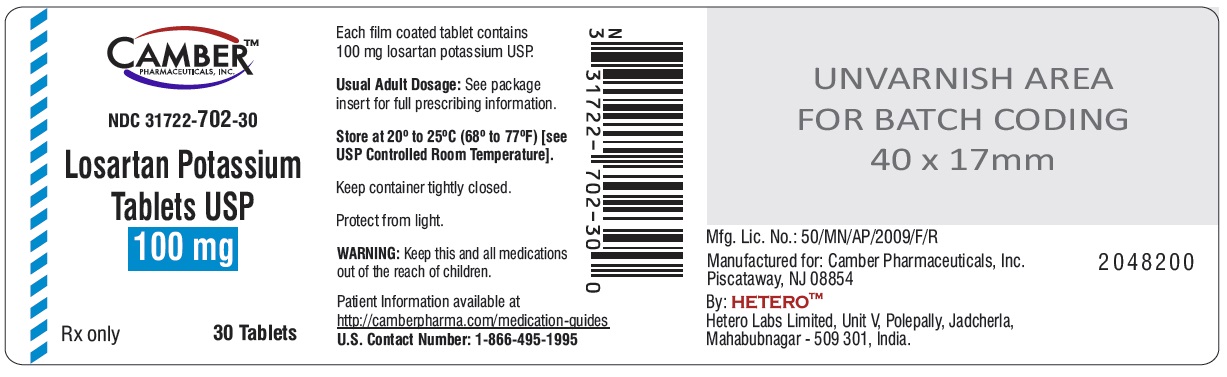
Label for Losartan Potassium Tablets USP 100 mg film-coated tablets by Camber Pharmaceuticals, Inc. The label shows the product name, strength (100 mg), quantity (30 tablets), and the NDC 31722-702-30. It includes storage instructions, a warning to keep out of children's reach, a contact phone number, and manufacturer information including Hetero Labs Limited in India.*
FDA Label Image

Losartan25mg90scount (Losartan25mg90s)

Losartan25mg90scount (Losartan25mg90s)
Label for Losartan Potassium Tablets USP 25 mg by Camber Pharmaceuticals, Inc. The film coated oral tablets come in a bottle of 90 count. The label includes storage instructions, a barcode, dosage warnings, patient information URL, and manufacturer details including Hetero Labs in India.*
FDA Label Image

Losartan50mg30scount (Losartan50mg30s)

Losartan50mg30scount (Losartan50mg30s)
Label for Losartan Potassium Tablets USP, 50 mg oral film-coated tablets. The package contains 30 tablets. Manufacturer is Camber Pharmaceuticals, Inc., with distribution by Hetero Labs Limited, India. The label includes storage instructions, a warning to keep out of reach of children, and contact information.*
FDA Label Image

Losartanaddress2 (Losartanaddress2)

FDA Label Image

Losartanfigure1 (Losartanfigure1)

Losartanfigure1 (Losartanfigure1)
A line graph comparing the percentage of patients with a primary endpoint over months of study between Losartan potassium (solid line) and Atenolol (dotted line). The x-axis represents study months, and the y-axis shows percent of patients with the primary endpoint. The graph notes an adjusted risk reduction of 13% with p=0.021.*
FDA Label Image

Losartanfigure2 (Losartanfigure2)

Losartanfigure2 (Losartanfigure2)
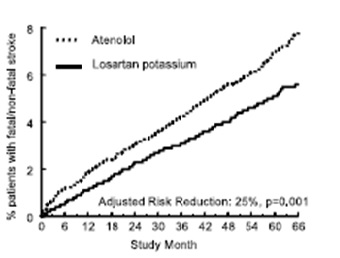
A line graph comparing the percentage of patients with fatal or non-fatal stroke over study months for Losartan potassium and Atenolol. The graph shows separate trend lines for each drug, with Losartan potassium having a lower percentage over time, indicating an adjusted risk reduction noted at the bottom of the graph.*
FDA Label Image

Losartanfigure3 (Losartanfigure3)

Losartanfigure3 (Losartanfigure3)
A figure titled 'Primary Endpoint Events within Demographic Subgroups' presenting hazard ratios with 95% confidence intervals for Losartan Potassium versus Atenolol. The chart compares event rates (%) for primary composite and stroke (fatal/non-fatal) outcomes across subgroups by age, gender, race, isolated systolic hypertension, diabetes, and history of cardiovascular disease, indicating relative favorability between the two treatments.*
FDA Label Image

Losartanfigure4 (Losartanfigure4)

Losartanfigure4 (Losartanfigure4)
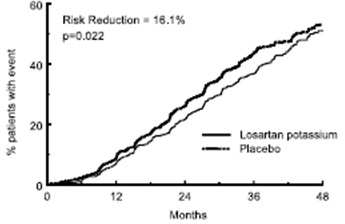
A line graph comparing the percentage of patients experiencing an event over 48 months between two groups: those treated with Losartan Potassium and those given a placebo. The graph shows greater risk reduction for the Losartan Potassium group, with time in months on the x-axis and percentage of patients with events on the y-axis.*
FDA Label Image

Losartanstructure (Losartanstructure)

Losartanstructure (Losartanstructure)
Chemical structure diagram of Losartan Potassium showing its molecular composition including chloride, hydroxyl, butyl, phenyl, triazole, and potassium ions.*

* About these descriptions: Image descriptions on this page are generated by automated AI analysis of the product label images from the manufacturer's FDA label submission (SPL). They are provided for reference only and may contain errors or omissions. Always rely on the printed label itself and the official FDA labeling, and consult a pharmacist or healthcare professional with any questions about this product.