Trial 1
Trial 1 was a phase 2, multicenter, randomized open-label study in patients with relapsed multiple myeloma (MM) who were refractory to their last myeloma therapy and had received lenalidomide and bortezomib. Patients were considered relapsed if they had achieved at least stable disease for at least 1 cycle of treatment to at least 1 prior regimen and then developed progressive disease. Patients were considered refractory if they experienced disease progression on or within 60 days of their last therapy. A total of 221 patients were randomized to receive pomalidomide alone or pomalidomide with Low-dose Dex. In Trial 1, the safety and efficacy of pomalidomide 4 mg, once daily for 21 of 28 days, until disease progression, were evaluated alone and in combination with Low-dose Dex (40 mg/day given only on Days 1, 8, 15, and 22 of each 28-day cycle for patients aged 75 years or younger, or 20 mg/day given only on Days 1, 8, 15, and 22 of each 28-day cycle for patients aged greater than 75 years). Patients in the pomalidomide alone arm were allowed to add Low-dose Dex upon disease progression.
Table 7 summarizes the baseline patient and disease characteristics in Trial 1. The baseline demographics and disease characteristics were balanced and comparable between the study arms.
Table 7: Baseline Demographic and Disease-Related Characteristics – Trial 1
| Pomalidomide
(n=108)
| Pomalidomide
+ Low-dose Dex
(n=113)
|
Patient Characteristics
|
|
|
Median age, years (range)
| 61 (37 to 88)
| 64 (34 to 88)
|
Age distribution, n (%)
<65 years
≥65 years
| 65 (60.2)
43 (39.8)
| 60 (53.1)
53 (46.9)
|
Sex, n (%)
Male
Female
|
57 (52.8)
51 (47.2)
|
62 (54.9)
51 (45.1)
|
Race/ethnicity, n (%)
White
Black or African American
All other race
| 86 (79.6)
16 (14.8)
6 (5.6)
| 92 (81.4)
17 (15)
4 (3.6)
|
ECOG Performance, n (%)
|
|
|
Status 0 to 1
| 95 (87.9)
| 100 (88.5)
|
Disease Characteristics
|
|
|
Number of prior therapies
Median (min, max)
| 5 (2, 12)
| 5 (2, 13)
|
Prior transplant, n (%)
| 82 (75.9)
| 84 (74.3)
|
Refractory to bortezomib and lenalidomide, n (%)
| 64 (59.3)
| 69 (61.1)
|
Data cutoff: 01 April 2011
Table 8 summarizes the analysis results of overall response rate (ORR) and duration of response (DOR), based on assessments by the Independent Review Adjudication Committee for the treatment arms in Trial 1. ORR did not differ based on type of prior antimyeloma therapy.
Table 8: Trial 1 Results
| Pomalidomide
a
(n=108)
| Pomalidomide
+ Low-dose Dex
(n=113)
|
Response
|
|
|
Overall Response Rate
(ORR),
bn (%)
| 8 (7.4)
| 33 (29.2)
|
95% CI for ORR (%)
| (3.3, 14.1)
| (21.0, 38.5)
|
Complete Response (CR), n (%)
| 0 (0.0)
| 1 (0.9)
|
Partial Response (PR), n (%)
| 8 (7.4)
| 32 (28.3)
|
Duration of Response (DOR)
|
|
|
Median, months
| NE
| 7.4
|
95% CI for DOR (months)
| NE
| (5.1, 9.2)
|
aResults are prior to the addition of dexamethasone.
bORR = PR + CR per EBMT criteria.
CI, confidence interval; NE, not established (the median has not yet been reached).
Data cutoff: 01 April 2011
Trial 2
Trial 2 was a Phase 3 multi-center, randomized, open-label study, where pomalidomide + Low-dose Dex therapy was compared to High-dose Dex in adult patients with relapsed and refractory MM, who had received at least two prior treatment regimens, including lenalidomide and bortezomib, and demonstrated disease progression on or within 60 days of the last therapy. Patients with creatinine clearance ≥ 45mL/min qualified for the trial. A total of 455 patients were enrolled in the trial: 302 in the pomalidomide + Low-dose Dex arm and 153 in the High-dose Dex arm. Patients in the pomalidomide + Low-dose Dex arm were administered 4 mg pomalidomide orally on Days 1 to 21 of each 28-day cycle. Dexamethasone (40 mg) was administered once per day on Days 1, 8, 15 and 22 of a 28-day cycle. Patients > 75 years of age started treatment with 20 mg dexamethasone using the same schedule. For the High-dose Dex arm, dexamethasone (40 mg) was administered once per day on Days 1 through 4, 9 through 12, and 17 through 20 of a 28-day cycle. Patients > 75 years of age started treatment with 20 mg dexamethasone using the same schedule. Treatment continued until patients had disease progression.
Baseline patient and disease characteristics were balanced and comparable between the study arms, as summarized in Table 9. Overall, 94% of patients had disease refractory to lenalidomide, 79% had disease refractory to bortezomib and 74% had disease refractory to both lenalidomide and bortezomib.
Table 9: Baseline Demographic and Disease-Related Characteristics – Trial 2
| Pomalidomide + Low-dose Dex
(N=302)
| High-dose Dex
(N=153)
|
Patient Characteristics
|
|
|
Median Age, years (range)
| 64 (35, 84)
| 65 (35, 87)
|
Age Distribution n (%)
< 65 years
≥ 65 years
| 158 (52)
144 (48)
| 74 (48)
79 (52)
|
Sex n (%)
Male
Female
| 181 (60)
121 (40)
| 87 (57)
66 (43)
|
Race/Ethnicity n (%)
White
Black or African American
Asian
Other Race
Not Collected
| 244 (81)
4 (1)
4 (1)
2 (1)
48 (16)
| 113 (74)
3 (2)
0 (0)
2 (1)
35 (23)
|
ECOG Performance n (%)
Status 0
Status 1
Status 2
Status 3
Missing
| 110 (36)
138 (46)
52 (17)
0 (0)
2 (1)
| 36 (24)
86 (56)
25 (16)
3 (2)
3 (2)
|
Disease Characteristics
|
|
|
Number of Prior Therapies Median, (Min, Max)
| 5 (2, 14)
| 5 (2, 17)
|
Prior stem cell transplant n (%)
| 214 (71)
| 105 (69)
|
Refractory to bortezomib and lenalidomide n (%)
| 225 (75)
| 113 (74)
|
Data cutoff: 01March 2013
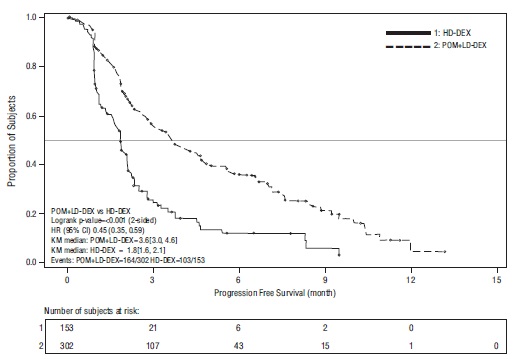
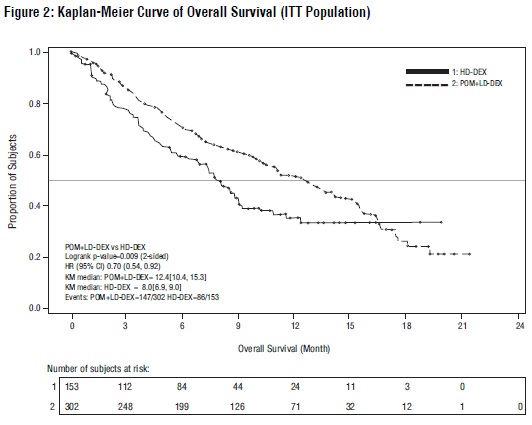
Table 10 summarizes the progression free survival (PFS) and overall response rate (ORR) based on the assessment by the Independent Review Adjudication Committee (IRAC) review at the final PFS analysis and overall survival (OS) at the OS analysis. PFS was significantly longer with pomalidomide + Low-dose Dex than High-dose Dex: HR 0.45 (95% CI: 0.35 to 0.59 p < 0.001). OS was also significantly longer with pomalidomide + Low-dose Dex than High-dose Dex: HR 0.70 (95% CI: 0.54 to 0.92 p = 0.009). The Kaplan-Meier curves for PFS and OS for the ITT population are provided in Figures 1 and 2, respectively.
Table 10: Trial 2 Results
| Pomalidomide
+ Low-dose Dex
(N=302)
| High-dose Dex
(N=153)
|
Progression Free Survival Time
|
|
|
Number (%) of events
| 164 (54.3)
| 103 (67.3)
|
Median
a(2-sided 95% CI)
(months
)
| 3.6 [3.0, 4.6]
| 1.8 [1.6, 2.1]
|
Hazard Ratio (Pom+LD-Dex:HD-Dex) 2-Sided 95% CI
b
| 0.45 [0.35, 0.59]
|
Log-Rank Test 2-sided P-Value
c
| <0.001
|
Overall Survival Time
d
|
|
Number (%) of deaths
| 147 (48.7)
| 86 (56.2)
|
Median
a(2-sided 95% CI)
(months
)
| 12.4 [10.4, 15.3]
| 8.0 [6.9, 9.0]
|
Hazard Ratio (Pom+LD-Dex:HD-Dex) 2-Sided 95% CI
e
| 0.70 [0.54, 0.92]
|
Log-Rank Test 2-sided P-Value
f, g
| 0.009
|
Overall Response Rate, n (%)
| 71 (23.5)
| 6 (3.9)
|
Complete Response
| 1 (0.3)
| 0
|
Very Good Partial Response
| 8 (2.6)
| 1 (0.7)
|
Partial Response
| 62 (20.5)
| 5 (3.3)
|
Note: CI=Confidence interval; HD-Dex=High dose dexamethasone; IRAC=Independent Review Adjudication Committee; LD-Dex=Low dose dexamethasone.
aThe median is based on Kaplan-Meier estimate.
bBased on Cox proportional hazards model comparing the hazard functions associated with treatment groups, stratified by age (≤75 vs >75), diseases population (refractory to both Lenalidomide and Bortezomib vs not refractory to both drugs), and prior number of antimyeloma therapy (=2 vs >2), stratification factors for the trial.
cThe p-value is based on a stratified log-rank test with the same stratification factors as the above Cox model.
d53% of patients in the High-dose Dex arm subsequently received pomalidomide.
eBased on Cox proportional hazards model (unstratified) comparing the hazard functions associated with treatment groups.
fThe p-value is based on an unstratified log-rank test.
gAlpha control for PFS and OS.
Data cutoff: 07 Sep 2012 for PFS
Data cutoff: 01 Mar 2013 for OS and ORR
Figure 1: Progression Free Survival Based on IRAC Review of Response by IMWG Criteria (Stratified Log Rank Test) (ITT Population)
Data cut-off: 07 Sep 2012
Data cutoff: 01 Mar 2013