Adult Patients with Schizophrenia
The following findings are based on a pool of five placebo-controlled trials (four 4-week and one 6-week) in which oral aripiprazole tablets were administered in doses ranging from 2 to 30 mg/day.
Commonly Observed Adverse Reactions
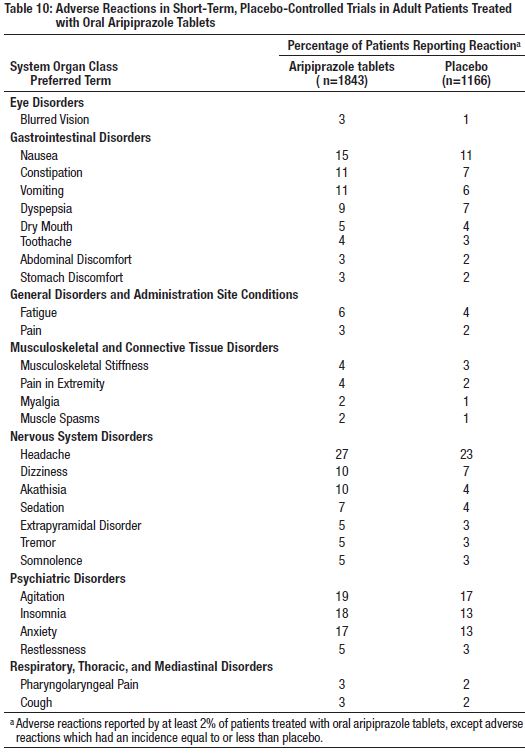
The only commonly observed adverse reaction associated with the use of aripiprazole tablets in patients with schizophrenia (incidence of 5% or greater and aripiprazole tablets incidence at least twice that for placebo) was akathisia (aripiprazole tablets 8%; placebo 4%).
Less Common Adverse Reactions in Adults
Table 10 enumerates the pooled incidence, rounded to the nearest percent, of adverse reactions that occurred during acute therapy (up to 6 weeks in schizophrenia and up to 3 weeks in another indication), including only those reactions that occurred in 2% or more of patients treated with aripiprazole tablets (doses ≥2 mg/day) and for which the incidence in patients treated with aripiprazole tablets was greater than the incidence in patients treated with placebo in the combined dataset.
An examination of population subgroups did not reveal any clear evidence of differential adverse reaction incidence on the basis of age, gender, or race.
Pediatric Patients (13 to 17 years) with Schizophrenia
The following findings are based on one 6-week, placebo-controlled trial in which oral aripiprazole tablet was administered in doses ranging from 2 to 30 mg/day.
Adverse Reactions Associated with Discontinuation of Treatment
The incidence of discontinuation due to adverse reactions between aripiprazole tablets-treated and placebo-treated pediatric patients (13 to 17 years) was 5% and 2%, respectively.
Commonly Observed Adverse Reactions
Commonly observed adverse reactions associated with the use of aripiprazole tablets in adolescent patients with schizophrenia (incidence of 5% or greater and aripiprazole tablets incidence at least twice that for placebo) were extrapyramidal disorder, somnolence, and tremor.
Less Common Adverse Reactions in Pediatric Patients (6 to 18 years) with Schizophrenia, or Other Indications
Table 11 enumerates the pooled incidence, rounded to the nearest percent, of adverse reactions that occurred during acute therapy (up to 6 weeks in schizophrenia, up to 4 weeks in one indication, up to 8 weeks in another indication, and up to 10 weeks in another indication), including only those reactions that occurred in 2% or more of pediatric patients treated with aripiprazole tablets (doses ≥2 mg/day) and for which the incidence in patients treated with aripiprazole tablets was greater than the incidence in patients treated with placebo.
Dose-Related Adverse Reactions
Schizophrenia
Dose response relationships for the incidence of treatment-emergent adverse events were evaluated from four trials in adult patients with schizophrenia comparing various fixed doses (2, 5, 10, 15, 20, and 30 mg/day) of oral aripiprazole tablets to placebo. This analysis, stratified by study, indicated that the only adverse reaction to have a possible dose response relationship, and then most prominent only with 30 mg, was somnolence [including sedation]; (incidences were placebo, 7.1%; 10 mg, 8.5%; 15 mg, 8.7%; 20 mg, 7.5%; 30 mg, 12.6%).
In the study of pediatric patients (13 to 17 years of age) with schizophrenia, three common adverse reactions appeared to have a possible dose response relationship: extrapyramidal disorder (incidences were placebo, 5%; 10 mg, 13%; 30 mg, 21.6%); somnolence (incidences were placebo, 6%; 10 mg, 11%; 30 mg, 21.6%); and tremor (incidences were placebo, 2%; 10 mg, 2%; 30 mg, 11.8%).
Extrapyramidal Symptoms
Schizophrenia
In short-term, placebo-controlled trials in schizophrenia in adults, the incidence of reported EPS-related events, excluding events related to akathisia, for aripiprazole tablets-treated patients was 13% vs. 12% for placebo; and the incidence of akathisia-related events for aripiprazole tablets-treated patients was 8% vs. 4% for placebo. In the short-term, placebo-controlled trial of schizophrenia in pediatric patients (13 to 17 years), the incidence of reported EPS-related events, excluding events related to akathisia, for aripiprazole tablets-treated patients was 25% vs. 7% for placebo; and the incidence of akathisia-related events for aripiprazole tablets-treated patients was 9% vs. 6% for placebo.
Objectively collected data from those trials was collected on the Simpson Angus Rating Scale (for EPS), the Barnes Akathisia Scale (for akathisia), and the Assessments of Involuntary Movement Scales (for dyskinesias). In the adult schizophrenia trials, the objectively collected data did not show a difference between aripiprazole tablets and placebo, with the exception of the Barnes Akathisia Scale (aripiprazole, 0.08; placebo, –0.05). In the pediatric (13 to 17 years) schizophrenia trial, the objectively collected data did not show a difference between aripiprazole tablets and placebo, with the exception of the Simpson Angus Rating Scale (aripiprazole tablets, 0.24; placebo, –0.29).
Similarly, in a long-term (26-week), placebo-controlled trial of schizophrenia in adults, objectively collected data on the Simpson Angus Rating Scale (for EPS), the Barnes Akathisia Scale (for akathisia), and the Assessments of Involuntary Movement Scales (for dyskinesias) did not show a difference between aripiprazole tablets and placebo.
Dystonia
Symptoms of dystonia, prolonged abnormal contractions of muscle groups, may occur in susceptible individuals during the first few days of treatment. Dystonic symptoms include: spasm of the neck muscles, sometimes progressing to tightness of the throat, swallowing difficulty, difficulty breathing, and/or protrusion of the tongue. While these symptoms can occur at low doses, they occur more frequently and with greater severity with high potency and at higher doses of first generation antipsychotic drugs. An elevated risk of acute dystonia is observed in males and younger age groups.
Additional Findings Observed in Clinical Trials
Adverse Reactions in Long-Term, Double-Blind, Placebo-Controlled Trials
The adverse reactions reported in a 26-week, double-blind trial comparing oral aripiprazole tablets and placebo in patients with schizophrenia were generally consistent with those reported in the short-term, placebo-controlled trials, except for a higher incidence of tremor [8% (12/153) for aripiprazole tablets vs. 2% (3/153) for placebo]. In this study, the majority of the cases of tremor were of mild intensity (8/12 mild and 4/12 moderate), occurred early in therapy (9/12 ≤49 days), and were of limited duration (7/12 ≤10 days). Tremor infrequently led to discontinuation (<1%) of aripiprazole tablets. In addition, in a long-term (52-week), active-controlled study, the incidence of tremor was 5% (40/859) for aripiprazole tablets.
Other Adverse Reactions Observed During the Premarketing Evaluation of Aripiprazole Tablets
The following listing does not include reactions: 1) already listed in previous tables or elsewhere in labeling, 2) for which a drug cause was remote, 3) which were so general as to be uninformative, 4) which were not considered to have significant clinical implications, or 5) which occurred at a rate equal to or less than placebo.
Reactions are categorized by body system according to the following definitions: frequent adverse reactions are those occurring in at least 1/100 patients; infrequent adverse reactions are those occurring in 1/100 to 1/1000 patients; rare reactions are those occurring in fewer than 1/1000 patients:
Adults - Oral Administration
Blood and Lymphatic System Disorders:
rare - thrombocytopenia
Cardiac Disorders:
infrequent – bradycardia, palpitations, rare – atrial flutter, cardio-respiratory arrest, atrioventricular block, atrial fibrillation, angina pectoris, myocardial ischemia, myocardial infarction, cardiopulmonary failure
Eye Disorders:
infrequent – photophobia; rare -diplopia
Gastrointestinal Disorders:
infrequent - gastroesophageal reflux disease
General Disorders and Administration Site Conditions:
frequent - asthenia; infrequent – peripheral edema, chest pain; rare – face edema
Hepatobiliary Disorders:
rare - hepatitis, jaundice
Immune System Disorders:
rare-hypersensitivity
Injury, Poisoning, and Procedural Complications:
infrequent– fall; rare – heat stroke
Investigations:
frequent - weight decreased, infrequent - hepatic enzyme increased, blood glucose increased, blood lactate dehydrogenase increased, gamma glutamyl transferase increased; rare – blood prolactin increased, blood urea inceased, blood creatinine increased, blood bilirubin increased, electrocardiogram QT prolonged, glycosylated hemoglobin increased
Metabolism and Nutrition Disorders:
frequent –anorexia; infrequent -rare -hypokalemia, hyponatremia, hypoglycemia
Musculoskeletal and Connective Tissue Disorders:
infrequent -muscular weakness, muscle tightness; rare – rhabdomyolysis, mobility decreased
Nervous System Disorders:
infrequent - parkinsonism, memory impairment, cogwheel rigidity, hypokinesia, myoclonus, bradykinesia; rare – akinesia, myoclonus, coordination abnormal, speech disorder, Grand Mal convulsion; <1/10,000 patients -choreoathetosis
Psychiatric Disorders:
infrequent – aggression, loss of libido, delirium; rare – libido increased, anorgasmia, tic, homicidal ideation, catatonia, sleep walking
Renal and Urinary Disorders:
rare - urinary retention, nocturia
Reproductive System and Breast Disorders:
infrequent - erectile dysfunction; rare – gynaecomastia, menstruation irregular, amenorrhea, breast pain, priapism
Respiratory, Thoracic, and Mediastinal Disorders:
infrequent -nasal congestion, dyspnea
Skin and Subcutaneous Tissue Disorders:
infrequent - rash, hyperhidrosis, pruritus, photosensitivity reaction, alopecia; rare -urticaria
Vascular Disorders:
infrequent – hypotension, hypertension;
Pediatric Patients - Oral Administration
Most adverse events observed in the pooled database of 1,686 pediatric patients, aged 6 to 18 years, were also observed in the adult population. Additional adverse reactions observed in the pediatric population are listed below.
Eye Disorders
infrequent - oculogyric crisis
Gastrointestinal Disorders:
infrequent -tongue dry, tongue spasm
Investigations:
frequent - blood insulin increased
Nervous System Disorders:
infrequent - sleep talking
Renal and Urinary Disorders:
frequent – enuresis
Skin and Subcutaneous Tissue Disorders:
infrequent - hirsutism
Additional pediatric use information is approved for Otsuka America Pharmaceutical, Inc.’s ABILIFY® (aripiprazole) product. However, due to Otsuka America Pharmaceutical, Inc.’s marketing exclusivity rights, this drug product is not labeled with that information.