Absorption
Fentanyl transdermal system is a drug-in-adhesive matrix designed formulation. Fentanyl is released from the matrix at a nearly constant amount per unit time. The concentration gradient existing between the matrix and the lower concentration in the skin, drives drug release. Fentanyl moves in the direction of the lower concentration at a rate determined by the matrix and the diffusion of fentanyl through the skin layers. While the actual rate of fentanyl delivery to the skin varies over the 72-hour application period, each system is labeled with a nominal flux which represents the average amount of drug delivered to the systemic circulation per hour across average skin.
While there is variation in dose delivered among patients, the nominal flux of the systems (12.5, 25, 37.5, 50, 75, and 100 mcg of fentanyl per hour) is sufficiently accurate as to allow individual titration of dosage for a given patient.
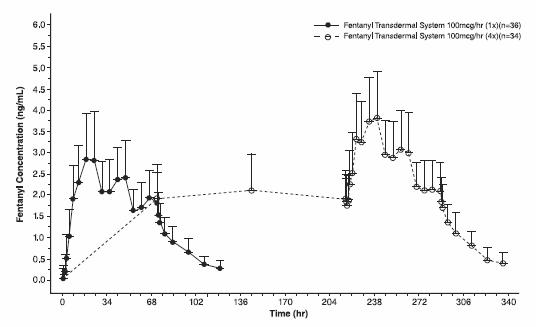
Following fentanyl transdermal system application, the skin under the system absorbs fentanyl, and a depot of fentanyl concentrates in the upper skin layers. Fentanyl then becomes available to the systemic circulation. Serum fentanyl concentrations increase gradually following initial fentanyl transdermal system application, generally leveling off between 12 and 24 hours and remaining relatively constant, with some fluctuation, for the remainder of the 72-hour application period. Peak serum concentrations of fentanyl generally occurred between 20 and 72 hours after initial application (see Table 6). Serum fentanyl concentrations achieved are proportional to the fentanyl transdermal system delivery rate. With continuous use, serum fentanyl concentrations continue to rise for the first two system applications. By the end of the second 72-hour application, a steady-state serum concentration is reached and is maintained during subsequent applications of a patch of the same size (see Figure 1). Patients reach and maintain a steady-state serum concentration that is determined by individual variation in skin permeability and body clearance of fentanyl.
After system removal, serum fentanyl concentrations decline gradually, falling about 50% in approximately 20 to 27 hours. Continued absorption of fentanyl from the skin accounts for a slower disappearance of the drug from the serum than is seen after an IV infusion, where the apparent half-life is approximately 7 (range 3 to 12) hours.
A clinical pharmacology study conducted in healthy adult subjects has shown that the application of heat over the fentanyl transdermal system increased mean overall fentanyl exposure by 120% and average maximum fentanyl level by 61%.
Table 7: Fentanyl Pharmacokinetic Parameters Following First 72-Hour Application of Fentanyl Transdermal System | Mean (SD) Time to Maximal Concentration
T
max(h)
| Mean (SD) Maximal Concentration
C
max(ng/mL)
|
| Fentanyl Transdermal System 12 mcg/hour | 28.8 (13.7) | 0.38 (0.13)* |
| Fentanyl Transdermal System 25 mcg/hour | 31.7 (16.5) | 0.85 (0.26)** |
| Fentanyl Transdermal System 50 mcg/hour | 32.8 (15.6) | 1.72 (0.53)** |
| Fentanyl Transdermal System 75 mcg/hour | 35.8 (14.1) | 2.32 (0.86)** |
| Fentanyl Transdermal System 100 mcg/hour | 29.9 (13.3) | 3.36 (1.28)** |
* C
maxvalues dose normalized from 4 x 12.5 mcg/h: Study 2003-038 in healthy volunteers
** C
maxvalues: Study C-2002-048 dose proportionality study in healthy volunteers
NOTE:
After system removal there is continued systemic absorption from residual fentanyl in the skin so that serum concentrations fall 50%, on average, in approximately 20 to 27 hours.
Figure 1 Serum Fentanyl Concentrations Following Single and Multiple Applications of Fentanyl Transdermal System 100 mcg/h
Table 8: Range of Pharmacokinetic Parameters of Intravenous Fentanyl In Patients
| Clearance (L/h) Range [70 kg] | Volume of Distribution V
SS
(L/kg) Range
| Half-Life t
1/2(h) Range
|
| Surgical Patients | 27 - 75 | 3 - 8 | 3 - 12 |
| Hepatically Impaired Patients | 3 - 80+ | 0.8 - 8+ | 4 - 12+ |
| Renally Impaired Patients | 30 - 78 | – | – |
+Estimated
NOTE:Information on volume of distribution and half-life not available for renally impaired patients.
Distribution
Fentanyl plasma protein binding capacity decreases with increasing ionization of the drug. Alterations in pH may affect its distribution between plasma and the central nervous system. Fentanyl accumulates in the skeletal muscle and fat and is released slowly into the blood. The average volume of distribution for fentanyl is 6 L/kg (range 3 to 8; N=8).
Elimination
Metabolism
Fentanyl is metabolized primarily via human cytochrome P450 3A4 isoenzyme system. In humans, the drug appears to be metabolized primarily by oxidative N-dealkylation to norfentanyl and other inactive metabolites that do not contribute materially to the observed activity of the drug.
Skin does not appear to metabolize fentanyl delivered transdermally. This was determined in a human keratinocyte cell assay and in clinical studies in which 92% of the dose delivered from the system was accounted for as unchanged fentanyl that appeared in the systemic circulation.
Excretion
Within 72 hours of IV fentanyl administration, approximately 75% of the dose is excreted in urine, mostly as metabolites with less than 10% representing unchanged drug. Approximately 9% of the dose is recovered in the feces, primarily as metabolites. Mean values for unbound fractions of fentanyl in plasma are estimated to be between 13 and 21%.
Specific Populations
Age: Geriatric Population
Data from intravenous studies with fentanyl suggest that the elderly patients may have reduced clearance and a prolonged half-life. Moreover elderly patients may be more sensitive to the active substance than younger patients. A study conducted with the fentanyl transdermal patch in elderly patients demonstrated that fentanyl pharmacokinetics did not differ significantly from young adult subjects, although peak serum concentrations tended to be lower and mean half-life values were prolonged to approximately 34 hours. In this study, a single fentanyl transdermal system 100 mcg/hour patch was applied to a skin site on the upper outer arm in a group of healthy elderly Caucasians ≥65 years old (n=21, mean age 71 years) and worn for 72 hours. The mean C
maxand AUC
∞values were approximately 8% lower and 7% higher, respectively, in the elderly subjects as compared with subjects 18 to 45 years old. Inter-subject variability in AUC
∞was higher in elderly subjects than in healthy adult subjects 18 to 45 years (58% and 37%, respectively). The mean half-life value was longer in subjects ≥65 years old than in subjects 18 to 45 years old (34.4 hours versus 23.5 hours)
[see Warnings and Precautions (
5.11) and Use in Specific Populations (
8.5)]
.
Age: Pediatric Population
In 1.5 to 5 year old, non-opioid-tolerant pediatric patients, the fentanyl plasma concentrations were approximately twice as high as that of adult patients. In older pediatric patients, the pharmacokinetic parameters were similar to that of adults. However, these findings have been taken into consideration in determining the dosing recommendations for opioid-tolerant pediatric patients (2 years of age and older). For pediatric dosing information, refer to
[see Dosage and Administration (
2.3)].
Hepatic Impairment
Information on the effect of hepatic impairment on the pharmacokinetics of fentanyl transdermal system is limited. The pharmacokinetics of fentanyl transdermal system delivering 50 mcg/hour of fentanyl for 72 hours was evaluated in patients hospitalized for surgery. Compared to the controlled patients (n=8), C
maxand AUC in the patients with cirrhosis (n=9) increased 35% and 73%, respectively.
Because there is
in-vitroand
in-vivoevidence of extensive hepatic contribution to the elimination of fentanyl transdermal system, hepatic impairment would be expected to have significant effects on the pharmacokinetics of fentanyl transdermal system. Avoid use of fentanyl transdermal system in patients with severe hepatic impairment
[see Dosing and Administration (
2.5), Warnings and Precautions (
5.17), and Use in Specific Populations (
8.6)]
.
Renal Impairment
Information on the effect of renal impairment on the pharmacokinetics of fentanyl transdermal system is limited. The pharmacokinetics of intravenous injection of 25 mcg/kg fentanyl was evaluated in patients (n=8) undergoing kidney transplantation. An inverse relationship between blood urea nitrogen level and fentanyl clearance was found.
Because there is
in-vivoevidence of renal contribution to the elimination of fentanyl transdermal system, renal impairment would be expected to have significant effects on the pharmacokinetics of fentanyl transdermal system. Avoid the use of fentanyl transdermal system in patients with severe renal impairment
[see Dosing and Administration (
2.6), Warnings and Precautions (
5.18) and Use in Specific Populations (
8.7)].
Drug Interaction Studies
CYP3A4 Inhibitors
Fentanyl is metabolized mainly via the human cytochrome P450 3A4 isoenzyme system (CYP3A4). The interaction between ritonavir, a CYP3A4 inhibitor, and fentanyl was investigated in eleven healthy volunteers in a randomized crossover study. Subjects received oral ritonavir or placebo for 3 days. The ritonavir dose was 200 mg three times a day on Day 1 and 300 mg three times a day on Day 2 followed by one morning dose of 300 mg on Day 3. On Day 2, fentanyl was given as a single IV dose at 5 mcg/kg two hours after the afternoon dose of oral ritonavir or placebo. Naloxone was administered to counteract the side effects of fentanyl. The results suggested that ritonavir might decrease the clearance of fentanyl by 67%, resulting in a 174% (range 52% to 420%) increase in fentanyl AUC
0-∞. The concomitant use of transdermal fentanyl with all CYP3A4 inhibitors (such as ritonavir, ketoconazole, itraconazole, troleandomycin, clarithromycin, nelfinavir, nefazodone, amiodarone, amprenavir, aprepitant, diltiazem, erythromycin, fluconazole, fosamprenavir, verapamil, or grapefruit juice) may result in an increase in fentanyl plasma concentrations, which could increase or prolong adverse drug effects and may cause potentially fatal respiratory depression. Carefully monitor patients receiving fentanyl transdermal system and any CYP3A4 inhibitor for signs of respiratory depression for an extended period of time and adjust the dosage if warranted
[see
Boxed Warningand Warnings and Precautions (
5.6), and Drug Interactions (
7)].
CYP3A4 Inducers
Co-administration with agents that induce CYP3A4 activity may reduce the efficacy of fentanyl transdermal system.