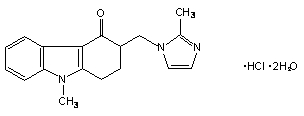
Ondansetron is well absorbed from the gastrointestinal tract and undergoes some first-pass metabolism. Mean bioavailability in healthy subjects, following administration of a single 8-mg tablet, is approximately 56%.
Ondansetron systemic exposure does not increase proportionately to dose. AUC from a 16-mg tablet was 24% greater than predicted from an 8-mg tablet dose. This may reflect some reduction of first-pass metabolism at higher oral doses. Bioavailability is also slightly enhanced by the presence of food but unaffected by antacids.
Ondansetron is extensively metabolized in humans, with approximately 5% of a radiolabeled dose recovered as the parent compound from the urine. The primary metabolic pathway is hydroxylation on the indole ring followed by subsequent glucuronide or sulfate conjugation. Although some nonconjugated metabolites have pharmacologic activity, these are not found in plasma at concentrations likely to significantly contribute to the biological activity of ondansetron.
In vitro metabolism studies have shown that ondansetron is a substrate for human hepatic cytochrome P-450 enzymes, including CYP1A2, CYP2D6, and CYP3A4. In terms of overall ondansetron turnover, CYP3A4 played the predominant role. Because of the multiplicity of metabolic enzymes capable of metabolizing ondansetron, it is likely that inhibition or loss of one enzyme (e.g., CYP2D6 genetic deficiency) will be compensated by others and may result in little change in overall rates of ondansetron elimination. Ondansetron elimination may be affected by cytochrome P-450 inducers. In a pharmacokinetic study of 16 epileptic patients maintained chronically on CYP3A4 inducers, carbamazepine, or phenytoin, reduction in AUC, Cmax, and T½ of ondansetron was observed.1 This resulted in a significant increase in clearance. However, on the basis of available data, no dosage adjustment for ondansetron is recommended (see PRECAUTIONS: Drug Interactions).
In humans, carmustine, etoposide, and cisplatin do not affect the pharmacokinetics of ondansetron.
Gender differences were shown in the disposition of ondansetron given as a single dose. The extent and rate of ondansetron's absorption is greater in women than men. Slower clearance in women, a smaller apparent volume of distribution (adjusted for weight), and higher absolute bioavailability resulted in higher plasma ondansetron levels. These higher plasma levels may in part be explained by differences in body weight between men and women. It is not known whether these gender-related differences were clinically important. More detailed pharmacokinetic information is contained in Tables 1 and 2 taken from 2 studies.
Table 1. Pharmacokinetics in Normal Volunteers: Single 8-mg Ondansetron Tablet Dose | Age-group (years) | Mean Weight (kg) | n | Peak Plasma Concentration (ng/mL) | Time of Peak Plasma Concentration (h) | Mean EliminationHalf-life (h) | Systemic Plasma Clearance L/h/kg | Absolute Bioavailability |
| 18-40 M F | 69 62.7 | 6 5 | 26.2 42.7 | 2 1.7 | 3.1 3.5 | 0.403 0.354 | 0.483 0.663 |
| 61-74 M F | 77.5 60.2 | 6 6 | 24.1 52.4 | 2.1 1.9 | 4.1 4.9 | 0.384 0.255 | 0.585 0.643 |
| ≥75 M F | 78 67.6 | 5 6 | 37 46.1 | 2.2 2.1 | 4.5 6.2 | 0.277 0.249 | 0.619 0.747 |
Table 2. Pharmacokinetics in Normal Volunteers: Single 24-mg Ondansetron Tablet Dose | Age-group (years) | Mean Weight (kg) | n | Peak Plasma Concentration (ng/mL) | Time of Peak Plasma Concentration (h) | Mean Elimination Half-life (h) |
| 18-43 M F | 84.1 71.8 | 8 8 | 125.8 194.4 | 1.9 1.6 | 4.7 5.8 |
A reduction in clearance and increase in elimination half-life are seen in patients over 75 years of age. In clinical trials with cancer patients, safety and efficacy were similar in patients over 65 years of age and those under 65 years of age; there was an insufficient number of patients over 75 years of age to permit conclusions in that age-group. No dosage adjustment is recommended in the elderly.
In patients with mild-to-moderate hepatic impairment, clearance is reduced 2-fold and mean half-life is increased to 11.6 hours compared to 5.7 hours in normals. In patients with severe hepatic impairment (Child-Pugh2 score of 10 or greater), clearance is reduced 2-fold to 3-fold and apparent volume of distribution is increased with a resultant increase in half-life to 20 hours. In patients with severe hepatic impairment, a total daily dose of 8 mg should not be exceeded.
Due to the very small contribution (5%) of renal clearance to the overall clearance, renal impairment was not expected to significantly influence the total clearance of ondansetron. However, ondansetron oral mean plasma clearance was reduced by about 50% in patients with severe renal impairment (creatinine clearance <30 mL/min). This reduction in clearance is variable and was not consistent with an increase in half-life. No reduction in dose or dosing frequency in these patients is warranted.
Plasma protein binding of ondansetron as measured in vitro was 70% to 76% over the concentration range of 10 to 500 ng/mL. Circulating drug also distributes into erythrocytes.
Four-and 8-mg doses of ondansetron orally disintegrating tablets are bioequivalent to corresponding doses of ondansetron tablets and may be used interchangeably. One 24-mg ondansetron tablet is bioequivalent to and interchangeable with three 8-mg ondansetron tablets.