Description
Bisoprolol fumarate and hydrochlorothiazide tablets USP are indicated for the treatment of hypertension. It combines two antihypertensive agents in a once–daily dosage: a synthetic beta1-selective (cardioselective) adrenoceptor blocking agent (bisoprolol fumarate) and a benzothiadiazine diuretic (hydrochlorothiazide).
Bisoprolol fumarate is chemically described as (±)-1-[4-[[-2-(1-methylethoxy)ethoxy]methyl] phenoxy]-3-[(1-methylethyl)amino]-2-propanol(E)-2-butenedioate(2:1)(salt). It possesses an asymmetric carbon atom in its structure and is provided as a racemic mixture. The S(-) enantiomer is responsible for most of the beta-blocking activity. Its molecular formula is (C18H31NO4)2•C4H4O4 and it has a molecular weight of 766.97. Its structural formula is:
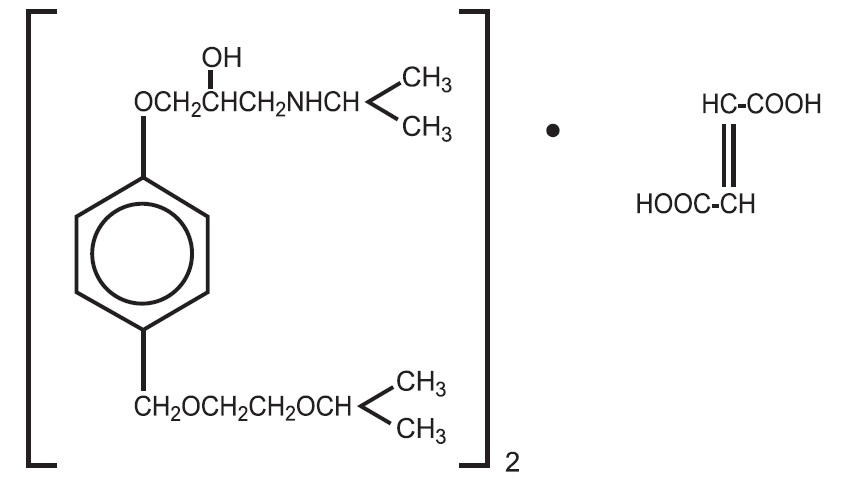
Bisoprolol Fumarate (Bisoprolol Hctz 5 And 6 25mg Tab For Unichem 1)
Bisoprolol fumarate is a white crystalline powder, approximately equally hydrophilic and lipophilic, and readily soluble in water, methanol, ethanol, and chloroform.
Hydrochlorothiazide (HCTZ) is 6-Chloro-3,4-dihydro-2H-1,2,4-benzothiadiazine-7-sulfonamide 1,1-dioxide. It is a white, or practically white, practically odorless crystalline powder. It is slightly soluble in water, sparingly soluble in dilute sodium hydroxide solution, freely soluble in n-butylamine and dimethylformamide, sparingly soluble in methanol, and insoluble in ether, chloroform, and dilute mineral acids. Its molecular formula is C7H8ClN3O4S2 and it has a molecular weight of 297.73. Its structural formula is:
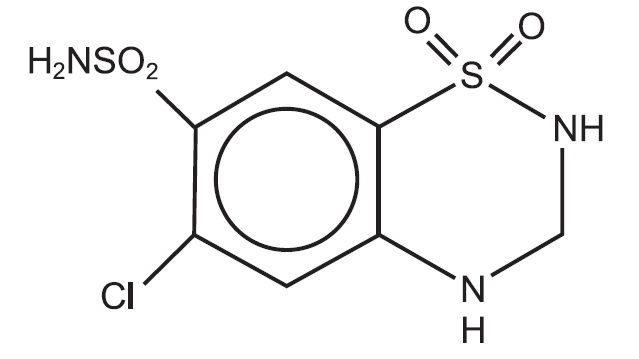
Hydrochlorothiazide (Bisoprolol Hctz 5 And 6 25mg Tab For Unichem 2)
Each Bisoprolol Fumarate and Hydrochlorothiazide tablet USP 2.5 mg/6.25 mg for oral administration contains:
Bisoprolol fumarate USP….. 2.5 mg
Hydrochlorothiazide USP…. 6.25 mg
Each Bisoprolol Fumarate and Hydrochlorothiazide tablet USP 5 mg/6.25 mg for oral administration contains:
Bisoprolol fumarate USP….. 5 mg
Hydrochlorothiazide USP…. 6.25 mg
Each Bisoprolol Fumarate and Hydrochlorothiazide tablet USP 10 mg/6.25 mg for oral administration contains:
Bisoprolol fumarate USP….. 10 mg
Hydrochlorothiazide USP…. 6.25 mg
Inactive ingredients include pregelatinized starch, dibasic calcium phosphate anhydrous, hypromellose, magnesium stearate, microcrystalline cellulose, polyethylene glycol, colloidal silicon dioxide, copovidone and titanium dioxide. The 5 mg/6.25 mg tablet also contains red and yellow iron oxide. The 2.5 mg/6.25 mg tablet also contains yellow iron oxide.
