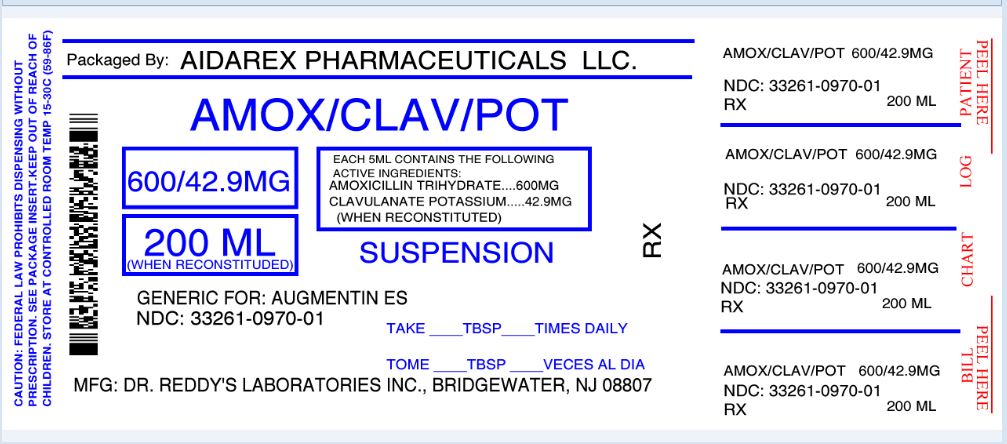
Two clinical studies were conducted in pediatric patients with acute otitis media.
A non-comparative, open-label study assessed the bacteriologic and
clinical efficacy of Amoxicillin and Clavulanate Potassium 600 mg/42.9 mg per 5
mL (90/6.4 mg/kg/day, divided every 12 hours) for 10 days in 521 pediatric
patients (3 to 50 months) with acute otitis media. The primary objective was to
assess bacteriological response in children with acute otitis media due to S.
pneumoniae with amoxicillin/clavulanic acid MICs of 4 mcg/mL. The study sought
the enrollment of patients with the following risk factors: Failure of
antibiotic therapy for acute otitis media in the previous 3 months, history of
recurrent episodes of acute otitis media, ≤ 2 years, or daycare attendance.
Prior to receiving Amoxicillin and Clavulanate Potassium 600 mg/42.9 mg per 5
mL, all patients had tympanocentesis to obtain middle ear fluid for
bacteriological evaluation. Patients from whom S. pneumoniae (alone or in
combination with other bacteria) was isolated had a second tympanocentesis 4 to
6 days after the start of therapy. Clinical assessments were planned for all
patients during treatment (4-6 days after starting therapy), as well as 2-4
days post-treatment and 15-18 days post-treatment. Bacteriological success was
defined as the absence of the pretreatment pathogen from the on-therapy
tympanocentesis specimen. Clinical success was defined as improvement or
resolution of signs and symptoms. Clinical failure was defined as lack of
improvement or worsening of signs and/or symptoms at any time following at
least 72 hours of Amoxicillin and Clavulanate Potassium 600 mg/42.9 mg per 5
mL; patients who received an additional systemic antibacterial drug for otitis
media after 3 days of therapy were considered clinical failures.
Bacteriological eradication on therapy (day 4-6 visit) in the per protocol
population is summarized in the following table:
Table 5. Bacteriologic Eradication Rates in the Per Protocol Population | Bacteriologic Eradication on Therapy |
|---|
| Pathogen | n/N | % | 95% CI |
| All S. pneumoniae | 121/123 | 98.4 | (94.3, 99.8) |
S. pneumoniae with penicillin
MIC = 2 mcg/mL | 19/19 | 100 | (82.4, 100.0) |
S. pneumoniae with penicillin
MIC = 4 mcg/mL | 12/14 | 85.7 | (57.2, 98.2) |
| H. influenzae | 75/81 | 92.6 | (84.6, 97.2) |
| M. catarrhalis | 11/11 | 100 | (71.5, 100.0) |
Clinical assessments were made in the per protocol population 2-4 days
post-therapy and 15-18 days post-therapy. Patients who responded to therapy 2-4
days post-therapy were followed for 15-18 days post-therapy to assess them for
acute otitis media. Nonresponders at 2-4 days post-therapy were considered
failures at the latter timepoint.
Table 6. Clinical Assessments in the Per Protocol Population (Includes S. pneumoniae Patients With Penicillin MICs = 2 or 4 mcg/mL)
| 2-4 Days Post-Therapy (Primary Endpoint) |
|---|
| Pathogen | n/N | % | 95% CI |
| All S. pneumoniae | 122/137 | 89.1 | (82.6, 93.7) |
S. pneumoniae with penicillin
MIC = 2 mcg/mL | 17/20 | 85.0 | (62.1, 96.8) |
S. pneumoniae with penicillin
MIC = 4 mcg/mL | 11/14 | 78.6 | (49.2, 95.3) |
| H. influenzae | 141/162 | 87.0 | (80.9, 91.8) |
| M. catarrhalis | 22/26 | 84.6 | (65.1, 95.6) |
| | | | |
| 15-18 Days Post-Therapy (Secondary Endpoint) |
|---|
| Pathogen | n/N | % | 95% CI |
| All S. pneumoniae | 95/136 | 69.9 | (61.4, 77.4) |
S. pneumoniae with penicillin
MIC = 2 mcg/mL | 11/20 | 55.0 | (31.5, 76.9) |
S. pneumoniae with penicillin
MIC = 4 mcg/mL | 5/14 | 35.7 | (12.8, 64.9) |
| H. influenzae | 106/156 | 67.9 | (60.0, 75.2) |
| M. catarrhalis | 14/25 | 56.0 | (34.9, 75.6) |
In the intent-to-treat analysis, overall clinical outcomes at 2-4 days
and 15-18 days post-treatment in patients with S. pneumoniae with penicillin
MIC = 2 mcg/mL and 4 mcg/mL were 29/41 (71%) and 17/41 (41.5%), respectively.
In the intent-to-treat population of 521 patients, the most frequently
reported adverse events were vomiting (6.9%), fever (6.1%), contact dermatitis
(i.e., diaper rash) (6.1%), upper respiratory tract infection (4.0%), and
diarrhea (3.8%). Protocol-defined diarrhea (i.e., 3 or more watery stools in
one day or 2 watery stools per day for 2 consecutive days as recorded on diary
cards) occurred in 12.9% of patients.
A double-blind, randomized, clinical study compared Amoxicillin and
Clavulanate Potassium 600 mg/42.9 mg per 5 mL (90/6.4 mg/kg/day, divided every
12 hours) to AMOXICILLIN AND CLAVULANATE POTASSIUM (45/6.4 mg/kg/day, divided
every 12 hours) for 10 days in 450 pediatric patients (3 months to 12 years)
with acute otitis media. The primary objective of the study was to compare the
safety of Amoxicillin and Clavulanate Potassium 600 mg/42.9 mg per 5 mL to
AMOXICILLIN AND CLAVULANATE POTASSIUM. There was no statistically significant
difference between treatments in the proportion of patients with 1 or more
adverse events. The most frequently reported adverse events for Amoxicillin
and Clavulanate Potassium 600 mg/42.9 mg per 5 mL and the comparator of
AMOXICILLIN AND CLAVULANATE POTASSIUM were coughing (11.9% versus 6.8%),
vomiting (6.5% versus 7.7%), contact dermatitis (i.e., diaper rash, 6.0% versus
4.8%), fever (5.5% versus 3.9%), and upper respiratory infection (3.0% versus
9.2%), respectively. The frequencies of protocol-defined diarrhea with
Amoxicillin and Clavulanate Potassium 600 mg/42.9 mg per 5 mL(11.1%) and
AMOXICILLIN AND CLAVULANATE POTASSIUM (9.4%) were similar (95% confidence
interval on difference: –4.2% to 7.7%). Only 2 patients in the group treated
with Amoxicillin and Clavulanate Potassium 600 mg/42.9 mg per 5mL and 1 patient
in the group treated with AMOXICILLIN AND CLAVULANATE POTASSIUM were withdrawn
due to diarrhea.