Mechanism of Action
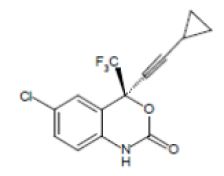
Efavirenz: EFV is a non-nucleoside reverse transcriptase (RT) inhibitor of HIV-1. Efavirenz activity is mediated predominantly by noncompetitive inhibition of HIV-1 reverse transcriptase. HIV-2 RT and human cellular DNA polymerases α, β, γ, and δ are not inhibited by EFV.
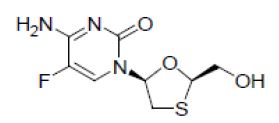
Emtricitabine: Emtricitabine, a synthetic nucleoside analog of cytidine, is phosphorylated by cellular enzymes to form FTC5'-triphosphate. Emtricitabine 5'-triphosphate inhibits the activity of the HIV-1 RT by competing with the natural substrate deoxycytidine 5'-triphosphate and by being incorporated into nascent viral DNA which results in chain termination. Emtricitabine 5'-triphosphate is a weak inhibitor of mammalian DNA polymerases α, β, ε, and mitochondrial DNA polymerase γ.
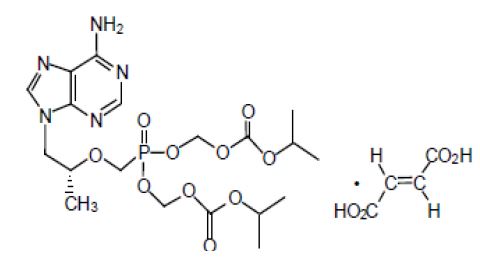
Tenofovir DF: TDF is an acyclic nucleoside phosphonate diester analog of adenosine monophosphate. TDF requires initial diester hydrolysis for conversion to tenofovir and subsequent phosphorylations by cellular enzymes to form tenofovir diphosphate. Tenofovir diphosphate inhibits the activity of HIV-1 RT by competing with the natural substrate deoxyadenosine 5'-triphosphate and, after incorporation into DNA, by DNA chain termination. Tenofovir diphosphate is a weak inhibitor of mammalian DNA polymerases α, β, and mitochondrial DNA polymerase γ.
Antiviral Activity
Efavirenz, Emtricitabine, and Tenofovir DF: In combination studies evaluating the antiviral activity in cell culture of FTC and EFV together, EFV and tenofovir together, and FTC and tenofovir together, additive to synergistic antiviral effects were observed.
Efavirenz: The concentration of EFV inhibiting replication of wild-type laboratory adapted strains and clinical isolates in cell culture by 90–95% (EC90-95) ranged from 1.7−25 nM in lymphoblastoid cell lines, peripheral blood mononuclear cells, and macrophage/monocyte cultures. Efavirenz demonstrated additive antiviral activity against HIV-1 in cell culture when combined with non-nucleoside reverse transcriptase inhibitors (NNRTIs) (delavirdine and nevirapine), nucleoside reverse transcriptase inhibitors (NRTIs) (abacavir, didanosine, lamivudine, stavudine, zalcitabine, and zidovudine), protease inhibitors (PIs) (amprenavir, indinavir, lopinavir, nelfinavir, ritonavir, and saquinavir), and the fusion inhibitor enfuvirtide. Efavirenz demonstrated additive to antagonistic antiviral activity in cell culture with atazanavir. Efavirenz demonstrated antiviral activity against clade B and most non-clade B isolates (subtypes A, AE, AG, C, D, F, G, J, and N), but had reduced antiviral activity against group O viruses. Efavirenz is not active against HIV-2.
Emtricitabine: The antiviral activity in cell culture of FTC against laboratory and clinical isolates of HIV-1 was assessed in lymphoblastoid cell lines, the MAGI-CCR5 cell line, and peripheral blood mononuclear cells. The 50% effective concentration (EC50) values for FTC were in the range of 0.0013–0.64 μM (0.0003–0.158 μg/mL). In drug combination studies of FTC with NRTIs (abacavir, lamivudine, stavudine, zalcitabine, and zidovudine), NNRTIs (delavirdine, EFV, and nevirapine), and PIs (amprenavir, nelfinavir, ritonavir, and saquinavir), additive to synergistic effects were observed. Emtricitabine displayed antiviral activity in cell culture against HIV-1 clades A, B, C, D, E, F, and G (EC50 values ranged from 0.007–0.075 μM) and showed strain-specific activity against HIV-2 (EC50 values ranged from 0.007–1.5 μM).
Tenofovir DF: The antiviral activity in cell culture of tenofovir against laboratory and clinical isolates of HIV-1 was assessed in lymphoblastoid cell lines, primary monocyte/macrophage cells and peripheral blood lymphocytes. The EC50 values for tenofovir were in the range of 0.04-8.5 μM. In drug combination studies of tenofovir with NRTIs (abacavir, didanosine, lamivudine, stavudine, zalcitabine, and zidovudine), NNRTIs (delavirdine, EFV, and nevirapine), and PIs (amprenavir, indinavir, nelfinavir, ritonavir, and saquinavir), additive to synergistic effects were observed. Tenofovir displayed antiviral activity in cell culture against HIV-1 clades A, B, C, D, E, F, G, and O (EC50 values ranged from 0.5–2.2 μM) and showed strain-specific activity against HIV-2 (EC50 values ranged from 1.6–5.5 μM).
Resistance:
EFV, FTC, and TDF: HIV-1 isolates with reduced susceptibility to the combination of FTC and tenofovir have been selected in cell culture and in clinical trials. Genotypic analysis of these isolates identified the M184V/I and/or K65R amino acid substitutions in the viral RT. In addition, a K70E substitution in HIV-1 reverse transcriptase has been selected by tenofovir and results in reduced susceptibility to tenofovir.
In a clinical trial of treatment-naïve subjects [Study 934, see Clinical Studies (14)] resistance analysis was performed on HIV-1 isolates from all confirmed virologic failure subjects with greater than 400 copies/mL of HIV-1 RNA at Week 144 or early discontinuations. Genotypic resistance to EFV, predominantly the K103N substitution, was the most common form of resistance that developed. Resistance to EFV occurred in 13/19 analyzed subjects in the FTC + TDF group and in 21/29 analyzed subjects in the zidovudine/lamivudine fixed-dose combination group. The M184V amino acid substitution, associated with resistance to FTC and lamivudine, was observed in 2/19 analyzed subject isolates in the FTC + TDF group and in 10/29 analyzed subject isolates in the zidovudine/lamivudine group. Through 144 weeks of Study 934, no subjects developed a detectable K65R substitution in their HIV-1 as analyzed through standard genotypic analysis.
In a clinical trial of treatment-naïve subjects, isolates from 8/47 (17%) analyzed subjects receiving TDF developed the K65R substitution through 144 weeks of therapy; 7 of these occurred in the first 48 weeks of treatment and one at Week 96. In treatment experienced subjects, 14/304 (5%) of tenofovir TDF treated subjects with virologic failure through Week 96 showed greater than 1.4-fold (median 2.7) reduced susceptibility to tenofovir. Genotypic analysis of the resistant isolates showed a substitution in the HIV-1 RT gene resulting in the K65R amino acid substitution.
Efavirenz: Clinical isolates with reduced susceptibility in cell culture to EFV have been obtained. The most frequently observed amino acid substitution in clinical trials with EFV is K103N (54%). One or more RT substitutions at amino acid positions 98, 100, 101, 103, 106, 108, 188, 190, 225, 227, and 230 were observed in subjects failing treatment with EFV in combination with other antiretrovirals. Other resistance substitutions observed to emerge commonly included L100I (7%), K101E/Q/R (14%), V108I (11%), G190S/T/A (7%), P225H (18%), and M230I/L (11%).
HIV-1 isolates with reduced susceptibility to EFV (greater than 380-fold increase in EC90 value) emerged rapidly under selection in cell culture. Genotypic characterization of these viruses identified substitutions resulting in single amino acid substitutions L100I or V179D, double substitutions L100I/V108I, and triple substitutions L100I/V179D/Y181C in RT.
Emtricitabine: Emtricitabine-resistant isolates of HIV-1 have been selected in cell culture and in clinical trials. Genotypic analysis of these isolates showed that the reduced susceptibility to FTC was associated with a substitution in the HIV-1 RT gene at codon 184 which resulted in an amino acid substitution of methionine by valine or isoleucine (M184V/I).
Tenofovir DF: HIV-1 isolates with reduced susceptibility to tenofovir have been selected in cell culture. These viruses expressed a K65R substitution in RT and showed a 2-to 4-fold reduction in susceptibility to tenofovir.
Cross Resistance
Efavirenz, Emtricitabine, and Tenofovir DF: Cross resistance has been recognized among NNRTIs. Cross resistance has also been recognized among certain NRTIs. The M184V/I and/or K65R substitutions selected in cell culture by the combination of FTC and tenofovir are also observed in some HIV-1 isolates from subjects failing treatment with tenofovir in combination with either lamivudine or FTC, and either abacavir or didanosine. Therefore, cross resistance among these drugs may occur in patients whose virus harbors either or both of these amino acid substitutions.
Efavirenz: Clinical isolates previously characterized as EFV resistant were also phenotypically resistant in cell culture to delavirdine and nevirapine compared to baseline. Delavirdine-and/or nevirapine-resistant clinical viral isolates with NNRTI resistance-associated substitutions (A98G, L100I, K101E/P, K103N/S, V106A, Y181X, Y188X, G190X, P225H, F227L, or M230L) showed reduced susceptibility to EFV in cell culture. Greater than 90% of NRTI-resistant isolates tested in cell culture retained susceptibility to EFV.
Emtricitabine: Emtricitabine-resistant isolates (M184V/I) were cross resistant to lamivudine but retained susceptibility in cell culture to didanosine, stavudine, tenofovir, zidovudine, and NNRTIs (delavirdine, EFV, and nevirapine). HIV-1 isolates containing the K65R substitution, selected in vivo by abacavir, didanosine, and tenofovir, demonstrated reduced susceptibility to inhibition by FTC. Viruses harboring substitutions conferring reduced susceptibility to stavudine and zidovudine (M41L, D67N, K70R, L210W, T215Y/F, and K219Q/E) or didanosine (L74V) remained sensitive to FTC.
Tenofovir DF: ross resistance has been observed among NRTIs. The K65R substitution in HIV-1 RT selected by tenofovir is also selected in some HIV-1 infected patients treated with abacavir, or didanosine. HIV-1 isolates with the K65R substitution also showed reduced susceptibility to FTC and lamivudine. Therefore, cross resistance among these drugs may occur in patients whose virus harbors the K65R substitution. The K70E substitution selected clinically by TDF results in reduced susceptibility to abacavir, didanosine, FTC, and lamivudine. HIV-1 isolates from subjects (N=20) whose HIV-1 expressed a mean of 3 zidovudine-associated RT amino acid substitutions (M41L, D67N, K70R, L210W, T215Y/F, or K219Q/E/N) showed a 3.1fold decrease in the susceptibility to tenofovir. Subjects whose virus expressed an L74V substitution without zidovudine resistance associated substitutions (N=8) had reduced response toTDF. Limited data are available for patients whose virus expressed a Y115F substitution (N=3), Q151M substitution (N=2), or T69 insertion (N=4), all of whom had a reduced response.