Duloxetine Hydrochloride Capsule, Delayed Release
Product Images NDC 33342-161

View Photos of Packaging, Regulatory Labels, and Product Appearance

Product Visual Gallery

This gallery contains 14 technical images submitted to the FDA as part of the official labeling for Duloxetine Hydrochloride (NDC 33342-161). Unlike standard consumer photos, these assets often include clinical data figures, molecular chemical structures, and official manufacturer packaging layouts.

As provided by Macleods Pharmaceuticals Limited, these visuals offer a comprehensive scientific overview of the product's physical and chemical identity, aiding pharmacists and researchers in product verification and study.

FDA Label Image

Duloxetine 20mg 60s Bottle
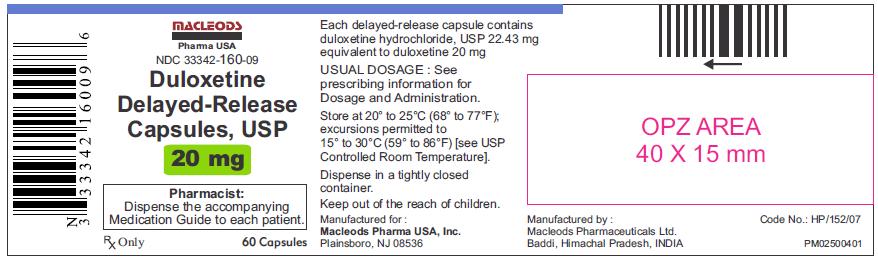
Duloxetine 20mg 60s Bottle
Phamms USA brand offers delayed-release capsules of duloxetine hydrochloride, USP, in a pack of 60 capsules. The medication guide should be dispensed to every patient. Each capsule contains 22.43 mg of duloxetine hydrochloride which is equivalent to 20 mg of duloxetine. Prescribing information should be referred to for the usual dosage and administration. The capsules should be stored in a tightly closed container at a temperature ranging from 20°C to 25°C (68°F to 77°F) with excursions permitted to 15°C to 30°C (59°F to 86°F). The manufacturer of this medication is Macleods Pharma USA Inc., located in Plainsboro, New Jersey. The capsules are manufactured by Macleods Pharmaceuticals Ltd based in Baddi, Himachal Pradesh, India. No non-English characters were detected.*
FDA Label Image

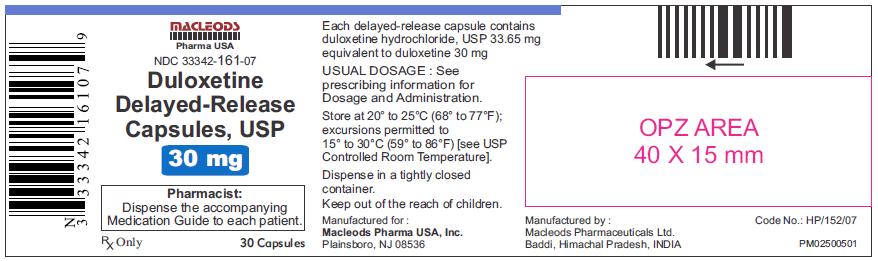
Duloxetine 30mg 30s Bottle

Duloxetine 30mg 30s Bottle
This is a description of a medication called Duloxetine in the form of delayed-release capsules. The medication contains 33.65 mg of duloxetine hydrochloride which is equivalent to 30 mg of duloxetine. The usual dosage and administration of this medication can be found in its prescribing information. The medication should be stored between 20°-25°C (68 - 77°F) and dispensed in a sealed container. Dispensers must provide each patient with an accompanying medication guide. The medication is manufactured for Macleods Pharma USA, Inc. and made by Madleods Pharmaceuticals Lid. The text also contains information on the product size, manufacturing codes, and storage considerations.*
FDA Label Image

Duloxetine 60mg 1000s Bottle

Duloxetine 60mg 1000s Bottle
This is a medication description for Duloxetine Delayed-Release Capsules USP, with NDC number 33342-162-44. Each capsule contains Duloxetine Hydrochloride, USP 67.29 mg, which is equivalent to Duloxetine 60 mg. The recommended dosage and administration should be obtained from the prescribing information. The medication guide should be provided to each patient along with the medication. The capsules should be stored at 20-25°C, with excursions permitted to 15-30°C. The medication should be dispensed in a tightly closed container and kept out of the reach of children. Macleods Pharma USA, Inc. manufactured this medication in Plainsboro, NJ, and it was manufactured by Macleods Pharmaceuticals Ltd in Baddi, Himachal Pradesh, India.*
FDA Label Image

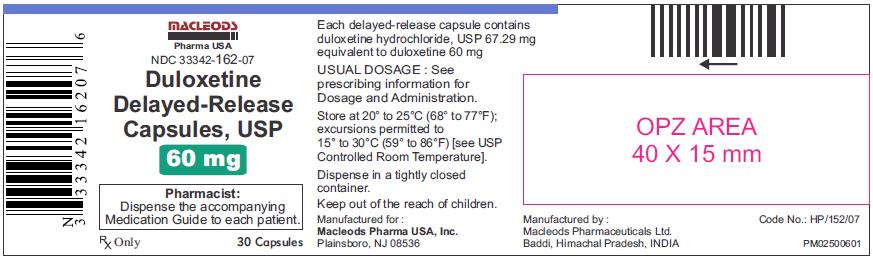
Duloxetine 60mg 30s Bottle

Duloxetine 60mg 30s Bottle
This is a medication for duloxetine hydrochloride in the form of delayed-release capsules, USP. The medication is dispensed in a container and comes with a Medication Guide to distribute to patients. The recommended dosage can be found in the prescribing information for Dosage and Administration. The medication should be stored at a temperature between 68 and 77 degrees Fahrenheit, and kept in a tightly closed container. It is manufactured by Macleods Pharma USA, Inc. for Madleods Pharmaceuticals Ltd in India. Code number is HP/152107.*
FDA Label Image

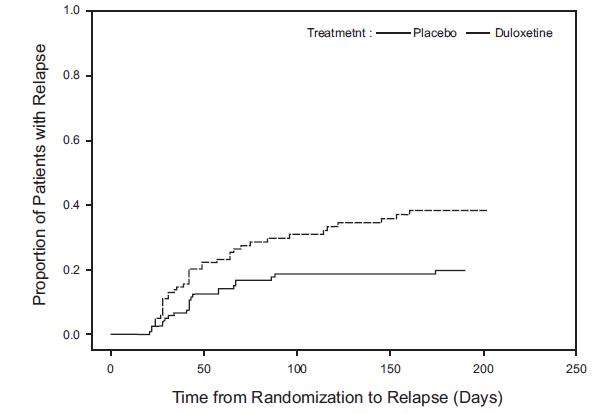
Fig-1 (Duloxetine Fig 1)

Fig-1 (Duloxetine Fig  1)
This is a graph showing the proportion of patients with relapse over time after being randomized to receive either placebo or duloxetine treatment. The x-axis represents the time in days from randomization to relapse, with a maximum of 250 days, and the y-axis represents the proportion of patients with relapse, ranging from 0 to 10%.*
FDA Label Image

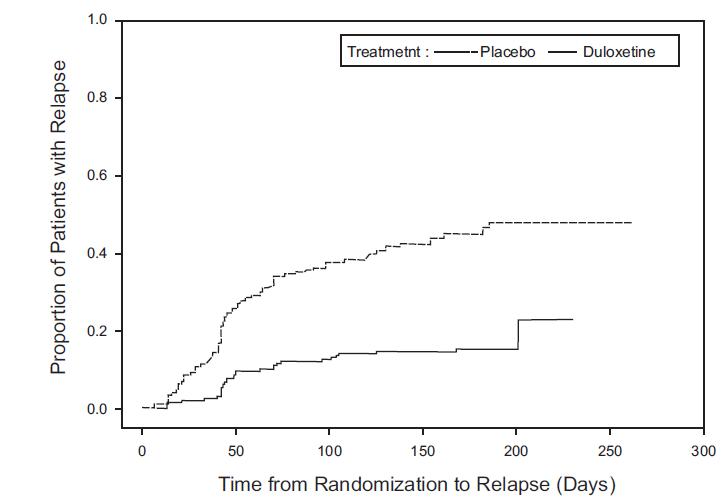
Fig-2 (Duloxetine Fig 2)

Fig-2 (Duloxetine Fig  2)
This is a graph showing the proportion of patients who experienced a relapse after receiving either a placebo or duloxetine treatment over time (measured in days). The x-axis shows the time from randomization to relapse (in days) while the y-axis shows the proportion of patients who relapsed. The graph shows that duloxetine treatment had a lower proportion of patients with relapse compared to placebo treatment.*
FDA Label Image

Fig-3 (Duloxetine Fig 3)

FDA Label Image

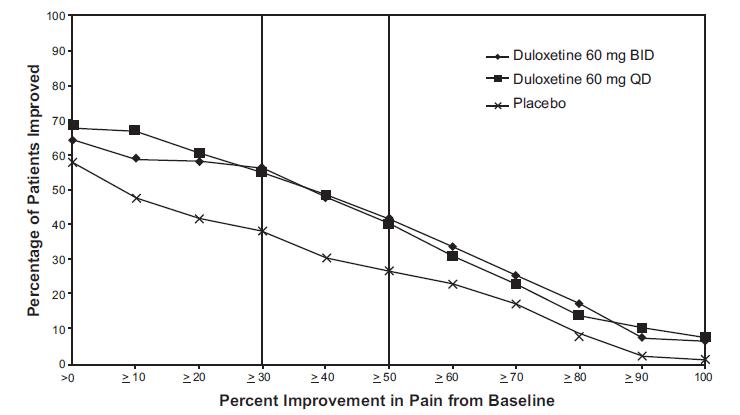
Fig-4 (Duloxetine Fig 4)

Fig-4 (Duloxetine Fig  4)
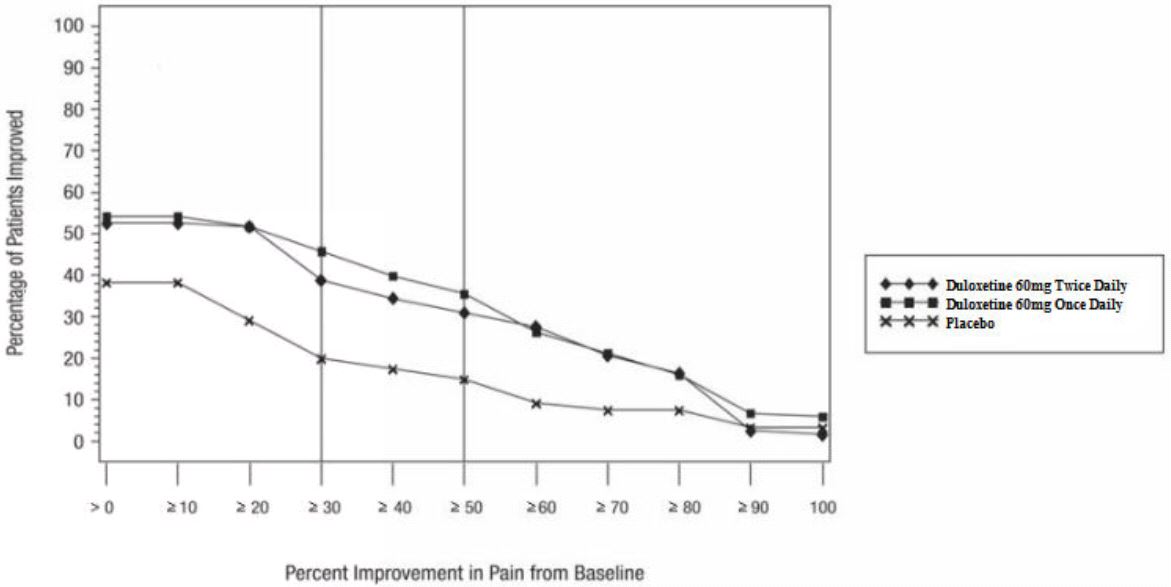
The figure displays the percentage of improvement in patients' pain after taking Duloxetine 60 mg BID, Duloxetine 60 mg QD, and a placebo. The horizontal axis shows the percent improvement in pain from the baseline, and the vertical axis displays the number of patients improved. The chart indicates that Duloxetine 60 mg BID resulted in the highest percentage of improvement in patients' pain, followed by Duloxetine 60 mg QD and the placebo. The information seems to be part of a study or clinical trial.*
FDA Label Image

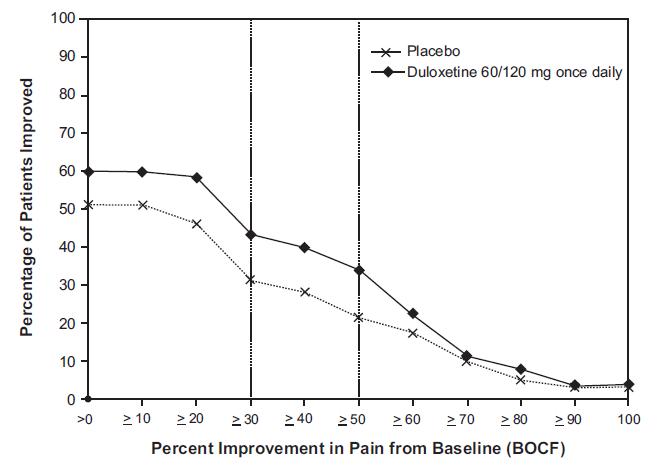
Fig-7 (Duloxetine Fig 7)

Fig-7 (Duloxetine Fig  7)
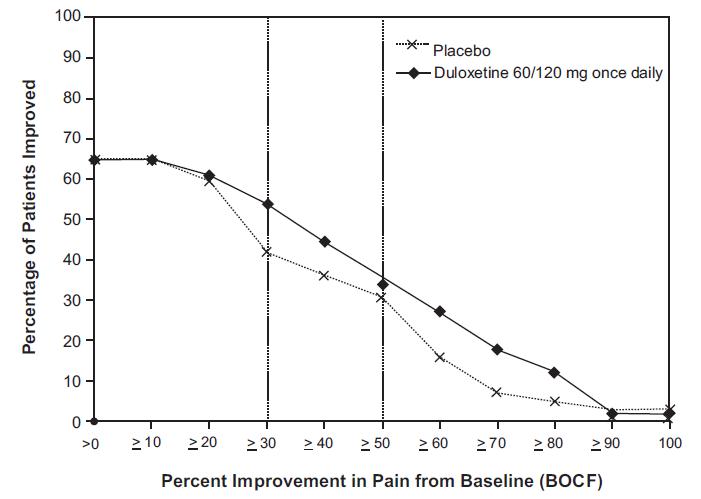
The text provided seems to be a graph showing the percentage of patients improved in regards to pain relief between the Placebo and Duloxetine 60/120 mg once daily treatment. The X-axis represents different percentages ranging from 220 to 260 while the Y-axis represents the percent improvement in pain from the baseline. The graph seems to have two lines, one for Placebo (labeled j) and the other for Duloxetine 60/120 mg once daily. However, without further context, it is difficult to analyze this graph or extract any meaningful insights.*
FDA Label Image

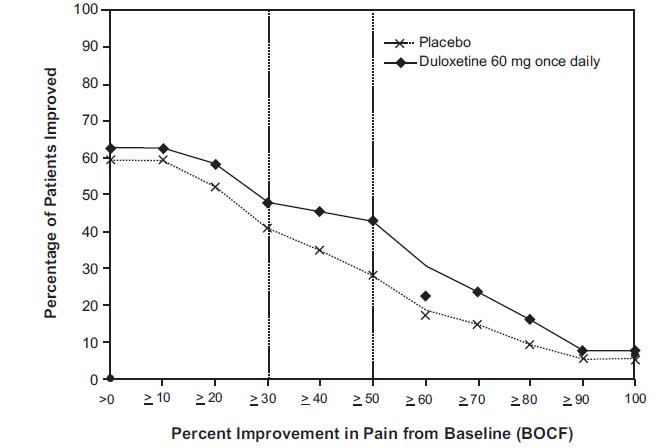
Fig-8 (Duloxetine Fig 8)

Fig-8 (Duloxetine Fig  8)
This is a chart showing the percentage of patients improved in pain from baseline using a placebo and Duloxetine 60 mg once daily. The chart shows a range from 220 to 290 on the x-axis and 0% to 100% on the y-axis. The percentage of patients improved for Duloxetine is represented by a solid line and the percentage of patients improved for the placebo is represented by a dotted line. The chart shows Duloxetine as being more effective in improving pain compared to the placebo.*
FDA Label Image

Fig-9 (Duloxetine Fig 9)

Fig-9 (Duloxetine Fig  9)
The text presents a graph showing the percentage of patients who improved and percent improvement in pain from baseline (BOCF) after taking Placebo or Duloxetine 60/120 mg once daily. The y-axis represents the percentage of patients who improved, and the x-axis shows different values of percent improvement in pain. The graph indicates that Duloxetine 60/120 mg once daily had a higher percentage of patient improvement compared to the placebo.*
FDA Label Image

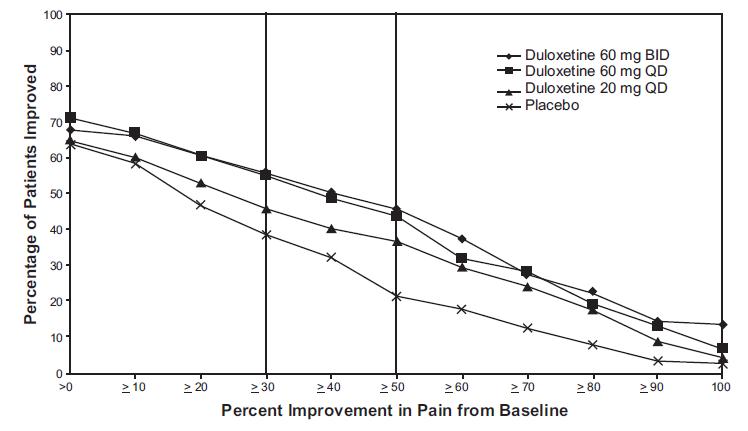
Duloxetine Fig 5

FDA Label Image

Duloxetine Fig 6

Duloxetine Fig 6
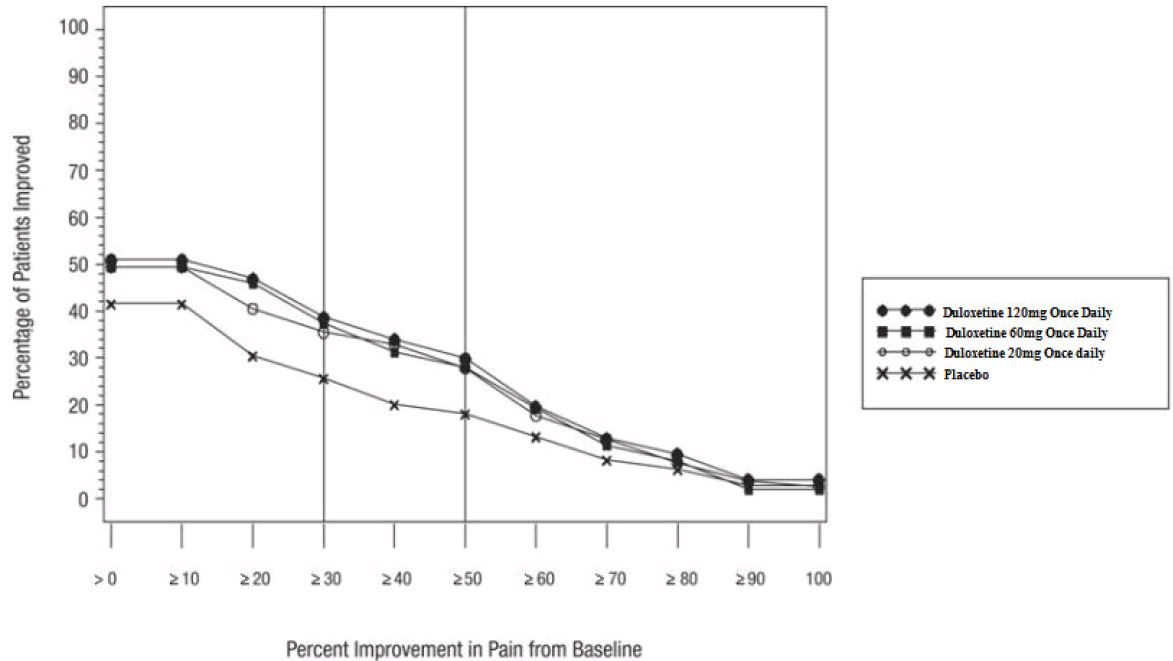
This appears to be a graph showing the percentage of patients who experienced an improvement in pain at various levels of percentage improvement. The graph has three lines representing different doses of a medication called Duloxetine taken once daily. The doses are 120mg, 60mg, and 20mg. The percentage improvement in pain is shown on the x-axis and ranges from 230% to 270%.*
FDA Label Image

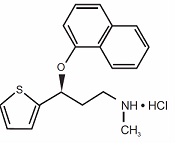
Str (Duloxetine Str)

* These product label images have been analyzed using experimental machine learning. Please verify findings with the primary label text.