Overview of Clinical Trials of Dapagliflozin in Adults with Type 2 Diabetes Mellitus
Dapagliflozin has been studied in adult patients as monotherapy, in combination with metformin, pioglitazone, sulfonylurea (glimepiride), sitagliptin (with or without metformin), metformin plus a sulfonylurea, or insulin (with or without other oral antidiabetic therapy), compared to a sulfonylurea (glipizide), and in combination with a GLP-1 receptor agonist (exenatide extended-release) added-on to metformin. Dapagliflozin has also been studied in adult patients with type 2 diabetes mellitus and moderate renal impairment.
Treatment with dapagliflozin as monotherapy and in combination with metformin, glimepiride, pioglitazone, sitagliptin, or insulin produced statistically significant improvements in mean change from baseline at Week 24 in HbA1c compared to control. Reductions in HbA1c were seen across subgroups including gender, age, race, duration of disease, and baseline body mass index (BMI).
Monotherapy
A total of 840 treatment-naive adult patients with inadequately controlled type 2 diabetes mellitus participated in 2 placebo-controlled trials to evaluate the safety and efficacy of monotherapy with dapagliflozin.
In one monotherapy trial, a total of 558 treatment-naive patients with inadequately controlled diabetes participated in a 24-week trial (NCT00528372). Following a 2-week diet and exercise placebo lead-in period, 485 patients with HbA1c ≥7% and ≤10% were randomized to dapagliflozin 5 mg or dapagliflozin 10 mg once daily in either the morning (QAM, main cohort) or evening (QPM), or placebo.
At Week 24, treatment with dapagliflozin 10 mg QAM provided significant improvements in HbA1c and the fasting plasma glucose (FPG) compared with placebo (see Table 7).
Table 7: Results at Week 24 (LOCF*) in a Placebo-Controlled Trial of Dapagliflozin Monotherapy in Adults with Type 2 Diabetes Mellitus (Main Cohort AM Doses)
Efficacy
Parameter
| Dapagliflozin
10 mg
N=70†
| Dapagliflozin
5 mg
N=64†
| Placebo
N=75†
|
HbA1c (%)
|
|
|
|
Baseline
(mean)
| 8.0
| 7.8
|
7.8
|
Change from
baseline
(adjusted mean‡)
| −0.9
| −0.8
| −0.2
|
Difference
from placebo
(adjusted mean‡)
(95% CI)
| −0.7§
(−1.0, −0.4)
| −0.5
(−0.8, −0.2)
|
|
Percent of patients
achieving
HbA1c <7%
adjusted for baseline
| 50.8%¶
| 44.2%¶
| 31.6%
|
FPG (mg/dL)
|
|
|
|
Baseline (mean)
| 166.6
| 157.2
| 159.9
|
Change from
baseline
(adjusted mean‡)
| −28.8
| −24.1
| −4.1
|
Difference from
placebo
(adjusted mean‡)
(95% CI)
| −24.7§
(−35.7, −13.6)
| −19.9
(−31.3, −8.5)
|
|
*LOCF: last observation (prior to rescue for rescued patients) carried forward.
†All randomized patients who took at least one dose of double-blind trial medication during the short-term double-blind period.
‡Least squares mean adjusted for baseline value.
§p-value <0.0001 versus placebo. Sensitivity analyses yielded smaller estimates of treatment difference with placebo.
¶Not evaluated for statistical significance as a result of the sequential testing procedure for the secondary endpoints.
Initial Combination Therapy with Metformin XR
A total of 1236 treatment-naive adult patients with inadequately controlled type 2 diabetes mellitus (HbA1c ≥7.5% and ≤12%) participated in 2 active-controlled trials of 24-week duration to evaluate initial therapy with dapagliflozin 5 mg or 10 mg in combination with metformin extended-release (XR) formulation.
In one trial (NCT00859898), 638 patients randomized to 1 of 3 treatment arms following a 1-week lead-in period received: dapagliflozin 10 mg plus metformin XR (up to 2,000 mg per day), dapagliflozin 10 mg plus placebo, or metformin XR (up to 2,000 mg per day) plus placebo. Metformin XR dose was up-titrated weekly in 500 mg increments, as tolerated, with a median dose achieved of 2,000 mg.
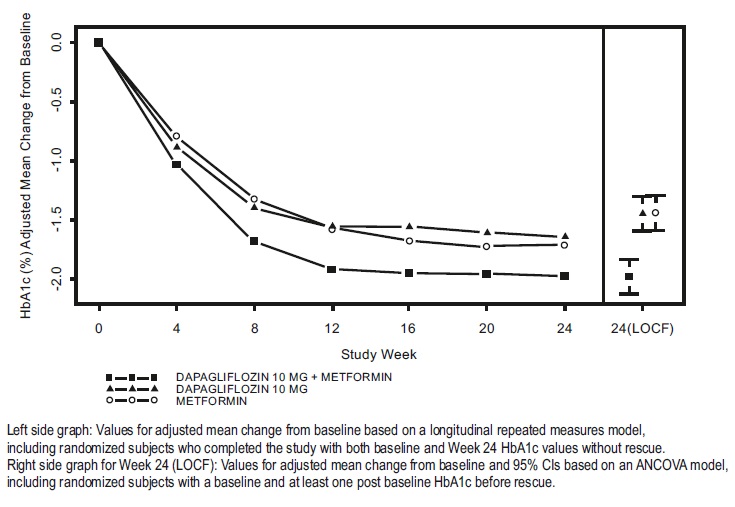
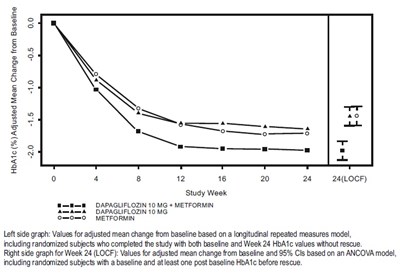
The combination treatment of dapagliflozin 10 mg plus metformin XR provided statistically significant improvements in HbA1c and FPG compared with either of the monotherapy treatments and statistically significant reduction in body weight compared with metformin XR alone (see Table 8 and Figure 2). Dapagliflozin 10 mg as monotherapy also provided statistically significant improvements in FPG and statistically significant reduction in body weight compared with metformin alone and was non-inferior to metformin XR monotherapy in lowering HbA1c.
Table 8: Results at Week 24 (LOCF*) in an Active-Controlled Trial of Dapagliflozin Initial Combination Therapy with Metformin XR
Efficacy
Parameter
| Dapagliflozin 10 mg
+ Metformin
XR
N=211†
| Dapagliflozin
10 mg
N=219†
| Metformin
XR
N=208†
|
HbA1c (%)
|
|
|
|
Baseline (mean)
| 9.1
| 9.0
| 9.0
|
Change from
baseline
(adjusted mean‡)
| −2.0
| − 1.5
| −1.4
|
Difference from
Dapagliflozin
(adjusted mean‡)
(95% CI)
| −0.5§
(−0.7, −0.3)
|
|
|
Difference from
metformin XR
(adjusted mean‡)
(95% CI)
| −0.5§
(−0.8, −0.3)
| 0.0¶
(−0.2, 0.2)
|
|
Percent of patients
achieving
HbA1c <7%
adjusted for baseline
| 46.6%#
|
31.7%
| 35.2%
|
FPG (mg/dL)
|
|
|
|
Baseline (mean)
| 189.6
| 197.5
| 189.9
|
Change from
baseline
(adjusted mean‡)
| −60.4
| −46.4
| −34.8
|
Difference from
Dapagliflozin
(adjusted mean‡)
(95% CI)
| −13.9§
(−20.9, −7.0)
|
|
|
Difference from
metformin XR
(adjusted mean‡)
(95% CI)
| −25.5§
(−32.6, −18.5)
| −11.6#
(−18.6, −4.6)
|
|
Body Weight (kg)
|
|
|
|
Baseline (mean)
| 88.6
| 88.5
| 87.2
|
Change from baseline
(adjusted mean‡)
| −3.3
| −2.7
| −1.4
|
Difference from
metformin XR
(adjusted mean‡)
(95% CI)
| −2.0§
(−2.6, −1.3)
| −1.4§
(−2.0,
−0.7)
|
|
*LOCF: last observation (prior to rescue for rescued patients) carried forward.
†All randomized patients who took at least one dose of double-blind trial medication during the short-term double-blind period.
‡Least squares mean adjusted for baseline value.
§p-value <0.0001.
¶Non-inferior versus metformin XR.
#p-value <0.05.
Figure 2: Adjusted Mean Change from Baseline Over Time in HbA1c (%) in a 24-Week Active-Controlled Trial of Dapagliflozin Initial Combination Therapy with Metformin XR
658 (Dapagliflozin Fig 2)
In a second trial (NCT00643851), 603 patients were randomized to 1 of 3 treatment arms following a 1-week lead-in period: Dapagliflozin 5 mg plus metformin XR (up to 2,000 mg per day), dapagliflozin 5 mg plus placebo, or metformin XR (up to 2,000 mg per day) plus placebo. Metformin XR dose was up-titrated weekly in 500 mg increments, as tolerated, with a median dose achieved of 2,000 mg.
The combination treatment of dapagliflozin 5 mg plus metformin XR provided statistically significant improvements in HbA1c and FPG compared with either of the monotherapy treatments and statistically significant reduction in body weight compared with metformin XR alone (see Table 9).
Table 9: Results at Week 24 (LOCF*) in an Active-Controlled Trial of Dapagliflozin Initial Combination Therapy with Metformin XR
Efficacy
Parameter
| Dapagliflozin
5 mg +
Metformin XR
N=194†
| Dapagliflozin
5 mg
N=203†
| Metformin XR
N=201†
|
HbA1c (%)
|
|
|
|
Baseline (mean)
| 9.2
| 9.1
| 9.1
|
Change from
baseline
(adjusted mean‡)
| −2.1
| −1.2
| −1.4
|
Difference from
Dapagliflozin
(adjusted mean‡)
(95% CI)
| −0.9§
(−1.1, −0.6)
|
|
|
Difference from
metformin XR
(adjusted mean‡)
(95% CI)
| −0.7§
(−0.9, −0.5)
|
|
|
Percent of patients
achieving
HbA1c <7%
adjusted for baseline
| 52.4%¶
| 22.5%
| 34.6%
|
FPG (mg/dL)
|
|
|
|
Baseline (mean)
| 193.4
|
190.8
| 196.7
|
Change from baseline
(adjusted mean‡)
| −61.0
| −42.0
| −33.6
|
Difference from
Dapagliflozin
(adjusted mean‡)
(95% CI)
| −19.1§
(−26.7, −11.4)
|
|
|
Difference from
metformin XR
(adjusted mean‡)
(95% CI)
| −27.5§
(−35.1, −19.8)
|
|
|
Body Weight (kg)
|
|
|
|
Baseline (mean)
| 84.2
| 86.2
|
85.8
|
Change from baseline
(adjusted mean‡)
| −2.7
| −2.6
| −1.3
|
Difference from metformin
XR (adjusted mean‡) (95% CI)
| −1.4§
(−2.0, −0.7)
|
|
|
*LOCF: last observation (prior to rescue for rescued patients) carried forward.
†All randomized patients who took at least one dose of double-blind trial medication during the short-term double-blind period.
‡Least squares mean adjusted for baseline value.
§p-value <0.0001.
¶p-value <0.05.
Add-On to Metformin
A total of 546 adult patients with type 2 diabetes mellitus with inadequate glycemic control (HbA1c ≥7% and ≤10%) participated in a 24-week, placebo-controlled trial to evaluate dapagliflozin in combination with metformin (NCT00528879). Patients on metformin at a dose of at least 1,500 mg per day were randomized after completing a 2-week, single-blind, placebo lead-in period. Following the lead-in period, eligible patients were randomized to dapagliflozin 5 mg, dapagliflozin 10 mg, or placebo in addition to their current dose of metformin.
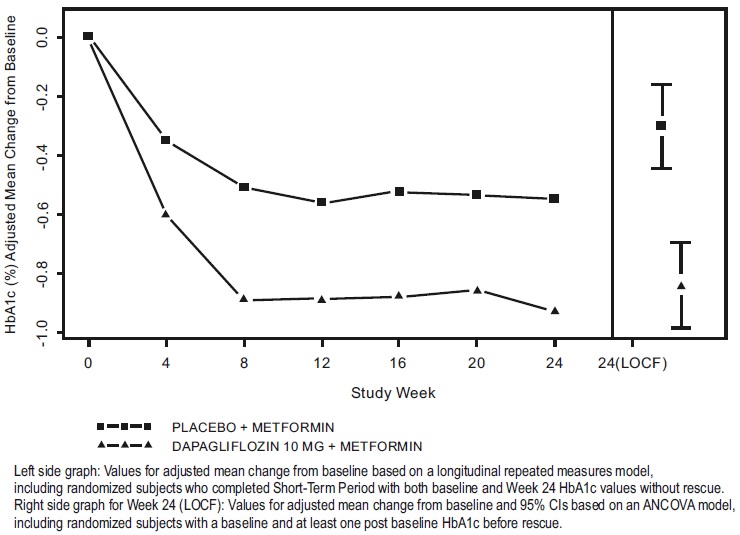
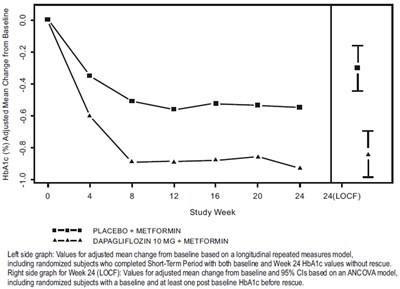
As add-on treatment to metformin, dapagliflozin 10 mg provided statistically significant improvements in HbA1c and FPG, and statistically significant reduction in body weight compared with placebo at Week 24 (see Table 10 and Figure 3). Statistically significant (p <0.05 for both doses) mean changes from baseline in systolic blood pressure relative to placebo plus metformin were −4.5 mmHg and −5.3 mmHg with dapagliflozin 5 mg and 10 mg plus metformin, respectively.
Table 10: Results of a 24-Week (LOCF*) Placebo-Controlled Trial of Dapagliflozin in Add-On Combination with Metformin
Efficacy
Parameter
| Dapagliflozin
10 mg +
Metformin
N=135†
| Dapagliflozin
5 mg + Metformin
N= 137†
| Placebo
+Metformin
N=137†
|
HbA1c (%)
|
|
|
|
Baseline (mean)
| 7.9
| 8.2
| 8.1
|
Change from
baseline
(adjusted mean‡)
| −0.8
| −0.7
| −0.3
|
Difference from
placebo
(adjusted mean‡)
(95% CI)
| −0.5§
(−0.7, −0.3)
| −0.4§
(−0.6, −0.2)
|
|
Percent of
patients
achieving
HbA1c <7%
adjusted for
baseline
| 40.6%¶
| 37.5%¶
| 25.9%
|
FPG (mg/dL)
|
|
|
|
Baseline
(mean)
| 156.0
| 169.2
| 165.6
|
Change from
baseline
at Week 24
(adjusted mean‡)
| −23.5
| −21.5
| −6.0
|
Difference from
placebo
(adjusted mean‡)
(95% CI)
| −17.5§
(−25.0, −10.0)
| −15.5§
(−22.9, −8.1)
|
|
Change from
baseline
at Week 1
(adjusted mean‡)
| −16.5§
(N=115)
| −12.0§
(N=121)
| 1.2
(N=126)
|
Body Weight (kg)
|
|
|
|
Baseline (mean)
| 86.3
| 84.7
| 87.7
|
Change from
baseline
(adjusted mean‡)
| −2.9
| −3.0
| −0.9
|
Difference from
placebo
(adjusted mean‡)
(95% CI)
| −2.0§
(−2.6, −1.3)
| −2.2§
(−2.8, −1.5)
|
|
*LOCF: last observation (prior to rescue for rescued patients) carried forward.
†All randomized patients who took at least one dose of double-blind trial medication during the short-term double-blind period.
‡Least squares mean adjusted for baseline value.
§p-value <0.0001 versus placebo + metformin.
¶p-value <0.05 versus placebo + metformin.
Figure 3: Adjusted Mean Change from Baseline Over Time in HbA1c (%) in a 24-Week Placebo-Controlled Trial of Dapagliflozin in Combination with Metformin
575 (Dapagliflozin Figure 3)
Active Glipizide-Controlled Trial Add-On to Metformin
A total of 816 adult patients with type 2 diabetes mellitus with inadequate glycemic control (HbA1c >6.5% and ≤10%) were randomized in a 52-week, glipizide-controlled, non-inferiority trial to evaluate dapagliflozin as add-on therapy to metformin (NCT00660907). Patients on metformin at a dose of at least 1,500 mg per day were randomized following a 2-week placebo lead-in period to glipizide or dapagliflozin (5 mg or 2.5 mg, respectively) and were up-titrated over 18 weeks to optimal glycemic effect (FPG <110 mg/dL, <6.1 mmol/L) or to the highest dose level (up to glipizide 20 mg and dapagliflozin 10 mg) as tolerated by patients. Thereafter, doses were kept constant, except for down-titration to prevent hypoglycemia.
At the end of the titration period, 87% of patients treated with dapagliflozin had been titrated to the maximum trial dose (10 mg) versus 73% treated with glipizide (20 mg). Dapagliflozin led to a similar mean reduction in HbA1c from baseline at Week 52 (LOCF), compared with glipizide, thus demonstrating non-inferiority (see Table 11). Dapagliflozin treatment led to a statistically significant mean reduction in body weight from baseline at Week 52 (LOCF) compared with a mean increase in body weight in the glipizide group. Statistically significant (p<0.0001) mean change from baseline in systolic blood pressure relative to glipizide plus metformin was -5.0 mmHg with dapagliflozin plus metformin.
Table 11: Results at Week 52 (LOCF*) in an Active-Controlled Trial Comparing Dapagliflozin to Glipizide as Add-On to Metformin
Efficacy
Parameter
| Dapagliflozin +
Metformin N=400†
| Glipizide +
Metformin N=401†
|
HbA1c (%)
|
|
|
Baseline (mean)
| 7.7
| 7.7
|
Change from baseline
(adjusted mean‡)
| −0.5
| −0.5
|
Difference from glipizide +
metformin (adjusted mean‡)
(95% CI)
| 0.0§
(−0.1, 0.1)
|
|
Body Weight (kg)
|
|
|
Baseline (mean)
| 88.4
| 87.6
|
Change from baseline
(adjusted mean‡)
| −3.2
| 1.4
|
Difference from glipizide +
metformin (adjusted mean‡)
(95
% CI)
| −4.7¶
(−5.1, −4.2)
|
|
*LOCF: last observation carried forward.
†Randomized and treated patients with baseline and at least 1 post-baseline efficacy measurement.
‡Least squares mean adjusted for baseline value.
§Non-inferior to glipizide + metformin.
¶p-value <0.0001.
Add-On Combination Therapy with Other Antidiabetic Agents
Add-On Combination Therapy with a Sulfonylurea
A total of 597 adult patients with type 2 diabetes mellitus and inadequate glycemic control (HbA1c ≥7% and ≤10%) were randomized in this 24-week, placebo-controlled trial to evaluate dapagliflozin in combination with glimepiride (a sulfonylurea) (NCT00680745).
Patients on at least half the maximum recommended dose of glimepiride as monotherapy (4 mg) for at least 8 weeks lead-in were randomized to dapagliflozin 5 mg, dapagliflozin 10 mg, or placebo in addition to glimepiride 4 mg per day. Down-titration of glimepiride to 2 mg or 0 mg was allowed for hypoglycemia during the treatment period; no up-titration of glimepiride was allowed.
In combination with glimepiride, dapagliflozin 10 mg provided statistically significant improvement in HbA1c, FPG, and 2-hour PPG, and statistically significant reduction in body weight compared with placebo plus glimepiride at Week 24 (see Table 12). Statistically significant (p<0.05 for both doses) mean changes from baseline in systolic blood pressure relative to placebo plus glimepiride were −2.8 mmHg and −3.8 mmHg with dapagliflozin 5 mg and 10 mg plus glimepiride, respectively.
Add-on Combination Therapy with Metformin and a Sulfonylurea
A total of 218 adult patients with type 2 diabetes mellitus and inadequate glycemic control (HbA1c ≥7% and ≤10.5%) participated in a 24-week, placebo-controlled trial to evaluate dapagliflozin in combination with metformin and a sulfonylurea (NCT01392677). Patients on a stable dose of metformin (immediate-or extended-release formulations) ≥1,500 mg/day plus maximum tolerated dose, which must be at least half the maximum dose, of a sulfonylurea for at least 8 weeks prior to enrollment were randomized after an 8-week placebo lead-in period to dapagliflozin 10 mg or placebo. Dose-titration of dapagliflozin or metformin was not permitted during the 24–week treatment period. Down-titration of the sulfonylurea was permitted to prevent hypoglycemia, but no up-titration was permitted. As add-on treatment to combined metformin and a sulfonylurea, treatment with dapagliflozin 10 mg provided statistically significant improvements in HbA1c and FPG and statistically significant reduction in body weight compared with placebo at Week 24 (Table 12). A statistically significant (p <0.05) mean change from baseline in systolic blood pressure relative to placebo in combination with metformin and a sulfonylurea was -3.8 mmHg with dapagliflozin 10 mg in combination with metformin and a sulfonylurea at Week 8.
Add-On Combination Therapy with a Thiazolidinedione
A total of 420 adult patients with type 2 diabetes mellitus with inadequate glycemic control (HbA1c ≥7% and ≤10.5%) participated in a 24-week, placebo-controlled trial to evaluate dapagliflozin in combination with pioglitazone [a thiazolidinedione (TZD)] alone (NCT00683878). Patients on a stable dose of pioglitazone of 45 mg per day (or 30 mg per day, if 45 mg per day was not tolerated) for 12 weeks were randomized after a 2-week lead-in period to 5 or 10 mg of dapagliflozin or placebo in addition to their current dose of pioglitazone. Dose titration of dapagliflozin or pioglitazone was not permitted during the trial.
In combination with pioglitazone, treatment with dapagliflozin 10 mg provided statistically significant improvements in HbA1c, 2-hour PPG, FPG, the proportion of patients achieving HbA1c <7%, and a statistically significant reduction in body weight compared with the placebo plus pioglitazone treatment groups (see Table 12) at Week 24. A statistically significant (p <0.05) mean change from baseline in systolic blood pressure relative to placebo in combination with pioglitazone was −4.5 mmHg with dapagliflozin 10 mg in combination with pioglitazone.
Add-On Combination Therapy with a DPP4 Inhibitor
A total of 452 adult patients with type 2 diabetes mellitus who were drug naive, or who were treated at entry with metformin or a DPP4 inhibitor alone or in combination, and had inadequate glycemic control (HbA1c ≥7.0% and ≤10.0% at randomization), participated in a 24-week, placebo-controlled trial to evaluate dapagliflozin in combination with sitagliptin (a DPP4 inhibitor) with or without metformin (NCT00984867).
Eligible patients were stratified based on the presence or absence of background metformin (≥1,500 mg per day), and within each stratum were randomized to either dapagliflozin 10 mg plus sitagliptin 100 mg once daily, or placebo plus sitagliptin 100 mg once daily. Endpoints were tested for dapagliflozin 10 mg versus placebo for the total trial group (sitagliptin with and without metformin) and for each stratum (sitagliptin alone or sitagliptin with metformin). Thirty-seven percent (37%) of patients were drug naive, 32% were on metformin alone, 13% were on a DPP4 inhibitor alone, and 18% were on a DPP4 inhibitor plus metformin. Dose titration of dapagliflozin, sitagliptin, or metformin was not permitted during the trial.
In combination with sitagliptin (with or without metformin), dapagliflozin 10 mg provided statistically significant improvements in HbA1c, FPG, and a statistically significant reduction in body weight compared with the placebo plus sitagliptin (with or without metformin) group at Week 24 (see Table 12). These improvements were also seen in the stratum of patients who received dapagliflozin 10 mg plus sitagliptin alone (placebo-corrected mean change for HbA1c −0.56%; n=110) compared with placebo plus sitagliptin alone (n=111), and the stratum of patients who received dapagliflozin 10 mg plus sitagliptin and metformin (placebo-corrected mean change for HbA1c −0.40; n=113) compared with placebo plus sitagliptin with metformin (n=113).
Add-On Combination Therapy with Insulin
A total of 808 adult patients with type 2 diabetes mellitus who had inadequate glycemic control (HbA1c ≥7.5% and ≤10.5%) were randomized in a 24-week, placebo-controlled trial to evaluate dapagliflozin as add-on therapy to insulin (NCT00673231). Patients on a stable insulin regimen, with a mean dose of at least 30 IU of injectable insulin per day, for a period of at least 8 weeks prior to enrollment and on a maximum of 2 oral antidiabetic medications (OADs), including metformin, were randomized after completing a 2-week enrollment period to receive either dapagliflozin 5 mg, dapagliflozin 10 mg, or placebo in addition to their current dose of insulin and other OADs, if applicable. Patients were stratified according to the presence or absence of background OADs. Up- or down-titration of insulin was only permitted during the treatment phase in patients who failed to meet specific glycemic goals. Dose modifications of blinded trial medication or OAD(s) were not allowed during the treatment phase, with the exception of decreasing OAD(s) where there were concerns over hypoglycemia after cessation of insulin therapy.
In this trial, 50% of patients were on insulin monotherapy at baseline, while 50% were on 1 or 2 OADs in addition to insulin. At Week 24, dapagliflozin 10 mg dose provided statistically significant improvement in HbA1c and reduction in mean insulin dose, and a statistically significant reduction in body weight compared with placebo in combination with insulin, with or without up to 2 OADs (see Table 12); the effect of dapagliflozin on HbA1c was similar in patients treated with insulin alone and patients treated with insulin plus OAD. Statistically significant (p<0.05) mean change from baseline in systolic blood pressure relative to placebo in combination with insulin was −3.0 mmHg with dapagliflozin 10 mg in combination with insulin.
At Week 24, dapagliflozin 5 mg (−5.7 IU, difference from placebo) and 10 mg (−6.2 IU, difference from placebo) once daily resulted in a statistically significant reduction in mean daily insulin dose (p<0.0001 for both doses) compared to placebo in combination with insulin, and a statistically significantly higher proportion of patients on dapagliflozin 10 mg (19.6%) reduced their insulin dose by at least 10% compared to placebo (11.0%).
Table 12: Results of 24-Week (LOCF*) Placebo-Controlled Trials of Dapagliflozin in Combination with Antidiabetic Agents
Efficacy
Parameter
| Dapagliflozin
10 mg
| Dapagliflozin
5 mg
| Placebo
|
In Combination with Sulfonylurea (Glimepiride)
|
Intent-to-Treat Population
| N=151†
| N=142†
| N=145†
|
HbA1c (%)
|
|
|
|
Baseline (mean)
| 8.1
| 8.1
| 8.2
|
Change from
baseline (adjusted mean‡)
| −0.8
| −0.6
| −0.1
|
Difference from
placebo (adjusted mean‡)
(95% CI)
| −0.7§
(−0.9, −0.5)
| −0.5§
(−0.7, −0.3)
|
|
Percent of patients achieving HbA1c <7%
adjusted for baseline
| 31.7%§
| 30.3%§
| 13.0%
|
FPG (mg/dL)
|
|
|
|
Baseline (mean)
| 172.4
| 174.5
| 172.7
|
Change from baseline
(adjusted mean‡)
| −28.5
| −21.2
| −2.0
|
Difference from
placebo (adjusted mean‡)
(95% CI)
| −26.5§
(−33.5, −19.5)
| −19.3§
(−26.3, −12.2)
|
|
2-hour PPG¶(mg/dL)
|
|
|
|
Baseline (mean)
| 329.6
| 322.8
| 324.1
|
Change from baseline
(adjusted mean‡)
| −60.6
| –54.5
| −11.5
|
Difference from
placebo
(adjusted mean‡)
(95% CI)
| −49.1§
(−64.1, −34.1)
| −43.0§
(–58.4, −27.5)
|
|
Body Weight (kg)
|
|
|
|
Baseline (mean)
| 80.6
| 81.0
| 80.9
|
Change from baseline
(adjusted mean‡)
| −2.3
| −1.6
| −0.7
|
Difference from placebo
(adjusted mean‡)
(95% CI)
| −1.5§
(−2.2, −0.9)
| −0.8§
(−1.5, −0.2)
|
|
In Combination with Metformin and a Sulfonylurea
|
Intent-to-Treat
Population
| N=108†
| -
| N=108†
|
HbA1c (%)
|
|
|
|
Baseline (mean)
| 8.08
| -
| 8.24
|
Change from baseline
(adjusted mean‡#)
| −0.86
| -
| −0.17
|
Difference from placebo
(adjusted mean‡#)
(95% CI)
| −0.69§
(−0.89, −0.49)
| -
|
|
Percent of patients
achieving HbA1c <7%
adjusted for baseline
| 31.8%§
| -
| 11.1%
|
FPG (mg/dL)
|
|
|
|
Baseline (mean)
| 167.4
| -
| 180.3
|
Change from baseline
(adjusted mean‡)
| −34.2
| -
| −0.8
|
Difference from
placebo (adjusted mean‡)
(95% CI)
| −33.5§
(−43.1, −23.8)
| -
|
|
Body Weight (kg)
|
|
|
|
Baseline (mean)
| 88.57
| -
| 90.07
|
Change from baseline
(adjusted mean‡)
| −2.65
| -
| −0.58
|
Difference from placebo
(adjusted mean‡)
(95% CI)
| −2.07§
(−2.79, −1.35)
| -
|
|
In Combination with Thiazolidinedione (Pioglitazone)
|
Intent-to-Treat
Population
| N=140Þ
| N=141Þ
| N=139Þ
|
HbA1c (%)
|
|
|
|
Baseline (mean)
| 8.4
| 8.4
| 8.3
|
Change from baseline
(adjusted mean‡)
| −1.0
| −0.8
| −0.4
|
Difference from placebo
(adjusted mean‡)
(95% CI)
| −0.6§
(−0.8, −0.3)
| −0.4§
(−0.6, −0.2)
|
|
Percent of patients achieving HbA1c <7% adjusted for baseline
| 38.8%ß
| 32.5%ß
| 22.4%
|
FPG
(mg/dL)
|
|
|
|
Baseline (mean)
| 164.9
| 168.3
| 160.7
|
Change from baseline
(adjusted mean‡)
| −29.6
| −24.9
| −5.5
|
Difference from placebo
(adjusted mean‡)
(95% CI)
|
−24.1§
(−32.2, −16.1) |
−19.5§
(−27.5, −11.4) |
|
2-hour PPG¶ (mg/dL)
|
|
|
|
Baseline (mean)
| 308.0
| 284.8
| 293.6
|
Change from baseline
(adjusted mean‡)
| −67.5
| −65.1
| −14.1
|
Difference from placebo
(adjusted mean‡)
(95% CI)
|
−53.3§
(−71.1, −35.6) |
−51.0§
(−68.7, −33.2) |
|
Body Weight (kg)
|
|
|
|
Baseline (mean)
| 84.8
| 87.8
| 86.4
|
Change from baseline
(adjusted mean‡)
| −0.1
| 0.1
| 1.6
|
Difference from placebo
(adjusted mean‡)
(95% CI)
| −1.8§
(−2.6, −1.0)
| −1.6§
(−2.3, −0.8)
|
|
In Combination with DPP4 Inhibitor (Sitagliptin) with or without Metformin
|
Intent-to-Treat Population
| N=223†
| –
| N=224†
|
HbA1c (%)
|
|
|
|
Baseline
(mean)
| 7.90
| –
| 7.97
|
Change from baseline
(adjusted mean‡)
| −0.45
| –
| 0.04
|
Difference from placebo
(adjusted mean‡)
(95% CI)
| −0.48§
(−0.62, −0.34)
| –
|
|
Patients with HbA1c
decrease ≥0.7% (adjusted percent)
| 35.4%
| –
| 16.6%
|
FPG (mg/dL)
|
|
|
|
Baseline
(mean)
| 161.7
| –
| 163.1
|
Change from baseline
at Week 24 (adjusted mean‡)
| −24.1
| –
| 3.8
|
Difference from placebo
(adjusted mean‡)
(95% CI)
| −27.9§
(−34.5, −21.4)
| –
|
|
Body Weight (kg)
|
|
|
|
Baseline (mean)
| 91.02
| –
| 89.23
|
Change from baseline
(adjusted mean‡)
| −2.14
| –
| −0.26
|
Difference from placebo
(adjusted mean‡)
(95% CI)
| −1.89§
(−2.37, −1.40)
| –
|
|
In Combination with Insulin with or without up to 2 Oral Antidiabetic Therapies
|
Intent-to-Treat Population
| N=194†
| N=211†
| N=193†
|
HbA1c (%)
|
Baseline (mean)
| 8.6
| 8.6
| 8.5
|
Change from baseline
(adjusted mean‡)
| −0.9
| −0.8
| −0.3
|
Difference from placebo
(adjusted mean‡)
(95% CI)
|
−0.6§
(−0.7, −0.5)
|
−0.5§
(−0.7, −0.4) |
|
FPG (mg/dL)
|
|
|
|
Baseline (mean)
| 173.7
| NTà
| 170.0
|
Change from baseline
(adjusted mean‡)
| −21.7
| NTà
| 3.3
|
Difference from placebo
(adjusted mean‡)
(95% CI)
| −25.0§
(−34.3, −15.8)
| NTà
|
|
Body Weight (kg)
|
|
|
|
Baseline (mean)
| 94.6
|
93.2
| 94.2
|
Change from baseline
(adjusted mean‡)
| −1.7
| −1.0
| 0.0
|
Difference from placebo
(adjusted mean‡)
(95% CI)
| −1.7§
(−2.2, −1.2)
| −1.0§
(−1.5, −0.5)
|
|
* LOCF: last observation (prior to rescue for rescued patients) carried forward.
† Randomized and treated patients with baseline and at least 1 post-baseline efficacy measurement.
‡ Least squares mean adjusted for baseline value based on an ANCOVA model.
§ p-value <0.0001 versus placebo.
¶ 2-hour PPG level as a response to a 75-gram oral glucose tolerance test (OGTT).
# Least squares mean adjusted for baseline value based on a longitudinal repeated measures model.
Þ All randomized patients who took at least one dose of double-blind trial medication during the short-term, double-blind period.
ß p-value <0.05 versus placebo.
à NT: Not formally tested because of failing to achieve a statistically significant difference in an endpoint that was earlier in the testing sequence.
Combination Therapy with Exenatide-Extended Release as Add-On to Metformin
A total of 694 adult patients with type 2 diabetes mellitus and inadequate glycemic control (HbA1c ≥8.0 and ≤12.0%) on metformin, were evaluated in a 28-week double-blind, active-controlled trial to compare dapagliflozin in combination with exenatide extended-release (a GLP-1 receptor agonist) to dapagliflozin alone and exenatide extended-release alone, as add-on to metformin (NCT02229396). Patients on metformin at a dose of at least 1,500 mg per day were randomized following a 1-week placebo lead-in period to receive either dapagliflozin 10 mg once daily (QD) in combination with exenatide extended-release 2 mg once weekly (QW), dapagliflozin 10 mg QD, or exenatide extended–release 2 mg QW.
At Week 28, dapagliflozin in combination with exenatide extended-release provided statistically significantly greater reductions in HbA1c (-1.77%) compared to dapagliflozin alone (-1.32%, p=0.001) and exenatide extended-release alone (-1.42%, p=0.012). dapagliflozin in combination with exenatide extended-release provided statistically significantly greater reductions in FPG (-57.35 mg/dL) compared to dapagliflozin alone (-44.72 mg/dL, p=0.006) and exenatide extended-release alone (-40.53, p <0.001).
Use in Adults with Type 2 Diabetes Mellitus and Moderate Renal Impairment
Dapagliflozin was assessed in two placebo-controlled trials of adult patients with type 2 diabetes mellitus and moderate renal impairment.
Patients with type 2 diabetes mellitus and an eGFR between 45 to less than 60 mL/min/1.73 m2 inadequately controlled on current diabetes therapy participated in a 24-week, double-blind, placebo-controlled clinical trial (NCT02413398). Patients were randomized to either dapagliflozin 10 mg or placebo, administered orally once daily. At Week 24, dapagliflozin provided statistically significant reductions in HbA1c compared with placebo (Table 13).
Table 13: Results at Week 24 of Placebo-Controlled Trial for Dapagliflozin in Adults with Type 2 Diabetes Mellitus and Renal Impairment (eGFR 45 to less than 60 mL/min/1.73 m2)
| Dapagliflozin 10 mg
| Placebo
|
Number of patients:
| N=160
| N=161
|
HbA1c (%)
|
|
|
Baseline (mean)
| 8.3
| 8.0
|
Change from baseline (adjusted mean*)
| -0.4
| -0.1
|
Difference from placebo (adjusted mean*) (95% CI)
| -0.3†
(-0.5, -0.1)
|
|
*Least squares mean adjusted for baseline value; at Week 24, HbA1c was missing for 5.6% and 6.8% of individuals treated with dapagliflozin and placebo, respectively. Retrieved dropouts, i.e., observed HbA1c at Week 24 from subjects who discontinued treatment, were used to impute missing values in HbA1c.
†p-value =0.008 versus placebo.
Pediatric use information is approved for AstraZeneca AB’s Farxiga® (dapagliflozin) Tablets. However, due to AstraZeneca AB’s marketing exclusivity rights, this drug product is not labeled with that information.