Other
Cardiovascular Thrombotic Events
- Nonsteroidal anti-inflammatory drugs (NSAIDs) cause an increased risk of serious cardiovascular thrombotic events, including myocardial infarction and stroke, which can be fatal. This risk may occur early in treatment and may increase with duration of use [see Warnings and Precautions (5.1)].
- ZORVOLEX is contraindicated in the setting of coronary artery bypass graft (CABG) surgery [see Contraindications (4) and Warnings and Precautions (5.1)].
- NSAIDs cause an increased risk of serious gastrointestinal (GI) adverse events including bleeding, ulceration, and perforation of the stomach or intestines, which can be fatal. These events can occur at any time during use and without warning symptoms. Elderly patients and patients with a prior history of peptic ulcer disease and/or GI bleeding are at greater risk for serious GI events [see Warnings and Precautions (5.2)].
- Use the lowest effective dosage for the shortest possible duration.
- Avoid administration of more than one NSAID at a time.
- Avoid use in patients at higher risk unless benefits are expected to outweigh the increased risk of bleeding. For such patients, as well as those with active GI bleeding, consider alternate therapies other than NSAIDs.
- Remain alert for signs and symptoms of GI ulceration and bleeding during NSAID therapy.
- If a serious GI adverse event is suspected, promptly initiate evaluation and treatment, and discontinue ZORVOLEX until a serious GI adverse event is ruled out.
- In the setting of concomitant use of low-dose aspirin for cardiac prophylaxis, monitor patients more closely for evidence of GI bleeding [see Drug Interactions (7)].
Gastrointestinal Bleeding, Ulceration, and Perforation
Acute Pain
For management of mild to moderate acute pain, the dosage is 18 mg or 35 mg orally three times daily.
Osteoarthritis Pain
For management of osteoarthritis pain, the dosage is 35 mg orally three times daily.
Status Post Coronary Artery Bypass Graft (CABG) Surgery
Two large, controlled clinical trials of a COX-2 selective NSAID for the treatment of pain in the first 10–14 days following CABG surgery found an increased incidence of myocardial infarction and stroke. NSAIDs are contraindicated in the setting of CABG [see Contraindications (4)].
Post-MI Patients
Observational studies conducted in the Danish National Registry have demonstrated that patients treated with NSAIDs in the post-MI period were at increased risk of reinfarction, CV-related death, and all-cause mortality beginning in the first week of treatment. In this same cohort, the incidence of death in the first year post-MI was 20 per 100 person years in NSAID-treated patients compared to 12 per 100 person years in non-NSAID exposed patients. Although the absolute rate of death declined somewhat after the first year post-MI, the increased relative risk of death in NSAID users persisted over at least the next four years of follow-up.
Avoid the use of ZORVOLEX in patients with a recent MI unless the benefits are expected to outweigh the risk of recurrent CV thrombotic events. If ZORVOLEX is used in patients with a recent MI, monitor patients for signs of cardiac ischemia.
Risk Factors for GI Bleeding, Ulceration, and Perforation
Patients with a prior history of peptic ulcer disease and/or GI bleeding who used NSAIDs had a greater than 10-fold increased risk for developing a GI bleed compared to patients without these risk factors. Other factors that increase the risk of GI bleeding in patients treated with NSAIDs include longer duration of NSAID therapy; concomitant use of oral corticosteroids, aspirin, anticoagulants, or selective serotonin reuptake inhibitors (SSRIs); smoking; use of alcohol; older age; and poor general health status. Most postmarketing reports of fatal GI events occurred in elderly or debilitated patients. Additionally, patients with advanced liver disease and/or coagulopathy are at increased risk for GI bleeding.
Strategies to Minimize the GI Risks in NSAID-treated patients:
Renal Toxicity
Long-term administration of NSAIDs has resulted in renal papillary necrosis and other renal injury.
Renal toxicity has also been seen in patients in whom renal prostaglandins have a compensatory role in the maintenance of renal perfusion. In these patients, administration of an NSAID may cause a dose-dependent reduction in prostaglandin formation and, secondarily, in renal blood flow, which may precipitate overt renal decompensation. Patients at greatest risk of this reaction are those with impaired renal function, dehydration, hypovolemia, heart failure, liver dysfunction, those taking diuretics and ACE inhibitors or ARBs, and the elderly. Discontinuation of NSAID therapy is usually followed by recovery to the pretreatment state.
No information is available from controlled clinical studies regarding the use of ZORVOLEX in patients with advanced renal disease. The renal effects of ZORVOLEX may hasten the progression of renal dysfunction in patients with preexisting renal disease.
Correct volume status in dehydrated or hypovolemic patients prior to initiating ZORVOLEX. Monitor renal function in patients with renal or hepatic impairment, heart failure, dehydration, or hypovolemia during use of ZORVOLEX [see Drug Interactions (7)]. Avoid the use of ZORVOLEX in patients with advanced renal disease unless the benefits are expected to outweigh the risk of worsening renal function. If ZORVOLEX is used in patients with advanced renal disease, monitor patients for signs of worsening renal function.
Hyperkalemia
Increases in serum potassium concentration, including hyperkalemia, have been reported with use of NSAIDs, even in some patients without renal impairment. In patients with normal renal function, these effects have been attributed to a hyporeninemic-hypoaldosteronism state.
Adverse Reactions in Patients with Acute Pain
Two-hundred sixteen (216) patients received ZORVOLEX in the completed, 48-hour, double-blind, placebo-controlled, clinical trial of acute pain following bunionectomy. The most frequent adverse reactions in this study are summarized in Table 1.
| Adverse Reactions | ZORVOLEX 18 mg or 35 mg three times daily One tablet of hydrocodone/acetaminophen 10 mg/325 mg was permitted every 4 to 6 hours as rescue medication for pain management. There was a greater use of concomitant opioid rescue medication in placebo-treated patients than in ZORVOLEX-treated patients. About 82% of patients in the ZORVOLEX 35 mg group, 85% of the patients in the ZORVOLEX 18 mg group, and 97% of patients in the placebo group took rescue medication for pain management during the study. N = 216 | Placebo N = 106 |
|---|---|---|
| Edema | 33% | 32% |
| Nausea | 27% | 37% |
| Headache | 13% | 15% |
| Dizziness | 10% | 16% |
| Vomiting | 9% | 12% |
| Constipation | 8% | 4% |
| Pruritus | 7% | 6% |
| Flatulence | 3% | 2% |
| Pain in Extremity | 3% | 1% |
| Dyspepsia | 2% | 1% |
Adverse Reactions in Patients with Osteoarthritis Pain
Two-hundred two (202) patients received ZORVOLEX in the completed, 12-week, double-blind, placebo-controlled, clinical trial of osteoarthritis pain of the knee or hip. The most frequent adverse reactions in this study are summarized in Table 2.
| Adverse Reactions | ZORVOLEX 35 mg N=202 | Placebo N=103 |
|---|---|---|
| Nausea | 7% | 2% |
| Diarrhea | 6% | 3% |
| Headache | 4% | 3% |
| Abdominal Pain Upper | 3% | 1% |
| Sinusitis | 3% | 1% |
| Vomiting | 3% | 1% |
| Alanine Aminotransferase Increased | 2% | 0 |
| Blood Creatinine Increased | 2% | 0 |
| Dyspepsia | 2% | 1% |
| Flatulence | 2% | 0 |
| Hypertension | 2% | 1% |
Six-hundred one (601) patients received ZORVOLEX 35 mg either twice or three times daily in a 52-week, open-label, clinical trial in osteoarthritis pain of the knee or hip. Of those, 360 (60%) patients completed the trial. The most frequent adverse reactions in this study are summarized in Table 3.
| Adverse Reactions | ZORVOLEX 35 mg N=601 |
|---|---|
| Upper respiratory tract infection | 8% |
| Headache | 8% |
| Urinary tract infection | 7% |
| Diarrhea | 6% |
| Nasopharyngitis | 6% |
| Nausea | 6% |
| Constipation | 5% |
| Sinusitis | 5% |
| Osteoarthritis | 5% |
| Cough | 4% |
| Alanine aminotransferase increased | 4% |
| Back pain | 3% |
| Dyspepsia | 3% |
| Procedural pain | 3% |
| Bronchitis | 3% |
| Hypertension | 3% |
| Abdominal pain upper | 3% |
| Influenza | 3% |
| Arthralgia | 3% |
| Contusion | 3% |
| Vomiting | 3% |
| Abdominal discomfort | 2% |
| Aspartate aminotransferase increased | 2% |
| Dizziness | 2% |
| Fall | 2% |
| Abdominal pain | 2% |
Adverse reactions reported for diclofenac and other NSAIDs:
In patients taking other NSAIDs, the most frequently reported adverse reactions occurring in approximately 1%-10% of patients are:
Gastrointestinal experiences including: abdominal pain, constipation, diarrhea, dyspepsia, flatulence, gross bleeding/perforation, heartburn, nausea, GI ulcers (gastric/duodenal) and vomiting.
Abnormal renal function, anemia, dizziness, edema, elevated liver enzymes, headaches, increased bleeding time, pruritus, rashes and tinnitus.
Additional adverse reactions reported occasionally include:
Body as a Whole: fever, infection, sepsis
Cardiovascular System: congestive heart failure, hypertension, tachycardia, syncope
Digestive System: dry mouth, esophagitis, gastric/peptic ulcers, gastritis, gastrointestinal bleeding, glossitis, hematemesis, hepatitis, jaundice
Hemic and Lymphatic System: ecchymosis, eosinophilia, leukopenia, melena, purpura, rectal bleeding, stomatitis, thrombocytopenia
Metabolic and Nutritional: weight changes
Nervous System: anxiety, asthenia, confusion, depression, dream abnormalities, drowsiness, insomnia, malaise, nervousness, paresthesia, somnolence, tremors, vertigo
Respiratory System: asthma, dyspnea
Skin and Appendages: alopecia, photosensitivity, sweating increased
Special Senses: blurred vision
Urogenital System: cystitis, dysuria, hematuria, interstitial nephritis, oliguria/polyuria, proteinuria, renal failure
Other adverse reactions, which occur rarely are:
Body as a Whole: anaphylactic reactions, appetite changes, death
Cardiovascular System: arrhythmia, hypotension, myocardial infarction, palpitations, vasculitis
Digestive System: colitis, eructation, fulminant hepatitis with and without jaundice, liver failure, liver necrosis, pancreatitis
Hemic and Lymphatic System: agranulocytosis, hemolytic anemia, aplastic anemia, lymphadenopathy, pancytopenia
Metabolic and Nutritional: hyperglycemia
Nervous System: convulsions, coma, hallucinations, meningitis
Respiratory System: respiratory depression, pneumonia
Skin and Appendages: angioedema, toxic epidermal necrolysis, erythema multiforme, exfoliative dermatitis, Stevens-Johnson syndrome, urticaria
Special Senses: conjunctivitis, hearing impairment
Risk Summary
Use of NSAIDs, including ZORVOLEX, during the third trimester of pregnancy increases the risk of premature closure of the fetal ductus arteriosus. Avoid use of NSAIDs, including ZORVOLEX, in pregnant women starting at 30 weeks of gestation (third trimester).
There are no adequate and well-controlled studies of ZORVOLEX in pregnant women.
Data from observational studies regarding potential embryofetal risks of NSAID use in women in the first or second trimesters of pregnancy are inconclusive. In the general U.S. population, all clinically recognized pregnancies, regardless of drug exposure, have a background rate of 2-4% for major malformations, and 15-20% for pregnancy loss.
In animal reproduction studies, no evidence of teratogenicity was observed in mice, rats, and rabbits given diclofenac during the period of organogenesis at doses approximately 1, 1, and 2 times, respectively, the maximum recommended human dose (MRHD) of ZORVOLEX despite the presence of maternal and fetal toxicity at these doses [see Data]. Based on animal data, prostaglandins have been shown to have an important role in endometrial vascular permeability, blastocyst implantation, and decidualization. In animal studies, administration of prostaglandin synthesis inhibitors such as diclofenac, resulted in increased pre- and post-implantation loss.
Clinical Considerations
Labor or Delivery
There are no studies on the effects of ZORVOLEX during labor or delivery. In animal studies, NSAIDs, including diclofenac, inhibit prostaglandin synthesis, cause delayed parturition, and increase the incidence of stillbirth.
Data
Animal data
Reproductive and developmental studies in animals demonstrated that diclofenac sodium administration during organogenesis did not produce teratogenicity despite the induction of maternal toxicity and fetal toxicity in mice at oral doses up to 20 mg/kg/day (approximately equivalent to the maximum recommended human dose [MRHD] of ZORVOLEX, 105 mg/day, based on body surface area (BSA) comparison), and in rats and rabbits at oral doses up to 10 mg/kg/day (approximately 1 and 2 times, respectively, the MRHD based on BSA comparison). In rats, maternally toxic doses were associated with dystocia, prolonged gestation, reduced fetal weights and growth, and reduced fetal survival. Diclofenac has been shown to cross the placental barrier in mice, rats, and humans.
Risk Summary
Based on available data, diclofenac may be present in human milk. The developmental and health benefits of breastfeeding should be considered along with the mother's clinical need for ZORVOLEX and any potential adverse effects on the breastfed infant from the ZORVOLEX or from the underlying maternal condition.
Data
One woman treated orally with a diclofenac salt, 150 mg/day, had a milk diclofenac level of 100 mcg/L, equivalent to an infant dose of about 0.03 mg/kg/day. Diclofenac was not detectable in breast milk in 12 women using diclofenac (after either 100 mg/day orally for 7 days or a single 50 mg intramuscular dose administered in the immediate postpartum period).
Infertility
Females
Based on the mechanism of action, the use of prostaglandin-mediated NSAIDs, including ZORVOLEX, may delay or prevent rupture of ovarian follicles, which has been associated with reversible infertility in some women. Published animal studies have shown that administration of prostaglandin synthesis inhibitors has the potential to disrupt prostaglandin-mediated follicular rupture required for ovulation. Small studies in women treated with NSAIDs have also shown a reversible delay in ovulation. Consider withdrawal of NSAIDs, including ZORVOLEX, in women who have difficulties conceiving or who are undergoing investigation of infertility.
Absorption
Diclofenac is 100% absorbed after oral administration compared to IV administration as measured by urine recovery. However, due to first-pass metabolism, only about 50% of the absorbed dose is systemically available. After repeated oral administration, no accumulation of diclofenac in plasma occurred.
Administration of ZORVOLEX capsules 18 mg and 35 mg was associated with dose proportional pharmacokinetics.
Taking ZORVOLEX with food causes a significant decrease in the rate but not the overall extent of systemic absorption of diclofenac compared with taking ZORVOLEX on an empty stomach. ZORVOLEX capsules results in 60% lower Cmax, 11% lower AUCinf, and 2.32 hours delayed Tmax (1.0 hour during fasted versus 3.32 hours during fed) under the fed condition compared to the fasted condition. The effectiveness of ZORVOLEX when taken with food has not been studied in clinical studies. The decreased Cmax may be associated with decreased effectiveness. Taking ZORVOLEX with food may cause a reduction in effectiveness compared to taking ZORVOLEX on an empty stomach.
Distribution
The apparent volume of distribution (V/F) of diclofenac potassium is 1.3 L/kg. Diclofenac is more than 99% bound to human serum proteins, primarily to albumin. Serum protein binding is constant over the concentration range (0.15-105 mg/mL) achieved with recommended doses.
Diclofenac diffuses into and out of the synovial fluid. Diffusion into the joint occurs when plasma levels are higher than those in the synovial fluid, after which the process reverses and synovial fluid levels are higher than plasma levels. It is not known whether diffusion into the joint plays a role in the effectiveness of diclofenac.
Elimination
Diclofenac is eliminated through metabolism and subsequent urinary and biliary excretion of the glucuronide and the sulfate conjugates of the metabolites. The terminal half-life of unchanged diclofenac is approximately 2 hours.
Metabolism
Five diclofenac metabolites have been identified in human plasma and urine. The metabolites include 4'-hydroxy-, 5-hydroxy-, 3'-hydroxy-, 4',5-dihydroxy- and 3'-hydroxy-4'-methoxy diclofenac. The major diclofenac metabolite, 4'-hydroxy-diclofenac, has very weak pharmacologic activity. The formation of 4'-hydroxy-diclofenac is primarily mediated by CYP2C9. Both diclofenac and its oxidative metabolites undergo glucuronidation or sulfation followed by biliary excretion. Acylglucuronidation mediated by UGT2B7 and oxidation mediated by CYP2C8 may also play a role in diclofenac metabolism. CYP3A4 is responsible for the formation of minor metabolites, 5-hydroxy and 3'-hydroxy-diclofenac. In patients with renal dysfunction, peak concentrations of metabolites 4'-hydroxy and 5-hydroxy-diclofenac were approximately 50% and 4% of the parent compound after single oral dosing compared to 27% and 1% in normal healthy subjects.
Excretion
Diclofenac is eliminated through metabolism and subsequent urinary and biliary excretion of the glucuronide and the sulfate conjugates of the metabolites. Little or no free unchanged diclofenac is excreted in the urine. Approximately 65% of the dose is excreted in the urine, and approximately 35% in the bile as conjugates of unchanged diclofenac plus metabolites. Because renal elimination is not a significant pathway of elimination for unchanged diclofenac, dosing adjustment in patients with mild to moderate renal dysfunction is not necessary. The terminal half-life of unchanged diclofenac is approximately 2 hours.
Specific Populations
Pediatric: The pharmacokinetics of ZORVOLEX has not been investigated in pediatric patients.
Race: Pharmacokinetic differences due to race/ethnicity have not been identified.
Hepatic Impairment: No dedicated diclofenac pharmacokinetics studies in patients with hepatic impairment were conducted. Hepatic metabolism accounts for almost 100% of diclofenac elimination. Therefore, in patients with hepatic impairment, start with the lowest dose and if efficacy is not achieved, consider use of an alternate product [see Warnings and Precautions (5.3)].
Renal Impairment: Diclofenac pharmacokinetics has been investigated in subjects with renal insufficiency. No differences in the pharmacokinetics of diclofenac have been detected in studies of patients with renal impairment. In patients with renal impairment (inulin clearance 60-90, 30-60, and less than 30 mL/min; N=6 in each group), AUC values and elimination rate were comparable to those in healthy subjects [see Warnings and Precautions (5.6)].
Drug Interaction Studies
Aspirin: When NSAIDs were administered with aspirin, the protein binding of NSAIDs were reduced, although the clearance of free NSAID was not altered. The clinical significance of this interaction is not known. See Table 4 for clinically significant drug interactions of NSAIDs with aspirin [see Drug Interactions (7)].
Carcinogenesis
Long-term carcinogenicity studies in rats given diclofenac sodium up to 2 mg/kg/day (approximately 0.2 times the maximum recommended human dose [MRHD] of ZORVOLEX based on body surface area [BSA] comparison) have revealed no significant increase in tumor incidence. A 2-year carcinogenicity study conducted in mice employing diclofenac sodium at doses up to 0.3 mg/kg/day (approximately 0.014 times the MRHD based on BSA comparison) in males and 1 mg/kg/day (approximately 0.04 times the MRHD based on BSA comparison) in females did not reveal any oncogenic potential.
Mutagenesis
Diclofenac sodium did not show mutagenic activity in in vitro point mutation assays in mammalian (mouse lymphoma) and microbial (yeast, Ames) test systems and was nonmutagenic in several mammalian in vitro and in vivo tests, including dominant lethal and male germinal epithelial chromosomal aberration studies in Chinese hamsters.
Impairment of Fertility
Diclofenac sodium administered to male and female rats at 4 mg/kg/day (approximately 0.4 times the MRHD based on BSA comparison) did not affect fertility.
Acute Pain
The efficacy of ZORVOLEX in the management of acute pain was demonstrated in a single multicenter, randomized, double-blind, placebo-controlled, parallel arm study comparing ZORVOLEX 18 mg and 35 mg taken three times a day, placebo, and celecoxib in patients with pain following bunionectomy. The study enrolled 428 patients with a mean age of 40 years (range 18 to 65 years) and a minimum pain intensity rating of at least 40 mm on a 100-mm visual analog scale (VAS) during the 9-hour period after discontinuation of the anesthetic block following bunionectomy surgery. Patients were randomized equally across the treatment groups.
The mean and range (in parenthesis) of pain intensities on the VAS at baseline were 74 mm (44 to 100 mm), 77 mm (41 to 100 mm), and 76 mm (40 to 100 mm) for the ZORVOLEX 35 mg, ZORVOLEX 18 mg, and placebo groups, respectively. One tablet of hydrocodone/acetaminophen 10 mg/325 mg was permitted every 4 to 6 hours as rescue medication. About 82% of patients in the ZORVOLEX 35 mg group, 85% of the patients in the ZORVOLEX 18 mg group, and 97% of patients in the placebo group took rescue medication for pain management during the study.
The average pain intensities over time are depicted for the treatment groups in Figure 1. Both ZORVOLEX 18 mg and 35 mg demonstrated efficacy in pain intensity reduction compared with placebo, as measured by the sum of pain intensity difference over 0 to 48 hours after the first dose.
Figure 1 Average Pain Intensity Over 48 Hours for ZORVOLEX 18 mg, ZORVOLEX 35 mg, and Placebo Groups
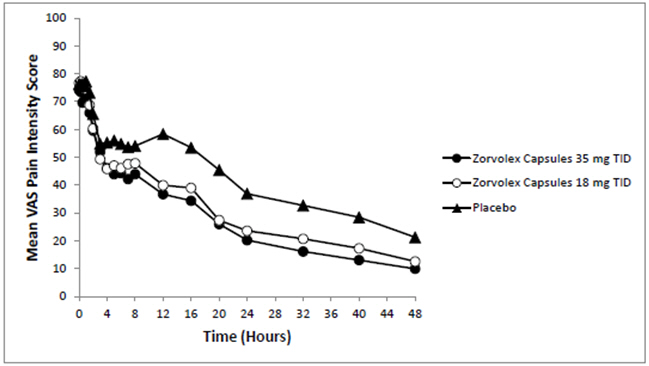
Figure 1 (Zorvolex 02)
Osteoarthritis Pain
The efficacy of ZORVOLEX in the management of osteoarthritis pain was demonstrated in a single multicenter, randomized, double-blind, placebo-controlled, parallel-arm study comparing ZORVOLEX 35 mg taken twice a day or three times a day and placebo in patients with osteoarthritis of the knee or hip. The study enrolled 305 patients with a mean age of 62 (range 41 to 90 years). Osteoarthritis pain was measured using the Western Ontario and McMaster University Osteoarthritis Index Pain Subscale (WOMAC Pain Subscale). Mean baseline WOMAC Pain Subscale Score across treatment groups was 75 mm using a 0 to 100 mm visual analog scale.
The primary efficacy parameter was the change from baseline at 12 weeks in the WOMAC Pain Subscale. ZORVOLEX 35 mg three times a day reduced osteoarthritis pain compared with placebo, as measured by WOMAC Pain Subscale Score. The distribution (%) of patients achieving various percentage reductions in pain intensity at Week 12 are depicted in Figure 2.
Figure 2 Distribution (%) of Patients Achieving Various Percentage Reductions in Pain Intensity at Week 12
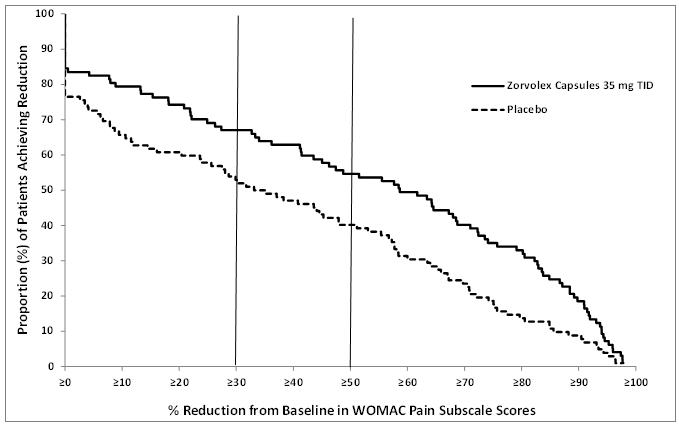
Figure 2 (Zorvolex 03)
Cardiovascular Thrombotic Events
Advise patients to be alert for the symptoms of cardiovascular thrombotic events, including chest pain, shortness of breath, weakness, or slurring of speech, and to report any of these symptoms to their health care provider immediately [see Warnings and Precautions (5.1)].
Gastrointestinal Bleeding, Ulceration, and Perforation
Advise patients to report symptoms of ulcerations and bleeding, including epigastric pain, dyspepsia, melena, and hematemesis to their health care provider. In the setting of concomitant use of low-dose aspirin for cardiac prophylaxis, inform patients of the increased risk for and the signs and symptoms of GI bleeding [see Warnings and Precautions (5.2)].
Hepatotoxicity
Inform patients of the warning signs and symptoms of hepatotoxicity (e.g., nausea, fatigue, lethargy, pruritus, diarrhea, jaundice, right upper quadrant tenderness, and "flu-like" symptoms). If these occur, instruct patients to stop ZORVOLEX and seek immediate medical therapy [see Warnings and Precautions (5.3)].
Heart Failure and Edema
Advise patients to be alert for the symptoms of congestive heart failure including shortness of breath, unexplained weight gain, or edema and to contact their healthcare provider if such symptoms occur [see Warnings and Precautions (5.5)].
Anaphylactic Reactions
Inform patients of the signs of an anaphylactic reaction (e.g., difficulty breathing, swelling of the face or throat). Instruct patients to seek immediate emergency help if these occur [see Contraindications (4) and Warnings and Precautions (5.7)].
Serious Skin Reactions
Advise patients to stop ZORVOLEX immediately if they develop any type of rash and to contact their healthcare provider as soon as possible [see Warnings and Precautions (5.9)].
Female Fertility
Advise females of reproductive potential who desire pregnancy that NSAIDs, including ZORVOLEX, may be associated with a reversible delay in ovulation [see Use in Specific Populations (8.3)].
Fetal Toxicity
Inform pregnant women to avoid use of ZORVOLEX and other NSAIDs starting at 30 weeks gestation because of the risk of the premature closing of the fetal ductus arteriosus [see Warnings and Precautions (5.10) and Use in Specific Populations (8.1)].
Avoid Concomitant Use of NSAIDs
Inform patients that the concomitant use of ZORVOLEX with other NSAIDs or salicylates (e.g., diflunisal, salsalate) is not recommended due to the increased risk of gastrointestinal toxicity, and little or no increase in efficacy [see Warnings and Precautions (5.2) and Drug Interactions (7)]. Alert patients that NSAIDs may be present in "over the counter" medications for treatment of colds, fever, or insomnia.
Use of NSAIDs and Low-Dose Aspirin
Inform patients not to use low-dose aspirin concomitantly with ZORVOLEX until they talk to their healthcare provider [see Drug Interactions (7)].
Manufactured (under license from iCeutica Pty Ltd.) for and Distributed by:
Iroko Pharmaceuticals, LLC
Philadelphia, PA 19112
Issued: May/2016