Methotrexate Tablet
FDA Label NDC 42291-594

Full FDA labeling including Indications, Dosage, Usage, and Precautions

Structured Product Label

The following Structured Product Label (SPL) was submitted to the FDA by Avkare for the product Methotrexate (NDC 42291-594). This document serves as the official prescribing information, containing essential scientific data and clinical materials required for healthcare providers and patients.

This specific version of the label includes detailed information regarding boxed warning, 1.1 neoplastic diseases, 1.2 rheumatoid arthritis, 1.3 polyarticular juvenile idipathic arthritis, 1.4 psoriasis, 2.1 important dosage and safety information, 2.2 recommended dosage for neoplastic diseases, 2.3 recommended dosage for rheumatoid arthritis, and other regulatory disclosures. Use the navigation below to review specific sections of the FDA submission.

Label Section Quick Index

Boxed Warning

WARNING: EMBRYO-FETAL TOXICITY, HYPERSENSITIVITY REACTIONS, SEVERE ADVERSE REACTIONS, AND RISK OF MEDICATION ERRORS
• Methotrexate tablets can cause embryo-fetal toxicity, including fetal death. For non-neoplastic diseases, methotrexate tablets are contraindicated in pregnancy. For neoplastic diseases, advise females and males of reproductive potential to use effective contraception [see Contraindications (4), Warnings and Precautions (5.1), Use in Specific Populations (8.1, 8.3)].
• Methotrexate tablets are contraindicated in patients with a history of severe hypersensitivity reactions to methotrexate, including anaphylaxis [Contraindications (4), Warnings and Precautions (5.2)].
• Serious adverse reactions, including death, have been reported with methotrexate. Closely monitor for adverse reactions of the bone marrow, gastrointestinal tract, liver, lungs, skin, and kidneys. Withhold or discontinue methotrexate tablets as appropriate [Warnings and Precautions (5.3, 5.4, 5.5, 5.6, 5.7, 5.8)].
• Methotrexate tablets when inadvertently administered once daily have resulted in death [Warnings and Precautions (5.9)].
1.1 Neoplastic Diseases

1.1 Neoplastic Diseases
Methotrexate tablets are indicated for the:
• treatment of adults and pediatric patients with acute lymphoblastic leukemia (ALL) as part of a combination chemotherapy maintenance regimen
• treatment of adults with mycosis fungoides (cutaneous T-cell lymphoma) as a single agent or as part of a combination chemotherapy regimen
• treatment of adults with relapsed or refractory non-Hodgkin lymphomas as part of a metronomic combination chemotherapy regimen

1.2 Rheumatoid Arthritis

Methotrexate tablets are indicated for the treatment of adults with rheumatoid arthritis.

1.4 Psoriasis

Methotrexate tablets are indicated for the treatment of adults with severe psoriasis.

2.1 Important Dosage And Safety Information

Verify pregnancy status in females of reproductive potential before starting methotrexate tablets [see Contraindications (4), Warnings and Precautions (5.1)].

Instruct patients and caregivers to take the recommended dosage as directed, because medication errors have led to deaths [see Warnings and Precautions (5.9)].

When switching the dosing regimen from oral administration to intravenous, intramuscular, or subcutaneous administration, an alternative dosing regimen may be necessary.

Do not administer to patients who are unable to swallow a tablet.

Methotrexate tablets are a cytotoxic drug. Follow applicable special handling and disposal procedures.1

Acute Lymphoblastic Leukemia
The recommended starting dosage of methotrexate tablets is 20 mg/m2 orally once weekly, as part of a combination chemotherapy maintenance regimen. After initiating methotrexate tablets, periodically monitor absolute neutrophil count (ANC) and platelet count and adjust the dose to maintain ANC at a desirable level and for excessive myelosuppression.

Mycosis Fungoides

The recommended dosage of methotrexate tablets is 25 to 75 mg orally once weekly when administered as a single agent or 10 mg/m2 orally twice weekly as part of a combination chemotherapy regimen.

Relapsed or Refractory Non-Hodgkin Lymphomas

The recommended dosage of methotrexate tablets is 2.5 mg orally 2 to 4 times per week (maximum 10 mg per week) as part of a metronomic combination chemotherapy regimen.

Contraindications

Methotrexate tablets are contraindicated in:
•Pre gnant women receiving methotrexate tablets for treatment of non-neoplastic diseases [see Warnings and Precautions (5.1), and Use in Specific Populations (8.1, 8.3)].
• Patients with a history of a severe hypersensitivity reactions, including anaphylaxis, to methotrexate [see Warnings and Precautions (5.2)].

Adverse Reactions

The following clinically significant adverse reactions are described elsewhere in the labeling:
• Hypersensitivity Reactions [see Warnings and Precautions (5.2)]
• Myelosuppression [see Warnings and Precautions (5.3)]
• Gastrointestinal Toxicity [see Warnings and Precautions (5.4)]
• Hepatotoxicity [see Warnings and Precautions (5.5)]
• Pulmonary Toxicity [see Warnings and Precautions (5.6)]
• Dermatologic Reactions [see Warnings and Precautions (5.7)]
• Renal Toxicity [see Warnings and Precautions (5.8)]
• Serious Infections [see Warnings and Precautions (5.11)]
• Neurotoxicity [see Warnings and Precautions (5.12)]
• Secondary Malignancies [see Warnings and Precautions (5.13)]
• Tumor Lysis Syndrome [see Warnings and Precautions (5.14)]
• Increased Risk of Adverse Reactions Due to Third-Space Accumulation [see Warnings and Precautions (5.17)]

6.1 Clinical Trials Experience

Because clinical trials and other studies are conducted under widely varying conditions, adverse reaction rates observed in the clinical trials of a drug cannot be directly compared to rates in the clinical trials of another drug and may not reflect the rates observed in practice.

Common adverse reactions were: ulcerative stomatitis, leukopenia, nausea, and abdominal distress. Other clinically relevant adverse reactions were infection, malaise, fatigue, chills, fever, and dizziness.

Rheumatoid Arthritis
The most common adverse reactions of methotrexate that exceeded the rate of placebo in 12- to 18-week double-blind studies in patients (n=128) with rheumatoid arthritis are listed below.

Patients received methotrexate 7.5 to 15 mg orally once weekly. Most patients received concomitant nonsteroidal anti-inflammatory drugs (NSAIDs) and some also received corticosteroids. Hepatic histology was not examined in these short-term studies.

Incidence ≥10%: Elevated liver tests 15%, nausea/vomiting 10%
Incidence 3% to <10%: Stomatitis, thrombocytopenia (platelet count < 100,000/mm3)
Incidence 1% to <3%: Rash/pruritus/dermatitis, diarrhea, alopecia, leukopenia (white blood cell count < 3000/mm3), pancytopenia, dizziness

Two other controlled trials of patients (n=680) with rheumatoid arthritis who received methotrexate 7.5 mg to 15 mg orally once weekly showed the following serious adverse reaction:

Incidence 1%: Interstitial pneumonitis

Other less common adverse reactions were: anemia, headache, upper respiratory infection, anorexia, arthralgias, chest pain, coughing, dysuria, eye discomfort, epistaxis, fever, infection, sweating, tinnitus, vaginal discharge.

Polyarticular Juvenile Idiopathic Arthritis (pJIA)

The most common adverse reactions reported in patients 2 to 18 years of age with pJIA treated with methotrexate 5 mg/m2 to 20 mg/m2 orally once weekly or 0.1 to 0.65 mg/kg orally once weekly were as follows: elevated liver tests 14%; gastrointestinal reactions (e.g., nausea, vomiting, diarrhea) 11%; stomatitis 2%; leukopenia 2%; headache 1.2%; alopecia 0.5%; dizziness 0.2%; rash 0.2%. Most patients received concomitant NSAIDs and some also received corticosteroids.

Psoriasis
In two published series of adults with psoriasis (n=204, 248) who received methotrexate up to 25 mg per week for up to 4 years, adverse reaction rates were similar to those in patients with rheumatoid arthritis, except for alopecia, photosensitivity, and “burning of skin lesions” (3% to 10% each). Painful plaque erosions have been reported.

6.2 Postmarketing Experience

The following adverse reactions have been identified during postapproval use of methotrexate. Because these reactions are reported voluntarily from a population of uncertain size, it is not always possible to reliably estimate their frequency or establish a causal relationship to drug exposure

Cardiovascular: Thromboembolic events (including arterial thrombosis, cerebral thrombosis, deep vein thrombosis, retinal vein thrombosis, thrombophlebitis, and pulmonary embolus), pericarditis, pericardial effusion, hypotension, sudden death

Endocrine: Diabetes

Eye: Optic neuropathy, blurred vision, ocular pain, conjunctivitis, xerophthalmia

Gastrointestinal: Hemorrhagic enteritis, intestinal perforation, gingivitis, pancreatitis, pharyngitis, hematemesis, melena, gastrointestinal ulceration

Hematology: Aplastic anemia, lymphadenopathy, hypogammaglobulinemia

Hepatobiliary: Acute hepatitis, decreased serum albumin, fibrosis, cirrhosis

Immune system: Anaphylaxis, anaphylactoid reactions, vasculitis

Metabolism: Hyperglycemia

Musculoskeletal: Stress fracture, soft tissue and bone necrosis, arthralgia, myalgia, osteoporosis

Nervous system: Headaches, drowsiness, blurred vision, speech impairment (including dysarthria and aphasia), transient cognitive dysfunction, mood alteration, unusual cranial sensations, paresis, encephalopathy, and convulsions.

Renal: Azotemia, hematuria, proteinuria, cystitis

Reproductive: Defective oogenesis or spermatogenesis, loss of libido, impotence, gynecomastia, menstrual dysfunction

Respiratory: Pulmonary fibrosis, respiratory failure, chronic interstitial obstructive pulmonary disease, pleuritic pain and thickening, alveolitis

Skin: Toxic epidermal necrolysis, Stevens-Johnson syndrome, exfoliative dermatitis, skin necrosis, and erythema multiforme, erythematous rashes, pruritus, alopecia, skin ulceration, accelerated nodulosis, urticaria, pigmentary changes, ecchymosis, telangiectasia, photosensitivity, acne, furunculosis

Overdosage

Overdosage, including fatal overdosage, has occurred with methotrexate [see Warnings and Precautions (5. 9)].

Manifestations
Manifestations of methotrexate overdosage include adverse reactions reported at pharmacologic doses, particularly hematologic and gastrointestinal reactions (e.g., leukopenia, thrombocytopenia, anemia, pancytopenia, myelosuppression, mucositis, stomatitis, oral ulceration, nausea, vomiting, gastrointestinal ulceration, or gastrointestinal bleeding). In some cases, no symptoms were reported; however, sepsis or septic shock, renal failure, and aplastic anemia were also reported.

Management
Leucovorin and levoleucovorin are indicated for diminishing the methotrexate adverse reactions of methotrexate overdosage. Administer leucovorin or levoleucovorin as soon as possible after methotrexate overdosage). Monitor serum creatinine and methotrexate levels to guide leucovorin or levoleucovorin therapy. Refer to the leucovorin or levoleucovorin prescribing information for additional dosage information.

Glucarpidase is indicated for the treatment of toxic plasma methotrexate concentrations (>1 micromole per liter) in patients with delayed methotrexate clearance due to impaired renal function. Refer to the glucarpidase prescribing information for additional dosage information.

Administer concomitant hydration and urinary alkalinization.

Neither hemodialysis nor peritoneal dialysis has been shown to improve methotrexate elimination; however, methotrexate has been effectively cleared with acute, intermittent hemodialysis using a high-flux dialyzer.

Description

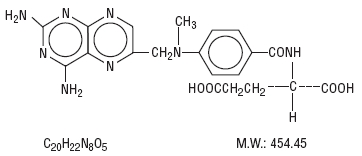
Methotrexate, USP is dihydrofolate reductase inhibitor with the chemical name of L-glutamic acid, N-[4-[[(2,4-diamino-6-pteridinyl)methyl]methylamino]benzoyl]. The molecular formula is C20H22N8O5 and the molecular weight is 454.45 g/mol. The structural formula is:

:

Structural Formula (Cd002dc0 F02b 4f98 8f27 C84005ee8d8a 01)

Structural Formula (Cd002dc0 F02b 4f98 8f27 C84005ee8d8a 01)

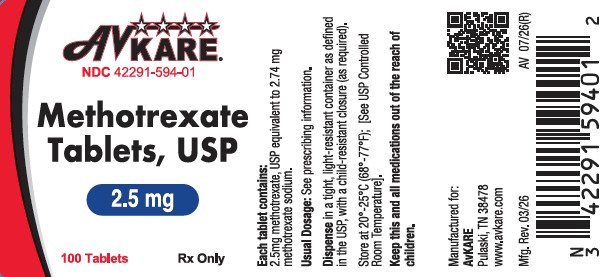
Methotrexate tablets, USP for oral use are available in bottles of 36 and 100 tablets. Each tablet contains 2.5 mg methotrexate, USP equivalent to 2.74 mg methotrexate sodium.

Inactive Ingredients: Anhydrous lactose, hypromellose, magnesium stearate, microcrystalline cellulose, polyethylene glycol, pregelatinized corn starch, propylene glycol, sodium carbonate monohydrate, and talc.

Clinical Pharmacology

Clinical Pharmacology

References

1. “OSHA Hazardous Drugs.” OSHA. http://www.osha.gov/SLTC/hazardousdrugs/index.html.

How Supplied

Methotrexate Tablets, USP are supplied as follows:
2.5 mg: Yellow, oval-shaped, film-coated, scored, biconvex tablet. Debossed with b/572 on the scored side. Available in bottles 100 tablets (NDC 42291-594-01).

Dispense in a tight, light-resistant container as defined in the USP, with a child-resistant closure (as required).

Store at 20° to 25°C (68° to 77°F) [See USP Controlled Room Temperature].

Keep this and all medications out of the reach of children.

Methotrexate Tablets is a cytotoxic drug. Follow applicable special handling and disposal procedures.1

Package Label.Principal Display Panel

42291-594-01

1 (594 01)

1 (594 01)

* Please review the disclaimer below.