Tamsulosin Hydrochloride Capsule
Product Images NDC 42291-989

View Photos of Packaging, Regulatory Labels, and Product Appearance

Product Visual Gallery

This gallery contains 8 technical images submitted to the FDA as part of the official labeling for Tamsulosin Hydrochloride (NDC 42291-989). Unlike standard consumer photos, these assets often include clinical data figures, molecular chemical structures, and official manufacturer packaging layouts.

As provided by Avkare, these visuals offer a comprehensive scientific overview of the product's physical and chemical identity, aiding pharmacists and researchers in product verification and study.

FDA Label Image

1 (989 10)

1 (989 10)
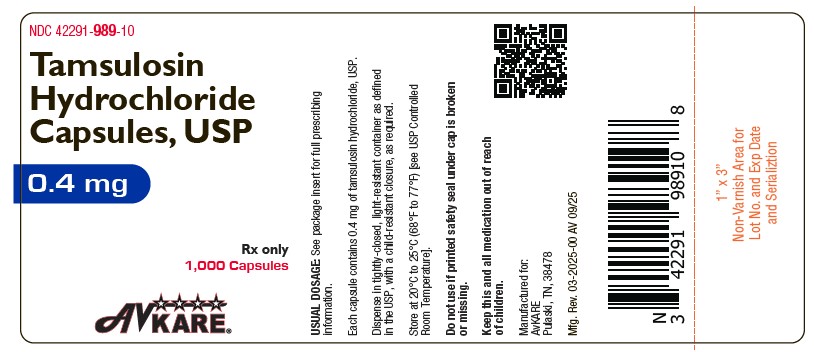
The label for Tamsulosin Hydrochloride Capsules, USP, 0.4 mg, features the brand AvKARE. It indicates the product contains 1,000 capsules and includes dosing and storage information. The label also displays the NDC 42291-989-10, barcodes, and QR code, with warnings to keep out of reach of children and not use if the safety seal is broken.*
FDA Label Image

1 (989 90)

1 (989 90)
Tamsulosin Hydrochloride Capsules USP 0.4 mg capsule bottle label from AvKARE. The label states the product is prescription only and contains 90 capsules. It includes usage directions, storage information, a barcode, and the AvKARE logo.*
FDA Label Image

Chemical Structure (Tamsulosin Hydrochloride Capsules 1)

Chemical Structure (Tamsulosin Hydrochloride Capsules 1)
Chemical structure of tamsulosin hydrochloride, showing the arrangement of atoms including methoxy, sulfonamide, and chloro-substituents, as well as the HCl component.*
FDA Label Image

Figure 1 (Tamsulosin Hydrochloride Capsules 2)

Figure 1 (Tamsulosin Hydrochloride Capsules 2)
This pharmacokinetic graph depicts plasma concentration (ng/mL) of Tamsulosin Hydrochloride capsules over time (hours) comparing fasting and fed states. The plot shows a higher initial peak concentration under fasting conditions relative to fed conditions, with both curves declining over a 36-hour period.*
FDA Label Image

Figure 2a (Tamsulosin Hydrochloride Capsules 3)

Figure 2a (Tamsulosin Hydrochloride Capsules 3)
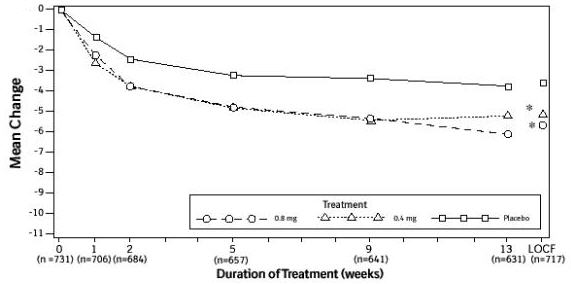
A line graph showing mean change over duration of treatment in weeks for three groups: 0.8 mg dosage, 0.4 mg dosage, and placebo. The x-axis represents weeks from baseline through week 13, and the y-axis shows mean change, with the 0.8 mg and 0.4 mg groups showing greater decreases over time compared to placebo.*
FDA Label Image

Figure 2b (Tamsulosin Hydrochloride Capsules 4)

Figure 2b (Tamsulosin Hydrochloride Capsules 4)
A line graph depicting mean change over time during treatment with Tamsulosin Hydrochloride capsules 0.4 mg and 0.8 mg compared to placebo. The x-axis represents duration of treatment in weeks, ranging from 0 to 13, and the y-axis shows mean change values. The graph includes a legend with three lines representing 0.8 mg, 0.4 mg, and placebo groups.*
FDA Label Image

Figure 3a (Tamsulosin Hydrochloride Capsules 5)

Figure 3a (Tamsulosin Hydrochloride Capsules 5)
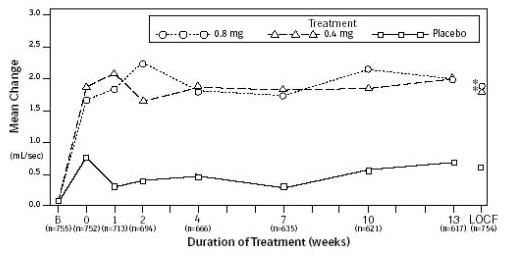
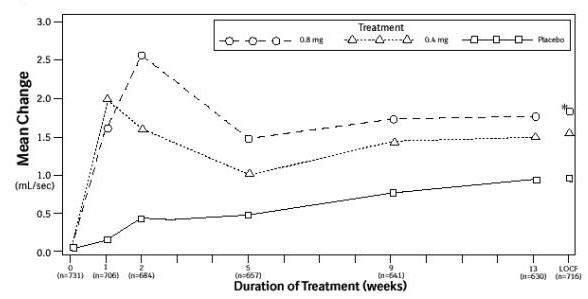
A line chart depicting the mean change in urinary flow rate (mL/sec) over a 13-week treatment period for three groups: Tamsulosin Hydrochloride 0.8 mg, 0.4 mg, and placebo. The x-axis shows duration of treatment in weeks, with sample sizes for each time point, and the y-axis shows mean change in flow rate. Both treatment groups show a significant increase compared to placebo over time.*
FDA Label Image

Figure 3b (Tamsulosin Hydrochloride Capsules 6)

Figure 3b (Tamsulosin Hydrochloride Capsules 6)
A line graph showing the mean change in a measured variable (mL/sec) over the duration of treatment in weeks for Tamsulosin Hydrochloride at 0.8 mg, 0.4 mg, and placebo groups. The x-axis represents treatment weeks, and the y-axis shows mean change in mL/sec. Data points are connected for each treatment group to compare trends over time.*

* About these descriptions: Image descriptions on this page are generated by automated AI analysis of the product label images from the manufacturer's FDA label submission (SPL). They are provided for reference only and may contain errors or omissions. Always rely on the printed label itself and the official FDA labeling, and consult a pharmacist or healthcare professional with any questions about this product.